
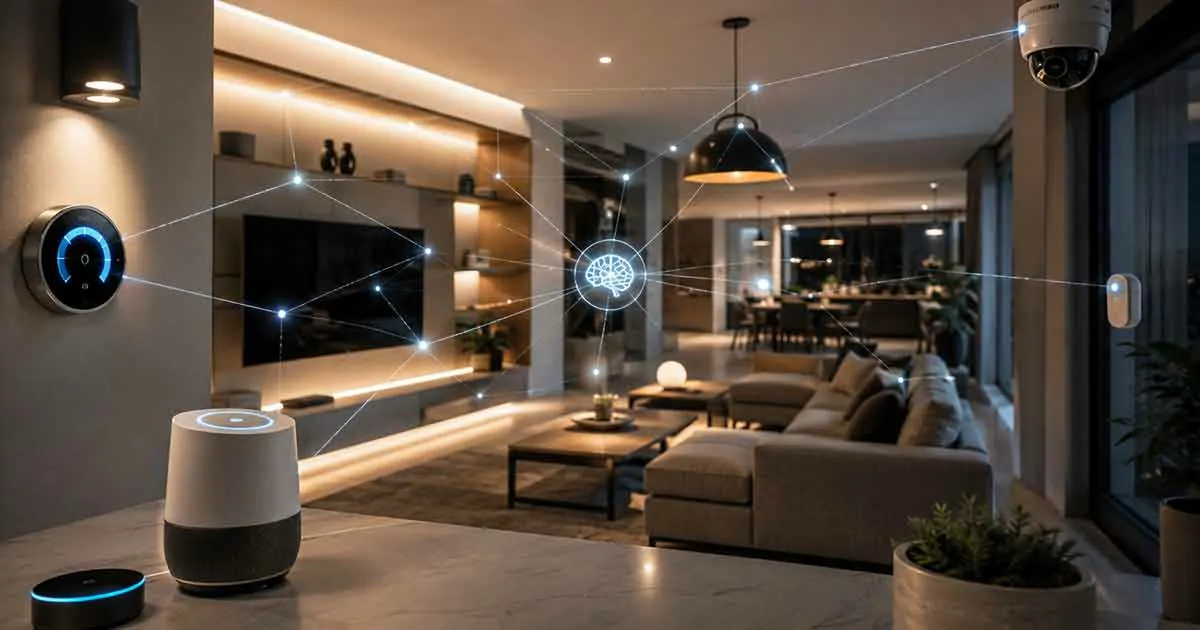
Artificial intelligence is changing the way smart homes operate.
Traditional smart home automation usually depends on predefined rules. A homeowner creates a routine such as turning the lights on at sunset, adjusting the thermostat at a specific time, or locking the doors when everyone leaves.
AI can make these systems more adaptive.
Instead of relying only on fixed commands, artificial intelligence can analyze information from sensors, connected devices, usage patterns, and environmental conditions to help a smart home respond more intelligently.
This does not mean that every smart home device now contains advanced AI. In many cases, AI works through software, cloud services, smart home platforms, or increasingly capable local devices.
The result is a shift from simple automation toward more adaptive home automation.
Table of Contents
What Is an AI Smart Home?
An AI smart home uses artificial intelligence or machine learning to improve how connected home devices operate.
A conventional smart home might follow a rule:
If motion is detected, turn on the light.
An AI-enhanced system may consider additional information such as:
- Time of day
- Occupancy
- Previous behavior
- Temperature
- Lighting conditions
- Energy consumption
- Device activity
- User preferences
This can allow the system to make more context-aware decisions.
AI can be used across many areas of the home, including:
- Smart thermostats
- Smart lighting
- Home security
- Cameras
- Smart speakers
- Energy management
- Appliances
- Smart locks
- Voice assistants
- Home automation platforms
How AI Is Different From Traditional Smart Home Automation
Traditional automation is generally rule-based.
For example:
At 7:00 PM → turn on living room lights.
The automation works because the homeowner explicitly created the rule.
AI can introduce another layer.
Instead of always turning the lights on at 7:00 PM, an AI-enabled system could potentially consider whether someone is actually home, how bright the room already is, and the household’s previous behavior.
The distinction can be summarized as:
Traditional automation: Follow predefined rules.
AI-powered automation: Analyze information and adapt decisions based on patterns or context.
AI does not necessarily replace traditional automation. In many smart homes, both approaches work together.
How Artificial Intelligence Is Changing Home Automation
AI is affecting smart home automation in several major ways.
1. More Personalized Automation
AI can learn patterns in household behavior.
For example, a smart thermostat may learn when occupants typically wake up, leave home, return, and go to sleep.
Over time, the system can use these patterns to optimize temperature settings.
The goal is not simply to automate one action but to make the automation more responsive to the household.
2. Better Voice Control
Voice assistants have already made smart homes easier to control.
AI is making conversational interactions more capable.
Instead of remembering an exact command, users can increasingly communicate using natural language.
For example:
“Make the living room comfortable for movie night.”
Depending on the platform and connected devices, an AI-enabled system could potentially interpret this as a combination of lighting, temperature, and entertainment actions.
The actual capabilities depend on the specific platform.
3. Smarter Energy Management
AI can help homeowners understand and optimize energy consumption.
A system can potentially analyze:
- Electricity usage
- Thermostat settings
- Occupancy
- Weather conditions
- Appliance activity
- Time-of-use pricing
This can help identify patterns of unnecessary energy consumption.
For example, an AI system could recognize that heating or cooling is frequently running while the home is empty and recommend or automate a more efficient schedule.
4. Improved Home Security
AI is becoming increasingly important in smart home security.
Traditional motion sensors detect movement.
AI-powered security systems can potentially analyze camera footage to distinguish between different types of activity.
Depending on the system, AI may help distinguish:
- People
- Vehicles
- Animals
- Packages
- General movement
This can reduce unnecessary alerts compared with systems that simply notify homeowners whenever motion occurs.
5. Predictive Maintenance
AI can also help identify unusual behavior from connected appliances and home systems.
For example, a system could potentially detect changes in:
- Energy consumption
- Operating cycles
- Temperature
- Vibration
- Runtime
These changes may indicate that a device is operating differently from its normal pattern.
Predictive maintenance can potentially help homeowners identify problems before an appliance fails completely.
AI Smart Thermostats
Thermostats are one of the clearest examples of AI-assisted home automation.
A traditional programmable thermostat follows a schedule.
An intelligent thermostat can use information such as:
- Temperature
- Occupancy
- Schedule
- Weather
- Historical preferences
- HVAC behavior
Some systems can automatically adjust heating and cooling based on these factors.
The objective is to maintain comfort while reducing unnecessary energy consumption.
However, not every smart thermostat uses advanced AI. Some rely primarily on predefined schedules, sensors, and conventional automation.
When choosing an AI-enabled thermostat, look at the actual features rather than assuming that the word “smart” means artificial intelligence.
AI-Powered Smart Lighting
AI can make lighting automation more adaptive.
Traditional lighting automation might use:
Motion detected → light turns on.
AI-assisted lighting could potentially consider:
- Occupancy
- Time
- Natural daylight
- User behavior
- Room activity
- Previous lighting preferences
This could reduce situations where lights turn on unnecessarily.
AI can also help create more personalized lighting scenes.
For example, the system could recognize that a household typically uses brighter lighting for working and softer lighting during evening relaxation.
AI and Smart Home Security Cameras
Security cameras are one of the areas where AI has become particularly useful.
Basic cameras can detect movement and send an alert.
AI-enabled cameras may analyze the detected activity before sending an alert.
For example:
Motion detected → AI analyzes object → person detected → notification sent.
This can be more useful than receiving an alert every time a tree moves or an animal passes through the camera’s field of view.
Some systems can also provide object recognition, activity summaries, or more advanced search capabilities.
The available features vary significantly by manufacturer and subscription plan.
AI and Smart Doorbells
AI can also improve video doorbells.
A basic doorbell can notify you when motion occurs.
An AI-enabled doorbell may help identify whether the activity involves:
- A person
- A vehicle
- A package
- An animal
Some systems can also provide more descriptive notifications.
For example, instead of simply reporting motion, a system may describe that a person was detected near the front door.
This can make security notifications more useful.
AI Smart Speakers and Voice Assistants
Smart speakers are increasingly becoming interfaces for AI-powered home control.
Traditional voice assistants typically work through predefined commands.
Generative AI can provide a more conversational interface.
Users may be able to ask questions, describe tasks naturally, and interact with the assistant without memorizing exact command structures.
For smart home control, this could make complex routines easier to create and manage.
However, the ability to control specific devices depends on the assistant, smart home platform, and device compatibility.
AI and Smart Locks
Smart locks can also benefit from AI-assisted automation.
For example, an intelligent system could combine information from:
- Smart locks
- Smartphones
- Presence detection
- Door sensors
- Security systems
This could help create more context-aware routines.
For example:
Household arrives → system detects presence → entry lighting activates → thermostat adjusts.
AI could potentially help determine whether the situation matches a normal household pattern.
However, security-critical actions such as unlocking a door should be designed conservatively.
Convenience should never come at the expense of access security.
AI and Home Energy Savings
One of the biggest potential advantages of AI smart home technology is energy optimization.
AI can analyze large amounts of data much more effectively than simple schedules.
Potential inputs include:
- Electricity consumption
- Temperature
- Weather forecasts
- Occupancy
- HVAC operation
- Smart plug data
- Solar generation
- Time-of-use electricity rates
The system can then identify opportunities to reduce unnecessary consumption.
For example, an AI energy-management system might determine that certain appliances consistently consume power during periods when nobody is home.
It could then recommend or automate changes.
AI Smart Plugs
Smart plugs already provide basic automation.
AI can potentially make them more useful by analyzing the connected device’s behavior.
For example, an energy-monitoring smart plug could track the power consumption of a device over time.
AI could identify patterns such as:
- Normal operating cycles
- Unusual energy consumption
- Long periods of standby power
- Changes in daily usage
This could help homeowners understand where electricity is being wasted.
AI and Appliance Automation
Connected appliances are another potential area for AI.
AI can potentially help appliances adapt to:
- Usage patterns
- Household schedules
- Energy prices
- Weather
- Occupancy
For example, an intelligent appliance might optimize when it operates based on household preferences and energy conditions.
However, appliance automation should always respect manufacturer safety requirements.
Not every appliance is designed to be automatically switched on or off.
AI and Occupancy Detection
Knowing whether someone is home is essential for intelligent automation.
Traditional occupancy detection may rely on:
- Motion sensors
- Door sensors
- Smartphone presence
- Dedicated occupancy sensors
AI can combine multiple signals to make more informed estimates.
For example:
Motion + phone presence + door activity + room sensors → estimated occupancy.
This can potentially make automation more accurate.
It can also reduce false triggers.
AI Smart Home Routines
Traditional smart home routines often look like this:
Trigger → Condition → Action
For example:
Motion detected → after sunset → turn on light.
AI can introduce additional context.
A more intelligent system could consider:
Who is home + time + room activity + natural light + previous behavior → choose appropriate lighting.
The more contextual information available, the more adaptive the automation can become.
Generative AI in Smart Homes
Generative AI introduces another possibility.
Instead of manually configuring dozens of automation rules, homeowners could describe what they want in natural language.
For example:
“When we leave the house, turn off unnecessary devices, adjust the thermostat, and make sure the doors are locked.”
An AI assistant could potentially translate this request into multiple automation rules.
This could make advanced smart home automation accessible to people without technical knowledge.
The exact ability to create or modify automations varies by platform.
AI and Smart Home Personalization
Different people in the same home may have different preferences.
One person may prefer a cooler bedroom.
Another may prefer warmer temperatures.
One person may want bright lighting for reading.
Another may prefer dim lighting in the evening.
AI can potentially learn individual patterns and adapt the environment accordingly.
This could lead to more personalized automation instead of one fixed schedule for the entire household.
AI and Predictive Home Automation
Predictive automation attempts to anticipate what will happen next.
For example, if the system recognizes that occupants typically return home around the same time every weekday, it could potentially prepare the home before arrival.
Possible actions include:
- Adjusting temperature
- Activating selected lights
- Preparing an entertainment system
- Checking security status
The goal is to move from:
“Do this when I tell you.”
to:
“Understand the pattern and help automatically.”
Predictive automation should still provide users with control over important decisions.
Edge AI vs Cloud AI
AI smart home systems can process information in two major ways.
Cloud AI
Data is sent to remote servers for processing.
Advantages can include:
- More computing power
- More advanced AI models
- Easier software updates
- Large-scale data processing
Potential disadvantages include:
- Internet dependence
- Privacy considerations
- Subscription requirements
- Possible delays
Edge AI
Processing happens locally on the device or within the home.
Advantages can include:
- Lower latency
- Greater privacy
- Reduced cloud dependence
- Continued operation during some internet outages
However, local devices may have less computing power than large cloud systems.
The best architecture may combine local processing with cloud services.
AI Smart Home Privacy
Privacy is one of the most important issues surrounding AI-enabled homes.
Smart homes can generate large amounts of information about household behavior.
Potentially sensitive data can include:
- When people are home
- When people leave
- Sleeping patterns
- Room activity
- Camera footage
- Voice recordings
- Energy consumption
- Door activity
Before purchasing an AI smart home product, consider:
- Where data is processed
- Whether data is stored in the cloud
- How long data is retained
- Whether recordings can be deleted
- Whether local processing is available
- Whether a subscription is required
- What third parties receive the data
Privacy policies and device settings should be reviewed before enabling advanced AI features.
AI Smart Home Security Risks
AI can improve security, but it can also introduce new risks.
Potential concerns include:
- Incorrect object recognition
- False positives
- False negatives
- Unauthorized account access
- Compromised cameras
- Cloud-service vulnerabilities
- Overreliance on automated decisions
For critical security functions, homeowners should maintain backup methods.
For example, an AI camera should not be the only security measure protecting an important entrance.
AI and Smart Home Interoperability
A smart home can contain products from many manufacturers.
Interoperability standards such as Matter can help compatible devices work together.
AI can operate above this infrastructure by analyzing information and coordinating devices.
A possible architecture could look like:
Matter devices → smart home platform → AI layer → automation decisions
This can potentially allow devices from different manufacturers to participate in a unified smart home.
However, compatibility still depends on the platforms and devices involved.
AI Smart Home Without a Subscription
Not all AI smart home features require a subscription.
However, advanced AI capabilities are increasingly offered as premium services.
Examples may include:
- Advanced camera detection
- Video summaries
- Cloud AI processing
- Generative AI assistants
- Extended history
- Advanced automation
Before purchasing a product, determine which features are available without recurring fees.
For many homeowners, local processing can be particularly attractive because it may reduce cloud dependence.
How AI Can Reduce Energy Waste
AI can potentially identify energy waste in ways that fixed schedules cannot.
For example, a traditional thermostat might follow:
6:00 PM → heat the home.
An AI-enabled system could potentially consider:
- Whether anyone is home
- Outdoor temperature
- Weather forecast
- Historical heating patterns
- Indoor temperature
- Energy prices
It can then determine whether the normal schedule still makes sense.
This does not guarantee savings, but it can provide more adaptive energy management.
AI Smart Home for Families
Families can benefit from AI because household routines are rarely identical every day.
AI can potentially adapt to:
- School schedules
- Work schedules
- Different occupants
- Weekends
- Holidays
- Changing routines
For example, the system may recognize that the home is occupied earlier on weekends than on weekdays.
This can make fixed schedules less necessary.
AI Smart Home for Older Adults
AI-enabled smart homes can also support convenience and accessibility.
Potential applications include:
- Voice-controlled lighting
- Automated temperature management
- Smart doorbells
- Safety notifications
- Appliance monitoring
- Activity alerts
However, privacy and reliability should be carefully considered.
Automation should support the household without creating unnecessary surveillance or dependence on a cloud service.
AI Smart Home for Large Homes
Large homes can benefit from AI because there may be more devices and more data to manage.
A large smart home might contain:
- Multiple thermostats
- Dozens of lights
- Security cameras
- Door sensors
- Smart locks
- Energy monitors
- Appliances
AI can potentially help identify relationships between these devices.
For example, occupancy information could be used to coordinate lighting, climate control, and security.
A strong network infrastructure is still essential.
AI cannot compensate for poor Wi-Fi coverage or unreliable smart home hardware.
How to Build an AI Smart Home
You do not need to replace every device with an AI-enabled product.
A practical approach is to build the system gradually.
Step 1: Establish a Reliable Network
Start with reliable Wi-Fi and, where practical, Ethernet.
Step 2: Choose a Main Smart Home Platform
Select the ecosystem you expect to use most.
Step 3: Add Compatible Smart Devices
Begin with useful categories such as:
- Smart lights
- Smart plugs
- Smart thermostats
- Sensors
- Smart locks
Step 4: Add Energy Monitoring
Energy-monitoring devices can provide useful data for future optimization.
Step 5: Add AI Features
Use AI where it provides a clear benefit rather than adding it to every device.
Step 6: Protect Your Accounts
Use strong unique passwords and multi-factor authentication where available.
Step 7: Review Privacy Settings
Understand what information each device collects and where it is processed.
Best AI Smart Home Devices to Start With
If you want to experiment with AI-enhanced automation, start with devices that generate useful data.
Smart Thermostat
Useful for temperature optimization and occupancy-based automation.
Smart Security Camera
Useful for AI-assisted object and activity detection.
Smart Doorbell
Useful for intelligent visitor and package notifications.
Energy-Monitoring Smart Plug
Useful for analyzing appliance consumption.
Occupancy Sensor
Useful for determining whether rooms are being used.
Smart Speaker
Useful as a natural-language interface for smart home control.
Common AI Smart Home Mistakes
Buying AI Features Without a Clear Use Case
AI should solve a problem rather than simply add complexity.
Ignoring Privacy
Understand how household data is collected and processed.
Assuming AI Is Always More Accurate
AI systems can make mistakes.
Depending Entirely on Cloud Services
Consider what happens if the internet or cloud service becomes unavailable.
Ignoring Compatibility
Check whether devices actually work with your preferred smart home platform.
Automating Critical Security Decisions
Keep manual backup options for locks, alarms, and other important systems.
The Future of AI Smart Homes
The future of smart home automation is likely to become increasingly contextual.
Instead of controlling individual devices, homeowners may interact with the home as a complete environment.
A future request might be as simple as:
“Prepare the house for bedtime.”
The system could potentially coordinate:
- Lighting
- Thermostats
- Door locks
- Security sensors
- Entertainment devices
- Selected appliances
AI could determine which actions are appropriate based on household preferences and current conditions.
Another important trend is the combination of AI with local processing.
As smart home hardware becomes more powerful, more AI tasks may be performed inside the home rather than entirely in the cloud.
This could improve responsiveness and privacy.
Final Thoughts
AI is changing smart home automation by making connected devices more adaptive, contextual, and personalized.
Traditional automation remains useful for predictable tasks, but AI can analyze patterns and information that would be difficult to manage through hundreds of fixed rules.
The biggest opportunities are in:
- Energy management
- Home security
- Climate control
- Personalized lighting
- Voice control
- Predictive automation
- Appliance monitoring
- Occupancy detection
At the same time, AI introduces important considerations around privacy, security, reliability, and cloud dependence.
The smartest approach is not to add AI to everything.
Instead, choose AI-powered devices where the technology provides a measurable benefit and combine them with reliable smart home standards, secure networks, and straightforward automation.
As artificial intelligence continues to improve, the smart home is likely to move from a collection of connected devices toward a more context-aware and adaptive home environment.