
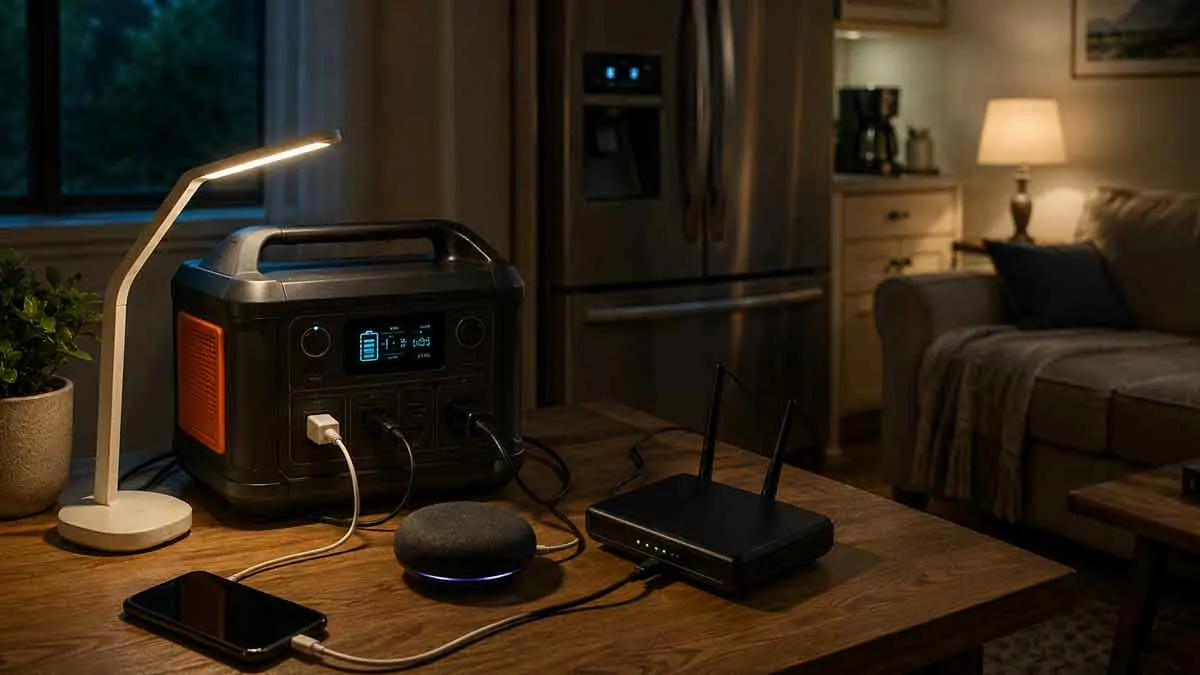
Power outages can happen without warning, leaving homeowners without lighting, refrigeration, internet access, heating, cooling, and other essential services. A portable power station for home backup can provide a convenient way to keep important devices running without relying on gasoline or diesel during an outage.
Unlike traditional generators, portable power stations store electricity in a rechargeable battery. They can typically be charged from a wall outlet, vehicle, or compatible solar panels and then used to power household devices through AC outlets, USB ports, or DC outputs.
Portable power stations are especially useful for short outages, emergency preparedness, essential electronics, and selected household appliances. However, they are not automatically a replacement for a whole-home generator or permanently installed home battery.
The right choice depends on battery capacity, continuous output, surge capability, recharge speed, battery chemistry, solar input, portability, and the appliances you need to operate.
This guide explains how portable power stations work, what they can run, how long they can last, and how to choose the right model for home backup.
Table of Contents
What Is a Portable Power Station?
A portable power station is a rechargeable battery system designed to provide electricity away from a conventional wall outlet.
It typically combines:
- A rechargeable battery
- An inverter
- AC outlets
- USB ports
- DC outputs
- Battery management electronics
- Charging circuitry
- A display or monitoring system
Some larger models also support:
- Solar charging
- Fast AC charging
- Vehicle charging
- Expandable battery modules
- Remote monitoring
- Uninterruptible power supply functionality
- Multiple charging inputs
The battery stores electrical energy, while the inverter converts stored DC electricity into AC power for compatible household devices.
Because the system stores energy instead of continuously generating electricity through combustion, it produces no exhaust during normal operation.
How Portable Power Stations Work
The basic process is straightforward:
Charge the battery → store energy → connect your devices → use the stored electricity.
There are several ways to recharge a portable power station.
AC Charging
The most common method is connecting the unit to a household wall outlet.
AC charging is generally convenient before an expected outage because the battery can be fully charged while grid power is available.
Solar Charging
Many portable power stations support compatible solar panels.
Solar charging can be particularly useful during an extended outage because it provides a way to replenish the battery without relying entirely on the electrical grid.
Actual charging speed depends on:
- Solar panel output
- Sunlight intensity
- Weather
- Panel orientation
- Solar input limits of the power station
- Battery state of charge
Vehicle Charging
Some models can be charged from a vehicle’s electrical system.
This can be useful during emergencies when grid electricity is unavailable, although charging speed may be slower than AC charging.
Portable Power Station vs. Traditional Generator
Portable power stations and generators solve the same broad problem—providing electricity when grid power is unavailable—but they do so differently.
A traditional generator converts fuel into electricity.
A portable power station stores electricity in a battery and delivers it when needed.
| Feature | Portable Power Station | Fuel Generator |
|---|---|---|
| Energy source | Stored electricity | Fuel |
| Exhaust during operation | None | Yes |
| Noise | Usually very low | Usually higher |
| Fuel storage | Not required | Required |
| Maintenance | Generally low | Generally higher |
| Solar charging | Often supported | Not normally integrated |
| Long-duration operation | Limited by recharge options | Strong when fuel is available |
| Portability | High | Varies |
| Indoor operation | Depends on manufacturer and model | Never operate fuel generators indoors |
Portable power stations are particularly attractive when quiet operation, simple storage, and low maintenance are priorities.
Generators generally have an advantage when large loads must be powered continuously for long periods and fuel is readily available.
Battery Capacity: Wh vs. kWh
One of the most important specifications when shopping for a portable power station is battery capacity.
Capacity is commonly measured in:
- Watt-hours (Wh)
- Kilowatt-hours (kWh)
One kilowatt-hour equals 1,000 watt-hours.
For example:
- 500 Wh = 0.5 kWh
- 1,000 Wh = 1 kWh
- 2,000 Wh = 2 kWh
- 3,000 Wh = 3 kWh
A larger battery generally stores more energy, but capacity alone does not determine whether the unit can operate a particular appliance.
You must also consider the power output.
Continuous Output vs. Surge Output
Portable power stations typically list both continuous AC output and surge or peak output.
Continuous Output
Continuous output is the amount of power the inverter can normally provide over an extended period.
For example, a power station rated for 1,500 watts may be designed to continuously supply up to approximately 1,500 watts, subject to its operating conditions and manufacturer specifications.
Surge Output
Some appliances require more power when they start.
Motors and compressors can have higher startup requirements than their normal running consumption.
Examples include:
- Refrigerators
- Freezers
- Pumps
- Fans
- Some power tools
- Certain air-conditioning equipment
A power station therefore needs enough surge capability to handle compatible appliances during startup.
Do not compare power stations using battery capacity alone.
A unit with a large battery but insufficient inverter output may still be unable to run a high-power appliance.
How Long Will a Portable Power Station Last?
Runtime depends primarily on:
- Battery capacity
- Appliance power consumption
- Inverter efficiency
- Conversion losses
- Battery reserve settings
- Temperature and operating conditions
A simplified estimate is:
Runtime ≈ Battery capacity × efficiency ÷ appliance wattage
For example, suppose a power station has a 1,000 Wh battery and the usable system efficiency is approximately 85%.
The estimated available energy would be:
1,000 Wh × 0.85 = 850 Wh
If a device consumes 100 watts continuously:
850 Wh ÷ 100 W = 8.5 hours
This is only an estimate. Real-world runtime can differ because of conversion losses, standby consumption, battery-management limits, temperature, and changing appliance loads.
What Can a Portable Power Station Run?
The answer depends on the capacity and output rating of the specific unit.
Small Devices
Even relatively small portable power stations can often handle devices such as:
- Smartphones
- Tablets
- Laptops
- LED lights
- Wi-Fi routers
- Modems
- Small electronics
- Camera equipment
These devices generally consume relatively little electricity, allowing a battery to operate them for many hours depending on capacity.
Medium Loads
Larger power stations may support:
- Refrigerators
- Freezers
- Televisions
- Fans
- Small kitchen appliances
- CPAP equipment
- Small pumps
- Other essential household devices
Startup requirements should be checked carefully for appliances with motors or compressors.
High-Power Appliances
Some appliances consume substantial amounts of electricity.
Examples include:
- Electric heaters
- Space heaters
- Hair dryers
- Electric ovens
- Clothes dryers
- Large air conditioners
- Electric water heaters
These loads can drain a battery quickly and may exceed the inverter’s output rating.
A portable power station is therefore not automatically suitable for every appliance in a home.
Can a Portable Power Station Run a Refrigerator?
Yes, many appropriately sized portable power stations can run a refrigerator.
However, refrigerator operation requires more than simply checking the refrigerator’s average wattage.
A refrigerator’s compressor can create a startup surge. The power station must be able to handle this demand.
You should check:
- Refrigerator running wattage
- Estimated startup or surge requirements
- Power station continuous output
- Power station surge output
- Battery capacity
A larger battery can also provide longer runtime.
For emergency preparedness, refrigeration is often one of the most practical household loads to prioritize because keeping food cold can become important during an extended outage.
Can a Portable Power Station Run a TV?
Yes.
Televisions generally use substantially less power than high-demand heating appliances.
The actual runtime depends on the television’s power consumption and the battery capacity of the power station.
For example, a system with hundreds or thousands of watt-hours can potentially operate a television for several hours, depending on its energy consumption and other connected loads.
If your goal is emergency communication and entertainment, a portable power station can be a convenient solution.
Can a Portable Power Station Run a Wi-Fi Router?
Yes, and networking equipment is one of the best uses for a portable power station.
A router and modem typically consume relatively little power compared with heating appliances or large motors.
Keeping internet equipment operational can be particularly valuable during outages because it allows household members to access:
- Emergency information
- Weather updates
- Work services
- Communication platforms
- Online news
- Other important resources
If internet service itself remains available during an outage, backup electricity can help keep your home network operating.
Can a Portable Power Station Run a Space Heater?
Technically, some high-output models may be able to operate certain electric heaters.
However, space heaters are usually poor choices for battery-powered backup because they can consume a large amount of electricity.
A high-wattage heater can drain a portable power station quickly.
For this reason, a portable power station is generally better suited to low- and moderate-power essential loads than continuous electric heating.
If heating is a critical requirement during outages, homeowners should evaluate the home’s heating system and backup strategy rather than assuming a portable battery will provide long-duration heating.
LiFePO4 vs. Other Battery Chemistries
Battery chemistry affects the expected lifespan, weight, safety characteristics, and performance of a portable power station.
Many newer portable power stations use lithium iron phosphate, commonly called LiFePO4 or LFP batteries.
Advantages commonly associated with LiFePO4
- Long cycle life
- Good thermal stability
- Strong durability
- Suitable for frequent charging and discharging
- Increasingly common in modern energy-storage products
Other lithium chemistries can provide different combinations of energy density, weight, cost, and performance.
When comparing models, do not evaluate battery chemistry in isolation. Consider the manufacturer’s warranty, cycle-life specification, operating conditions, safety systems, and overall product design.
How Many Watt-Hours Do You Need?
There is no universal battery size for home backup.
A useful way to estimate your requirement is to calculate the energy consumed by the devices you actually want to operate.
For example, imagine you want to operate:
- A 100 W refrigerator average load
- A 20 W router
- A 10 W LED light
- A 60 W laptop
If all four operated continuously at those approximate loads:
100 + 20 + 10 + 60 = 190 watts
For five hours:
190 W × 5 hours = 950 Wh
You would then need additional capacity to account for conversion losses and real-world variation.
This example demonstrates why simply choosing a battery based on one appliance’s wattage can be misleading.
Portable Power Station Sizing Guide
A general starting point can look like this:
Under 500 Wh
Best suited to:
- Phones
- Tablets
- Small lights
- Routers
- Laptops
- Small electronics
500–1,000 Wh
Suitable for:
- Electronics
- Lighting
- Networking equipment
- Small appliances
- Some refrigerators for limited periods
1,000–2,000 Wh
Better for:
- Refrigerators
- Freezers
- Multiple electronics
- Longer essential-load backup
- Selected moderate-power appliances
2,000 Wh and Above
Potentially suitable for:
- Larger collections of essential devices
- Longer backup periods
- Higher energy requirements
- Expandable home backup configurations
These are broad categories, not guarantees. Actual performance depends on inverter output, battery chemistry, appliance loads, surge requirements, and the specific product.
Expandable Portable Power Stations
Some modern power stations support additional battery modules.
An expandable system allows you to increase total stored energy without replacing the main power station.
This can be useful if your energy requirements change over time.
For example, you may initially need enough capacity for:
- Internet equipment
- Lighting
- Phones
- Laptops
Later, you may want additional capacity for:
- Refrigeration
- Freezers
- Longer outages
- Additional household devices
Expandable batteries can therefore provide more flexibility than a fixed-capacity system.
However, check the manufacturer’s compatibility requirements before purchasing expansion batteries.
Solar Charging for Portable Power Stations
Solar charging can turn a portable power station into a more useful long-duration emergency system.
During an outage, solar panels can potentially replenish some of the energy consumed during the day.
The amount of energy recovered depends on:
- Solar panel wattage
- Available sunlight
- Weather
- Panel orientation
- Shading
- Solar charge-controller efficiency
- Power station solar-input limits
Solar charging should therefore be viewed as a way to extend backup capability, not as a guarantee that the battery will remain full.
A cloudy day, poor panel positioning, or high household consumption can substantially reduce the energy recovered.
Portable Power Station Charging Speed
Charging speed matters because an outage may occur unexpectedly.
A slow-charging battery can take many hours to refill from an AC outlet.
Some newer systems support significantly faster charging.
When comparing products, look for:
- Maximum AC charging input
- Solar charging input
- Vehicle charging capability
- Combined charging options
- Estimated full-charge time
Fast charging can be especially valuable before a storm or other event when you have only a limited amount of time to prepare.
UPS Functionality
Some portable power stations offer UPS, or uninterruptible power supply, functionality.
A UPS can help protect and maintain power to connected equipment when grid electricity fails.
This can be useful for:
- Computers
- Routers
- Modems
- Networking equipment
- Security systems
- Home-office equipment
However, not every portable power station functions like a traditional dedicated UPS.
If uninterrupted operation is critical, check the manufacturer’s specifications for transfer time, supported operating modes, and device compatibility.
Portable Power Station Safety
Battery-powered equipment still requires proper handling.
Follow the manufacturer’s instructions for:
- Charging
- Storage
- Temperature
- Ventilation
- Maximum output
- Cable connections
- Solar input
- Battery expansion
Do not use damaged cables, connectors, or equipment.
Keep the power station away from excessive heat, moisture, and environments outside its specified operating range.
Do not modify the battery or electrical system.
If the unit becomes unusually hot, damaged, swollen, or behaves abnormally, stop using it and follow the manufacturer’s safety instructions.
Can You Use a Portable Power Station Indoors?
A portable power station does not burn fuel, so it does not produce carbon monoxide or combustion exhaust during normal battery operation.
This makes battery-based power stations fundamentally different from gasoline or propane generators.
However, “battery powered” does not mean that every model can be used anywhere without restrictions.
Always follow the manufacturer’s instructions regarding:
- Ventilation
- Temperature
- Charging
- Moisture
- Clearance
- Indoor use
Most importantly, do not confuse a battery power station with a fuel-burning generator. Fuel generators must never be operated inside homes or enclosed spaces because of carbon monoxide hazards.
Can You Connect a Portable Power Station to Your Home?
Some portable power stations can support home backup through specialized transfer equipment, dedicated circuits, or manufacturer-approved integration systems.
However, this should not be improvised.
Never attempt to energize household wiring by plugging a power station into a normal wall outlet.
Improper electrical connections can create dangerous backfeeding and other electrical hazards.
If you want a portable power station to supply household circuits, use an installation method specifically designed and approved for the equipment and have electrical work performed by a qualified professional when required.
Portable Power Station vs. Home Battery
These technologies overlap, but they are designed for different use cases.
A portable power station is generally:
- Mobile
- Easy to deploy
- Simple to store
- Suitable for emergency devices
- Useful outside the home as well
A permanently installed home battery is generally:
- Integrated with the home’s electrical system
- Designed for automatic backup
- Higher capacity in many installations
- Less portable
- Better suited to whole-home or structured backup
If portability is important, a portable power station has a clear advantage.
If automatic whole-home backup is the priority, a permanently installed battery system may be more appropriate.
Portable Power Station vs. Portable Generator
Both can be useful emergency tools.
Choose a portable power station when you prioritize:
- Quiet operation
- No fuel storage
- Low routine maintenance
- Indoor-friendly battery operation according to manufacturer requirements
- Solar charging
- Portability
Choose a portable generator when you prioritize:
- Long-duration operation
- Higher sustained power
- Fuel-based energy replenishment
- Large appliance loads
For many households, the decision ultimately comes down to how much power is needed and how long the outage may last.
What to Look for When Buying a Portable Power Station
Before purchasing, compare the following specifications.
1. Battery Capacity
Look at the Wh or kWh rating.
Higher capacity generally means more stored energy.
2. Continuous AC Output
Make sure the inverter can handle the appliances you intend to use.
3. Surge Output
Check whether the system can handle startup requirements for refrigerators, pumps, and other motor-driven appliances.
4. Battery Chemistry
LiFePO4 is common in newer models and is known for long cycle life and good thermal stability.
5. Solar Input
If you plan to use solar charging, check the maximum solar input and supported panel configuration.
6. Charging Speed
A faster AC charging system can reduce preparation time.
7. Expansion Capability
Expandable systems can provide additional capacity later.
8. UPS Capability
If the system will support computers, networking equipment, or other sensitive electronics, check whether it offers suitable UPS functionality.
9. Port Selection
Consider whether you need:
- AC outlets
- USB-A
- USB-C
- DC outputs
- Vehicle-style outlets
10. Weight and Portability
A very large battery may provide more energy but can become difficult to move.
If portability is important, consider the physical size and weight rather than battery capacity alone.
11. Warranty and Support
Check:
- Warranty duration
- Battery warranty terms
- Customer support
- Replacement policies
- Firmware support
- Availability of accessories
A backup system is an emergency product, so long-term support matters.
Common Portable Power Station Mistakes
Buying the Largest Battery Without Checking Output
A large battery cannot compensate for an inverter that cannot supply enough power.
Ignoring Surge Requirements
A refrigerator or pump may fail to start if the power station cannot handle its startup demand.
Assuming Advertised Runtime Is Guaranteed
Runtime estimates depend on load and operating conditions.
Forgetting Conversion Losses
The usable energy available to AC appliances is normally lower than the battery’s headline capacity because energy is lost during conversion.
Using High-Wattage Appliances Unnecessarily
Electric heaters and other high-power appliances can drain batteries rapidly.
Ignoring Solar Input Limits
Buying large solar panels does not necessarily mean the power station can accept all of their output.
The station’s maximum solar-input specifications must be respected.
Leaving the Battery Unprepared
A power station that is empty when an outage occurs provides little emergency value.
Include battery charging and periodic inspection in your emergency-preparedness routine.
How to Prepare a Portable Power Station for a Power Outage
A simple preparation routine can make the system much more useful.
Before an outage:
- Charge the battery according to the manufacturer’s recommendations.
- Check the display for battery status and warnings.
- Inspect charging cables and adapters.
- Confirm that the AC outlets and USB ports work.
- Keep compatible charging cables together.
- Test important devices.
- If using solar panels, verify that the panels and cables are ready.
- Review the maximum output limits.
- Keep the user manual or digital documentation accessible.
If severe weather is expected, charge the system before the power goes out rather than waiting until the last minute.
How to Extend Runtime During an Outage
You can significantly extend battery runtime by reducing unnecessary consumption.
Prioritize:
- Refrigerator
- Essential lighting
- Internet equipment
- Communication devices
- Security equipment
- Necessary medical equipment
Reduce:
- Large televisions
- Gaming systems
- Decorative lighting
- High-power kitchen appliances
- Electric heaters
- Other unnecessary loads
Turning off a device is often more effective than trying to find a larger battery.
Energy management is one of the most important parts of emergency battery backup.
Are Portable Power Stations Worth It?
For many homeowners, portable power stations can be worth considering because they combine battery storage, multiple outlets, portability, and relatively simple operation in one device.
They are especially useful for:
- Short power outages
- Emergency preparedness
- Home offices
- Refrigeration backup
- Communication equipment
- Camping and travel
- Temporary power needs
- Solar-assisted emergency power
They become less practical when the goal is to operate a high-consumption home for several days without access to a reliable recharge source.
In that situation, a larger battery system, solar-plus-storage system, generator, or hybrid setup may be more appropriate.
Frequently Asked Questions
What is the best portable power station for home backup?
The best model depends on your required battery capacity, continuous output, surge capability, recharge options, portability, and budget. Start by calculating the appliances you need to operate instead of choosing a model based only on its battery size.
How many watts should a portable power station have?
That depends on your appliances. Add the running power of the devices you expect to use and make sure the power station also has sufficient surge capacity for appliances with motors or compressors.
How many watt-hours do I need for a home power outage?
The required capacity depends on how much electricity your essential devices consume and how long you need them to operate. Calculate total watt-hours rather than relying on a generic battery size.
Can a portable power station run a refrigerator all night?
Some appropriately sized units can. You need to account for the refrigerator’s energy consumption, compressor startup demand, battery capacity, and inverter efficiency.
Can a portable power station run a whole house?
Most portable units are designed for selected loads rather than unrestricted whole-home operation. Some large systems can support more household circuits when used with compatible equipment and proper electrical integration.
How long does a portable power station battery last?
There are two different meanings of “last.” Runtime during an outage depends on battery capacity and load. Overall battery lifespan depends on battery chemistry, cycle count, temperature, charging behavior, and the manufacturer’s specifications.
Are LiFePO4 power stations better?
LiFePO4 batteries are attractive because they generally offer long cycle life and good thermal stability. However, the overall quality of the power station matters more than chemistry alone.
Can solar panels recharge a portable power station during an outage?
Yes, if the power station supports solar charging and compatible panels are available. Actual charging performance depends heavily on sunlight, panel capacity, and the unit’s solar-input limits.
Can I use a portable power station while it is charging?
Some models support pass-through operation, but capabilities vary. Check the manufacturer’s specifications before using this feature for critical equipment.
Can I leave a portable power station plugged in?
Some manufacturers support maintaining the unit on AC power, while others provide specific battery-management recommendations. Follow the manufacturer’s guidance rather than assuming every model should remain plugged in continuously.
Is a portable power station safer than a gas generator?
They have different safety considerations. Battery power stations do not produce combustion exhaust during normal operation, while fuel generators produce carbon monoxide and must be operated outdoors in accordance with safety requirements.
Final Thoughts
A portable power station for home backup can be an effective way to keep essential electronics and selected household appliances running during a power outage.
The most important specifications are not simply the advertised battery capacity. You should evaluate watt-hours, continuous inverter output, surge capacity, charging speed, solar input, battery chemistry, portability, and expansion options.
For phones, laptops, routers, lighting, and other small devices, a relatively compact unit may be enough. Larger systems can provide backup for refrigerators, freezers, and other essential appliances, but high-power loads can consume stored energy quickly.
Before purchasing, make a list of the devices you need during an outage, calculate their approximate energy requirements, and determine how long you expect the battery to operate. Then select a power station with enough capacity and output to handle those requirements with a reasonable margin.
For short outages and essential loads, portable power stations offer a quiet and convenient alternative to traditional generators. For long-duration or whole-home backup, however, they may need to be supplemented by solar charging, additional battery capacity, a generator, or a dedicated home energy-storage system.