
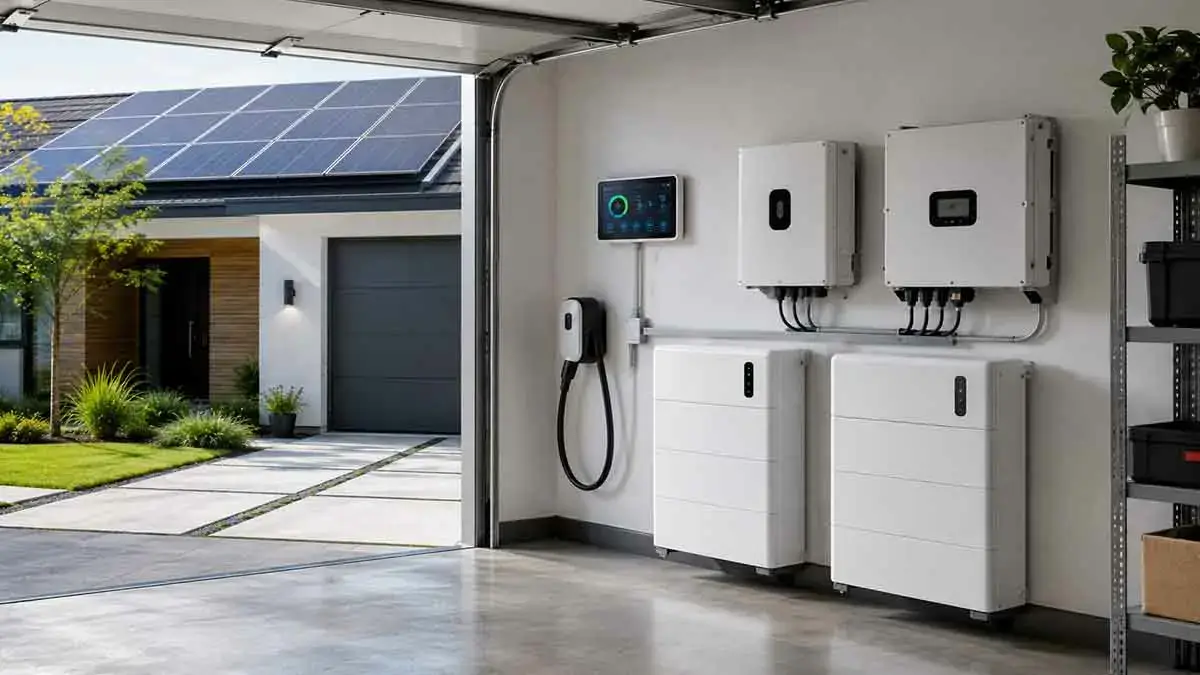
Home battery storage allows homeowners to store electricity and use it later when it is more valuable or needed. A battery can store electricity generated by solar panels, charge from the electrical grid, or use both sources depending on the system design and local utility rules.
Home batteries are commonly considered for three main reasons: backup power, greater solar self-consumption, and electricity-cost management. However, a battery is not automatically the best investment for every household.
The right system depends on your electricity consumption, critical loads, solar production, utility rate structure, backup requirements, battery capacity, power output, installation conditions, and total cost.
This guide explains how home battery storage works, how to size a system, what battery specifications matter, and how to determine whether storage makes sense for your home.
Table of Contents
What Is Home Battery Storage?
Home battery storage is a system that stores electrical energy for later use.
A residential battery system may include:
- Battery modules
- Battery management system
- Inverter or hybrid inverter
- Electrical protection equipment
- Backup or transfer equipment
- Monitoring hardware and software
- Mounting equipment
The battery charges when electricity is available and discharges when the home requires stored energy.
Depending on the system, electricity can come from:
- Solar panels
- The electrical grid
- Both solar and the grid
The stored electricity can then be used by household loads at a later time.
How Does Home Battery Storage Work?
A battery system typically operates through several stages.
Charging
Electricity enters the battery from an approved source such as solar panels or the electrical grid.
Storage
The battery stores electrical energy under the control of its battery management system.
Discharging
When the home needs electricity, stored energy is converted into usable household power through the system’s inverter.
A simplified solar-plus-storage flow is:
Solar Panels → Inverter → Battery → Home
The exact configuration depends on whether the battery is AC-coupled, DC-coupled, or integrated through a hybrid inverter.
Why Install a Home Battery?
Homeowners install batteries for different reasons.
Backup Power
A battery can keep selected appliances and circuits operating during a grid outage when the system is designed for backup.
Solar Self-Consumption
A battery can store excess solar electricity generated during the day for use later.
Electricity Cost Management
A battery may charge when electricity is less expensive and discharge when electricity costs more.
Greater Energy Control
Storage gives homeowners more control over when electricity is purchased, stored, and consumed.
The best reason to install a battery depends on the home’s electricity rates, solar system, outage requirements, and energy-use pattern.
Home Battery Storage With Solar
Solar and battery storage can complement each other.
During the day:
- Solar panels generate electricity.
- The home uses electricity directly.
- Excess electricity can charge the battery.
- Additional surplus may be exported to the grid if permitted.
Later in the day:
- Solar production decreases.
- The battery can supply stored electricity.
- Grid electricity can provide additional power when needed.
This can increase the percentage of solar electricity used by the household rather than exported.
The financial benefit depends heavily on the difference between the value of exported solar electricity and the cost of purchasing electricity from the grid.
Can a Home Battery Work Without Solar?
Yes. Some residential battery systems can charge from the electrical grid without solar panels.
Potential uses include:
- Backup power
- Time-of-use electricity management
- Charging during lower-cost periods
- Reducing consumption during expensive periods
However, charging a battery from the grid only saves money when the rate structure creates a meaningful economic advantage after accounting for charging losses, battery degradation, and system costs.
Types of Home Battery Systems
Residential batteries can be classified by chemistry, electrical architecture, and intended use.
The battery chemistry affects characteristics such as energy density, cycle life, thermal behavior, and cost.
The electrical architecture determines how the battery interacts with solar panels, the grid, and household loads.
Lithium-Ion Batteries
Lithium-ion technology is widely used in modern residential energy storage.
Potential advantages include:
- High energy density
- Compact equipment
- High efficiency
- Long operating life
Different lithium-ion chemistries have different characteristics, so homeowners should evaluate the specifications of the complete battery system rather than assuming all lithium batteries perform identically.
Lithium Iron Phosphate Batteries
Lithium iron phosphate, commonly called LFP, is a lithium-based chemistry used in many stationary energy-storage systems.
It is generally associated with:
- Long cycle life
- Good thermal stability
- Strong durability
- Lower energy density than some other lithium chemistries
Actual performance depends on the battery’s design, controls, operating conditions, and manufacturer specifications.
Lead-Acid Batteries
Lead-acid batteries have been used for energy storage for decades.
They can offer:
- Established technology
- Potentially lower initial equipment cost
- Simple technology in certain applications
However, they are generally larger and may have shorter usable cycle life than modern lithium-based systems when used for frequent residential cycling.
They are less common in many modern grid-connected home storage installations.
Battery Capacity Explained
Battery capacity describes how much energy a battery can store.
It is measured in:
Kilowatt-hours (kWh)
For example:
10 kWh battery
does not necessarily mean that 10 kWh is available for every operating condition.
The system may reserve part of its capacity to protect battery performance or comply with operating limits.
When comparing batteries, focus on usable capacity, not only the headline capacity.
Also review:
- Usable kWh
- Continuous power
- Peak power
- Depth of discharge
- Round-trip efficiency
- Warranty conditions
Battery Power vs. Capacity
Battery capacity and battery power describe different things.
Capacity
Measured in:
kWh
Capacity indicates how much energy can be stored.
Power
Measured in:
kW
Power indicates how much electricity the system can deliver at a particular moment.
For example, a battery may have enough stored energy to operate a refrigerator, lights, and internet equipment for many hours but may not have enough instantaneous power to operate several large appliances simultaneously.
This distinction is especially important when designing backup systems.
How Much Battery Storage Does a Home Need?
There is no universal battery size for every home.
The correct size depends on the purpose of the system.
Consider:
- Daily electricity consumption
- Average evening consumption
- Critical loads
- Desired backup duration
- Maximum electrical demand
- Solar production
- Solar system size
- Electricity rate structure
A household seeking several hours of backup for essential circuits may need considerably less storage than a household seeking whole-home backup for an extended outage.
How to Calculate Critical Loads
If backup power is the main goal, begin by identifying which appliances and circuits are genuinely essential.
Common critical loads may include:
- Refrigerator
- Freezer
- Lighting
- Internet equipment
- Security equipment
- Sump pump
- Selected outlets
- Essential medical equipment where appropriate
Large electrical loads can require substantially more battery power.
Examples include:
- Central air conditioning
- Electric resistance heating
- Electric water heaters
- Electric ovens
- Clothes dryers
- EV chargers
Do not size a battery based only on the number of appliances. Consider both their operating power and how long they need to operate.
A qualified installer can perform a load assessment and determine whether the proposed battery system can support the selected circuits.
How to Estimate Battery Runtime
A simplified estimate is:
Usable Battery Capacity ÷ Average Load = Approximate Runtime
For example:
10 kWh ÷ 1 kW = approximately 10 hours
This is only a simplified estimate.
Actual runtime depends on:
- Inverter efficiency
- Battery operating limits
- Appliance cycling
- Temperature
- Simultaneous loads
- Battery state of charge
A home using 3 kW continuously will deplete a 10 kWh usable battery much faster than a home using 1 kW.
Essential Loads vs. Whole-Home Backup
Battery backup can generally be designed around either selected circuits or a broader portion of the home.
Essential-Load Backup
Only selected circuits receive backup power.
Advantages may include:
- Smaller battery requirements
- Lower installation costs
- Easier prioritization of important equipment
Whole-Home Backup
The system is designed to support most or all household loads.
This generally requires greater:
- Battery capacity
- Inverter power
- Electrical equipment
- Installation complexity
Whole-home backup does not necessarily mean every appliance can operate simultaneously. The system must still remain within its power limits.
How Home Batteries Work During Power Outages
A battery does not automatically provide backup power simply because it is installed in a home.
Backup operation requires compatible equipment and an appropriate system configuration.
A backup system may include:
- Automatic transfer equipment
- Backup gateway
- Critical-load panel
- System controls
- Backup-capable inverter
During a grid outage, the system must safely isolate the home from the electrical grid according to applicable requirements.
Before purchasing a battery, confirm exactly:
- Which circuits will receive backup power
- How much power is available
- How long the battery is expected to operate
- Whether backup starts automatically
- Whether solar can recharge the battery during an outage
Can Solar and a Battery Work During an Outage?
Some solar-plus-battery systems can continue operating solar generation during a grid outage.
However, this depends on the complete system design.
A conventional grid-tied solar system may shut down when the grid fails because it is not designed to operate independently of the utility.
A properly designed battery backup system may create a controlled electrical environment that allows compatible solar equipment to continue operating.
Therefore, homeowners should not assume that simply having solar panels means the home will have electricity during an outage.
Depth of Discharge
Depth of discharge (DoD) describes how much of a battery’s stored energy is used during a discharge cycle.
For example, a battery may have a 10 kWh nominal capacity while providing a different usable capacity according to its operating limits.
Manufacturers may specify a recommended or maximum depth of discharge.
When comparing systems, use the manufacturer’s usable capacity specification rather than trying to calculate it from nominal capacity alone.
Round-Trip Efficiency
Round-trip efficiency describes how much energy remains available after a battery is charged and discharged.
For example, if 10 kWh of electricity is used to charge a battery, less than 10 kWh may be available for the home later because energy is lost during conversion and storage.
Higher round-trip efficiency can reduce these losses.
When comparing products, check whether efficiency figures are based on comparable testing conditions and whether they refer to the battery alone or the complete storage system.
Battery Cycle Life
Cycle life describes how a battery performs over repeated charge and discharge cycles.
Battery longevity can be influenced by:
- Depth of discharge
- Operating temperature
- Charging behavior
- Discharge rate
- System controls
- Usage frequency
For homeowners who plan to cycle a battery every day, cycle-life and throughput specifications deserve particular attention.
Battery Warranty
A battery warranty can contain several different performance conditions.
Review:
- Warranty duration
- Guaranteed remaining capacity
- Energy throughput limits
- Cycle limits
- Operating conditions
- Installation requirements
- Warranty exclusions
A 10-year warranty, for example, does not necessarily mean the battery will retain its original capacity for the entire period.
Read the warranty conditions rather than comparing warranty length alone.
AC-Coupled vs. DC-Coupled Storage
Battery systems can connect to solar and household electrical equipment in different ways.
AC-Coupled Storage
An AC-coupled battery connects through the home’s alternating-current electrical system.
Potential advantages include:
- Convenient integration with some existing solar installations
- Flexibility for certain retrofit projects
- Independent battery inverter operation in some designs
DC-Coupled Storage
A DC-coupled battery connects on the direct-current side of a compatible solar system.
Potential advantages can include:
- Fewer conversion stages in some operating conditions
- Efficient integration with new solar-plus-storage systems
- Potentially efficient solar-to-battery charging
The best architecture depends on whether the solar system is new or existing, the inverter configuration, system goals, and installation requirements.
Hybrid Inverters
A hybrid inverter can manage electricity from solar panels, batteries, and the home’s electrical system.
Depending on the model, it may provide:
- Solar conversion
- Battery charging
- Battery discharge control
- Grid interaction
- Backup operation
- System monitoring
Compatibility is critical. Not every battery works with every inverter.
Confirm equipment compatibility before purchasing a system.
Can a Battery Lower Electricity Bills?
A battery can reduce electricity costs in some situations, but it does not automatically reduce bills.
Potential savings are greater when the battery can:
- Charge during low-cost periods
- Discharge during high-cost periods
- Store solar electricity that would otherwise receive low export compensation
- Reduce electricity purchases during expensive periods
The calculation should account for:
- Electricity rate differences
- Round-trip efficiency
- Battery degradation
- Financing costs
- Installation costs
- Utility rules
A battery should be evaluated based on its actual operating economics rather than its storage capacity alone.
Time-of-Use Electricity Rates
Time-of-use pricing charges different electricity rates during different periods.
For example, electricity may be cheaper during certain overnight hours and more expensive during high-demand periods.
A battery can potentially:
- Charge when electricity is less expensive.
- Store the energy.
- Discharge during higher-cost periods.
The strategy only makes financial sense when the price difference is large enough to offset storage losses and battery-related costs.
Solar Self-Consumption
Solar self-consumption refers to using electricity generated by your solar panels directly in the home.
Without storage, excess daytime solar production may be exported to the grid.
With a battery, some of that surplus can be stored for evening or nighttime consumption.
This can be particularly valuable when the utility pays less for exported solar electricity than it charges for electricity imported from the grid.
Home Battery Costs
The total cost of a battery system can include much more than the battery itself.
Potential costs include:
- Battery modules
- Inverter
- Backup equipment
- Electrical installation
- Labor
- Permits
- Monitoring equipment
- Electrical-panel upgrades
- Structural or mounting work
The actual price varies by system size, equipment, installation complexity, location, and market conditions.
Compare the complete installed system cost rather than battery price alone.
How to Compare Battery Systems
Use the following specifications when comparing products:
| Specification | Why It Matters |
|---|---|
| Usable capacity | Determines how much energy is available |
| Continuous power | Determines sustained electrical output |
| Peak power | Helps determine whether high-demand loads can operate |
| Round-trip efficiency | Indicates storage and conversion losses |
| Battery chemistry | Affects performance, size, and operating characteristics |
| Warranty | Defines long-term coverage |
| Cycle or throughput limit | Important for frequent use |
| Expansion capability | Allows future storage increases |
| Backup capability | Determines outage functionality |
| Installed cost | Reflects the actual project expense |
No single specification determines the best battery.
Where Can a Home Battery Be Installed?
The installation location depends on the battery manufacturer’s requirements, local regulations, environmental conditions, and available space.
Possible locations may include:
- Garage
- Exterior wall
- Utility area
- Dedicated equipment space
Before installation, evaluate:
- Required clearances
- Temperature
- Moisture exposure
- Ventilation requirements
- Accessibility
- Fire-safety requirements
- Electrical-code requirements
Never install a battery based solely on available wall space.
The equipment must be installed according to manufacturer instructions and applicable local requirements.
Temperature and Battery Performance
Temperature can affect battery operation and longevity.
Extreme temperatures may:
- Reduce available performance
- Trigger protective controls
- Affect charging
- Affect battery life
The battery should be installed within the environmental conditions specified by the manufacturer.
If the intended installation location experiences very high or low temperatures, ask the installer how the system is designed to manage those conditions.
Home Battery Safety
Residential batteries contain significant amounts of stored electrical energy and must be installed correctly.
Important safety considerations include:
- Proper electrical protection
- Manufacturer-approved equipment
- Correct installation
- Required clearances
- Appropriate environmental conditions
- Qualified installation personnel
- Compliance with applicable electrical and fire requirements
Do not open, modify, repair, or relocate battery equipment yourself.
If the system displays a fault or warning, follow the manufacturer’s instructions and contact a qualified professional when necessary.
Home Battery Maintenance
Most modern residential batteries require relatively little routine maintenance.
Homeowners should:
- Monitor system status
- Review alerts
- Keep equipment clear of obstructions
- Follow manufacturer recommendations
- Maintain required access around the equipment
- Arrange professional service when necessary
Do not attempt internal battery repairs or disassembly.
Regular monitoring is often more important than performing unnecessary physical maintenance.
Can You Expand a Battery System?
Some battery systems support future expansion, while others have fixed capacity limits.
If future electricity demand may increase, ask about:
- Maximum supported capacity
- Additional battery modules
- Inverter capacity
- Compatibility of future modules
- Installation requirements
- Warranty implications
Future expansion can be useful if you later add:
- An electric vehicle
- A heat pump
- Electric water heating
- Additional solar capacity
However, expansion is not guaranteed to be simple or economical. Confirm compatibility before choosing the original system.
Is Home Battery Storage Worth It?
A home battery may be worthwhile when one or more of the following apply:
- Backup power is important
- Solar export compensation is relatively low
- Electricity prices vary significantly by time
- The household has substantial evening consumption
- Grid outages are a meaningful concern
- The system can be installed at a reasonable total cost
A battery may provide less financial value when:
- Electricity rates are flat and inexpensive
- Solar export compensation is highly favorable
- Outages are rare and backup power has little value
- Installation costs are high
- The battery would be used infrequently
The decision should separate financial value from backup value.
A battery can be financially unattractive but still worthwhile to a homeowner who places a high value on keeping essential equipment operating during outages.
Home Battery Storage Checklist
Energy Assessment
- Review daily electricity consumption
- Review seasonal usage
- Identify major electrical loads
- Determine critical backup loads
- Estimate desired backup duration
- Consider future electricity demand
Battery Specifications
- Usable capacity
- Continuous power
- Peak power
- Round-trip efficiency
- Battery chemistry
- Depth-of-discharge specifications
- Cycle or throughput rating
- Warranty
Solar Integration
- Solar compatibility
- AC or DC coupling
- Inverter compatibility
- Solar charging capability
- Solar operation during outages
Backup Planning
- Essential-load or whole-home backup
- Supported circuits
- Automatic transfer capability
- Expected runtime
- Maximum simultaneous load
- Recharging during outages
Financial Evaluation
- Total installed cost
- Electricity rate structure
- Time-of-use savings
- Solar export compensation
- Financing cost
- Expected battery degradation
- Long-term value
Installation
- Approved installation location
- Required clearances
- Temperature conditions
- Electrical requirements
- Fire-safety requirements
- Installer qualifications
- Permit requirements
Common Home Battery Storage Mistakes
Choosing Capacity Without Checking Power
A battery can have substantial energy capacity but still lack enough power to operate multiple high-demand appliances at the same time.
Always evaluate both kWh and kW.
Assuming Every Battery Provides Whole-Home Backup
Backup capability depends on inverter power, electrical configuration, supported circuits, and system design.
Assuming Solar Works During Every Outage
Standard grid-tied solar may shut down when the grid fails.
Solar backup requires compatible equipment and an appropriate operating configuration.
Comparing Batteries Only by Price per kWh
A low price per kWh does not necessarily mean better value.
Consider power output, efficiency, warranty, installation cost, and backup functionality.
Ignoring Usable Capacity
Nominal battery capacity does not always equal the amount of energy available for household use.
Ignoring the Utility Rate Structure
The financial value of storage often depends on when electricity is purchased and consumed.
Oversizing for Rare Outages
A very large battery may cost substantially more while providing capacity that is rarely used.
Prioritize the loads and outage duration that actually matter to your household.
Ignoring Future Expansion
If electricity demand is expected to increase, check whether the battery system can support additional storage.
Focusing Only on the Battery
The inverter, backup equipment, electrical installation, and system controls are all important parts of the complete storage system.
How to Choose a Home Battery
Use a structured process rather than choosing a battery based on capacity alone.
Step 1: Define Your Main Goal
Decide whether your priority is:
- Backup power
- Solar self-consumption
- Lower electricity costs
- Time-of-use optimization
- Greater control over household energy
Step 2: Analyze Your Electricity Use
Review daily, monthly, and seasonal consumption.
Identify when your household uses the most electricity.
Step 3: Identify Critical Loads
If backup is important, determine which appliances and circuits must remain operational.
Step 4: Determine Power Requirements
Calculate the approximate simultaneous load in kW.
This helps determine whether the battery and inverter can operate the equipment you need.
Step 5: Determine Capacity Requirements
Estimate how many kWh are required for your desired backup period or daily energy-shifting strategy.
Step 6: Evaluate Solar Compatibility
If you have or plan to install solar, determine whether AC-coupled, DC-coupled, or hybrid architecture is most appropriate.
Step 7: Compare Battery Specifications
Evaluate:
- Usable capacity
- Continuous power
- Peak power
- Efficiency
- Chemistry
- Warranty
- Cycle or throughput limits
- Expansion capability
Step 8: Compare Complete Installation Quotes
Compare total installed costs, not just battery prices.
Make sure proposals specify the equipment, backup capability, expected operation, and warranty coverage.
Step 9: Evaluate the Economics
Consider electricity rates, solar export compensation, financing, efficiency losses, and expected battery use.
Step 10: Confirm Installation and Safety Requirements
Verify the installation location, electrical requirements, permits, clearances, and installer qualifications.
Step 11: Monitor the System After Installation
Track battery state of charge, energy flows, system alerts, and performance.
Monitoring helps determine whether the system is operating as expected.
Final Thoughts
Home battery storage can provide several useful functions, from storing excess solar electricity to managing time-of-use electricity rates and providing backup power during grid outages.
However, the best battery system is not necessarily the largest or most expensive option. The right system should match your home’s actual electricity requirements and the specific purpose of the installation.
Start by identifying your goals and analyzing your energy consumption. Then determine both power requirements in kilowatts and energy requirements in kilowatt-hours.
From there, compare usable capacity, power output, efficiency, battery chemistry, warranty, backup capability, installation requirements, and total installed cost.
A well-designed battery system should provide a clear practical benefit—whether that benefit is lower electricity costs, greater solar self-consumption, or reliable backup for the loads that matter most.