
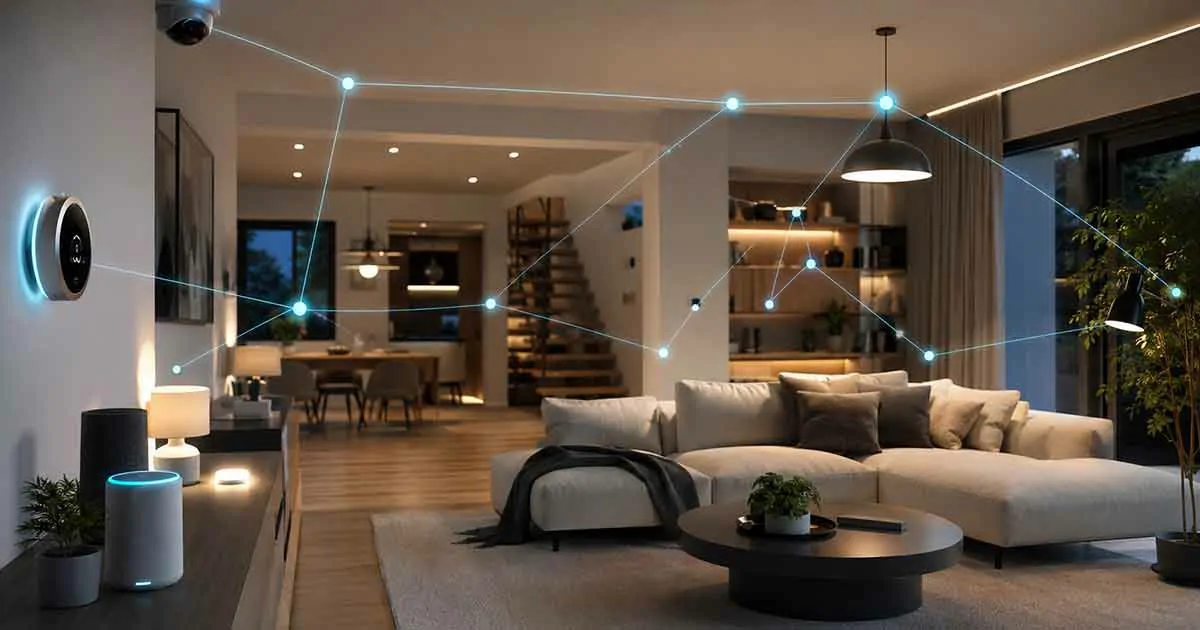
Smart home technology has already changed the way people control lighting, thermostats, security systems, appliances, and entertainment devices.
The next stage is making those systems more intelligent.
AI home automation combines connected devices with artificial intelligence to help homes understand patterns, respond to context, and automate decisions with less manual programming.
Traditional smart home automation usually depends on rules created by the homeowner.
For example:
At 7:00 AM → turn on the lights.
When motion is detected → turn on the hallway light.
When everyone leaves → adjust the thermostat.
AI can take this concept further by analyzing multiple sources of information and adapting automation to changing circumstances.
Instead of simply following a fixed schedule, an AI-powered home can potentially consider occupancy, weather, energy consumption, previous behavior, and device activity before deciding what should happen.
This does not mean every AI smart home will operate completely on its own. Human control, reliable automation rules, privacy protections, and security remain essential.
Table of Contents
What Is AI Home Automation?
AI home automation is the use of artificial intelligence and machine learning to improve the operation of connected home devices and systems.
An AI-enabled smart home can potentially analyze information from:
- Smart sensors
- Cameras
- Thermostats
- Smart plugs
- Lighting
- Door locks
- Energy monitors
- Weather services
- Voice assistants
- Connected appliances
The system can use this information to recognize patterns, make predictions, and automate certain actions.
For example, instead of programming a thermostat to lower the temperature at exactly 10:00 PM every night, an intelligent system could learn the household’s typical schedule and adjust the temperature based on occupancy and conditions.
AI Automation vs Traditional Smart Home Automation
The biggest difference is how decisions are made.
Traditional automation generally follows predetermined rules.
Trigger → Condition → Action
For example:
Motion detected → after sunset → hallway light turns on.
AI automation can introduce additional context.
Occupancy + time + daylight + previous behavior + room activity → determine appropriate lighting.
Traditional automation is predictable and easy to understand.
AI automation can be more adaptive but may also be more complex.
The best smart homes will likely use both approaches.
Simple tasks can remain rule-based, while AI can handle situations where more context is useful.
Why AI Is Important for the Future of Smart Homes
Smart homes are becoming more complicated.
A modern home may contain:
- Dozens of smart lights
- Multiple sensors
- Smart locks
- Security cameras
- Thermostats
- Smart plugs
- Appliances
- Speakers
- Energy monitoring devices
Managing all these devices manually can become difficult.
AI can potentially act as an intelligence layer that coordinates information from multiple devices.
Instead of controlling individual products, homeowners can interact with the home as a connected system.
This could make automation more natural and less dependent on manually created routines.
How AI Can Make Smart Homes More Intelligent
AI can improve smart homes in several important areas.
1. Learning Household Patterns
AI can analyze recurring behavior.
For example, it may recognize that:
- The home is usually empty during working hours.
- Certain lights are used every evening.
- The thermostat is adjusted before bedtime.
- Specific rooms are rarely occupied overnight.
These patterns can help the system make more useful automation decisions.
2. Understanding Context
A single sensor reading may not provide enough information.
For example, motion in a room does not necessarily mean someone is actively using the room.
AI can potentially combine multiple signals to estimate what is happening.
3. Predicting Future Needs
AI can analyze historical patterns and potentially anticipate events.
For example, the system may predict when occupants are likely to return home and prepare the environment accordingly.
4. Reducing Manual Configuration
Advanced AI assistants could allow homeowners to describe desired behavior using natural language rather than creating complicated automation rules manually.
AI and Smart Thermostats
Heating and cooling are among the biggest opportunities for AI automation.
A traditional thermostat may use a fixed schedule.
An AI-assisted thermostat can potentially analyze:
- Indoor temperature
- Outdoor temperature
- Occupancy
- Historical preferences
- Weather forecasts
- HVAC behavior
- Time of day
The goal is to balance comfort and energy efficiency.
For example, if the system knows that nobody is normally home during a particular period, it may reduce heating or cooling during that time.
If household behavior changes, the system can potentially adapt instead of requiring the homeowner to manually rewrite the schedule.
AI for Home Energy Management
AI can make energy management more sophisticated.
An intelligent system can potentially analyze:
- Electricity consumption
- Smart plug data
- HVAC usage
- Appliance activity
- Occupancy
- Weather
- Solar generation
- Electricity rates
This information can reveal patterns that are difficult to identify manually.
For example, the system could detect that a particular appliance consistently consumes significant electricity during periods when the home is unoccupied.
It could then recommend a schedule change or, where appropriate, automate the device.
AI Smart Plugs and Energy Monitoring
Smart plugs can provide useful energy data.
An energy-monitoring plug can measure the electricity consumption of a connected device.
AI can potentially analyze that information over time.
For example:
Smart plug → energy data → AI analysis → usage pattern → recommendation or automation.
This can help homeowners identify:
- Standby power consumption
- Unusual usage
- High-consumption appliances
- Changes in operating behavior
AI does not make the appliance itself more efficient, but it can help homeowners understand and control how the appliance is used.
AI for Smart Lighting
Lighting is another area where AI can make automation more adaptive.
A basic smart lighting routine might be:
Sunset → lights turn on.
An AI-powered system could potentially consider:
- Whether anyone is home
- Which rooms are occupied
- Natural daylight
- Time of day
- User preferences
- Previous lighting behavior
This could reduce unnecessary lighting and make the home feel more natural.
For example, the system might use brighter lighting when someone is working and softer lighting during evening relaxation.
AI and Home Security
Home security is one of the most visible applications of AI.
Traditional security systems often rely on motion detection.
AI can analyze additional information to help determine what caused the motion.
For example:
Camera detects movement → AI analyzes footage → person detected → notification sent.
Depending on the system, AI may distinguish between:
- People
- Animals
- Vehicles
- Packages
- General movement
This can reduce unnecessary notifications.
However, AI detection is not perfect and should not be treated as a replacement for a complete security strategy.
AI Security Cameras
AI-enabled security cameras can provide more useful alerts than basic motion detection.
Some systems can analyze footage and provide descriptions of detected activity.
Potential capabilities include:
- Person detection
- Vehicle detection
- Animal detection
- Package detection
- Activity recognition
- Smart search
- Event summaries
The exact capabilities depend on the manufacturer and whether processing occurs locally or in the cloud.
Advanced features may also require a subscription.
AI Doorbells
Smart doorbells can use AI to improve visitor detection.
A basic doorbell may simply report that motion occurred.
An AI-enabled system can potentially determine whether the event involves a person, vehicle, package, or animal.
This can make notifications more useful.
For example:
“Motion detected”
is less informative than:
“Person detected at the front door.”
Some newer systems can provide more detailed descriptions of events.
AI and Smart Locks
AI can potentially make smart locks part of broader context-aware automation.
For example, a smart home could combine:
- Lock status
- Door sensors
- Smartphone presence
- Motion sensors
- Time of day
This information could help determine whether household members have arrived or left.
However, homeowners should be cautious with AI-based security decisions.
A smart home should not automatically unlock a door simply because an AI system believes someone is approaching.
Critical security actions should require reliable authentication.
AI Occupancy Detection
Occupancy is fundamental to intelligent home automation.
A home cannot make useful decisions about lighting, heating, or security without knowing whether rooms are occupied.
Occupancy can be estimated using:
- Motion sensors
- Presence sensors
- Smartphones
- Door sensors
- Cameras
- Wi-Fi-based systems
AI can potentially combine multiple sources to improve occupancy estimates.
For example:
Motion sensor + smartphone presence + door activity → occupancy estimate.
This can be more reliable than depending on one sensor.
AI-Powered Voice Control
Voice control has been part of smart homes for years.
AI can make voice interactions more conversational.
Instead of memorizing specific commands, homeowners may be able to describe what they want naturally.
For example:
“Make the house comfortable for the evening.”
Depending on the platform, the AI system could potentially interpret this as a combination of temperature, lighting, and entertainment adjustments.
The exact level of control depends on the smart home platform and connected devices.
Generative AI and Smart Home Control
Generative AI introduces another important development.
Instead of manually configuring complex automation routines, users could describe the desired behavior in natural language.
For example:
“When everyone leaves, turn off unnecessary lights, adjust the thermostat, and make sure the doors are locked.”
An AI assistant could potentially convert this request into multiple automation rules.
This could make advanced smart home automation easier for nontechnical users.
However, users should review AI-generated automations before activating them, especially when they involve security or electrical devices.
Predictive Home Automation
Predictive automation is one of the most promising applications of AI.
Instead of waiting for a trigger, the system attempts to anticipate what will happen.
For example, if a household usually arrives home around the same time, the system could potentially prepare the home shortly before arrival.
Possible actions include:
- Adjusting temperature
- Activating selected lights
- Preparing entertainment devices
- Checking doors
- Changing security settings
This creates a more responsive environment.
However, predictive automation should remain adjustable because household routines can change.
Personalized Smart Homes
Every household has different preferences.
AI can potentially personalize the home for different occupants.
For example:
One person may prefer a cooler bedroom.
Another may prefer warmer temperatures.
Someone may want brighter lighting for work.
Another person may prefer softer lighting in the evening.
AI can analyze these patterns and potentially adapt automation accordingly.
This is one of the major differences between a simple smart home and a more intelligent one.
AI for Families
Family schedules are often unpredictable.
School, work, weekends, holidays, and activities can all change the household routine.
AI can potentially recognize these changes instead of relying on a rigid weekly schedule.
For example, a system may learn that the house is occupied earlier on weekends than during weekdays.
It can then adapt temperature and lighting behavior accordingly.
The goal is not to eliminate schedules completely but to make them more flexible.
AI Home Automation for Older Adults
AI-powered smart homes can also improve convenience and accessibility.
Potential applications include:
- Voice-controlled lighting
- Automatic temperature adjustment
- Smart doorbells
- Security notifications
- Appliance monitoring
- Automated routines
These features can reduce the need to interact with complicated controls.
However, reliability and privacy remain important.
An automated system should always provide simple manual alternatives.
AI for Large Homes
Large homes often have more devices, rooms, and automation requirements.
An AI system can potentially coordinate information from:
- Multiple thermostats
- Smart lighting
- Sensors
- Security cameras
- Smart locks
- Energy monitors
- Appliances
For example, occupancy information could be used to coordinate climate control and lighting across different areas of the property.
However, network infrastructure becomes increasingly important as the number of connected devices grows.
AI cannot compensate for poor connectivity.
Edge AI vs Cloud AI
AI smart home systems can process information locally or in the cloud.
Cloud AI
Data is sent to remote servers for processing.
Advantages can include:
- Greater computing power
- More advanced models
- Frequent software updates
- Large-scale data analysis
Potential disadvantages include:
- Internet dependence
- Privacy concerns
- Subscription requirements
- Cloud-service outages
Edge AI
AI processing occurs locally on the device or inside the home.
Potential advantages include:
- Faster response
- Greater privacy
- Reduced cloud dependence
- Better operation during some internet outages
The limitation is that local hardware may have less processing power than large cloud platforms.
A hybrid approach can combine local and cloud processing.
AI Home Automation and Privacy
Privacy is one of the most important considerations.
An AI-enabled home can collect information about household behavior.
This may include:
- Occupancy
- Camera footage
- Voice recordings
- Door activity
- Energy consumption
- Daily routines
- Room activity
Before buying an AI-enabled product, check:
- Where data is processed
- Whether recordings are stored
- How long data is retained
- Whether local processing is available
- Whether a subscription is required
- Whether data is shared with third parties
- Whether collected data can be deleted
Privacy settings should be reviewed before enabling advanced AI features.
AI Home Automation Security Risks
AI can improve smart home security, but it also creates potential risks.
These include:
- False positives
- False negatives
- Incorrect recognition
- Compromised accounts
- Cloud-service vulnerabilities
- Unauthorized access
- Overreliance on automated decisions
For critical functions, maintain backup controls.
A smart lock should have a reliable backup entry method.
A security camera should not be the only security measure protecting the home.
An AI assistant should not have unrestricted authority over sensitive systems without appropriate safeguards.
AI and Smart Home Interoperability
Modern homes often contain products from multiple manufacturers.
Standards such as Matter can help compatible devices communicate across supported smart home ecosystems.
AI can potentially operate above this infrastructure.
A simplified architecture could be:
Smart devices → smart home platform → AI intelligence → automation
This allows the AI layer to analyze information from multiple connected devices.
However, interoperability still depends on the specific platform and device capabilities.
AI Home Automation Without a Subscription
Some AI features can operate without recurring fees, while others are offered as premium services.
Subscription-based features may include:
- Advanced camera analysis
- Cloud AI
- Video summaries
- Extended event history
- Generative AI assistants
- Advanced automation
When building an AI smart home, compare the total long-term cost rather than the initial device price.
A device that is inexpensive initially but requires a monthly subscription may cost considerably more over several years.
AI and Energy Efficiency
AI can help optimize energy use by analyzing multiple variables simultaneously.
For example:
Occupancy + weather + temperature + electricity usage + HVAC activity → optimized heating and cooling.
This can be more flexible than a simple fixed schedule.
AI can also identify unusual energy patterns.
For example, if an appliance normally consumes a certain amount of electricity but suddenly begins consuming significantly more, the system could potentially flag the change.
This may help identify inefficient operation or possible equipment problems.
AI Predictive Maintenance
Predictive maintenance is another promising application.
Smart devices can generate information about:
- Temperature
- Runtime
- Energy consumption
- Vibration
- Operating cycles
AI can analyze this information to identify deviations from normal behavior.
For example, an HVAC system that begins consuming significantly more electricity while producing less heating or cooling could potentially indicate a developing problem.
Predictive maintenance does not guarantee that a failure will be detected, but it can provide an additional source of information.
AI and Smart Appliances
Connected appliances may become increasingly intelligent.
Potential applications include:
- Washing machines adjusting cycles
- Ovens optimizing cooking programs
- Refrigerators monitoring usage
- Dishwashers scheduling operation
- Dryers adapting cycles
AI could potentially use household behavior and environmental information to optimize these tasks.
However, safety remains the priority.
Appliances should only be automated within the limits intended by their manufacturers.
AI Home Automation for Better Comfort
Comfort is one of the most practical benefits of intelligent automation.
An AI system can potentially coordinate multiple devices to create a more comfortable environment.
For example:
Occupancy detected → temperature adjusted → lights optimized → ventilation activated.
The system can potentially learn household preferences over time.
This is more sophisticated than controlling each device independently.
How to Build an AI-Powered Smart Home
You do not need to replace everything at once.
A gradual approach is usually more practical.
Step 1: Build a Reliable Network
Start with strong Wi-Fi coverage and Ethernet where practical.
Step 2: Choose a Smart Home Platform
Select the ecosystem you expect to use most.
Step 3: Add Core Devices
Start with useful products such as:
- Smart thermostat
- Smart lights
- Smart plugs
- Motion sensors
- Door sensors
- Smart lock
Step 4: Add Energy Monitoring
Energy-monitoring devices provide useful information for future optimization.
Step 5: Add AI Where It Provides Value
Choose AI features that solve an actual problem.
Step 6: Secure the System
Use strong passwords and multi-factor authentication where available.
Step 7: Review Privacy Settings
Understand what data each device collects and how it is processed.
Step 8: Keep Manual Controls
Important home functions should remain usable without AI.
Best AI Smart Home Devices to Start With
You do not need an AI device in every room.
A practical starting setup can include:
Smart Thermostat
Useful for climate optimization.
AI Security Camera
Useful for intelligent event detection.
Smart Doorbell
Useful for visitor and package detection.
Energy-Monitoring Smart Plug
Useful for analyzing appliance consumption.
Occupancy Sensor
Useful for determining whether rooms are being used.
Smart Speaker
Useful as a natural-language interface.
Common AI Home Automation Mistakes
Adding AI Without a Purpose
AI should solve a real problem rather than simply make the system more complicated.
Ignoring Privacy
Understand where your data goes.
Trusting AI Completely
AI systems can make mistakes.
Ignoring Network Reliability
Poor connectivity can make even advanced automation unreliable.
Automating Critical Security Actions
Keep human control over important security decisions.
Ignoring Subscription Costs
Calculate long-term costs before purchasing cloud-dependent products.
Creating Too Much Automation
A smart home can become frustrating if dozens of unnecessary routines are constantly triggering.
The goal should be useful automation, not maximum automation.
The Future of AI Home Automation
The future of smart homes is likely to become increasingly contextual.
Instead of asking users to control individual devices, AI systems may allow them to communicate with the home as a whole.
A homeowner could potentially say:
“Prepare the house for bedtime.”
The system could then coordinate:
- Lights
- Thermostats
- Locks
- Security devices
- Entertainment systems
- Selected appliances
Another important development will be the combination of AI with local processing.
As smart home hardware becomes more powerful, more AI functions may run directly inside the home.
This could improve privacy, reduce latency, and decrease dependence on cloud services.
Will AI Replace Traditional Smart Home Automation?
Probably not.
Traditional automation has an important advantage: predictability.
A rule such as:
At 10:00 PM → turn off the hallway light
will behave the same way every night.
AI can be more flexible, but flexibility can sometimes introduce uncertainty.
The most effective smart homes will likely combine both.
Use traditional automation for predictable actions.
Use AI for tasks that benefit from:
- Pattern recognition
- Prediction
- Natural-language interaction
- Context awareness
- Personalization
This hybrid approach can provide both reliability and intelligence.
Is AI Home Automation Worth It?
For many homeowners, AI can provide meaningful benefits when applied to the right problems.
The strongest use cases are currently areas where large amounts of information need to be interpreted.
These include:
- Home security
- Energy management
- Climate control
- Occupancy detection
- Voice interaction
- Predictive maintenance
- Personalized automation
However, AI should not be treated as a replacement for good hardware, reliable networking, or sensible home security practices.
Final Thoughts
AI home automation represents an important evolution of the smart home.
Traditional automation tells devices what to do when specific conditions occur.
AI can potentially help the home understand patterns, interpret context, predict behavior, and coordinate multiple devices.
The biggest opportunities are in energy savings, security, comfort, personalization, and easier control.
At the same time, homeowners need to consider privacy, security, reliability, interoperability, and subscription costs.
The future smart home will probably not be completely autonomous.
Instead, it will combine reliable automation with AI assistance, giving homeowners more useful control while allowing the system to handle routine decisions in the background.
The smartest approach today is to build a strong connected-home foundation first and then add AI features where they provide a clear and measurable benefit.