
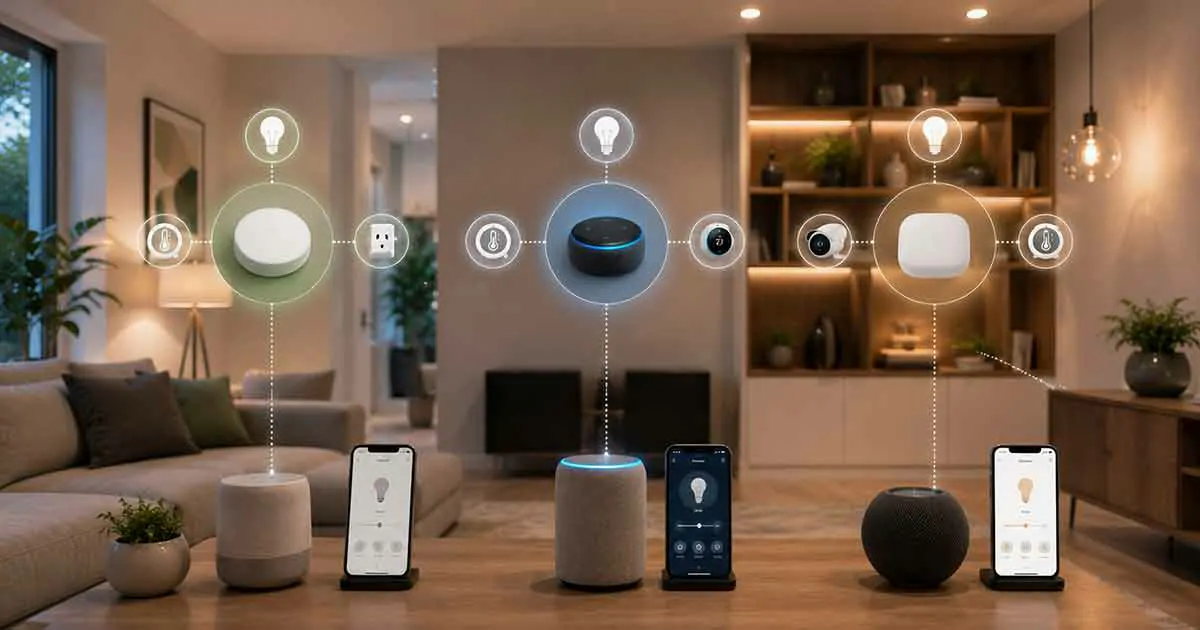
Choosing the right smart home platform is one of the most important decisions when building a connected home. A platform determines how your smart devices communicate, how you control them, and which products can work together.
The three most widely recognized options are Google Home, Amazon Alexa, and Apple Home. Each platform offers a different combination of compatibility, voice control, automation, privacy, and ease of use.
This guide compares the three major smart home platforms to help you decide which one is the best fit for your home.
Table of Contents
What Is a Smart Home Platform?
A smart home platform is the software ecosystem that connects and manages compatible smart devices throughout your home.
Instead of controlling every device through a separate app, a smart home platform allows you to manage multiple products from one place. Depending on the platform and devices you use, you can control smart lights, thermostats, locks, cameras, speakers, appliances, sensors, and other connected products.
A good platform can also create automations. For example, you could create a routine that turns off the lights, locks the doors, and adjusts the thermostat when you leave home.
The main platforms most homeowners consider are Google Home, Amazon Alexa, and Apple Home.
Google Home vs Alexa vs Apple Home
Although these platforms perform many of the same functions, they differ in several important areas.
| Feature | Google Home | Amazon Alexa | Apple Home |
|---|---|---|---|
| Voice assistant | Google Assistant/Gemini integration | Alexa | Siri |
| Device compatibility | Very broad | Very broad | More selective |
| Android integration | Excellent | Excellent | Limited |
| iPhone integration | Excellent | Excellent | Excellent |
| Apple ecosystem | Good | Good | Excellent |
| Smart home automation | Excellent | Excellent | Excellent |
| Privacy focus | Moderate | Moderate | Strong |
| Ease of setup | Easy | Easy | Easy |
| Matter support | Yes | Yes | Yes |
| Best for | Google users | Broad compatibility | Apple users |
The best option depends largely on the devices you already own and the ecosystem you use every day.
Google Home
Google Home is a strong choice for households that use Android phones, Google services, Nest products, or Google smart speakers and displays.
The platform allows compatible devices to be organized and controlled through the Google Home app. Users can also create routines that automate multiple devices.
Advantages of Google Home
One of Google’s biggest strengths is its integration with the broader Google ecosystem.
If you already use Android, Google Assistant, Google Calendar, Google Maps, YouTube, or Nest products, Google Home can provide a familiar experience.
Google Home also supports a large selection of third-party smart home devices, making it possible to build a system without buying every product from one manufacturer.
Another advantage is its support for modern interoperability standards such as Matter, which can make it easier to connect compatible devices from different manufacturers.
Potential drawbacks
Google Home may not be the ideal choice for someone who prefers Apple’s ecosystem or wants the strongest possible focus on local control and privacy.
The experience can also vary depending on the manufacturer and type of device being connected.
Amazon Alexa
Amazon Alexa is one of the most established smart home platforms and is particularly known for its extensive device compatibility.
Alexa can control smart lights, plugs, thermostats, locks, cameras, appliances, speakers, and many other connected products.
Advantages of Alexa
One of Alexa’s biggest strengths is the enormous range of compatible smart home devices.
This makes Alexa particularly attractive if you want flexibility when choosing products from different manufacturers.
Alexa also offers routines that can combine multiple actions. For example, a bedtime routine could turn off selected lights, lock compatible doors, adjust the thermostat, and activate other devices with a single command.
Echo smart speakers and displays also provide convenient voice control throughout the home.
Potential drawbacks
Alexa can become complicated when a home contains a large number of devices, routines, and manufacturer-specific integrations.
Some advanced features may also depend on the individual device manufacturer or additional services.
Apple Home
Apple Home is designed primarily for people who already use Apple products such as the iPhone, iPad, Apple Watch, Apple TV, and HomePod.
Its biggest advantage is the way smart home control is integrated into the Apple ecosystem.
Compatible devices can be controlled through the Home app, Siri, and supported Apple devices.
Advantages of Apple Home
Apple places strong emphasis on privacy and security, making Apple Home attractive to homeowners who want greater control over their connected devices and personal data.
The platform also provides a polished user experience, especially when the household already relies heavily on Apple products.
Apple Home supports automations and scenes that allow several devices to respond to a specific condition or command.
For example, a “Good Night” scene could turn off lights, lock compatible doors, and adjust other connected devices.
Potential drawbacks
Apple Home generally has a more selective device ecosystem than Alexa and Google Home.
This does not necessarily mean that Apple Home is difficult to use, but homeowners should check compatibility before purchasing smart devices.
If you use Android phones or do not own Apple devices, Apple Home is usually less attractive.
Which Smart Home Platform Has the Best Compatibility?
If device compatibility is your highest priority, Amazon Alexa and Google Home are generally strong choices.
Alexa has historically offered support for a very large range of third-party products, while Google Home also supports a broad selection of smart devices and modern standards such as Matter.
Apple Home is more selective, but that can also be an advantage because the ecosystem places greater emphasis on compatibility, security, and a consistent user experience.
Before buying a device, check whether it officially supports the platform you intend to use.
Which Platform Is Best for Android Users?
For Android households, Google Home is usually the most natural option.
Google Home integrates directly with Android phones and other Google services, making everyday control straightforward.
Alexa is also an excellent option for Android users, particularly if device compatibility and the wide Alexa ecosystem are more important than integration with Google services.
Apple Home is generally better suited to households that already use Apple devices.
Which Platform Is Best for iPhone Users?
iPhone users can use Google Home or Alexa, but Apple Home offers the deepest integration with the Apple ecosystem.
If your household already uses iPhones, Apple Watches, Apple TVs, or HomePods, Apple Home can provide a particularly seamless experience.
However, owning an iPhone does not mean you must choose Apple Home. Google Home and Alexa can still be excellent choices if you prefer their device compatibility or features.
Smart Home Platforms and Matter
Matter is becoming increasingly important when choosing a smart home platform.
Matter is designed to improve interoperability between compatible smart home products. Instead of being locked into one manufacturer’s ecosystem, homeowners can potentially use compatible devices across different platforms.
Google Home, Alexa, and Apple Home all support Matter-compatible smart home products.
However, Matter support does not mean that every feature of every device will work identically across all platforms.
Before purchasing a device, check both its Matter compatibility and the specific features supported by your chosen platform.
Smart Home Platform vs Smart Home Hub
A smart home platform and a smart home hub are related but not necessarily the same thing.
A smart home platform is the ecosystem used to manage and automate connected devices.
A smart home hub is hardware or software that can act as a central connection point for compatible devices and protocols.
For example, some smart home systems can connect devices directly through Wi-Fi, while others may use technologies such as Zigbee, Z-Wave, or Thread.
This distinction becomes more important as your smart home grows and you add devices from different manufacturers.
How to Choose the Right Smart Home Platform
The best platform is not necessarily the one with the most features. It is the one that fits your existing devices, preferred ecosystem, and future plans.
Consider these factors before choosing.
1. Check Your Existing Devices
Start by listing the smart devices you already own.
Check whether your smart lights, cameras, thermostats, locks, plugs, and appliances support Google Home, Alexa, or Apple Home.
Choosing a platform that already supports most of your devices can save time and money.
2. Consider Your Phone
Your smartphone ecosystem can make a significant difference.
Android users may prefer Google Home, while households heavily invested in Apple products may prefer Apple Home.
Alexa remains a flexible option for both Android and iPhone users.
3. Think About Future Devices
Do not choose a platform only according to the products you own today.
Think about what you may add later, such as smart locks, security cameras, thermostats, sensors, lighting systems, and appliances.
A platform with broad compatibility can make future expansion easier.
4. Consider Privacy
Smart home devices can collect information about your routines, presence, preferences, and activities.
If privacy is a major concern, carefully review the privacy controls and data practices associated with your chosen ecosystem and individual devices.
Apple Home is particularly attractive to privacy-conscious users, although privacy also depends on the manufacturers of the devices you connect.
5. Look at Automation Features
A smart home becomes much more useful when devices can work together automatically.
Look at the routines, scenes, schedules, triggers, and conditions supported by each platform.
Simple automation can make a larger difference to everyday convenience than adding dozens of individual smart devices.
Can You Use More Than One Smart Home Platform?
Yes. Some households use more than one platform.
For example, someone might primarily use Apple devices while also keeping Alexa-enabled speakers for certain rooms.
However, using multiple ecosystems can make a smart home more complicated. You may need several apps, separate routines, and different voice assistants.
For most beginners, choosing one primary platform is simpler.
Best Smart Home Platform for Different Users
There is no universal winner.
Choose Google Home if:
- You primarily use Android devices.
- You use Google services extensively.
- You want broad device compatibility.
- You want an easy-to-manage smart home ecosystem.
Choose Amazon Alexa if:
- You want extensive third-party device compatibility.
- You use Echo devices.
- You want flexible voice control and routines.
- You want many choices when purchasing smart home products.
Choose Apple Home if:
- Your household is heavily invested in Apple products.
- Privacy is a major consideration.
- You want strong integration with iPhone, Apple Watch, Apple TV, and HomePod.
- You prefer a more controlled ecosystem.
Final Thoughts
Google Home, Amazon Alexa, and Apple Home can all serve as the foundation of a modern connected home.
The right choice depends on your existing devices, smartphone ecosystem, preferred voice assistant, compatibility requirements, automation needs, and privacy priorities.
For Android and Google users, Google Home is a natural choice. Alexa is an excellent option for homeowners who prioritize broad compatibility and flexibility. Apple Home is particularly compelling for households already invested in Apple’s ecosystem.
Most importantly, choose the platform before buying a large number of smart devices. Building around one primary ecosystem can make your smart home easier to manage, expand, and automate over time.