
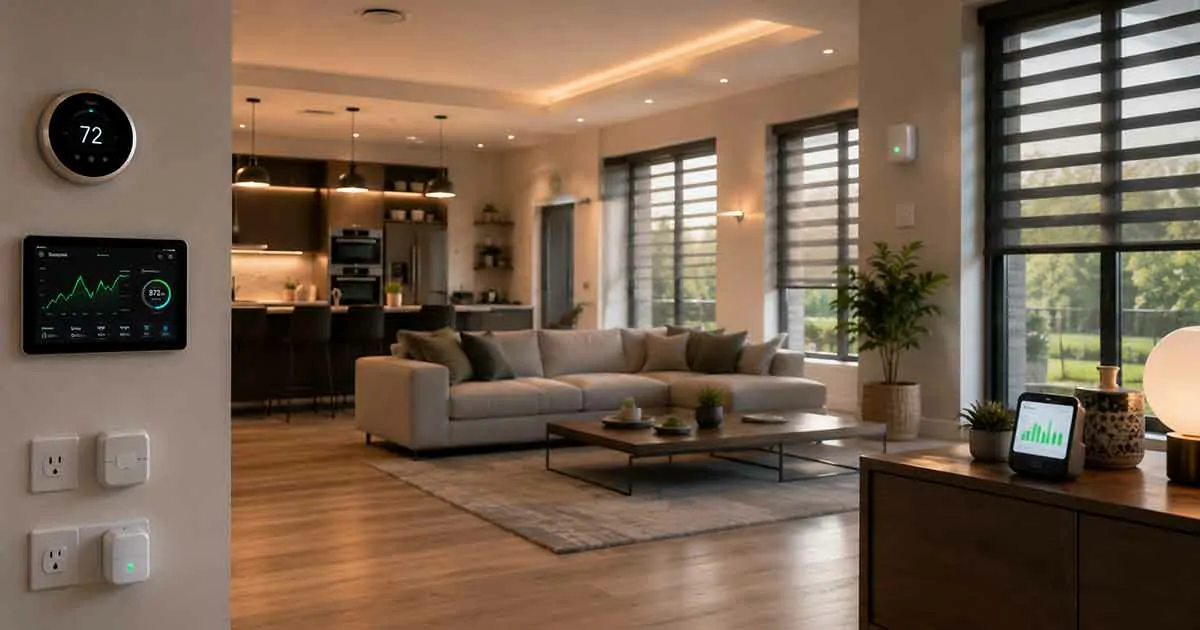
Rising energy costs make it increasingly important for homeowners to understand how their homes use electricity, heating, and cooling. Smart home technology can help by providing better control, useful energy data, and automation that reduces unnecessary consumption.
The best smart home devices for home energy savings are not simply gadgets that can be controlled from a smartphone. Their real value comes from helping homeowners identify waste, automate energy-consuming systems, and adjust how the home operates based on schedules, occupancy, and actual usage.
Smart thermostats, energy-monitoring systems, smart plugs, smart lighting, temperature sensors, and occupancy-based devices can all contribute to a more efficient home.
However, smart devices do not automatically guarantee lower energy bills. Results depend on the home’s insulation, HVAC equipment, appliances, climate, household habits, and how the devices are configured.
This guide explains the most useful smart home devices for energy savings and how to use them as part of a practical home energy strategy.
Table of Contents
How Smart Home Devices Can Save Energy
Smart home devices can contribute to energy efficiency in several ways.
They can help homeowners:
- Reduce unnecessary heating and cooling
- Turn lights off automatically
- Monitor electricity consumption
- Identify energy-hungry appliances
- Create schedules
- Adjust devices when the home is unoccupied
- Track energy-use patterns
- Automate equipment based on conditions
The biggest benefit is often better control and visibility.
When homeowners understand where energy is being used, they can make more informed decisions.
Best Smart Home Devices for Home Energy Savings
Several device categories can provide meaningful energy-management benefits.
1. Smart Thermostats
A smart thermostat is one of the most useful energy-focused smart home devices.
Heating and cooling can account for a significant portion of household energy consumption, so managing HVAC operation efficiently can have a noticeable impact.
Smart thermostats can provide:
- Programmable schedules
- Smartphone control
- Remote access
- Temperature monitoring
- Occupancy-based adjustments
- Energy reports
- Smart home integration
For example:
Home becomes unoccupied → thermostat adjusts to an energy-saving setting.
Before purchasing, verify compatibility with the home’s HVAC system.
2. Smart Temperature Sensors
Temperature sensors can help identify differences between rooms.
A bedroom, home office, upper floor, or room with significant sunlight may have a different temperature from the location of the main thermostat.
Smart temperature sensors can provide additional information and, with compatible systems, help influence thermostat operation.
They can be useful for:
- Bedrooms
- Home offices
- Large living rooms
- Upper floors
- Rooms with inconsistent temperatures
However, a temperature sensor alone does not create an independent HVAC zone.
3. Smart Energy Monitoring Systems
A whole-home energy monitoring system can provide a broader view of electricity consumption.
Depending on the system, it may track:
- Total electricity use
- Energy trends
- Major circuits
- High-consumption equipment
- Daily and monthly patterns
This information can help homeowners identify unusual consumption and determine which systems deserve attention.
For example, if electricity use increases significantly at a particular time each day, the homeowner can investigate which appliances or systems are operating during that period.
4. Smart Plugs With Energy Monitoring
Smart plugs can provide energy information for individual devices.
They are particularly useful when you want to understand the electricity consumption of:
- Entertainment systems
- Computers
- Lamps
- Fans
- Small appliances
- Home office equipment
A smart plug with energy monitoring can show how much electricity a compatible device consumes.
This makes it easier to identify devices that consume more energy than expected.
5. Smart Lighting
Lighting is another area where automation can reduce unnecessary energy use.
Smart lighting systems can provide:
- Scheduling
- Automatic shutoff
- Dimming
- Motion-based control
- Remote control
- Scenes and routines
For example:
No motion detected → lights turn off.
Or:
Sunrise → outdoor lights turn off.
Smart lighting is particularly useful in rooms where lights are frequently left on.
6. Smart Light Switches
Smart switches can be an effective alternative to replacing every bulb with a smart bulb.
They can control existing compatible light fixtures while adding automation and remote control.
Smart switches can be useful for:
- Hallways
- Kitchens
- Living rooms
- Outdoor lighting
- Bedrooms
For homes with many fixtures, smart switches can provide a more centralized approach to lighting automation.
7. Occupancy and Motion Sensors
Motion sensors can help determine when a space is being used.
They can trigger lighting and other compatible routines.
For example:
Motion detected → light turns on.
After a period without activity:
Light turns off.
More advanced occupancy sensors can detect whether someone remains in a room even when they are not moving significantly.
This can make occupancy-based automation more practical in certain rooms.
8. Smart Power Strips
A smart power strip can help manage multiple connected devices.
It can be useful for:
- Entertainment centers
- Home offices
- Computer equipment
- Chargers
- Peripheral devices
Some smart power strips allow outlets to be controlled individually.
This can make it easier to turn off selected equipment rather than leaving everything powered continuously.
9. Smart Home Hubs
A smart home hub does not directly reduce energy consumption, but it can coordinate energy-saving routines across multiple devices.
For example:
Away mode activated → lights turn off → thermostat adjusts → selected smart plugs turn off.
A central controller can become particularly useful when a home contains devices from multiple categories.
However, a hub should be selected based on the devices and protocols you actually use.
10. Smart Plugs for Scheduled Control
Even without energy monitoring, smart plugs can help automate power use.
For example:
- Turn a lamp off at bedtime
- Turn decorative lighting off overnight
- Schedule a fan
- Control compatible equipment during specific hours
Scheduling can reduce the amount of time certain devices remain unnecessarily powered.
Not every appliance is suitable for automated power cycling, so check the appliance and smart plug manufacturer’s instructions.
11. Smart Window Sensors
Smart window sensors can provide useful information about whether windows are open.
When integrated with compatible home automation, they can trigger alerts or routines.
For example:
Window opens → homeowner receives notification.
In some systems, an open window can also be used as a condition for a compatible climate-control routine.
The goal is to avoid running heating or cooling unnecessarily while a window is open.
12. Smart Home Automation Routines
Automation itself can become an important energy-saving tool.
Examples include:
Away Routine
Home becomes unoccupied → thermostat changes → selected lights turn off → unnecessary smart plugs switch off.
Night Routine
Bedtime → selected lights turn off → thermostat changes to nighttime settings.
Morning Routine
Scheduled time → thermostat adjusts → selected lights activate.
Outdoor Lighting Routine
Sunset → exterior lights turn on.
Sunrise → exterior lights turn off.
These routines can reduce unnecessary operation without requiring constant manual control.
13. Smart Appliances
Some modern appliances include connected features that can help homeowners monitor and control operation.
Examples include:
- Smart washing machines
- Smart dryers
- Smart refrigerators
- Smart dishwashers
- Smart ovens
Depending on the appliance, features may include scheduling, energy monitoring, notifications, and remote control.
However, connectivity does not automatically make an appliance more energy efficient.
Compare the appliance’s actual energy-efficiency specifications rather than buying solely because it has smart features.
14. Smart Water Heaters and Water Heating Controls
Water heating can represent a meaningful portion of household energy use.
Some connected water-heating systems provide:
- Scheduling
- Remote temperature control
- Usage monitoring
- Vacation modes
- Energy reports
The available features depend on the type of water heater and the control system.
Any changes to water temperature should also consider household safety requirements.
15. Smart Solar Monitoring Systems
Homeowners with solar panels can use connected monitoring systems to track:
- Solar production
- Household consumption
- Grid electricity
- Battery storage
- Historical performance
This can help homeowners understand when the property produces and consumes energy.
For homes with batteries or time-of-use electricity pricing, this information can also support more informed energy-management decisions.
16. Smart Battery Storage Systems
Home battery systems can store electricity for later use.
When combined with compatible solar or utility systems, batteries may help homeowners manage when electricity is consumed.
Potential benefits can include:
- Using stored solar energy
- Reducing grid dependence
- Managing peak electricity periods
- Providing backup power
The financial benefits depend heavily on electricity rates, local incentives, solar production, battery capacity, and installation costs.
17. Smart Ceiling Fans
Connected ceiling fans can provide scheduling and remote control.
They can be useful for:
- Bedrooms
- Living rooms
- Home offices
Using a ceiling fan can improve perceived comfort in certain conditions and may allow homeowners to reduce reliance on air conditioning.
However, fans consume electricity themselves, so they should be used when they provide a practical comfort benefit.
18. Smart Blinds and Shades
Automated blinds can help manage sunlight entering a home.
Depending on the system, blinds can respond to:
- Time
- Sunlight
- Temperature
- Schedules
- Smart home routines
For example:
Strong sunlight → shades close.
Or:
Morning → shades open.
Reducing unwanted solar heat can help in hot conditions, while allowing sunlight indoors can provide passive warmth in colder conditions.
Actual energy benefits depend on window orientation, climate, glazing, insulation, and shade design.
Smart Home Energy Savings by Room
Different rooms can benefit from different devices.
Living Room
Useful options include:
- Smart lighting
- Smart thermostat
- Smart plugs
- Occupancy sensors
Kitchen
Consider:
- Smart appliance monitoring
- Smart lighting
- Energy-monitoring plugs
Bedrooms
Useful devices include:
- Temperature sensors
- Smart thermostats
- Smart lighting
- Smart fans
Home Office
Consider:
- Smart power strips
- Energy-monitoring smart plugs
- Smart lighting
Garage
Useful devices can include:
- Smart lighting
- Motion sensors
- Energy monitoring
Smart Home Energy Savings for Large Homes
Large homes can have greater opportunities for energy management because they often contain:
- Multiple HVAC zones
- More lighting
- More appliances
- Larger areas to heat or cool
A combination of smart thermostats, temperature sensors, energy monitoring, and occupancy-based automation can help homeowners understand how different areas of the property use energy.
Network reliability is also important because a large number of devices can depend on stable connectivity.
Smart Home Energy Savings for Apartments
Apartments have fewer options for permanent energy infrastructure, but renters and apartment owners can still use:
- Smart plugs
- Smart lighting
- Smart bulbs
- Smart thermostats where compatible
- Energy monitors
- Smart power strips
Portable devices are often easier to install without modifying the property.
Smart Home Devices Without Subscriptions
Subscription costs can reduce the long-term value of smart energy devices.
Before purchasing, check whether energy reports, automation, or historical data require a paid service.
Many basic energy-monitoring and automation functions can be available without monthly fees, but this varies by manufacturer and product.
Always calculate the total cost of ownership.
Do Smart Home Devices Really Save Energy?
Smart devices can help reduce energy use, but they are not a replacement for basic energy efficiency.
A smart thermostat cannot compensate for severe insulation problems.
Smart lighting cannot eliminate high energy use from inefficient appliances.
Energy monitoring can show where electricity is being consumed, but the homeowner still needs to act on the information.
The greatest results often come from combining smart technology with:
- Good insulation
- Efficient windows
- Efficient HVAC equipment
- Proper air sealing
- Energy-efficient appliances
- Sensible temperature settings
- Efficient lighting
How to Use Smart Devices to Reduce Energy Waste
A practical strategy is to start with measurement.
Step 1: Measure
Use an energy monitoring system to understand overall consumption.
Step 2: Identify
Determine which appliances or systems use the most energy.
Step 3: Automate
Use smart thermostats, plugs, lighting, and sensors to reduce unnecessary operation.
Step 4: Monitor
Review energy data after making changes.
Step 5: Adjust
Modify schedules and automation based on actual household behavior.
This approach is more effective than installing smart devices without measuring their impact.
Common Mistakes When Using Smart Devices for Energy Savings
Buying Devices Without Measuring Energy Use
Without baseline data, it can be difficult to know where the biggest opportunities are.
Overusing Automation
Too many routines can create unnecessary complexity.
Ignoring HVAC Efficiency
Smart controls cannot compensate for an inefficient HVAC system.
Leaving Smart Devices Unconfigured
A smart device does not save energy simply because it is connected to Wi-Fi.
Choosing Devices Based Only on Smart Features
Look at actual energy performance, not just connectivity.
Ignoring Standby Consumption
Smart devices themselves consume some electricity.
The amount is usually small for individual devices, but large numbers of connected devices can add up.
How to Choose the Best Smart Home Devices for Energy Savings
Before buying, consider:
- What energy problem does the device solve?
- Can it measure or reduce actual energy use?
- Does it support useful automation?
- Does it work with your existing ecosystem?
- Does it require a subscription?
- Does it require professional installation?
- How much electricity does the device itself consume?
- Can you measure the results?
- Will it remain useful long term?
- Does it complement the home’s existing energy-efficiency improvements?
These questions can help prevent spending money on smart products that provide little practical value.
A Practical Energy-Saving Smart Home Setup
A balanced setup can start with a few high-value devices.
Core Devices
- Smart thermostat
- Smart lighting
- Smart plugs
- Energy-monitoring system
Automation Devices
- Motion sensors
- Occupancy sensors
- Temperature sensors
- Smart switches
Advanced Options
- Smart blinds
- Solar monitoring
- Battery storage
- Connected water heating
Start with the devices that address your home’s biggest energy-management problems.
Are Smart Home Energy Devices Worth It?
Smart energy devices can be worthwhile when they provide useful information or automate actions that would otherwise be forgotten.
A smart thermostat may help manage heating and cooling.
An energy monitor can reveal where electricity is being consumed.
Smart plugs can provide device-level information.
Motion sensors and smart lighting can reduce unnecessary lighting.
The value depends on how effectively the devices are used.
Final Thoughts
The best smart home devices for home energy savings combine monitoring, automation, and better control.
Smart thermostats, temperature sensors, energy-monitoring systems, smart plugs, smart lighting, occupancy sensors, and automated shades can all contribute to a more energy-aware home.
However, smart technology should be viewed as one part of a broader energy-efficiency strategy.
Start by measuring consumption, identify the biggest sources of waste, and then choose smart devices that address those specific problems.
A well-planned system can make energy use easier to understand and everyday energy-saving habits easier to maintain.