
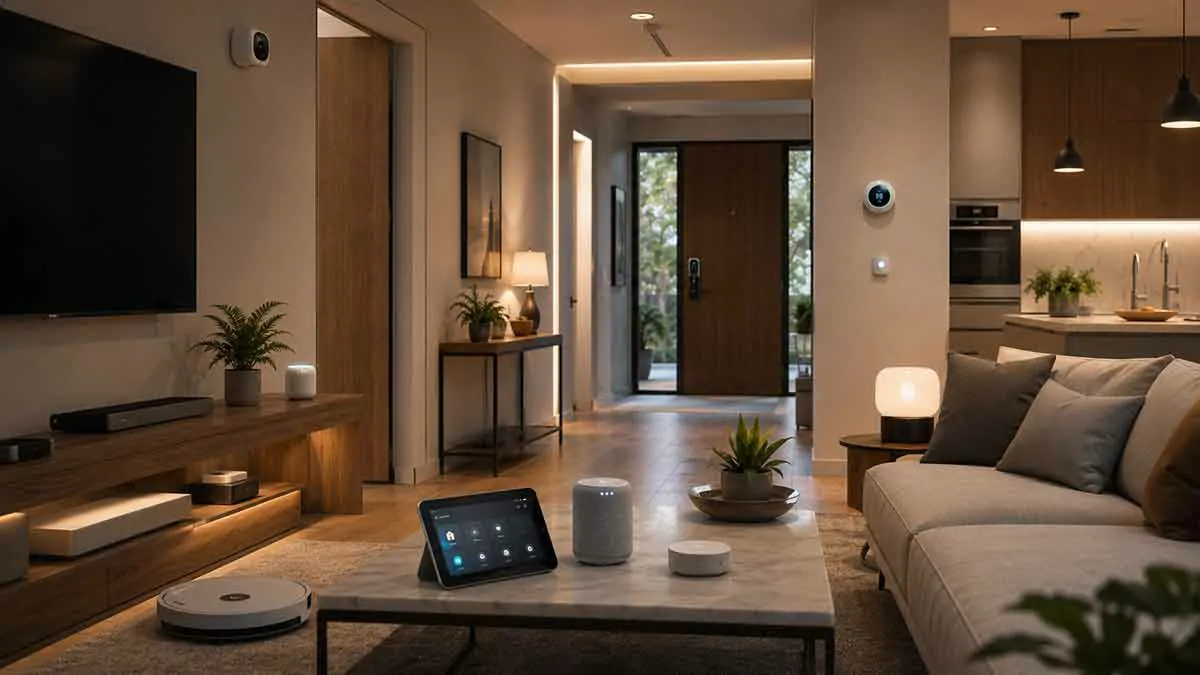
Smart home technology is no longer limited to smart bulbs and voice assistants. Today’s connected home products can help automate everyday tasks, improve comfort, simplify entertainment, monitor your property, and make ordinary parts of the home more convenient.
Some smart devices are practical purchases that solve obvious problems. Others are simply interesting because they introduce useful features that you would not expect from a traditional household product.
The best “cool” smart home devices are usually the ones that combine both ideas. They offer something interesting while still providing a real reason to use them.
In this guide, we look at smart home devices worth considering for different parts of the home, from smart displays and automated lighting to sensors, robot vacuums, smart blinds, security devices, and newer Matter-compatible products.
What Makes a Smart Home Device Worth Buying?
A smart device should do more than connect to an app.
Before buying a new product, consider whether it offers at least one meaningful advantage over a traditional alternative.
A good smart home device should ideally provide one or more of these benefits:
- Saves time
- Reduces repetitive tasks
- Improves comfort
- Adds useful automation
- Improves visibility or monitoring
- Works well with your existing ecosystem
- Provides a feature that would be difficult to achieve manually
It is also important to consider reliability.
A device that looks impressive but frequently loses connectivity may be less useful than a simpler product that works every day without attention.
Smart Displays
Smart displays are among the most useful connected devices because they combine a voice assistant with a screen.
Instead of relying entirely on voice commands, you can use the display to see information and interact with compatible smart home devices.
A smart display can be used for:
- Controlling smart lights
- Viewing compatible cameras
- Checking the weather
- Following recipes
- Managing routines
- Playing media
- Displaying household information
A display is particularly useful in the kitchen, living room, or another central area where household members regularly interact with it.
Google Nest Hub products are one example of this category, while other ecosystems offer their own smart displays.
The biggest advantage is that a screen provides visual feedback. You can see information and controls instead of remembering which voice command to use.
Smart Speakers
Smart speakers remain one of the easiest ways to introduce voice control into a home.
A compatible speaker can control smart devices, play music, provide information, and trigger supported routines.
They become even more useful when several devices are distributed around the house.
For example, you could use one speaker in the kitchen, another in the bedroom, and another in the living room.
This creates a more consistent voice-control experience throughout the home.
Our guide to best smart speakers for home covers this category in more detail.
Smart Lighting
Smart lighting is one of the best combinations of usefulness and convenience.
Smart bulbs, switches, and lighting systems allow you to change lighting remotely, create schedules, adjust brightness, and build automations.
You can create settings such as:
Morning Lighting
Lights gradually turn on around your normal wake-up time.
Evening Lighting
Selected lights activate around sunset.
Movie Lighting
Living room lights dim when entertainment starts.
Bedtime Lighting
Lights turn off or switch to a low level at night.
Smart lighting can also be surprisingly useful for practical purposes.
A hallway light can turn on when motion is detected. Exterior lights can follow a schedule. Entry lighting can activate when someone arrives home.
The key is to automate lighting according to how the room is used rather than creating complicated routines simply because the technology allows it.
Smart Plugs
Smart plugs are simple but extremely versatile.
They add smart control to compatible devices without requiring you to replace the appliance itself.
A smart plug can be useful for:
- Lamps
- Fans
- Decorative lights
- Certain small appliances
- Seasonal lighting
- Other suitable devices
One of the more interesting uses is scheduling.
For example, a lamp connected to a smart plug can turn on automatically in the evening and turn off at bedtime.
Smart plugs are also inexpensive compared with many other connected products, making them a good entry point for experimenting with automation.
See our guide to best smart plugs for more information.
Smart Thermostats
Smart thermostats are not necessarily flashy, but they can make a noticeable difference in everyday comfort.
A smart thermostat can provide features such as:
- Remote control
- Scheduling
- Temperature monitoring
- Automation
- Energy-related insights
- Integration with other smart home devices
Some systems can also use sensors to account for temperature differences between rooms.
Smart thermostats become particularly interesting when integrated into larger routines.
For example, the home could use different temperature settings during sleeping hours, working hours, and periods when everyone is away.
Our guide to best smart thermostats explores this category in more detail.
Smart Sensors
Smart sensors are easy to overlook because they are often small and visually uninteresting.
However, sensors can make a smart home significantly more intelligent.
Depending on the type, sensors can monitor:
- Motion
- Door and window status
- Temperature
- Humidity
- Water leaks
- Occupancy
- Light levels
Sensors can provide information that triggers other devices.
For example:
Motion detected → Turn on hallway light
or:
Water detected → Send an alert
This makes sensors one of the building blocks of advanced home automation.
Smart Doorbells
A smart doorbell combines a traditional doorbell with connected video and notifications.
Depending on the model, you may be able to:
- See who is at the door
- Receive notifications
- Communicate with visitors
- Monitor the entrance remotely
- Review recorded or stored video
A smart doorbell is especially useful for homeowners who receive deliveries or want better visibility around the main entrance.
When choosing one, pay attention to power requirements, Wi-Fi coverage, storage options, privacy features, and subscription requirements.
Smart Security Cameras
Smart cameras can provide visibility around and inside the home.
Modern cameras may offer features such as:
- Motion detection
- Night vision
- Person detection
- Activity notifications
- Two-way communication
- Remote viewing
The most useful camera is not necessarily the one with the highest resolution.
Placement, field of view, connectivity, storage, and notification quality can matter just as much.
Exterior cameras should also be specifically designed for outdoor environments.
Security devices should be treated as one part of a broader security strategy rather than a complete replacement for physical security measures.
Smart Locks
Smart locks are one of the most interesting upgrades for a front door because they can change how you enter and manage your home.
Depending on the model, a smart lock may support:
- Keypad entry
- Smartphone access
- Temporary codes
- Remote control
- Automatic locking
- Activity history
- Integration with supported smart home systems
A temporary access code can be particularly useful for guests, cleaners, maintenance workers, or other authorized visitors.
Before installing one, verify compatibility with your existing door hardware and understand how the lock behaves if the battery or network connection fails.
Robot Vacuums
Robot vacuums are among the most obvious examples of useful home automation.
Instead of manually vacuuming every room, a robot can clean according to a schedule.
Modern models may include features such as:
- Room mapping
- Automatic navigation
- Scheduled cleaning
- No-go zones
- Multi-floor maps
- Self-emptying docks
- Mopping functions
- App-based control
A robot vacuum becomes more useful when it can understand the layout of your home and clean according to your routine.
For example, you could schedule cleaning while everyone is away.
When comparing models, focus on navigation quality, maintenance requirements, obstacle avoidance, dock functionality, and replacement-part availability.
Smart Air Purifiers
Air purifiers are another category that benefits from connectivity.
A smart model can provide information about indoor air conditions and automate operation based on detected changes, depending on the device.
Potential benefits include:
- Remote control
- Scheduling
- Air-quality monitoring
- Automatic operating modes
- Filter notifications
The value of this feature depends heavily on the quality of the underlying air-quality sensors.
A connected air purifier with poor sensing or an expensive replacement filter may not offer the best overall value.
Smart Air Quality Monitors
A dedicated indoor air-quality monitor can provide information without combining it with another appliance.
Depending on the model, it may monitor variables such as:
- Temperature
- Humidity
- Carbon dioxide
- Particulate matter
- Volatile organic compounds
This information can help you understand conditions inside the home.
For example, a monitor might reveal that a particular room becomes humid after cooking or that carbon dioxide levels rise when several people are in a closed room.
The device becomes even more useful when you can use its information to improve ventilation or other household routines.
Smart Blinds and Shades
Automated blinds can make a room feel much more futuristic while also solving practical problems.
Depending on the system, smart blinds can be scheduled to:
- Open in the morning
- Close during intense sunlight
- Adjust for privacy
- Close at night
- Follow household routines
They can also help reduce direct sunlight entering certain rooms during the hottest part of the day.
Smart blinds are usually more expensive than basic smart lighting, but they can provide a noticeable convenience upgrade in bedrooms, living rooms, and large windows.
Before buying them, measure the windows carefully and verify motor, mounting, and power requirements.
Smart Leak Sensors
Water damage can be expensive, which makes leak sensors one of the more practical smart home devices.
A small sensor placed near a washing machine, water heater, sink, dishwasher, or other risk area can alert you when moisture is detected.
Some systems can also trigger other actions or integrate with broader home automation.
The most useful installation strategy is to place sensors near locations where an unnoticed leak could cause significant damage.
A leak sensor is a good example of a device that may look simple but can provide significant value.
Smart Smoke and Safety Devices
Connected smoke and carbon monoxide detectors can provide additional notification capabilities compared with conventional alarms.
Depending on the product, you may receive alerts through a smartphone or connected home system.
However, safety devices should be selected based on certification, reliability, installation requirements, and local regulations rather than smart features alone.
Do not replace a required safety device with an uncertified connected product simply because it offers app control.
Smart Water Shutoff Systems
For homeowners concerned about water damage, a smart water shutoff system can be one of the most advanced upgrades available.
These systems can monitor water flow or detect abnormal activity and, depending on the configuration, automatically shut off the main water supply.
This can be especially valuable when the home is unoccupied for long periods.
Installation can be more complicated than adding a smart plug or light, and many systems require professional plumbing work.
For that reason, this is a device category where installation requirements deserve serious attention before purchase.
Smart Garage Door Controllers
A smart garage door controller can make a traditional garage door part of your connected home.
Depending on the system, you may be able to:
- Check whether the garage is open
- Receive alerts
- Open or close the door remotely
- Create schedules or automations
- Share access with other household members
This is especially useful when you frequently wonder whether the garage door was left open.
Compatibility with the existing garage door opener is an important consideration.
Smart Irrigation Controllers
For homes with gardens or lawns, a smart irrigation controller can automate watering.
Some systems can use schedules and environmental information to adjust irrigation.
This can reduce the need to manually change watering schedules throughout the year.
The most useful systems are those that make the watering process easier without creating unnecessary complexity.
Before buying, check compatibility with your irrigation wiring and the number of watering zones required.
Smart Air Conditioners and Fans
Portable air conditioners, window units, and fans are increasingly available with smart controls.
A connected system can allow remote control, scheduling, or integration with supported smart home platforms.
For a fan, an automation might turn it on during particular hours or after certain conditions are detected.
For an air conditioner, remote control can be useful when you want to adjust the room before arriving home.
Energy consumption should still be considered. Smart control does not automatically make an inefficient appliance efficient.
Smart Kitchen Devices
The kitchen is becoming one of the more interesting areas for connected technology.
Examples include:
- Smart ovens
- Connected coffee makers
- Smart refrigerators
- Smart displays
- Connected cooking appliances
The useful question is not whether an appliance has an app.
Ask whether the connected features actually improve how you use the appliance.
Remote monitoring, notifications, scheduling, and maintenance alerts can be more valuable than novelty features.
Smart Mirrors and Bathroom Technology
Some smart bathroom products combine lighting, displays, speakers, sensors, or other technology.
These products can be visually impressive, but their value varies considerably.
A connected mirror may provide useful lighting control and information, while another model may mainly add features that you rarely use.
For bathroom devices, pay particular attention to moisture resistance, electrical safety, installation requirements, and cleaning.
Smart Furniture
Smart furniture is another emerging area.
Examples can include:
- Motorized standing desks
- Smart beds
- Connected nightstands
- Furniture with integrated charging
- Powered recliners
These products can make specific parts of the home more convenient.
The best purchases are those where the integrated technology solves a problem that would otherwise require multiple separate products.
Matter-Compatible Devices
Matter is particularly interesting for people building or expanding a smart home.
Matter is designed to improve interoperability between supported devices and smart home ecosystems.
For buyers, the main advantage is flexibility.
A Matter-compatible device may be easier to integrate into a broader multi-platform smart home, depending on the product category and implementation.
However, Matter support does not mean every product offers identical features across every platform.
Always check the specific device requirements before purchasing.
Smart Home Hubs
A smart home hub can serve as a central part of a connected system.
Depending on the ecosystem, a hub may help devices communicate, provide local processing, support specific wireless technologies, or enable more advanced automations.
Not every household needs a dedicated hub.
Some modern smart home platforms use compatible speakers, displays, routers, or streaming devices as hubs for supported technologies.
Our guide to best smart home hubs covers the broader category.
Cool Smart Home Devices for Entertainment
Smart home technology can also improve entertainment.
Useful products include:
- Streaming devices
- Smart TVs
- Multi-room speakers
- Smart lighting
- Smart displays
- Motorized shades
One interesting setup is to connect entertainment and lighting.
For example, a movie-night routine could lower the blinds, dim the lights, and activate compatible entertainment equipment.
The more devices you connect, the more important it becomes to keep the system simple and reliable.
Cool Smart Home Devices for Pet Owners
Pet owners can also benefit from connected technology.
Smart pet devices can include:
- Automatic feeders
- Water fountains
- Pet cameras
- Activity monitors
- Smart doors
A connected pet camera can provide visibility when you are away.
An automatic feeder can help maintain a feeding schedule.
However, automated feeding and access systems should have suitable backup plans because technical failures can affect essential pet care.
Cool Smart Home Devices for People Working From Home
A smart home office can go beyond a computer and desk.
Interesting devices include:
- Smart lighting
- Smart plugs
- Air-quality monitors
- Smart displays
- Smart speakers
- Motorized blinds
- Smart thermostats
For example, a work routine could activate desk lighting, adjust compatible blinds, and prepare the room for the start of the workday.
Comfort can also have a significant impact on how useful these devices are during long periods of work.
How to Choose Between Cool and Practical Devices
The most attractive smart home products are not always the best purchases.
Before buying something because it looks interesting, ask:
What problem does it solve?
Will I use this feature regularly?
Does it work with my current ecosystem?
Does it require a subscription?
What happens if the internet connection fails?
How difficult is installation?
What will maintenance cost?
Can I still operate it manually?
A device that passes these tests has a much better chance of being worth buying.
Avoid Building a Smart Home Full of Unnecessary Gadgets
It is easy to become fascinated by connected technology and gradually fill the house with devices that each require another app, account, subscription, or charger.
This can create more complexity than convenience.
Try to build around a small number of important categories.
For many homes, the strongest foundation is:
- Smart lighting
- Smart plugs
- Smart speakers
- Climate control
- Security devices
- Sensors
- One or two useful automation routines
Once those systems are working well, you can decide whether additional devices genuinely add value.
Final Thoughts
The coolest smart home devices are not necessarily the strangest or most futuristic products.
The best ones combine useful technology with everyday convenience.
Smart displays can centralize control, smart lighting can transform a room, robot vacuums can remove repetitive chores, leak sensors can provide valuable protection, and automated blinds can improve comfort and privacy.
More advanced products such as smart water shutoff systems, Matter devices, smart irrigation controllers, and connected appliances can extend the system even further.
The key is to buy based on what you actually need rather than trying to make every part of the house smart.
A well-designed collection of compatible devices can make your home feel more convenient without turning it into a complicated collection of gadgets.