
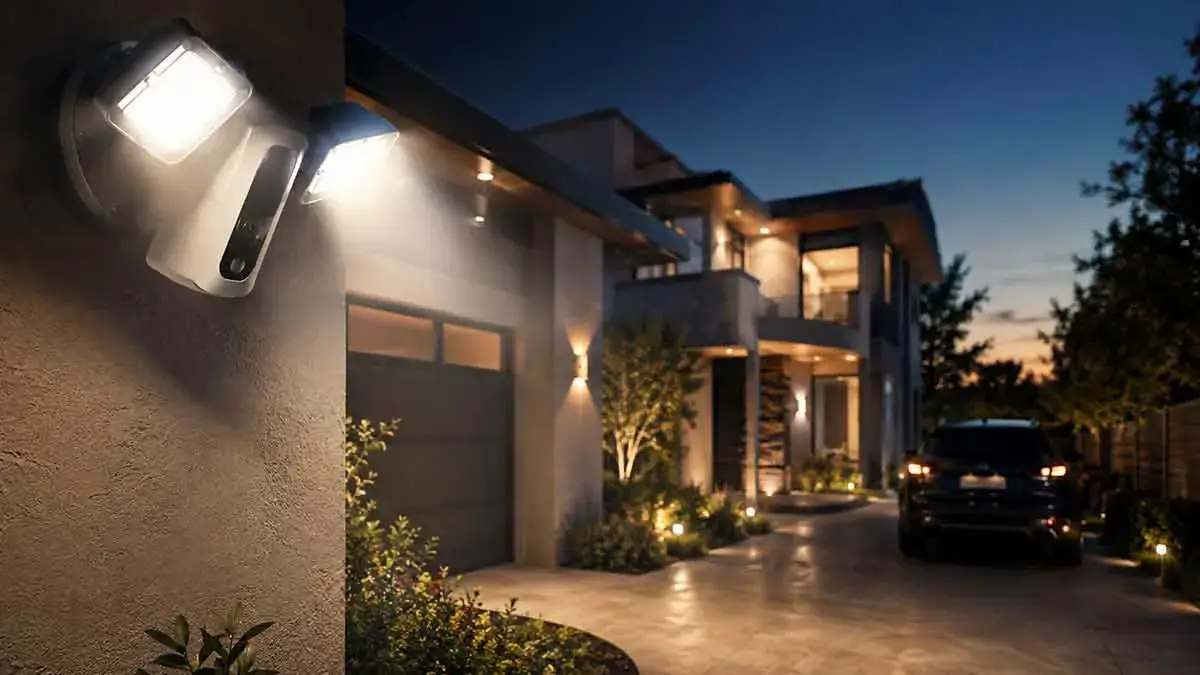
Smart floodlights are a practical way to combine outdoor lighting with modern home security. Instead of installing a separate floodlight and security camera, a smart floodlight camera can illuminate an area when movement is detected while also providing video monitoring, alerts, and remote access.
The best models can help monitor driveways, entrances, backyards, garages, and other areas around the property. Depending on the product, they can also provide features such as intelligent motion detection, two-way audio, night vision, app control, and integration with a smart home platform.
Not every floodlight camera is right for every home. Some are better for bright illumination, some prioritize video quality, others offer local storage, and some work particularly well with ecosystems such as Alexa, Google Home, or Apple Home.
This guide compares some of the best smart floodlights for home security and explains what to look for before choosing one.
What Is a Smart Floodlight?
A smart floodlight is an outdoor light that can be controlled automatically or remotely through a connected system.
A smart floodlight can usually provide features such as:
- Motion-activated lighting
- Scheduled lighting
- Smartphone control
- Adjustable brightness
- Smart home integration
- Remote notifications
A smart floodlight camera adds a security camera to the lighting system.
This combination is particularly useful because the light can illuminate the area when activity is detected while the camera records or streams the event.
Best Smart Floodlights at a Glance
| Product | Best For | Main Advantage |
|---|---|---|
| Ring Floodlight Cam Wired Pro | Overall security | Strong Ring ecosystem integration |
| eufy Floodlight Cam E340 | Local storage and camera flexibility | Dual-camera design and local storage |
| Arlo Pro 3 Floodlight Camera | Flexible installation | Wireless floodlight camera design |
| TP-Link Tapo C720 | Value-focused security | Smart detection and floodlight features |
| Ring Floodlight Cam Wired Plus | Straightforward Ring setup | Bright outdoor lighting and security monitoring |
Current 2026 testing and buying guides continue to highlight Ring, eufy, Arlo, and Tapo among the leading floodlight-camera options.
1. Ring Floodlight Cam Wired Pro
The Ring Floodlight Cam Wired Pro is one of the strongest choices for homeowners already using Ring devices.
It combines an outdoor security camera with integrated floodlights and connects to Ring’s broader security ecosystem.
It is particularly suitable for:
- Driveways
- Front yards
- Side entrances
- Garages
- Large outdoor areas
The main advantage is ecosystem integration. If your home already uses Ring doorbells, cameras, or other Ring security products, adding a Ring floodlight camera can make the overall system easier to manage.
The model is also frequently ranked among the leading floodlight cameras in current 2026 buying guides.
2. eufy Floodlight Cam E340
The eufy Floodlight Cam E340 is a strong option for homeowners who want broad outdoor coverage and local storage capabilities.
The E340 combines floodlighting with a dual-camera system and mechanical pan-and-tilt functionality, making it useful when you want to monitor a relatively large area.
It is particularly attractive for homeowners who prefer to reduce dependence on monthly cloud subscriptions.
Current 2026 testing from PCMag ranks the E340 as a leading hardwired floodlight camera, highlighting its combination of video coverage, illumination, and local storage options.
3. Arlo Pro 3 Floodlight Camera
The Arlo Pro 3 Floodlight Camera is worth considering when flexibility is important.
Its floodlight-camera design makes it suitable for outdoor areas where traditional wired installations may be less convenient.
Arlo also has a broad range of security products, making the floodlight camera attractive to homeowners who want to build a larger Arlo-based security system.
It can be a good option for:
- Side yards
- Driveways
- Garages
- Outdoor activity areas
Current comparisons continue to list the Arlo Pro 3 Floodlight Camera among notable floodlight-camera options, particularly for flexible outdoor security setups.
4. TP-Link Tapo C720
The TP-Link Tapo C720 is an interesting choice for buyers looking for smart floodlight security without necessarily committing to one of the largest security ecosystems.
Tapo focuses heavily on connected home products, so the floodlight camera can fit naturally into a broader smart home environment.
The product can be especially appealing when you want:
- Outdoor lighting
- Security monitoring
- Smart alerts
- App control
- Smart home integration
The Tapo C720 is also frequently highlighted among newer floodlight camera options, particularly for buyers interested in smart detection and lower ongoing costs.
5. Ring Floodlight Cam Wired Plus
The Ring Floodlight Cam Wired Plus is another option for homeowners who want Ring integration without moving to the Pro model.
It combines outdoor illumination with video monitoring and can work as part of a wider Ring security installation.
The Wired Plus can make sense when your primary priorities are:
- Reliable outdoor lighting
- Motion detection
- Video monitoring
- Ring ecosystem compatibility
- Simple management through the Ring platform
It is particularly suitable for homeowners who want to cover a fixed area such as a driveway or entrance.
Smart Floodlight vs Regular Floodlight
A conventional floodlight provides illumination.
A smart floodlight adds connectivity and automation.
A standard floodlight might simply turn on when a traditional motion detector is triggered.
A smart floodlight can potentially:
- Send a smartphone notification
- Be controlled remotely
- Follow a schedule
- Connect with other smart devices
- Use intelligent motion detection
- Record video when a camera is included
The additional features can be useful, but they also introduce networking, software, and privacy considerations.
Smart Floodlight Camera vs Security Camera
A floodlight camera and a conventional outdoor security camera serve different purposes.
A standard security camera is primarily designed for video monitoring.
A floodlight camera combines monitoring and illumination.
This makes floodlight cameras particularly useful for:
- Dark driveways
- Side entrances
- Backyards
- Garages
- Large outdoor spaces
The light can also make recorded footage easier to see at night.
For smaller areas where strong illumination is not needed, a standard camera may be a better choice.
How Bright Should a Smart Floodlight Be?
Brightness matters because the purpose of a floodlight is to illuminate an area effectively.
However, more brightness is not automatically better.
A floodlight that is excessively bright can:
- Create glare
- Disturb neighbors
- Reduce night-time visibility outside the illuminated area
- Create unnecessary light pollution
Consider the size and shape of the area you want to illuminate.
A driveway may require broader coverage than a small side entrance.
Adjustable light heads can also make it easier to direct illumination where it is needed.
Motion Detection
Motion detection is one of the most important features in a smart floodlight.
Basic systems may respond to general movement.
More advanced models can use intelligent detection to distinguish between different types of activity.
Depending on the camera, the system may identify:
- People
- Vehicles
- Animals
- General motion
Better motion detection can reduce unnecessary notifications.
This is particularly important for outdoor cameras because trees, pets, vehicles, changing light, and other movement can otherwise generate frequent alerts.
Night Vision
A smart floodlight camera should provide useful visibility after dark.
Many cameras use infrared night vision, while the integrated floodlight can provide visible illumination when activity is detected.
When comparing models, consider how the camera behaves:
- With the floodlight off
- With the floodlight on
- During complete darkness
- When a subject moves toward the camera
- When a vehicle enters the monitored area
The quality of night-time footage can be more important than resolution alone.
Camera Field of View
A wide field of view can cover a larger section of the property.
However, extremely wide coverage can also make distant objects appear smaller.
Consider what you actually need to monitor.
For a driveway, you may want to see vehicles approaching from a distance.
For an entrance, identifying people near the door may be more important.
The mounting location and camera angle are therefore as important as the camera’s specifications.
Two-Way Audio
Two-way audio allows you to communicate with someone near the camera through the app.
This can be useful for:
- Delivery drivers
- Visitors
- Contractors
- Family members
The feature is convenient, but it should not be considered a replacement for a dedicated intercom or other security system when more advanced communication is required.
Storage Options
Storage is one of the biggest differences between smart security cameras.
Depending on the product, recordings may be stored:
- In the cloud
- On local storage
- On a memory card
- Through a dedicated home security hub
Cloud storage can make remote access easier, but it may require a subscription.
Local storage can reduce recurring costs and provide greater control over recordings.
Before buying, check exactly what recording features remain available without a subscription.
Subscription Costs
A camera can appear inexpensive at first but become more expensive over time if important features require a monthly plan.
Before purchasing, check whether the subscription is required for:
- Video history
- Person detection
- Cloud recording
- Advanced alerts
- AI features
- Extended storage
For homeowners who want to avoid recurring costs, products with useful local-storage options can be particularly attractive.
Wired vs Wireless Floodlights
Most traditional floodlight installations use permanent wiring because the light requires significant power.
Smart floodlight cameras are commonly wired for the same reason.
There are also wireless and battery-based alternatives in the broader spotlight-camera category.
Wired
Advantages include:
- Continuous power
- No battery replacement
- Suitable for permanent installations
- More appropriate for high-use locations
Disadvantages include:
- More complicated installation
- Possible need for electrical work
Wireless or Battery
Advantages include:
- Easier placement
- Greater installation flexibility
- No permanent electrical connection in some setups
Disadvantages can include:
- Battery maintenance
- More limited lighting duration
- Performance affected by charging requirements
For a powerful permanent floodlight, wired installation is usually the more practical approach.
Where Should You Install a Smart Floodlight?
The location determines how useful the device will be.
Common installation points include:
Driveway
A floodlight can illuminate vehicles and approaching people.
Front Entrance
Lighting can improve visibility around the main entry.
Garage
The combination of lighting and monitoring can provide useful coverage.
Side Yard
This is often one of the darker areas around a property.
Backyard
A floodlight can cover larger outdoor spaces where regular porch lighting is insufficient.
Rear Entrance
Monitoring a secondary door can help cover an area that may otherwise be overlooked.
Avoid positioning the camera so that it points unnecessarily toward neighboring private spaces.
Smart Floodlights for Home Security
Lighting can be part of a broader security strategy.
A well-lit entrance can make it easier to see people approaching the property.
A floodlight camera can also provide recorded or live video when activity occurs.
However, a smart floodlight should not be treated as the only security measure.
A complete security strategy can also include:
- Strong exterior doors
- Quality locks
- Door and window sensors
- Security cameras
- Smart doorbells
- Exterior lighting
- Alarm systems
- Appropriate physical security
The floodlight is one layer of the system.
Smart Floodlights and Smart Home Platforms
Compatibility with your preferred smart home platform is worth checking before purchase.
Depending on the product, integration may include:
- Amazon Alexa
- Google Home
- Apple Home
- Manufacturer-specific systems
- Matter or other supported standards
Integration can allow the floodlight to participate in broader routines.
For example:
Motion detected → Floodlight turns on → Smart home notification is sent
Or:
Sunset → Exterior lighting becomes active
The exact functions depend on the specific device and platform.
Smart Floodlights and Privacy
Outdoor cameras can capture information beyond your own property.
Before installation, consider:
- Camera angle
- Recording zones
- Privacy zones
- Local laws
- Neighboring properties
- Public areas
Use available privacy settings to limit unnecessary recording.
You should also understand where video is stored and how long recordings remain available.
Weather Resistance
Outdoor floodlights need to handle the environment where they are installed.
Look for appropriate protection against:
- Rain
- Dust
- Humidity
- Temperature changes
- Snow where relevant
The appropriate weather-resistance rating depends on the installation location.
A device installed under a protected roof has different exposure from one mounted fully outdoors and directly exposed to weather.
Wi-Fi and Network Requirements
Smart floodlights are often installed around the exterior of the home, where Wi-Fi coverage may be weaker.
Before installation, test the wireless signal at the intended location.
Poor connectivity can result in:
- Delayed notifications
- Video buffering
- Lost connections
- Failed live views
- Unreliable automation
For larger homes, improving Wi-Fi coverage may be necessary before installing exterior smart cameras.
Smart Floodlight Installation
Some smart floodlights can replace an existing outdoor fixture.
Others may require more involved electrical work.
If installation involves household electrical wiring, follow local electrical requirements and use a qualified professional when appropriate.
The camera should also be mounted securely and positioned so that:
- The important area is visible
- The floodlight covers the intended zone
- The camera is not easily obstructed
- Privacy is respected
- Wi-Fi coverage is reliable
Taking time to select the right mounting position can improve performance more than simply choosing a camera with higher specifications.
Best Smart Floodlight for Different Needs
Best Overall
Ring Floodlight Cam Wired Pro
A strong option for homeowners who want a mature security ecosystem and integrated outdoor lighting.
Best for Local Storage
eufy Floodlight Cam E340
A compelling choice for homeowners who prefer local storage options and broad camera coverage.
Best for Flexible Outdoor Security
Arlo Pro 3 Floodlight Camera
A useful choice for buyers who value flexibility and the broader Arlo ecosystem.
Best Value-Oriented Option
TP-Link Tapo C720
Worth considering when smart detection, outdoor lighting, and lower ongoing costs are priorities.
Best for Ring Ecosystem Users on a Simpler Setup
Ring Floodlight Cam Wired Plus
A practical option for homeowners already building around Ring products.
What to Look for When Buying a Smart Floodlight
Before choosing a model, compare:
Lighting
Check brightness, coverage, beam direction, and adjustable heads.
Video
Consider resolution, field of view, night performance, and motion capture.
Detection
Look for useful motion and object detection rather than focusing only on the number of advertised AI features.
Storage
Decide whether you prefer cloud storage, local storage, or both.
Subscription
Check which important features require an ongoing payment.
Power
Determine whether the device is wired, battery-powered, or another configuration.
Weather Protection
Choose a device designed for its installation environment.
Smart Home Compatibility
Check compatibility with your existing ecosystem.
Privacy
Review recording controls, privacy zones, and data-storage policies.
Common Smart Floodlight Mistakes
Installing It Too High
A camera mounted excessively high may capture a less useful angle.
Pointing It Directly at the Road
This can create excessive motion alerts from passing vehicles.
Ignoring Wi-Fi Coverage
A powerful camera is not useful if the connection is unreliable.
Choosing Only by Resolution
Higher resolution does not automatically mean better security footage.
Forgetting Subscription Costs
Calculate the long-term cost before committing to a cloud-based system.
Overlooking Light Placement
The floodlight should illuminate the area the camera is monitoring rather than shining directly into the camera lens or creating unnecessary glare.
Are Smart Floodlights Worth Buying?
Smart floodlights can be worthwhile when you need both outdoor illumination and security monitoring.
They are especially useful for large outdoor areas where a standard porch light does not provide enough visibility.
The combination of lighting, motion detection, video, and smartphone notifications can make a floodlight camera more useful than a conventional outdoor light.
However, not every home needs a floodlight camera.
A smaller property may be better served by a standard smart outdoor light combined with a separate security camera.
The best choice depends on the area you need to protect and the features you actually need.
Final Thoughts
The best smart floodlights for home security combine effective outdoor lighting with dependable monitoring.
The Ring Floodlight Cam Wired Pro is a strong choice for Ring users, while the eufy Floodlight Cam E340 is particularly interesting for homeowners who value local storage and broad camera coverage. Arlo and Tapo offer additional alternatives for different installation and feature requirements. Current 2026 comparisons continue to place these brands among the leading options in the category.
Before buying, focus on lighting coverage, camera placement, motion detection, storage, subscription requirements, weather resistance, network reliability, and smart home compatibility.
A smart floodlight should illuminate the areas that matter while providing useful security information without creating unnecessary alerts or privacy concerns.
When properly selected and installed, it can become a valuable part of a broader home security system.