
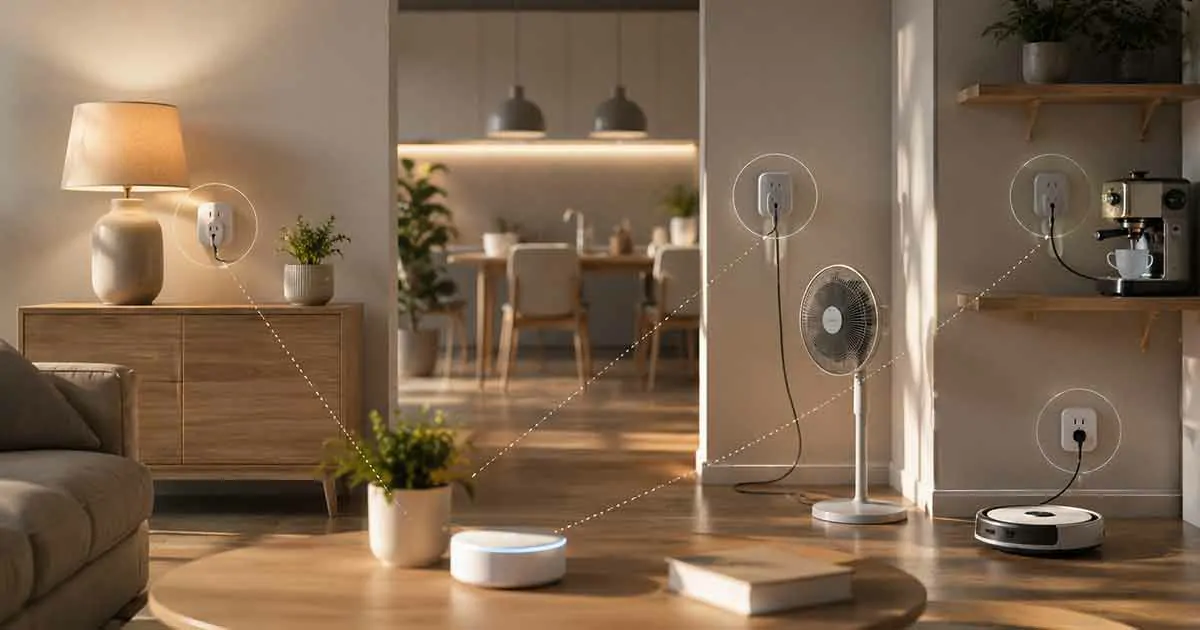
Smart plugs are one of the easiest ways to add automation to an existing home. Instead of replacing a lamp, fan, coffee maker, or other compatible appliance, you can connect it to a smart plug and control its power through a compatible smart home platform.
Matter has made this category more interesting because compatible smart plugs can work across supported ecosystems without being tied to a single manufacturer’s smart home platform.
The best Matter smart plugs can provide remote control, schedules, voice commands, and, in some models, energy monitoring. However, not every Matter plug offers the same features, and some important capabilities may depend on the manufacturer’s app or the smart home platform you use.
If you are choosing a Matter smart plug today, the most important factors are Matter compatibility, connection type, energy monitoring, electrical rating, size, ecosystem support, and reliability.
What Is a Matter Smart Plug?
A Matter smart plug is a connected electrical outlet accessory that supports the Matter smart home standard.
Matter is designed to improve interoperability between compatible smart home devices and supported ecosystems.
A Matter smart plug can potentially work with platforms such as:
- Apple Home
- Google Home
- Amazon Alexa
- Samsung SmartThings
However, compatibility should always be checked for the specific plug and the features you need.
Matter does not mean every feature will appear identically in every platform.
Why Choose a Matter Smart Plug?
Matter smart plugs are particularly useful for homeowners who want flexibility.
Instead of selecting a plug only because it works with one manufacturer’s ecosystem, you can look for a Matter-certified model that supports your preferred platform.
Potential benefits include:
- Cross-platform compatibility
- Remote control
- Scheduling
- Voice control
- Local network control
- Smart home automation
- Energy monitoring on supported models
This makes Matter smart plugs a practical entry point for people building a new smart home.
Best Matter Smart Plugs at a Glance
The right plug depends on your priorities.
| Type | Best For | Important Feature |
|---|---|---|
| Matter Wi-Fi plug | Simple installations | Easy network connectivity |
| Matter Thread plug | Efficient mesh networks | Thread connectivity |
| Matter energy-monitoring plug | Energy-conscious homes | Power and energy tracking |
| Compact Matter plug | Small spaces | Space-saving design |
| Matter outdoor plug | Exterior devices | Outdoor-rated construction |
| Multi-pack Matter plugs | Whole-home automation | Lower cost per device |
Availability and exact features vary by market, so always verify the current product specifications before purchasing.
1. Eve Energy
Eve Energy is one of the best-known Matter smart plugs for homeowners who want energy monitoring and Thread connectivity.
It supports Matter over Thread and can provide power consumption information.
A Thread-based Matter plug can also become part of a Thread mesh network, provided the home has the required Thread infrastructure.
Eve Energy is particularly appealing to users who prioritize:
- Energy monitoring
- Thread
- Matter
- Local smart home control
- Apple Home integration
- A premium build
The main drawback is that it can cost more than basic Matter Wi-Fi plugs.
2. TP-Link Tapo P110M
The Tapo P110M is a Matter-certified smart plug with energy monitoring.
According to TP-Link, it can track the energy use of connected devices and provide electricity-cost estimates when billing information is configured.
It also provides scheduling, timers, voice control, and a compact form factor.
This makes it an interesting choice for homeowners who want Matter compatibility while also tracking the electricity consumption of individual appliances.
Before purchasing, check the regional model because specifications and availability can differ between markets.
3. TP-Link Kasa KP125M
The Kasa KP125M is another Matter-certified smart plug with energy monitoring.
TP-Link introduced the KP125M as a Matter-certified plug with energy monitoring, scheduling, and timer functions.
It can be useful for monitoring devices such as:
- Lamps
- Fans
- Humidifiers
- Small appliances
- Home office equipment
The energy-monitoring feature makes it particularly useful when your goal is to understand which devices consume the most electricity.
4. TP-Link Tapo P210M
The Tapo P210M is a smart outlet rather than a simple plug adapter.
It combines Matter compatibility with energy monitoring and additional electrical-management features.
TP-Link lists energy tracking, bill estimates, scheduling, remote control, and local control among its features.
This type of product can be useful when you want a more permanent smart outlet solution rather than adding a plug adapter to an existing outlet.
5. Other Matter Smart Plug Options
The Matter smart plug market continues to expand, with products from manufacturers such as Eve, TP-Link, Meross, and other brands.
When comparing models, do not choose based solely on the Matter logo.
Check whether the specific model provides:
- Energy monitoring
- Thread or Wi-Fi
- Required electrical rating
- Local control
- Scheduling
- Platform compatibility
- Physical size
- Outdoor certification when applicable
A cheaper Matter plug may be the better choice for basic on/off automation, while a more expensive model may be worthwhile if you need energy data.
Matter Smart Plugs With Energy Monitoring
Energy monitoring is one of the most useful features available on selected smart plugs.
It allows you to understand how much electricity an individual connected device consumes.
Depending on the product and platform, you may see information such as:
- Current power
- Energy consumption
- Historical usage
- Estimated electricity costs
Matter’s newer specifications have expanded standardized energy-management capabilities, but the exact information exposed to the user can still depend on the device and smart home platform.
This distinction is important.
A product can advertise energy monitoring while the data may primarily be available through the manufacturer’s application rather than every Matter ecosystem.
Why Energy Monitoring Matters
Energy monitoring can help answer practical questions.
For example:
How much electricity does my home office equipment use?
Does my entertainment system consume significant standby power?
How much energy does a fan use overnight?
Which appliance should I stop leaving connected?
Instead of guessing, homeowners can use actual consumption data to identify potential energy waste.
Matter Wi-Fi vs Matter Thread Smart Plugs
Matter smart plugs commonly use Wi-Fi or Thread.
Neither is automatically better for every home.
Matter Wi-Fi Plugs
Wi-Fi Matter plugs are convenient because most homes already have a Wi-Fi network.
Advantages include:
- No dedicated Thread network required
- Familiar setup
- Good availability
- Suitable for basic smart plugs
The main consideration is Wi-Fi network capacity and coverage.
Matter Thread Plugs
Thread is a low-power mesh networking technology designed for connected home devices.
Advantages can include:
- Low-power operation
- Mesh networking
- Local connectivity
- Reduced dependence on Wi-Fi for individual devices
However, Thread devices require appropriate Thread infrastructure, including a compatible Thread Border Router.
Which Is Better: Wi-Fi or Thread?
For a simple home with a few smart plugs, a Matter Wi-Fi plug may be the easiest option.
For a larger smart home with many low-power Matter devices, Thread can become more attractive.
Consider Thread if you are already building a Thread-based Matter ecosystem.
Consider Wi-Fi if you want the simplest installation and already have reliable Wi-Fi coverage.
Matter Smart Plugs for Energy Savings
Smart plugs can contribute to energy savings by making it easier to control when devices receive power.
For example:
Scheduled time → smart plug turns off.
Or:
Home enters Away mode → selected devices turn off.
Energy-monitoring models can also help identify unnecessary consumption.
However, a smart plug does not automatically make an appliance energy efficient.
Its main benefit is better control and visibility.
Best Devices to Use With Matter Smart Plugs
Matter smart plugs work best with appliances that return to an operating state when power is restored.
Good examples can include:
- Lamps
- Fans
- Some coffee makers
- Certain humidifiers
- Decorative lighting
- Some chargers
- Selected home office equipment
Always check the appliance manufacturer’s instructions before using a smart plug.
Devices that require a manual button press after receiving power may not work well with automated power control.
Smart Plugs for Lamps
Lamps are among the simplest uses for a smart plug.
You can create routines such as:
Sunset → lamp turns on.
Bedtime → lamp turns off.
Away mode → selected lights turn off.
If you only need on/off control, a Matter smart plug can be a simple alternative to replacing the lamp with a smart bulb.
However, a smart bulb is usually better when you want brightness control or color-changing features.
Smart Plugs for Home Offices
A home office may contain several devices that consume standby power.
A smart plug can help automate selected equipment.
For example:
Workday begins → equipment turns on.
Workday ends → selected equipment turns off.
An energy-monitoring plug can also show how much electricity individual equipment consumes.
For multiple devices, a smart power strip may be more appropriate than several individual smart plugs.
Smart Plugs for Entertainment Systems
Entertainment equipment can also benefit from scheduled control.
Potential examples include:
- Lamps
- Speakers
- Certain accessories
- Selected peripheral equipment
However, be careful when cutting power to devices that are designed to remain connected.
Some televisions, game consoles, computers, network equipment, and other electronics may perform updates or maintenance while connected to power.
Smart Plugs for Energy Monitoring
Energy-monitoring Matter plugs are particularly useful when trying to understand household electricity consumption.
A practical approach is to monitor one device at a time.
For example:
- Connect the device.
- Record its energy consumption.
- Monitor it over several days.
- Compare usage patterns.
- Decide whether automation would help.
This creates a more useful picture than simply installing smart plugs everywhere.
Do Matter Smart Plugs Need a Hub?
It depends on the type of Matter plug and the smart home ecosystem.
Matter itself is not a traditional hub-based technology like some older smart home systems.
However, Matter devices still need a compatible controller within the smart home ecosystem.
For Thread-based Matter devices, a Thread Border Router is also required.
Therefore, before purchasing a Matter Thread plug, verify that your existing smart home setup includes the necessary infrastructure.
Can Matter Smart Plugs Work Without Internet?
Some Matter smart home functions can operate locally, but the exact experience depends on the device, controller, network, and ecosystem.
This is one reason to check the manufacturer’s specifications rather than assuming that every Matter feature works without internet access.
Local control can provide advantages such as:
- Faster response
- Reduced cloud dependence
- Better privacy
- Continued automation during some internet outages
But local operation should be confirmed for the specific product.
Matter Smart Plug Compatibility
Before buying a Matter smart plug, check compatibility with your preferred platform.
Common ecosystems include:
- Apple Home
- Google Home
- Amazon Alexa
- Samsung SmartThings
Also check whether the particular features you want are supported.
For example, a plug may support basic on/off control across multiple ecosystems while advanced energy data may be available only through certain apps or platforms.
How to Choose the Best Matter Smart Plug
Use the following checklist.
1. Check Matter Certification
Look for genuine Matter certification rather than relying only on marketing language.
2. Choose Wi-Fi or Thread
Select the network technology that fits your existing smart home.
3. Decide Whether You Need Energy Monitoring
If you want to track electricity consumption, make sure the exact model supports it.
4. Check the Electrical Rating
Never assume every smart plug can safely handle every appliance.
Check voltage, current, and maximum load specifications.
5. Consider Size
A compact plug is useful when you need to keep the adjacent outlet available.
6. Check Platform Support
Confirm compatibility with the ecosystem you use.
7. Check Local Control
If local operation is important, verify it before purchasing.
8. Consider the Manufacturer’s App
Some advanced features may require the manufacturer’s application.
9. Check the Warranty
A smart plug is connected to your home’s electrical system, so build quality and warranty support matter.
10. Buy the Right Regional Version
Electrical standards differ between countries.
Always purchase a model designed for your local electrical system.
Common Mistakes to Avoid
Buying Only Because It Says Matter
Matter compatibility is useful, but it does not tell you everything about a smart plug.
Ignoring Energy Monitoring Limitations
Energy monitoring may not be exposed equally across every platform.
Using the Wrong Electrical Load
Never exceed the manufacturer’s maximum rated load.
Ignoring Wi-Fi Coverage
A Wi-Fi smart plug placed in an area with poor signal may become unreliable.
Buying Thread Without Thread Infrastructure
Make sure your home has a compatible Thread Border Router when required.
Automating Unsafe Appliances
Avoid automatically switching power to appliances unless the manufacturer and safety instructions allow that use.
Are Matter Smart Plugs Worth It?
For many smart homes, yes.
They are particularly useful if you want simple automation without replacing existing appliances.
A Matter smart plug can turn a basic lamp or compatible appliance into a controllable smart device while keeping your options open across supported ecosystems.
Energy-monitoring models provide additional value by showing how much electricity connected devices consume.
The most important factor is choosing the right plug for your specific use case rather than simply choosing the newest model.
Best Matter Smart Plug Strategy for a New Smart Home
If you are building your smart home from scratch, start with a few devices rather than buying dozens immediately.
A practical setup could include:
- One Matter smart plug for a lamp
- One energy-monitoring Matter plug for a high-use device
- One Matter smart thermostat
- A compatible Matter controller
- Thread infrastructure if you plan to use Thread devices
Once the system is stable, expand it gradually.
This approach makes troubleshooting easier and helps you determine which devices actually provide value.
Final Thoughts
The best Matter smart plugs combine reliable connectivity, useful automation, appropriate electrical ratings, and compatibility with the smart home ecosystem you already use.
For simple installations, a Matter Wi-Fi plug can be an easy starting point.
For homes using a broader Thread-based smart home network, a Matter Thread plug may be a better long-term fit.
If energy savings are important, choose a model with energy monitoring and verify exactly where its energy data is available.
Products such as the Eve Energy, TP-Link Tapo P110M, and Kasa KP125M demonstrate the range of options available, from Thread-based premium models to Wi-Fi plugs with energy tracking.
Ultimately, the best Matter smart plug is not necessarily the most expensive one. It is the model that provides the connectivity, energy information, automation, and platform compatibility your home actually needs.