
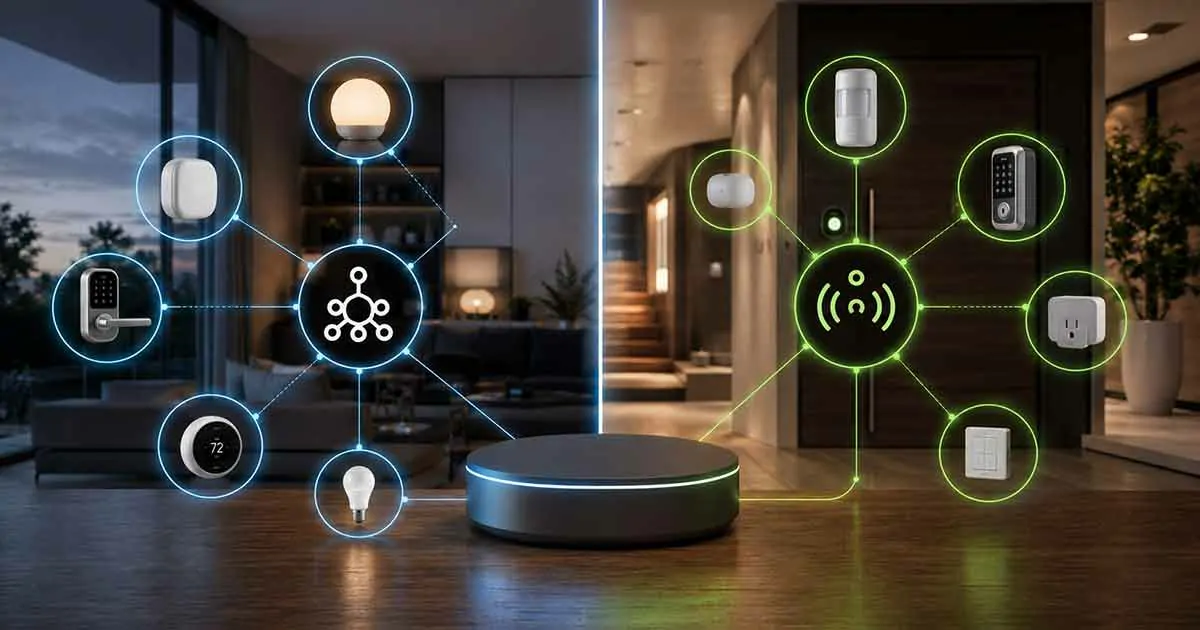
Choosing the right technology for a smart home can affect how reliable, flexible, and easy to expand the system will be.
Two technologies that often appear in smart home discussions are Matter and Z-Wave. Although both can be used to connect and automate smart home devices, they are fundamentally different technologies.
Matter is a newer, IP-based smart home standard designed to improve interoperability between compatible devices and major smart home platforms. It can operate over Wi-Fi, Thread, and Ethernet, while Bluetooth Low Energy can be used for commissioning.
Z-Wave is a mature wireless technology designed specifically for low-power home automation and control. It uses a sub-GHz radio system in many regions, which can help reduce interference from the crowded 2.4 GHz band commonly used by Wi-Fi, Bluetooth, Zigbee, and other devices.
Table of Contents
So, which is better?
For a new smart home where broad platform compatibility is the priority, Matter is often the better starting point. For homeowners who prioritize a mature low-power mesh network, reliable sensors, and existing Z-Wave infrastructure, Z-Wave remains a strong option.
The right choice depends on the devices you need, your smart home platform, network requirements, and how you plan to expand the system.
Matter vs Z-Wave at a Glance
| Feature | Matter | Z-Wave |
|---|---|---|
| Main purpose | Smart home interoperability | Home automation and device networking |
| Network approach | IP-based | Wireless mesh |
| Main connectivity | Wi-Fi, Thread, Ethernet | Z-Wave radio |
| Frequency | Depends on transport | Sub-GHz in many regions |
| Low-power devices | Yes, especially with Thread | Strong focus |
| Multi-platform support | Major design goal | Depends on controller and ecosystem |
| Hub/controller | Matter controller required | Z-Wave controller or hub required |
| Ecosystem maturity | Newer | Mature |
| Best for | New cross-platform smart homes | Established automation and sensor networks |
| Can they coexist? | Yes | Yes |
What Is Matter?
Matter is an open smart home connectivity standard developed by the Connectivity Standards Alliance.
Its primary goal is interoperability.
Instead of requiring consumers to choose products based entirely on whether they work with one manufacturer’s ecosystem, Matter provides a common standard for compatible smart home devices.
Matter can operate over:
- Wi-Fi
- Thread
- Ethernet
Bluetooth Low Energy can be used during device commissioning.
This makes Matter different from technologies such as Z-Wave because Matter is primarily concerned with how compatible smart home devices communicate at the application level over IP networks.
What Is Z-Wave?
Z-Wave is a wireless communication technology developed specifically for smart home and automation applications.
It is commonly used for:
- Smart locks
- Motion sensors
- Door sensors
- Window sensors
- Smart switches
- Lighting
- Thermostats
- Security devices
Z-Wave uses mesh networking, allowing compatible powered devices to help relay signals through the network.
One of its notable characteristics is its use of sub-GHz frequencies in many markets.
Because these frequencies are different from the 2.4 GHz band used by many Wi-Fi and Bluetooth devices, Z-Wave networks can experience a different interference environment.
Matter vs Z-Wave: The Biggest Difference
The most important difference is that Matter and Z-Wave operate at different levels of the smart home ecosystem.
Matter is an IP-based application-layer standard designed to provide interoperability across supported smart home platforms.
Z-Wave is a wireless networking technology designed specifically for smart home and automation devices.
This means Matter does not directly replace Z-Wave’s radio technology.
A Matter device can communicate using Wi-Fi, Thread, or Ethernet.
A Z-Wave device communicates using Z-Wave wireless networking.
This distinction is important when designing a smart home.
How Matter Works
A typical Matter setup includes:
- Matter devices
- A Matter controller
- An IP network
- Wi-Fi, Thread, or Ethernet connectivity
For Thread-based Matter devices, a Thread Border Router is also required to connect the Thread network to the wider IP network.
Matter is designed to allow compatible devices to work with supported smart home ecosystems.
One of its important features is multi-admin support, which can allow a compatible Matter device to be shared across supported ecosystems.
How Z-Wave Works
A typical Z-Wave system includes:
- Z-Wave controller
- Z-Wave devices
- Mesh network
- Powered routing devices
- Battery-powered end devices
The controller manages the Z-Wave network.
Powered Z-Wave devices can help extend the mesh by relaying communication.
This architecture is particularly useful for homes containing many sensors, switches, and other automation devices.
Matter vs Z-Wave for Compatibility
Matter has a major advantage when cross-platform compatibility is important.
The standard was designed specifically to help compatible devices work across supported smart home ecosystems.
Z-Wave has strong interoperability within its own technology ecosystem, but the overall user experience depends heavily on the Z-Wave controller and smart home platform.
A Z-Wave device may work with multiple platforms through compatible controllers, but consumers need to verify compatibility before purchasing.
With Matter, consumers can start by checking whether the product is Matter-certified and whether their preferred platform supports that particular device type.
Is Matter Better for a New Smart Home?
For many homeowners starting from scratch, Matter is an attractive choice.
It can reduce concerns about platform lock-in and provide more flexibility when choosing supported products.
Matter can be especially appealing if you:
- Are building a new smart home
- Want cross-platform compatibility
- Use Apple Home, Google Home, Alexa, SmartThings, or another supported ecosystem
- Want to mix compatible brands
- Expect your smart home to expand
However, Matter is not automatically better for every device.
You still need to check:
- Device category
- Supported platform
- Network technology
- Required controller
- Thread requirements
- Available features
- Local control
- Firmware support
Is Z-Wave Still Worth Using?
Yes.
Z-Wave remains a mature technology with a long history in home automation.
It is particularly attractive for users who want:
- Low-power sensors
- Mesh networking
- Smart locks
- Security devices
- Reliable automation
- A dedicated smart home wireless network
If you already have a Z-Wave hub and many compatible devices, replacing everything with Matter products would usually be unnecessary.
A functioning Z-Wave system can continue to be an important part of a modern smart home.
Matter vs Z-Wave for Battery-Powered Sensors
Battery-powered sensors are an important area of comparison.
Z-Wave was designed with low-power applications in mind and is widely used for:
- Motion sensors
- Door sensors
- Window sensors
- Temperature sensors
- Leak sensors
- Security sensors
Matter can also support low-power devices, particularly through Thread.
Both can therefore be suitable for battery-powered sensors.
The actual battery life depends on:
- Device design
- Communication frequency
- Sensor type
- Firmware
- Network conditions
- Battery capacity
For this reason, compare the manufacturer’s stated battery life rather than assuming that one technology will always last longer.
Matter vs Z-Wave for Smart Locks
Smart locks are one of the areas where Z-Wave has a long history.
Z-Wave smart locks can provide:
- Remote locking and unlocking
- Access codes
- Automation
- Lock status
- Security routines
Matter also supports smart locks, giving newer products the possibility of broader ecosystem compatibility.
For a new installation, Matter can be attractive if platform flexibility is important.
For an existing Z-Wave security system, continuing with Z-Wave may be more practical.
Matter vs Z-Wave for Security Systems
Both technologies can be used in smart home security.
Z-Wave has extensive use in:
- Door sensors
- Window sensors
- Motion sensors
- Smart locks
- Alarm-related devices
Matter can support several smart home security device categories and is designed to integrate compatible devices across supported ecosystems.
However, homeowners should distinguish between smart home automation and professionally monitored security systems.
A smart sensor or lock does not automatically provide professional emergency monitoring.
Matter vs Z-Wave for Smart Lighting
Both technologies can control smart lighting.
Z-Wave products include:
- Smart switches
- Dimmers
- Relays
- Lighting controllers
Matter can also be used with compatible smart bulbs, switches, and lighting products.
For a new home, Matter may be attractive when cross-platform compatibility matters.
For a mature Z-Wave installation, replacing working switches simply to move to Matter usually provides little practical benefit.
Matter vs Z-Wave for Large Homes
Large homes require careful consideration of network coverage.
Z-Wave’s mesh architecture can be useful because powered devices can help extend the network throughout the property.
Matter itself does not have one single range because it can operate over Wi-Fi, Thread, or Ethernet.
A Matter system using Wi-Fi depends heavily on Wi-Fi coverage.
A Matter system using Thread depends on the Thread mesh and appropriate Thread Border Router placement.
For large homes, the best solution may involve a combination of wired networking, Wi-Fi, Thread, and Z-Wave depending on the devices being installed.
Matter vs Z-Wave: Range
There is no universal winner for range.
Actual range depends on:
- Building materials
- Walls
- Floors
- Antenna design
- Device placement
- Frequency
- Network topology
- Number of mesh nodes
Z-Wave’s sub-GHz operation in many markets can provide useful propagation characteristics compared with crowded 2.4 GHz environments.
Matter devices using Wi-Fi will depend on Wi-Fi coverage.
Matter devices using Thread use a low-power mesh network.
Therefore, compare the actual network architecture rather than assuming that Matter or Z-Wave always has better range.
Matter vs Z-Wave: Interference
Z-Wave has an advantage in some homes because it generally operates outside the crowded 2.4 GHz band used by many wireless technologies.
Matter has no single radio frequency.
A Matter device using Wi-Fi typically operates over the home’s Wi-Fi network.
A Matter device using Thread uses the 2.4 GHz band.
Therefore, interference depends on which underlying transport a Matter product uses.
In a home with heavy 2.4 GHz congestion, this distinction can become relevant.
Matter vs Z-Wave: Security
Both technologies provide security mechanisms, but overall security depends on the complete implementation.
A secure smart home should use:
- Strong unique passwords
- Two-factor authentication where available
- Updated firmware
- Secure Wi-Fi
- Trusted controllers
- Proper device authentication
Matter was designed with security as a core part of its architecture.
Z-Wave also includes security mechanisms and has evolved over time, including stronger security features in newer generations.
Consumers should therefore focus on certified products, current firmware, and proper account security rather than assuming one protocol is automatically secure and the other is not.
Matter vs Z-Wave: Setup
Matter is designed to simplify device commissioning and cross-platform setup.
A compatible Matter device can typically be added through a supported ecosystem using standardized commissioning procedures.
Z-Wave setup generally involves pairing the device with a compatible Z-Wave controller or hub.
The exact experience depends on the hub and software.
For beginners, Matter can provide a simpler starting point if they are purchasing newer devices.
For users who already understand Z-Wave, its setup process is usually straightforward once the controller and network are established.
Matter vs Z-Wave: Device Availability
Z-Wave has been available for many years and has a mature ecosystem covering numerous smart home categories.
Matter is newer but continues to expand.
The best choice should therefore be based on the specific product you need rather than the total number of devices available.
For example, if you need a particular smart lock, sensor, or switch, compare the Matter and Z-Wave versions of that specific product.
Look at:
- Features
- Price
- Battery life
- Ecosystem compatibility
- Local control
- Installation
- Firmware support
Matter vs Z-Wave: Do You Need a Hub?
Both ecosystems can involve a central controller.
Matter requires a Matter controller to manage Matter devices within an ecosystem.
Thread-based Matter devices may also require a Thread Border Router.
Z-Wave devices require a Z-Wave controller or hub to manage the Z-Wave network.
The exact hardware depends on the smart home platform.
This means neither technology should be viewed as completely hub-free.
Can Matter and Z-Wave Work Together?
Yes, but not through native communication.
Matter and Z-Wave are different technologies.
A compatible bridge or controller can expose Z-Wave devices to a Matter ecosystem.
The general architecture can look like this:
Z-Wave device → Z-Wave controller/bridge → Matter ecosystem → Matter controller
This allows homeowners to keep existing Z-Wave devices while adding Matter products.
For many existing smart homes, this is more practical than replacing every device.
Matter vs Z-Wave for Existing Smart Homes
If you already have a reliable Z-Wave system, there is usually no need to replace it simply because Matter is newer.
A better strategy is to:
- Keep working Z-Wave devices.
- Add Matter devices where they provide clear advantages.
- Use compatible bridging when appropriate.
- Replace devices only when they need upgrading.
This reduces unnecessary costs and allows the smart home to evolve gradually.
Matter vs Z-Wave for New Homeowners
New homeowners often have an opportunity to design the smart home system before buying large numbers of devices.
A practical approach is to first establish:
- Reliable internet
- Good Wi-Fi coverage
- Ethernet where practical
- A primary smart home platform
- A clear device ecosystem
Then choose Matter or Z-Wave based on the products and features required.
Avoid purchasing devices simply because they use the newest technology.
Which Is Better for Smart Home Automation?
Both can provide excellent automation.
Examples include:
Motion detected → hallway lights turn on.
Door opens → entry light activates.
Home becomes unoccupied → selected devices turn off.
Smart lock activates → security routine starts.
The automation possibilities depend more on the controller, devices, and software than on the protocol alone.
Matter vs Z-Wave for Energy Management
Both can participate in energy-saving automation.
For example:
Home enters Away mode → thermostat adjusts → selected lights turn off → smart devices switch to an energy-saving state.
Z-Wave has long been used with thermostats, switches, and energy-management products.
Matter can connect compatible thermostats, switches, plugs, and other supported devices across participating ecosystems.
The quality of the automation depends on the products and controller being used.
Matter vs Z-Wave: Pros and Cons
Matter Pros
- Strong focus on interoperability
- Works across supported smart home ecosystems
- IP-based
- Supports Wi-Fi, Thread, and Ethernet
- Designed for modern cross-platform smart homes
- Growing device ecosystem
Matter Cons
- Newer technology
- Feature support can vary by platform
- Thread devices require appropriate infrastructure
- Wi-Fi Matter devices depend on Wi-Fi coverage
- Not every advanced device feature is standardized
Z-Wave Pros
- Mature smart home technology
- Low-power design
- Mesh networking
- Strong history in security and automation
- Sub-GHz operation in many regions
- Large range of sensors, switches, locks, and controllers
Z-Wave Cons
- Usually requires a compatible controller or hub
- Ecosystem experience depends on the controller
- Not natively compatible with Matter
- Product availability can vary by market
- Less focused on broad IP-based interoperability
Which Should You Choose?
Choose Matter If:
- You are starting a new smart home.
- Cross-platform compatibility is important.
- You want flexibility between supported ecosystems.
- You are buying new devices.
- Matter versions of the products you need are available.
Choose Z-Wave If:
- You already have a Z-Wave hub.
- You have an established Z-Wave network.
- You need specific Z-Wave devices.
- Low-power sensors are a priority.
- You want a mature dedicated smart home mesh network.
Choose Both If:
- You already use Z-Wave.
- You want to add newer Matter devices.
- Your controller supports appropriate bridging.
- You want to expand without replacing working equipment.
For many homeowners, this mixed approach is the most practical.
Best Strategy for a New Smart Home
If you are starting from scratch, use a simple decision process.
Step 1: Choose Your Main Platform
Select the smart home ecosystem you expect to use most.
Step 2: Identify Your Important Devices
Make a list of the devices you actually need:
- Thermostat
- Smart locks
- Sensors
- Lighting
- Security devices
- Plugs
- Cameras
Step 3: Compare Matter and Z-Wave Products
Do not compare protocols in isolation.
Compare the actual products available for your needs.
Step 4: Plan the Network
Determine whether you will use:
- Wi-Fi
- Thread
- Z-Wave
- Ethernet
Step 5: Plan for Expansion
Choose a system that can accommodate additional devices without requiring a complete rebuild.
Final Verdict: Matter vs Z-Wave
So, Matter vs Z-Wave: which is better for smart homes?
For a new smart home, Matter is generally the better starting point when interoperability and platform flexibility are the main priorities.
However, Z-Wave remains a strong choice for mature smart home networks, especially when low-power sensors, security devices, dedicated mesh networking, and existing infrastructure are important.
The two technologies are not mutually exclusive.
If you already have Z-Wave devices, keeping them and gradually adding Matter products can be more practical than replacing a working system.
Ultimately, the best smart home technology is the one that provides the devices, compatibility, reliability, and automation features your home actually needs.
Matter is often the better choice for starting fresh, while Z-Wave remains an excellent option for established and automation-focused smart homes.