
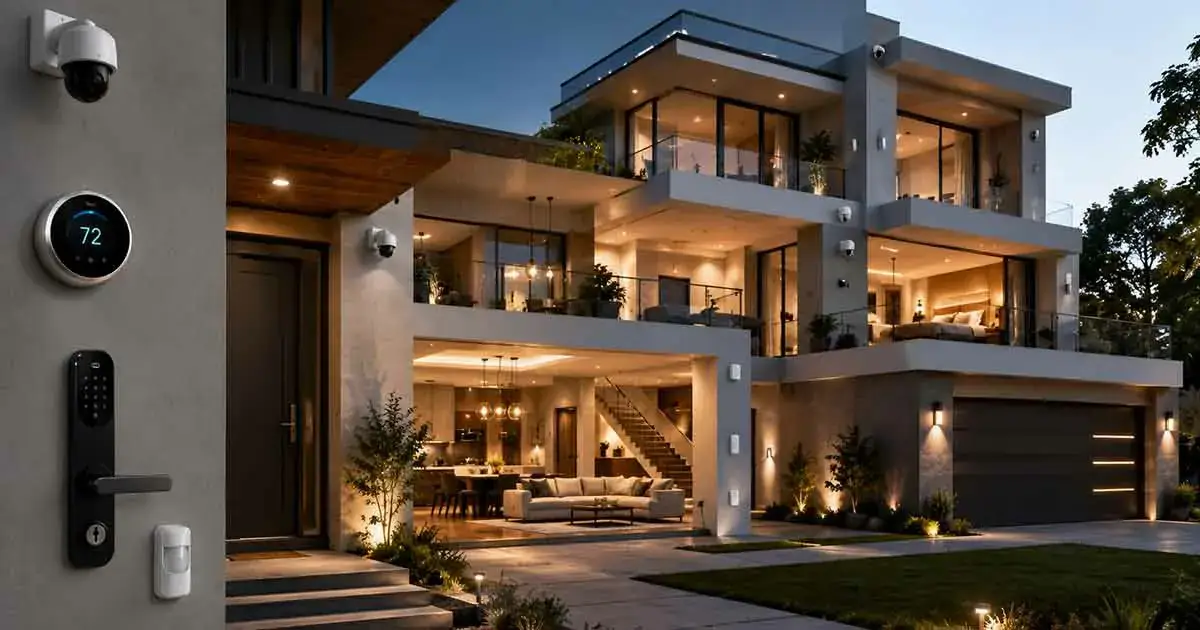
Large homes can benefit significantly from smart home technology, but they also present challenges that smaller properties may not have.
Multiple floors, larger distances between rooms, several entrances, separate HVAC zones, garages, outdoor areas, and more demanding network requirements can make a large home harder to manage.
The best smart home devices for large homes should therefore do more than provide basic remote control. They should offer reliable connectivity, flexible placement, automation, and the ability to work together across the entire property.
A well-designed system can help homeowners manage lighting, security, climate control, energy use, access, and property protection from one connected environment.
This guide explains which smart home devices are most useful for large homes, what features matter most, and how to build a reliable system without unnecessary complexity.
Table of Contents
Why Large Homes Need a Different Smart Home Strategy
A smart home setup that works well in a small apartment may not work equally well in a large property.
Large homes often have:
- Multiple floors
- More rooms
- Multiple entrances
- Larger outdoor areas
- Separate HVAC systems or zones
- Garages
- Longer distances between devices
- More connected devices
- More complex Wi-Fi requirements
These factors make infrastructure and device placement particularly important.
The goal is not simply to add more smart devices. The goal is to create a system that remains reliable throughout the property.
Best Smart Home Devices for Large Homes
The ideal setup depends on the property, but several categories are especially useful.
1. Smart Home Wi-Fi and Network Equipment
Network infrastructure is one of the most important parts of a large smart home.
Smart devices depend on reliable communication, and a large property can have areas where a single router cannot provide adequate coverage.
Consider using:
- Mesh Wi-Fi
- Multiple wireless access points
- Ethernet backhaul
- Wired connections for permanent devices
A well-designed network can improve the reliability of cameras, thermostats, sensors, smart locks, and other connected devices.
For large homes, network planning should come before adding dozens of smart devices.
2. Smart Thermostats
Large homes often have more complicated heating and cooling requirements.
A single thermostat may not accurately represent temperatures throughout multiple floors or distant rooms.
Smart thermostats can provide:
- Scheduling
- Smartphone control
- Remote access
- Energy reports
- Remote temperature sensors
- Smart home integration
For homes with multiple HVAC zones, verify that the thermostat system supports the property’s specific configuration.
Remote sensors can also help monitor rooms that are far from the main thermostat.
3. Smart Temperature Sensors
Temperature sensors can be particularly useful in large homes.
A sensor placed in an upstairs bedroom, home office, or other priority room can provide temperature information that may differ from the main thermostat location.
Useful locations include:
- Bedrooms
- Upper floors
- Home offices
- Large living areas
- Rooms with significant sunlight
- Areas with inconsistent temperatures
Sensors measure conditions, but they do not automatically create independent HVAC zones.
If independent control is required, the HVAC system must support zoning.
4. Smart Lighting
Large homes often contain many lights, making automation particularly valuable.
Smart lighting can provide:
- Scheduling
- Remote control
- Dimming
- Motion-based automation
- Voice control
- Scene creation
Homeowners can automate lighting by area.
For example:
Sunset → exterior lights turn on.
Motion detected → hallway lights activate.
Bedtime routine → selected lights turn off.
Smart switches can be especially useful in large homes because they can control existing fixtures while providing centralized automation.
5. Smart Motion Sensors
Motion sensors can help automate large areas without requiring manual control of every device.
They can be useful in:
- Hallways
- Stairways
- Entryways
- Garages
- Basements
- Utility rooms
For example:
Motion detected in hallway → lights turn on.
After a period without activity:
Lights turn off.
Large homes may require multiple sensors because of the greater number of rooms and passageways.
6. Smart Door and Window Sensors
Large homes usually have more exterior openings than smaller properties.
Door and window sensors can help monitor:
- Front doors
- Back doors
- Patio doors
- Garage entrances
- Ground-floor windows
- Other accessible openings
A sensor can provide an alert when an opening is detected.
For example:
Window opens while Away mode is active → smartphone notification.
These sensors can also participate in automation routines.
7. Smart Locks
Large homes may have multiple entry points.
Smart locks can simplify access while providing additional control over who can enter.
Depending on the product, features may include:
- Keypad access
- Smartphone control
- Temporary access codes
- Automatic locking
- Activity history
- Remote management
Some systems can assign different access credentials to household members or trusted visitors.
Before installation, check compatibility with each door because not every lock works with every door configuration.
8. Smart Video Doorbells
A large property may have multiple entrances or a long distance between the front door and the main living area.
A smart video doorbell can provide:
- Visitor notifications
- Motion detection
- Two-way communication
- Video monitoring
- Activity history
If the property has multiple important entrances, homeowners may need more than one compatible security device.
Check the manufacturer’s support for multi-camera or multi-door configurations.
9. Smart Security Cameras
Large properties often require broader camera coverage.
Potential locations include:
- Front entrance
- Driveway
- Garage
- Backyard
- Side entrances
- Gates
- Other exterior areas
Wired cameras can be particularly useful for permanent installations because they can provide continuous power and, where supported, a reliable network connection.
Wireless cameras offer easier installation but require careful consideration of battery life and wireless coverage.
For outdoor cameras, consider:
- Weather resistance
- Night visibility
- Lighting
- Network coverage
- Storage options
- Privacy
Avoid creating unnecessary camera coverage of private areas or neighboring properties.
10. Smart Garage Door Controllers
A large home may have one or more garage doors.
A compatible smart garage door controller can provide:
- Remote control
- Open/close notifications
- Activity history
- Automation
For example:
Garage door remains open → notification is sent.
If the property has multiple garage doors, verify whether the selected system can monitor and control them individually.
Garage door automation should always preserve the safety mechanisms of the existing door system.
11. Smart Energy Monitoring Systems
Large homes can consume significant amounts of electricity, especially when they have multiple HVAC systems and many appliances.
A whole-home energy monitoring system can help homeowners understand consumption patterns.
Depending on the system, it may provide information about:
- Total energy consumption
- Major circuits
- Daily usage
- Historical trends
- Unusual consumption
This information can help identify areas where energy use may be reduced.
12. Smart Plugs With Energy Monitoring
Smart plugs can provide device-level energy information.
They can be useful for monitoring:
- Home office equipment
- Entertainment systems
- Lamps
- Fans
- Small appliances
A smart plug is more limited than a whole-home energy monitor, but it can help identify the energy consumption of individual devices.
13. Smart Water Leak Sensors
Large properties often contain more bathrooms, appliances, plumbing fixtures, and utility areas.
This creates more potential locations for water leaks.
Smart leak sensors can be installed near:
- Water heaters
- Washing machines
- Dishwashers
- Sinks
- Toilets
- Basements
- Utility rooms
A sensor can send an alert when moisture is detected.
Early notification can help homeowners respond before a small leak causes significant damage.
14. Smart Water Shutoff Systems
For additional protection, homeowners can consider a smart water shutoff system.
Depending on the system, it may monitor water flow and automatically close the main supply when a leak or unusual pattern is detected.
This can be particularly valuable in large properties that may be unoccupied for extended periods.
Because installation can involve the main plumbing line, professional installation may be appropriate.
15. Smart Smoke and Carbon Monoxide Detectors
Large homes may have more rooms and floors, making proper placement of smoke and carbon monoxide detectors especially important.
Smart models can provide additional notifications and connectivity.
Some systems can send alerts to smartphones when an alarm occurs.
Install detectors according to manufacturer instructions and applicable safety requirements.
Smart connectivity should supplement, not replace, standard fire and carbon monoxide safety practices.
16. Smart Home Hub or Controller
A large smart home can eventually contain dozens of devices.
A central controller can help coordinate them.
Depending on the system, it may support technologies such as:
- Matter
- Thread
- Zigbee
- Z-Wave
A central controller can be useful for automation involving multiple sensors and devices.
However, homeowners should avoid adding a hub simply because they have a large house. The need depends on the devices and ecosystems being used.
17. Smart Speakers and Displays
Smart speakers and displays can provide convenient control throughout a large property.
Instead of using a smartphone every time, homeowners can use voice commands to control compatible devices.
Smart displays can also provide access to compatible:
- Security cameras
- Doorbells
- Thermostats
- Lighting
- Routines
Multiple speakers can provide access to smart home controls in different parts of the house.
Smart Home Devices for Multi-Story Homes
Multiple floors create specific challenges.
Temperature can vary between floors, while Wi-Fi coverage may become weaker as distance increases.
A multi-story smart home may benefit from:
- Additional wireless access points
- Remote temperature sensors
- Motion sensors
- Smart lighting
- Door sensors
- Separate HVAC zones where appropriate
Network planning is especially important.
Do not assume that a single router placed on one floor will provide reliable connectivity throughout the entire property.
Smart Home Devices for Large Outdoor Areas
Large homes often have larger outdoor spaces.
Useful smart devices can include:
- Outdoor security cameras
- Smart exterior lighting
- Motion sensors
- Smart irrigation controllers
- Smart gate controls
Outdoor devices should be selected based on weather exposure, power availability, network coverage, and installation requirements.
Smart Irrigation Controllers
A smart irrigation controller can automate watering schedules for compatible irrigation systems.
Depending on the system, it may use:
- Scheduled watering
- Weather information
- Rain conditions
- Seasonal adjustments
- Soil or moisture information
This can be useful for homeowners with larger lawns and landscaped areas.
The actual water savings depend on the irrigation system, local climate, landscaping, and how the controller is configured.
Smart Gate and Entry Controls
Properties with gates or long driveways may benefit from connected access controls.
Depending on the system, homeowners may be able to:
- Monitor gate activity
- Control access remotely
- Provide temporary access
- Integrate entry with cameras
For security-sensitive installations, professional evaluation may be appropriate.
Smart Home Automation for Large Properties
Automation becomes particularly useful when there are many rooms and devices.
A homeowner can create routines such as:
Leaving Home
Away mode activated → selected lights turn off → thermostat adjusts → security devices activate.
Arriving Home
Entry detected → exterior lights turn on → selected interior lights activate.
Night
Bedtime routine → selected doors lock → lights turn off → hallway lighting activates at low brightness.
Vacation
Vacation mode → selected lights operate on schedules → security notifications remain active → thermostat changes to an energy-saving setting.
The exact capabilities depend on the smart home platform.
Smart Home Devices for Large Homes Without a Subscription
Recurring fees can become more expensive when a large property contains many connected devices.
Before purchasing, check whether subscriptions are required for:
- Cloud video storage
- Advanced camera detection
- Security monitoring
- Extended activity history
- Premium automation
- Additional cloud services
Subscription-free products can reduce long-term operating costs, but compare features rather than choosing solely based on price.
Smart Home Devices That Work Together
Interoperability becomes more important as the number of devices increases.
A large home might combine:
Motion sensor → smart lighting
Door sensor → security notification
Smart lock → entry lighting
Temperature sensor → compatible thermostat routine
Leak sensor → water shutoff system
The more devices you install, the more important compatibility becomes.
Matter for Large Smart Homes
Matter is designed to improve interoperability between compatible smart home products.
This can provide additional flexibility when building a large system across supported platforms.
However, Matter does not mean that every advanced function is automatically available across every ecosystem.
Check the manufacturer’s specifications before purchasing devices for complex automations.
Wired vs. Wireless Devices
Large homes often benefit from a combination of wired and wireless technology.
Wired Devices
Good candidates include:
- Security cameras
- Network access points
- Smart switches
- Permanent networking equipment
Benefits include:
- Continuous power
- Reliable connectivity
- Reduced battery maintenance
Wireless Devices
Useful for:
- Door sensors
- Window sensors
- Motion sensors
- Temperature sensors
- Leak sensors
Wireless devices provide flexibility and can be placed where wiring would be difficult.
Smart Home Network Planning
Network design is one of the most important considerations for a large smart home.
Consider:
Ethernet
Ethernet connections can be useful for permanent devices and access points.
Wi-Fi Access Points
Multiple access points can provide better coverage than relying on one router.
Mesh Wi-Fi
Mesh systems can simplify coverage across multiple floors when properly configured.
Device Placement
Avoid placing important devices in areas where wireless signals are weak.
Network Equipment Location
A central, organized location for networking equipment can simplify maintenance.
For new construction or major renovation, planning network infrastructure before walls are closed can provide significant advantages.
Smart Home Privacy and Security
Large smart homes can contain many cameras, microphones, sensors, locks, and other connected devices.
Security should therefore be part of the initial design.
Use:
- Strong unique passwords
- Two-factor authentication
- Updated firmware
- Secure Wi-Fi
- Separate guest access where appropriate
For security cameras, carefully consider viewing areas and account permissions.
Common Mistakes With Large Smart Homes
Trying to Automate Everything
Complexity can make the system harder to maintain.
Ignoring Network Infrastructure
Poor connectivity can cause unreliable automation.
Buying Devices From Too Many Ecosystems
Too many disconnected platforms can make management difficult.
Assuming Sensors Create HVAC Zones
Temperature sensors provide information but do not automatically create independent heating and cooling zones.
Using Wireless Devices Everywhere
Permanent devices may benefit from wired power or network connections.
Ignoring Long-Term Costs
Consider subscriptions, batteries, maintenance, and replacement costs.
Installing Without a Property-Wide Plan
Large homes benefit from planning device locations before installation.
How to Choose Smart Home Devices for a Large Home
Before buying, consider:
- How large is the property?
- How many floors are there?
- How many HVAC zones exist?
- Where are the main entry points?
- Which areas need security coverage?
- Where are the Wi-Fi weak spots?
- Which devices should be wired?
- Which ecosystem will control the home?
- Are subscriptions required?
- Can the system expand in the future?
These questions can prevent expensive compatibility and installation problems.
A Practical Smart Home Setup for a Large Home
A balanced large-home system can be built in stages.
Stage 1: Infrastructure
Start with:
- Reliable internet
- Ethernet where practical
- Wi-Fi access points
- Network equipment
- Camera wiring
Stage 2: Climate and Lighting
Add:
- Smart thermostats
- Remote temperature sensors
- Smart switches
- Smart lighting
Stage 3: Security
Add:
- Smart locks
- Door sensors
- Window sensors
- Motion sensors
- Video doorbells
- Security cameras
Stage 4: Property Protection
Add:
- Leak sensors
- Smart water shutoff
- Smart smoke and carbon monoxide detectors
- Garage door controls
Stage 5: Energy and Advanced Automation
Add:
- Whole-home energy monitoring
- Smart plugs
- Outdoor automation
- Irrigation controls
- Advanced routines
This approach allows homeowners to expand without creating unnecessary complexity from the beginning.
Are Smart Home Devices Worth It for Large Homes?
Smart home technology can be particularly useful in large properties because there are more rooms, systems, entry points, and daily tasks to manage.
The strongest use cases include:
- Security
- Climate control
- Lighting
- Energy monitoring
- Water protection
- Access control
- Property management
However, the size of the home alone does not justify buying more devices.
The best results come from solving specific problems and designing the system around the property’s layout.
Final Thoughts
The best smart home devices for large homes should provide reliable control across a larger and more complex property.
Smart thermostats and temperature sensors can improve climate management, while smart lighting and motion sensors can automate large areas. Smart locks, door sensors, video doorbells, and security cameras can provide better visibility around multiple entrances.
Large properties can also benefit from energy monitoring, leak detection, water shutoff systems, smart garage controls, and outdoor automation.
Most importantly, plan the network and device ecosystem before expanding the system. Use wired connections for suitable permanent devices, wireless sensors where flexibility matters, and choose products that can work together.
A well-designed smart home for a large property should make the entire house easier to monitor and manage without turning everyday life into a complicated technology project.