
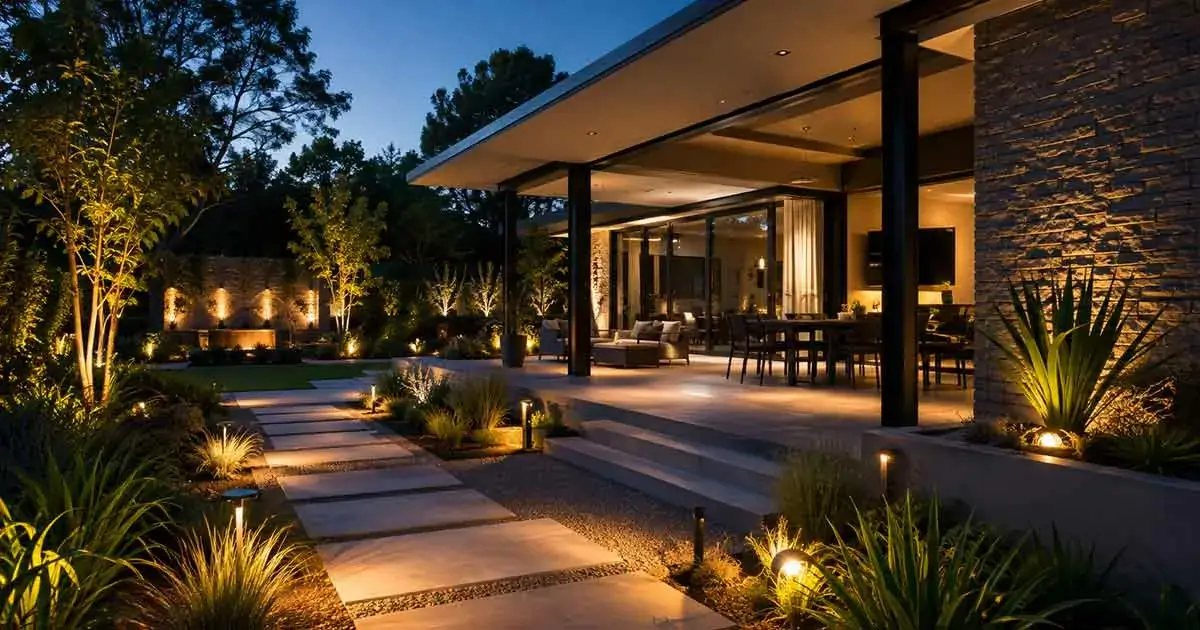
Smart outdoor lighting systems are changing the way homeowners illuminate patios, gardens, driveways, pathways, balconies, and other outdoor spaces. Instead of relying on traditional outdoor lights that must be switched on and off manually, a smart outdoor lighting system can be scheduled, automated, controlled remotely, and integrated with other smart home devices.
Whether you want to create a more comfortable outdoor living area, improve nighttime visibility, automate landscape lighting, or reduce unnecessary energy consumption, smart outdoor lighting provides flexible options for modern homes.
In this guide, we explain how smart outdoor lighting systems work, the different types available, important features to consider, installation options, automation ideas, energy-saving benefits, and how to choose the right system for your home.
Table of Contents
What Is a Smart Outdoor Lighting System?
A smart outdoor lighting system is a connected lighting setup that allows outdoor lights to be controlled automatically or remotely through a smartphone app, voice assistant, smart home platform, timer, motion sensor, or other control method.
Unlike conventional outdoor lighting, smart systems can do more than simply turn lights on and off. Depending on the products you choose, you may be able to adjust brightness, change colors, create schedules, activate lighting scenes, and coordinate multiple lights.
A typical smart outdoor lighting setup may include:
- Smart outdoor bulbs
- Smart landscape lights
- Smart pathway lights
- Smart outdoor fixtures
- Smart plugs or switches
- Motion and light sensors
- A mobile app
- A smart home controller or platform
- Wi-Fi, Bluetooth, Zigbee, or another wireless technology
The exact configuration depends on the size of the outdoor area and the level of automation you want.
How Do Smart Outdoor Lights Work?
Smart outdoor lights communicate with a control system using wireless or wired connections. The lights can then receive commands from a smartphone, smart home platform, sensor, timer, or automation routine.
For example, you could create a schedule that turns your patio lights on at sunset and turns them off at 11:00 PM.
A more advanced automation could combine several conditions. Your outdoor lights could turn on after sunset when someone enters the patio area, then automatically switch off after a certain period.
Some systems can also connect outdoor lighting with other smart home devices, allowing multiple devices to respond to the same event.
The main technologies used in smart outdoor lighting include Wi-Fi, Bluetooth, Zigbee, and other smart home communication protocols.
Types of Smart Outdoor Lighting
Smart outdoor lighting is available in several forms. Choosing the right type depends on the area you want to illuminate and how much control you need.
Smart Landscape Lights
Smart landscape lights are designed to illuminate gardens, flower beds, trees, pathways, and other landscape features.
Many landscape lighting systems use multiple fixtures connected to a central controller. This makes them useful for larger outdoor areas where several lights need to operate together.
Smart Pathway Lights
Smart pathway lights are designed for walkways, garden paths, and outdoor entrances.
They can often be scheduled to turn on automatically in the evening and turn off later at night. Some models also support brightness adjustments and motion-based automation.
Smart Outdoor Bulbs
Smart outdoor bulbs provide a simple way to add connected lighting to compatible outdoor fixtures.
They can be useful when you already have outdoor light fixtures and want to add smart control without replacing the entire installation.
However, the bulb and fixture must be suitable for outdoor use and compatible with the environmental conditions where they will be installed.
Smart Outdoor String Lights
Smart string lights are popular for patios, decks, balconies, pergolas, and outdoor entertainment spaces.
Depending on the model, they may support scheduling, dimming, color adjustment, and lighting scenes.
They can be particularly useful when the goal is to create a specific atmosphere rather than provide basic illumination.
Smart Outdoor Wall Lights
Smart wall-mounted fixtures can provide controlled lighting around patios, entrances, garages, and exterior walls.
Some models include integrated smart controls, while others can be connected through smart switches or compatible controllers.
Smart Outdoor Floodlights
Smart floodlights can illuminate larger areas such as yards, driveways, and outdoor living spaces.
Some models combine lighting with motion detection or other sensors. However, homeowners should distinguish general smart outdoor lighting from dedicated security lighting because the objectives and features can be different.
Smart Outdoor Lighting vs. Outdoor Security Lighting
Smart outdoor lighting and outdoor security lighting can overlap, but they are not the same thing.
Smart outdoor lighting primarily focuses on convenience, automation, ambiance, scheduling, and control.
Outdoor security lighting focuses more specifically on visibility, deterrence, motion activation, and security-related applications.
For example, smart patio lights may gradually turn on at sunset to create a comfortable outdoor environment. A security light may instead activate at full brightness when motion is detected.
Some products can perform both functions, but the primary purpose of the system should determine which features you prioritize.
Key Features to Look For
Not every smart outdoor lighting system provides the same capabilities. Before choosing one, consider the features that are most important for your home.
Smartphone Control
Smartphone control allows you to manage outdoor lights from an app.
Depending on the system, you may be able to:
- Turn lights on or off
- Adjust brightness
- Change colors
- Create schedules
- Set scenes
- Control individual lights
- Control groups of lights
Remote control can be especially useful when you are away from home or want to change the lighting without physically reaching the switch.
Scheduling
Scheduling is one of the most useful features of smart outdoor lighting.
You can create routines based on specific times, such as:
- Turn on patio lights at 6:00 PM
- Dim landscape lighting at 10:00 PM
- Turn pathway lights off at midnight
- Turn outdoor lights on before you arrive home
Some systems can also use sunrise and sunset information instead of fixed times.
Sunset and Sunrise Automation
Outdoor lighting naturally depends on changing daylight conditions, which makes sunrise and sunset automation particularly useful.
Instead of manually changing your schedule throughout the year, a smart system can automatically adjust when the lights activate based on local sunrise and sunset times.
This can reduce unnecessary manual adjustments and help maintain consistent lighting throughout the year.
Dimming
Dimming allows you to adjust the brightness according to the situation.
For example, bright lighting may be appropriate when using an outdoor cooking area, while lower brightness may create a more comfortable atmosphere during an evening gathering.
Dimming can also help reduce energy consumption when full brightness is unnecessary.
Color Control
Some smart outdoor lights support adjustable color temperature or full-color lighting.
Color temperature controls can allow you to choose between warmer and cooler shades of white, while RGB lighting systems can offer a much wider range of colors.
Color-changing lighting can be useful for outdoor entertaining, seasonal decorations, and special occasions.
Motion Detection
Motion detection can trigger outdoor lights when movement is detected.
This feature can be useful for pathways, entrances, garages, and other areas where lighting is needed only when someone is present.
Motion-based automation can also be combined with schedules. For example, lights could remain dim after midnight and temporarily increase in brightness when motion is detected.
Voice Control
Compatible smart outdoor lighting can often be controlled using voice commands through a supported smart home platform.
You may be able to say commands such as:
- Turn on the patio lights.
- Dim the garden lights.
- Turn off the outdoor lights.
- Set the backyard lights to a specific brightness.
Voice control is most useful when it is integrated naturally into your existing smart home environment.
Smart Outdoor Lighting and Home Automation
The biggest advantage of connected outdoor lighting is that it can become part of a larger home automation system.
Instead of treating every light as an independent device, you can create routines that combine several devices and conditions.
For example, an evening outdoor routine could:
- Detect that sunset has occurred.
- Turn on pathway lights.
- Turn on patio lighting at a lower brightness.
- Activate landscape lighting.
- Adjust the lighting based on a predefined scene.
Another routine could turn off most outdoor lighting at bedtime while keeping selected pathway lights active at a lower brightness.
This type of automation makes outdoor lighting more convenient and reduces the need for manual control.
Smart Outdoor Lighting Scenes
Lighting scenes allow several lights to be controlled as a group using predefined settings.
For example, you could create an Outdoor Dinner scene with warm, moderate lighting around the patio.
A Garden scene could emphasize landscape features, while a Relax scene could reduce brightness throughout the outdoor area.
Scenes are particularly useful when multiple lights need to work together.
Instead of adjusting each light individually, a single command can apply the desired settings across the entire area.
Choosing Between Wi-Fi and Other Technologies
Connectivity is an important consideration when selecting smart outdoor lighting.
Wi-Fi
Wi-Fi lighting can connect directly to your home network and is often easy to set up.
The main advantage is that many homeowners already have Wi-Fi coverage throughout their homes. However, outdoor areas can be challenging because the signal may weaken through walls or over long distances.
Bluetooth
Bluetooth-based lighting can work well for smaller installations and direct local control.
However, its range and remote-control capabilities may be more limited depending on the product and configuration.
Zigbee and Other Mesh Technologies
Mesh-based technologies can allow compatible devices to communicate with one another and extend network coverage across multiple devices.
This can be useful for larger smart home installations where many connected devices need reliable communication.
The best option depends on your existing smart home ecosystem, outdoor area, network coverage, and the specific products you plan to install.
Outdoor Wi-Fi Coverage Matters
A smart outdoor lighting system is only as reliable as its communication connection.
If your outdoor lights are located far from your router, you may experience weak connectivity or delayed commands.
Before installing smart outdoor lights, check the Wi-Fi signal in the areas where the lights will be installed.
If coverage is weak, you may need to improve your home network using a suitable networking solution, access point, or mesh Wi-Fi system.
This is particularly important for large yards, detached garages, outdoor entertainment areas, and properties with thick exterior walls.
Weather Resistance and Outdoor Durability
Outdoor lighting must withstand environmental conditions that indoor smart devices do not normally encounter.
When selecting smart outdoor lights, check their suitability for outdoor installation and review the manufacturer’s specifications for weather exposure.
Important considerations include:
- Rain resistance
- Moisture protection
- Dust resistance
- Temperature range
- UV exposure
- Corrosion resistance
- Cable and connector protection
Do not assume that a smart bulb or indoor-rated device is appropriate for outdoor use simply because it can connect to a smart home platform.
Always verify that the product is designed for the intended outdoor environment.
Installation Options
Smart outdoor lighting can range from simple plug-in products to more complex landscape lighting installations.
Plug-and-Play Installation
Some smart outdoor lights are designed to be connected to an existing outdoor power source.
These products can be relatively simple to install and are suitable for homeowners who want a straightforward upgrade.
Smart Plug Installation
A compatible outdoor smart plug can add smart control to certain existing lights without replacing the lighting fixture itself.
This approach can be useful when the existing lights are suitable but lack connected control.
Smart Switch Installation
A smart switch can provide centralized control of compatible hardwired outdoor lighting.
Because electrical wiring is involved, installation may require professional assistance depending on the existing electrical system and local requirements.
Professional Landscape Lighting Installation
Large outdoor lighting systems may require planning for fixture placement, wiring, transformers, controllers, and power distribution.
Professional installation can be worthwhile for larger properties or more complex landscape lighting designs.
How Much Does Smart Outdoor Lighting Cost?
The cost of a smart outdoor lighting system varies considerably depending on the type and number of lights.
A simple installation using one or two smart outdoor bulbs may cost relatively little.
A larger landscape lighting system can require a substantially higher investment because it may include multiple fixtures, controllers, wiring, power equipment, and installation.
When calculating the total cost, consider:
- Number of lights
- Type of fixtures
- Smart controller requirements
- Wiring
- Power equipment
- Sensors
- Network equipment
- Installation labor
- Replacement costs
The cheapest system is not necessarily the best option if it lacks the reliability, outdoor durability, or automation features you need.
Energy-Saving Benefits
Smart outdoor lighting can help reduce unnecessary energy consumption by giving homeowners more precise control over when and how lights operate.
Useful energy-saving features include:
- Scheduling
- Automatic shutoff
- Dimming
- Motion-based activation
- Sunset and sunrise automation
- Group control
- Reduced brightness during low-use periods
For example, instead of leaving landscape lights at full brightness throughout the entire night, you could schedule them to operate at higher brightness during the evening and lower brightness later.
Smart lighting does not automatically guarantee lower energy consumption, however. The actual savings depend on the type of lights, operating schedule, brightness levels, and automation settings.
LED Lighting for Smart Outdoor Systems
LED technology is commonly used in modern outdoor lighting because LED lights can provide efficient illumination and long operating life.
Combining LED lighting with smart controls can provide additional flexibility.
For example, an LED landscape lighting system could be scheduled to operate only during selected hours, while dimming can reduce output when full brightness is unnecessary.
When replacing older outdoor lights, consider both the efficiency of the light source and the control strategy.
Smart Outdoor Lighting for Patios
Patios are one of the most practical applications for smart outdoor lighting.
A patio lighting setup may combine:
- Ceiling or wall lights
- String lights
- Landscape lighting
- Pathway lights
- Accent lighting
You can create different scenes depending on how the patio is being used.
For example, a dinner scene could use warm, moderate lighting, while an entertainment scene could use brighter lighting across the seating and cooking areas.
Smart Outdoor Lighting for Gardens
Garden lighting can be used to highlight plants, trees, architectural features, and pathways.
Smart controls make it easier to coordinate multiple fixtures.
Instead of turning every garden light on manually, you can create a scheduled routine that activates selected areas automatically in the evening.
Color-adjustable lights can also be used for decorative effects, although subtle lighting often produces a more natural result in landscaped areas.
Smart Outdoor Lighting for Driveways and Walkways
Driveways and walkways can benefit from automated lighting because these areas often need illumination during specific periods rather than continuously.
Pathway lights can be scheduled around sunset, while motion sensors can provide additional illumination when someone approaches.
For larger properties, combining scheduled lighting with motion-based activation can provide a balance between convenience and energy efficiency.
Smart Outdoor Lighting for Entertaining
Outdoor entertaining is another strong use case for smart lighting.
A connected lighting system can allow you to quickly change the atmosphere without manually adjusting individual fixtures.
You could create scenes for:
- Outdoor dining
- Family gatherings
- Relaxing
- Parties
- Seasonal events
- Quiet evening use
The ability to control multiple lights simultaneously is one of the main advantages of a smart system over traditional lighting.
Smart Outdoor Lighting and Smart Home Platforms
Before buying multiple outdoor lights, check whether they are compatible with the smart home platform you already use.
Platform compatibility can affect:
- Voice control
- Automation
- Device grouping
- Scenes
- Scheduling
- Remote access
- Integration with other smart devices
Choosing products that work within the same ecosystem can make configuration and automation considerably easier.
It is also worth checking whether the system requires a separate hub or bridge.
Privacy and Security Considerations
Connected outdoor lighting can involve cloud services, mobile applications, and network communication.
Before purchasing a system, review the manufacturer’s privacy and security practices.
Useful considerations include:
- Account security
- Two-factor authentication
- Firmware updates
- Data collection
- Cloud connectivity
- Local versus remote control
- App permissions
Use strong, unique passwords for smart home accounts and keep compatible devices updated whenever security updates are available.
Common Smart Outdoor Lighting Mistakes
Several mistakes can reduce the effectiveness of an outdoor smart lighting installation.
Choosing Indoor-Rated Products
Indoor devices may not be designed to handle rain, humidity, temperature changes, or other outdoor conditions.
Ignoring Network Coverage
A smart light placed outside the reliable range of your network may become difficult to control.
Installing Too Many Lights
More lights do not automatically produce better outdoor lighting. Excessive brightness can make a space uncomfortable and reduce the visual impact of carefully placed accent lighting.
Relying Only on Manual Control
If you are installing smart lighting but still control everything manually, you may not be taking full advantage of the system.
Schedules and automation can provide much more value.
Buying Without Checking Compatibility
A product may support smart control but still fail to integrate properly with the platform or devices you already use.
Always verify compatibility before purchasing.
How to Choose the Best Smart Outdoor Lighting System
Start by identifying the areas you want to illuminate and the purpose of each lighting zone.
Then consider the following factors:
1. Define the Outdoor Areas
Determine whether you need lighting for a patio, garden, driveway, walkway, balcony, deck, or multiple areas.
2. Decide How Much Automation You Need
Simple scheduling may be enough for some homeowners, while others may want sensors, scenes, voice control, and advanced routines.
3. Check Network Compatibility
Make sure the selected lights can communicate reliably from their installation locations.
4. Check Outdoor Ratings
Confirm that the fixtures and components are designed for the environmental conditions where they will be installed.
5. Check Smart Home Compatibility
Choose products that work with the smart home platform and devices you already use.
6. Consider Installation Requirements
Determine whether the system is plug-in, battery-powered, low-voltage, or hardwired and whether professional installation is necessary.
7. Plan for Future Expansion
If you expect to add more outdoor lights later, choose a system that can accommodate additional devices without requiring a complete replacement.
Is Smart Outdoor Lighting Worth It?
Smart outdoor lighting can be worthwhile for homeowners who want more control, convenience, and automation.
The value becomes particularly noticeable when several outdoor lighting zones need to operate on different schedules or when you frequently change lighting settings.
For a small outdoor area, a single smart bulb or smart plug may be enough.
For a larger property, a coordinated system with multiple fixtures, sensors, schedules, and automation routines can provide a much more complete solution.
The key is to choose a system based on your actual outdoor lighting needs rather than simply buying the largest number of smart features available.
Final Thoughts
A smart outdoor lighting system can transform outdoor spaces by combining traditional illumination with connected control and automation.
From patios and gardens to pathways and driveways, smart lighting can provide scheduled illumination, adjustable brightness, remote control, scenes, and automated routines.
The best system depends on the size of your outdoor area, the type of lighting you need, your existing smart home ecosystem, network coverage, installation requirements, and the level of automation you want.
For many homeowners, the most effective approach is to start with the areas that would benefit most from automated lighting and expand the system gradually. With the right combination of durable outdoor fixtures, reliable connectivity, and thoughtful automation, smart outdoor lighting can make outdoor spaces more comfortable, convenient, and energy-conscious.