
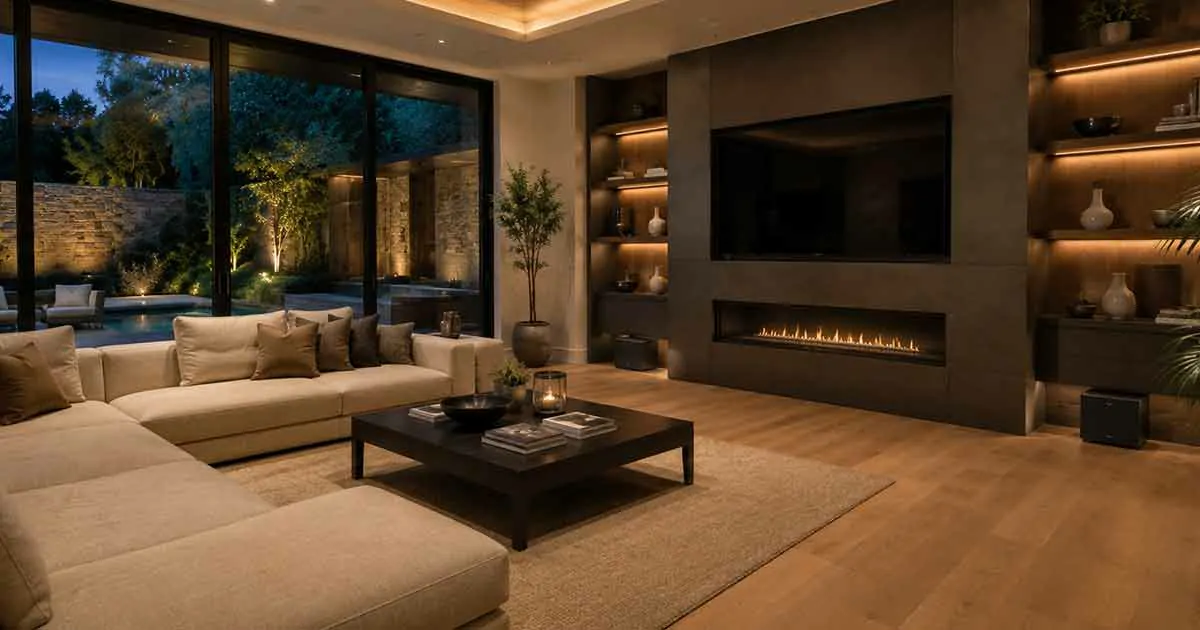
A smart home audio system can turn an ordinary home into a connected entertainment environment where music, podcasts, television audio, and other content can be controlled from multiple rooms. Instead of relying on a single speaker in one location, modern audio systems can connect speakers, streaming services, televisions, amplifiers, and smart home devices into a coordinated setup.
Whether you want background music throughout your home, better television sound, or a dedicated whole-home audio system, smart audio technology offers flexible options for different homes and budgets.
In this guide, we explain how smart home audio systems work, the main components to consider, different installation options, wireless and wired solutions, multi-room audio, voice control, and the factors that can help you choose the right system.
Table of Contents
What Is a Smart Home Audio System?
A smart home audio system is a connected audio setup that allows you to play and control sound using network-connected devices and software.
Unlike a traditional audio system that may require physical controls or a dedicated receiver, a smart audio setup can often be managed through a smartphone, tablet, smart display, remote control, or voice assistant.
A smart home audio system may include:
- Wireless or wired speakers
- Network audio players
- Amplifiers
- AV receivers
- Soundbars
- Subwoofers
- Streaming services
- Smart home controllers
- Mobile applications
- Voice assistants
- Home Wi-Fi or wired networking
The exact configuration depends on the size of the home, the type of audio you want, and whether you prefer a simple wireless system or a professionally installed whole-home solution.
How Does Smart Home Audio Work?
Smart home audio systems typically use a home network to connect compatible audio devices.
For example, you might have a speaker in the living room, another in the kitchen, and a third in the bedroom. Each device connects to the same home network and can be controlled through a compatible application.
Depending on the system, you may be able to:
- Play different music in different rooms
- Synchronize the same music throughout the home
- Adjust volume independently
- Group multiple rooms together
- Stream music from online services
- Control playback from a phone
- Use voice commands
- Automate certain audio functions
The network is particularly important because Audio devices depend on a stable Wi-Fi network for reliable communication between components.
A strong and stable home network can therefore make a significant difference to the overall experience.
Smart Home Audio vs Smart Speakers
Smart home audio and smart speakers are related, but they are not exactly the same thing.
A smart speaker is usually an individual speaker that provides features such as wireless streaming, voice control, and access to a digital assistant.
A smart home audio system, on the other hand, can include multiple speakers and audio components working together across a home.
For example, a smart speaker may be enough for a bedroom or small office. A larger home may benefit from a multi-room audio system with several speakers, amplifiers, and network-connected components.
This distinction is important when planning an audio system because you should choose the architecture based on your overall needs rather than simply buying individual speakers.
Key Components of a Smart Home Audio System
A complete system can contain several different components. You do not necessarily need all of them, but understanding their roles makes it easier to design the right setup.
Speakers
Speakers are the most visible part of the audio system and have the biggest effect on sound quality.
Common options include:
- Bookshelf speakers
- Floor-standing speakers
- In-wall speakers
- In-ceiling speakers
- Outdoor speakers
- Soundbars
- Wireless speakers
The best choice depends on the room, available space, desired sound quality, and installation requirements.
Amplifiers
An amplifier provides the power required by passive speakers.
Some wireless speakers and powered speakers already contain built-in amplification. Passive speakers, however, normally require a separate amplifier or receiver.
Multi-zone amplifiers can also distribute audio to several areas of a home.
Audio Receivers
An AV receiver can act as a central component for home entertainment systems.
It can connect sources such as:
- Television
- Game consoles
- Blu-ray players
- Streaming devices
- Media players
- External audio equipment
AV receivers are particularly useful when the system needs to combine television, movies, music, and surround sound.
Network Audio Players
A network audio player connects traditional audio equipment to a home network.
This can be useful if you already own high-quality speakers or an amplifier and want to add modern streaming capabilities without replacing the entire system.
Subwoofers
A subwoofer is designed to reproduce low-frequency sound.
It can improve the experience when listening to music or watching movies, particularly in larger rooms or dedicated entertainment spaces.
Controllers and Apps
Many smart audio systems are controlled through a mobile application.
Depending on the platform, the app may allow you to:
- Select rooms
- Choose music
- Adjust volume
- Create speaker groups
- Manage playlists
- Control playback
- Configure settings
Some systems can also integrate with broader smart home controllers.
What Is Multi-Room Audio?
Multi-room audio allows you to distribute audio throughout multiple areas of a home.
Instead of using separate systems that operate independently, compatible devices can communicate through a common platform.
A multi-room system can be configured in several ways.
Synchronized Audio
The same music can play simultaneously in multiple rooms.
This is useful when:
- Hosting guests
- Moving around the house
- Listening to music while cleaning
- Entertaining outdoors and indoors
Independent Room Playback
Different rooms can play different content at the same time.
For example, one person could listen to music in the living room while another listens to a podcast in the bedroom.
This requires a system that supports independent zones or rooms.
Grouped Rooms
Some platforms allow you to temporarily group rooms together.
You could combine the kitchen, dining room, and living room for a party and then separate them again later.
Wireless vs Wired Smart Home Audio
One of the biggest decisions when designing a smart home audio system is whether to use wireless, wired, or hybrid equipment.
Wireless Audio
Wireless systems communicate primarily through technologies such as Wi-Fi or Bluetooth.
Wi-Fi-based audio is particularly useful for multi-room installations because it can support network-based streaming and room grouping.
Advantages include:
- Easier installation
- Less cabling
- Flexible speaker placement
- Easy expansion
- Suitable for existing homes
The main limitation is dependence on the quality of the wireless network.
Wired Audio
Wired systems use physical speaker and network connections.
They can provide a highly reliable installation and are particularly attractive during new construction or major renovations.
Advantages include:
- Reliable connectivity
- Reduced dependence on Wi-Fi
- Clean permanent installation
- Excellent suitability for in-wall and in-ceiling speakers
- Potentially better scalability for large installations
The main disadvantage is installation complexity.
Hybrid Audio Systems
A hybrid approach combines wired and wireless equipment.
For example, a home could use wired in-ceiling speakers in the main living areas while using wireless speakers in bedrooms and other rooms.
For many homes, this provides a practical balance between reliability, installation effort, and flexibility.
Wi-Fi and Networking Requirements
Your home network plays an important role in a connected audio system.
Audio streaming does not necessarily require extremely fast internet service, but the local network should be stable and capable of handling multiple connected devices.
Potential problems include:
- Weak Wi-Fi coverage
- Network congestion
- Poor router placement
- Interference
- Outdated networking equipment
- Unstable connections
If multiple audio devices are used simultaneously, network reliability becomes increasingly important.
For larger homes, a well-designed Wi-Fi system or wired Ethernet infrastructure can provide a stronger foundation.
Voice Control for Smart Home Audio
Voice control can make a smart audio system more convenient.
Depending on the devices and platform you choose, you may be able to use voice commands to:
- Start music
- Pause playback
- Skip tracks
- Change volume
- Play content in a specific room
- Group rooms
- Request a particular playlist or station
Voice control is especially useful when your hands are occupied.
However, voice control should be considered a convenience feature rather than the only method of controlling the system. A good setup should still provide reliable controls through an application or physical interface.
Streaming Services and Smart Audio
Modern audio systems can connect to a variety of streaming platforms.
Depending on the ecosystem, users may be able to access:
- Music streaming
- Internet radio
- Podcasts
- Audiobooks
- Personal music libraries
Before buying equipment, check whether your preferred streaming services are supported.
Compatibility can vary between platforms, and some systems may offer a better experience with particular services.
Smart Home Audio for Different Rooms
Different rooms have different audio requirements.
Living Room
The living room is often the central entertainment area.
A suitable system could combine:
- Television audio
- Soundbar or AV receiver
- Front speakers
- Surround speakers
- Subwoofer
- Streaming capabilities
If movies and television are important, prioritize equipment that supports the required home theater formats.
Kitchen
The kitchen often benefits from compact speakers that are easy to control.
In-ceiling speakers or a compact wireless speaker can work well where counter space is limited.
Bedroom
A bedroom audio system usually prioritizes simplicity.
A compact wireless speaker or discreet in-wall solution may be sufficient for music, podcasts, or alarms.
Bathroom
Bathrooms require additional consideration because of moisture.
Equipment should be appropriate for the environment and installed according to applicable electrical and building requirements.
Outdoor Areas
Outdoor audio can extend entertainment beyond the main living space.
Outdoor-rated speakers are generally more appropriate than standard indoor equipment because they are designed to withstand environmental conditions.
In-Wall and In-Ceiling Audio
For homeowners who want a clean appearance, architectural speakers can be installed inside walls or ceilings.
These speakers can reduce visible equipment and integrate into the room more discreetly.
In-wall and in-ceiling systems are particularly attractive during:
- New construction
- Major renovations
- Home theater projects
- Whole-home audio installations
However, installation can be significantly more complicated than placing wireless speakers.
It may require speaker wiring, wall access, professional installation, and careful speaker positioning.
Smart Home Audio and Home Automation
Audio can become part of a broader smart home automation system.
For example, an automation routine could:
- Start music at a specific time
- Lower the volume when a doorbell rings
- Play audio in selected rooms
- Turn off entertainment equipment when everyone leaves
- Start a morning playlist
- Coordinate lighting and audio during an event
This is where smart audio becomes more than simple music playback.
Instead of treating the audio system as an isolated device, it can become one component of the wider connected home.
How to Choose a Smart Home Audio System
Choosing the right system starts with understanding how you intend to use it.
1. Determine the Number of Rooms
Start by identifying where you actually need audio.
You may only need one or two rooms initially. If you expect to expand later, choose a platform that supports additional rooms.
2. Decide Between Wireless and Wired
Wireless equipment is usually easier to install in an existing home.
Wired audio may be more suitable for new construction or major remodeling projects.
3. Consider Sound Quality
Not every system is designed for the same listening experience.
Think about whether you primarily want:
- Background music
- High-quality music playback
- Television audio
- Home theater
- Whole-home entertainment
Your answer will influence the type of equipment you need.
4. Check Platform Compatibility
Before purchasing equipment, verify compatibility with your existing smart home ecosystem.
A system that works well independently may be less useful if it cannot communicate with the other devices in your home.
5. Check Streaming Compatibility
Make sure the system supports the services you regularly use.
This can prevent compatibility problems after installation.
6. Evaluate Network Requirements
If you are installing several network-connected audio devices, check your Wi-Fi coverage and network capacity.
A reliable network can prevent many common connectivity problems.
7. Plan for Expansion
A smart audio system does not necessarily have to be installed throughout the entire house immediately.
You can start with important rooms and expand over time if the platform supports additional zones.
Common Smart Home Audio Mistakes
A few planning mistakes can reduce the performance of an otherwise good system.
Choosing Equipment Without Checking Compatibility
Buying devices from different ecosystems without confirming compatibility can create unnecessary limitations.
Always check supported platforms before purchasing.
Ignoring the Home Network
A smart audio system depends on connectivity.
If Wi-Fi coverage is poor, adding more speakers may not solve the underlying problem.
Buying More Equipment Than You Need
A large system is not automatically better.
A carefully planned two- or three-room system can provide a better experience than an unnecessarily complicated installation.
Forgetting Room Acoustics
The physical room affects how audio sounds.
Furniture, flooring, walls, ceilings, and room dimensions can all influence sound quality.
Speaker placement therefore matters as much as the specifications of the equipment.
Failing to Plan for Future Expansion
If you expect your system to grow, choose a platform that can accommodate additional rooms and devices.
This can prevent expensive replacements later.
Smart Home Audio System Costs
The cost of a smart home audio system can vary considerably.
A basic wireless setup may require only a few connected speakers. A more advanced whole-home system can involve multiple speakers, amplifiers, network equipment, wiring, and professional installation.
Factors that influence cost include:
- Number of rooms
- Number of speakers
- Speaker quality
- Wired or wireless installation
- Amplification requirements
- Home theater equipment
- Network upgrades
- Professional installation
- Architectural speakers
- Outdoor audio
Rather than focusing only on the initial equipment price, consider the total cost of installation and future expansion.
Are Smart Home Audio Systems Worth It?
A smart home audio system can be worthwhile if you regularly listen to music, podcasts, radio, or other audio throughout your home.
The biggest advantages are convenience, flexibility, and centralized control.
A well-designed system can allow you to move between rooms without interrupting playback and can make it easier to manage multiple audio zones.
However, homeowners who only need occasional audio in one room may not need a complex whole-home installation.
The best solution depends on the size of your home, your entertainment habits, your budget, and how much integration you want with other smart home technologies.
Smart Home Audio vs Traditional Audio Systems
Traditional audio systems can still provide excellent sound quality, particularly when built around high-quality amplifiers and speakers.
Smart audio adds another layer of convenience through network connectivity, mobile applications, streaming services, automation, and multi-room control.
The two approaches are not necessarily opposites.
A traditional high-quality audio system can often be upgraded with network-connected components, allowing homeowners to combine high-quality sound with modern smart features.
Tips for Building a Reliable Smart Audio System
A few planning principles can make the system easier to use and maintain:
- Start with the rooms that matter most.
- Choose a compatible ecosystem.
- Use reliable networking equipment.
- Plan speaker placement before installation.
- Consider wired connections for permanent installations.
- Use appropriate speakers for bathrooms and outdoor areas.
- Check streaming-service compatibility.
- Leave room for future expansion.
- Keep firmware and applications updated.
- Avoid unnecessary complexity.
A well-planned system should feel simple to use even if the technology behind it is sophisticated.
The Future of Smart Home Audio
Smart audio continues to become more integrated with connected home technology.
Future systems are likely to place greater emphasis on multi-room control, automation, spatial audio, voice interaction, improved wireless connectivity, and integration with other smart home devices.
As smart home ecosystems become more interconnected, audio can increasingly operate as part of broader home routines rather than as a standalone entertainment system.
This could make it easier to coordinate music, television, lighting, security, and other connected devices through a single environment.
Final Thoughts
A smart home audio system can provide a flexible way to bring connected entertainment into multiple areas of a home.
From a simple wireless speaker setup to a professionally installed whole-home audio system, there are solutions for different budgets, homes, and listening preferences.
The most important step is to plan the system around your actual needs. Consider the number of rooms, network reliability, speaker placement, sound quality, compatibility, streaming services, and future expansion before buying equipment.
When these factors are considered together, a smart audio system can become a useful part of the connected home rather than simply another collection of smart devices.