
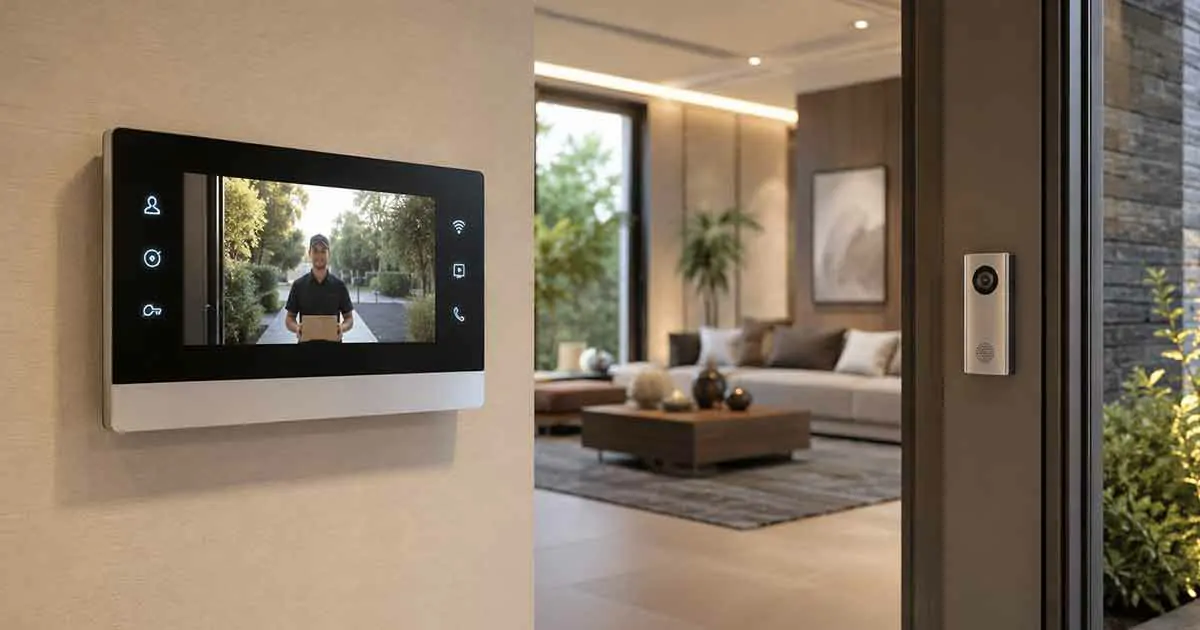
A smart home intercom system makes it easier to communicate between rooms, floors, entrances, and outdoor areas without relying on traditional intercom wiring. Modern smart intercoms can combine two-way audio, video, mobile notifications, remote communication, and smart home integration in a single system.
Whether you want to communicate between family members, answer the front door, check who is outside, or connect different areas of a larger home, a smart intercom can provide a convenient communication solution.
In this guide, we explain what smart home intercom systems are, how they work, the different types available, their main features, benefits, limitations, and what to consider before choosing one.
Table of Contents
What Is a Smart Home Intercom System?
A smart home intercom system is a connected communication system that allows people to communicate between different areas of a home or with visitors at an entrance.
Unlike older wired intercoms, modern systems can use Wi-Fi, wireless networks, mobile applications, or other smart home technologies to connect communication devices.
Depending on the system, users may be able to:
- Talk between rooms
- Communicate with people at the front door
- See visitors through video
- Receive notifications on a smartphone
- Answer calls remotely
- Communicate with multiple rooms
- Integrate the intercom with other smart home devices
Some systems are designed primarily for communication, while others combine intercom functionality with access control, video doorbells, or broader home automation.
How Does a Smart Intercom Work?
A smart intercom typically consists of one or more communication units connected through a home network.
A basic system may include an indoor station and an outdoor station.
When someone activates the outdoor unit, the indoor station can notify the homeowner. Depending on the system, the homeowner can then speak with the visitor, view video, or unlock a compatible door.
Some smart intercom systems also use smartphone applications.
This allows homeowners to receive calls even when they are not in the same room or even when they are away from home.
The communication process can therefore look like this:
Visitor or user → intercom station → home network → indoor device or smartphone → two-way communication
More advanced systems can connect several devices throughout the home.
Types of Smart Home Intercom Systems
Smart intercom systems come in several configurations.
Choosing the right type depends on the size of the home, the communication requirements, and whether the system needs to work with other smart home equipment.
Room-to-Room Intercoms
Room-to-room intercoms are designed primarily for communication between different areas inside the home.
For example, parents could communicate with children in another room without calling them on a phone.
These systems can be useful in:
- Multi-story homes
- Large houses
- Homes with separate living areas
- Home offices
- Bedrooms
- Kitchens
The main advantage is convenience.
Video Intercom Systems
A video intercom adds a camera to the communication system.
Instead of communicating through audio alone, users can see the person on the other side.
Video can be particularly useful for entrance communication because homeowners can visually identify visitors before deciding whether to open the door.
Door Intercom Systems
Door intercoms are installed near an exterior entrance.
They can allow visitors to communicate with people inside the home.
Depending on the system, a door intercom may include:
- Microphone
- Speaker
- Camera
- Doorbell button
- Motion detection
- Smartphone notifications
- Door lock integration
This makes an intercom system particularly useful for front-door communication.
Wireless Smart Intercoms
Wireless intercoms reduce the need for dedicated communication wiring.
Many modern systems communicate through Wi-Fi or another wireless network.
Wireless installation can be easier when retrofitting an existing home because homeowners may not need to run new cables between rooms.
However, wireless performance depends on network coverage and the location of the devices.
Wired Smart Intercoms
Wired systems can provide reliable communication and may be appropriate for new construction or major renovations.
They can be particularly useful when communication devices need a permanent connection and stable power.
The main disadvantage is installation complexity when the necessary wiring does not already exist.
Smart Intercom vs Traditional Intercom
Traditional intercom systems generally use dedicated wiring and fixed communication stations.
Smart intercoms can provide additional functionality through network connectivity.
| Traditional Intercom | Smart Intercom |
|---|---|
| Often uses dedicated wiring | Can use Wi-Fi or network connectivity |
| Fixed communication stations | Can support smartphones and smart devices |
| Limited remote access | Remote communication may be available |
| Primarily voice communication | Can support audio and video |
| Limited integration | Can integrate with smart home systems |
| Usually operates locally | May offer cloud-connected features |
This does not mean traditional systems are always inferior.
For some homes, a simple wired intercom may be more reliable and easier to maintain.
The advantage of a smart system is the additional flexibility and connectivity it can provide.
Key Features to Look For in a Smart Intercom
Not every smart intercom offers the same capabilities.
Before purchasing one, consider the features that are most important for your home.
Two-Way Audio
Two-way audio is the foundation of an intercom system.
Look for clear microphones and speakers that provide understandable communication without excessive background noise.
Video
If you want to identify visitors, a camera can be an important feature.
Look for:
- Clear image quality
- Wide viewing angle
- Good low-light performance
- Appropriate placement
- Privacy controls
Smartphone Access
Some systems allow communication through a smartphone application.
This can be useful when you are away from the room or away from home.
For example, a homeowner could receive an intercom notification while shopping or working elsewhere.
Multiple Stations
Large homes may benefit from multiple indoor stations.
Before purchasing, check how many devices the system supports and whether they can communicate independently or as a group.
Door Lock Integration
Some smart intercoms can integrate with compatible smart locks or access-control systems.
This can allow a homeowner to communicate with a visitor and then unlock the door remotely.
However, compatibility should always be verified before purchasing.
Motion Detection
Some systems can detect movement near an entrance.
This can provide additional awareness when someone approaches the property.
Motion detection can be especially useful when combined with video and smartphone notifications.
Night Vision
For an outdoor intercom, night vision can improve visibility in low-light conditions.
This is particularly important for entrances that are not well illuminated.
Notification Support
Smart notifications can alert homeowners when someone presses the intercom button or triggers a supported event.
The quality and reliability of notifications depend on the specific system and network connection.
Benefits of a Smart Home Intercom
A smart intercom can provide several practical benefits.
Convenient Communication
Family members can communicate between rooms without shouting or calling each other on a phone.
Easier Visitor Communication
An intercom can allow homeowners to communicate with visitors before opening the door.
Remote Communication
Systems with mobile applications can allow homeowners to communicate even when they are away from the property.
Better Awareness
Video and notifications can provide additional information about activity near an entrance.
Smart Home Integration
Compatible intercoms can work alongside other connected devices, creating a more unified smart home environment.
Useful for Large Homes
Intercoms can be particularly valuable in larger homes where communicating between distant rooms is inconvenient.
Smart Intercoms for Front Doors
One of the most practical applications of smart intercom technology is front-door communication.
A visitor can use the outdoor station to initiate a conversation.
The homeowner can then communicate through an indoor device or smartphone.
Depending on the system, the homeowner may also be able to:
- View the visitor
- Receive a notification
- Speak through the intercom
- Unlock a compatible door
- Monitor the entrance
This makes smart intercoms particularly useful for homeowners who want more control over visitor communication.
However, a smart intercom should not automatically be treated as a smart home security system.
Its primary purpose is communication, even when it includes cameras or access-control features.
Smart Intercoms and Smart Locks
A smart intercom can become more useful when integrated with a compatible smart lock.
The basic process can be:
Visitor arrives → Intercom notification → Homeowner communicates → Visitor is identified → Door is unlocked if appropriate
This can provide a convenient access-control experience.
However, security should remain a priority.
Only use compatible devices from reputable manufacturers, protect user accounts with strong credentials, and keep firmware and software updated.
Smart Intercoms and Video Doorbells
Smart intercoms and video doorbells can appear similar because both can provide visitor communication and video.
However, their intended use can be different.
A video doorbell is generally designed around the front entrance and visitor detection.
An intercom system may be designed for broader communication between multiple rooms, entrances, or areas of a property.
Some modern devices combine both concepts.
For a homeowner who only needs front-door communication, a video doorbell may be sufficient.
For a large home requiring communication between several areas, a dedicated intercom system may be more appropriate.
Can Smart Intercoms Work Without the Internet?
Some smart intercom systems can continue providing local communication when the internet is unavailable.
Others rely heavily on cloud services for mobile access, remote communication, notifications, or other features.
This distinction is important when selecting a system.
If reliable local communication is a priority, check whether the intercom supports local operation and what functions remain available during an internet outage.
A system may continue working between local devices while remote smartphone functionality becomes temporarily unavailable.
Smart Intercoms and Home Wi-Fi
Wireless smart intercoms depend heavily on network quality.
A weak Wi-Fi signal can cause:
- Delayed notifications
- Poor audio quality
- Video interruptions
- Connection failures
- Unreliable remote access
Before installing multiple wireless intercom stations, check Wi-Fi coverage throughout the home.
Large homes may benefit from a properly configured mesh network.
Network reliability is especially important for outdoor intercoms because exterior walls and long distances can weaken wireless signals.
Privacy and Security Considerations
Because smart intercoms can include microphones, cameras, and internet connectivity, privacy and security should be considered before installation.
Choose devices from established manufacturers and review how they handle recordings and user data.
Important security practices include:
- Use a strong unique password
- Enable two-factor authentication when available
- Keep firmware updated
- Secure your home Wi-Fi network
- Review app permissions
- Limit access to trusted users
- Disable unnecessary features
For video-enabled systems, consider camera placement carefully so that the device does not unnecessarily capture private areas.
How to Choose the Right Smart Intercom
Start by determining what you actually need the system to accomplish.
For Room-to-Room Communication
Choose a system that supports multiple indoor stations and reliable local communication.
For Front-Door Communication
Prioritize video, two-way audio, notifications, and compatibility with your entrance setup.
For Remote Access
Choose a system with reliable smartphone support and remote communication.
For Smart Home Integration
Check compatibility with the smart home ecosystem and devices you already use.
For Large Homes
Pay particular attention to network coverage, maximum device count, and communication range.
For New Construction
A wired system may be worth considering because network and power infrastructure can be planned during construction.
Smart Intercom Installation
Installation requirements depend on the system.
Wireless systems are generally easier to install because they require less dedicated communication wiring.
However, outdoor stations may still require a reliable power source and suitable mounting.
Wired systems may require professional installation, particularly when cables must be routed through walls.
For systems connected to electric door locks or access-control equipment, professional installation may be advisable to ensure that the electrical and security components are configured correctly.
Common Mistakes to Avoid
Choosing Based Only on Price
The cheapest intercom may not provide the reliability, audio quality, or compatibility needed for your home.
Ignoring Wi-Fi Coverage
A wireless intercom is only as reliable as the network supporting it.
Buying Without Checking Compatibility
Smart home integration can vary significantly between manufacturers.
Installing Cameras Without Considering Privacy
Outdoor and indoor cameras should be positioned carefully.
Forgetting Future Expansion
If you may add additional rooms or entrances later, make sure the system can support additional devices.
Overcomplicating the System
Not every home needs advanced automation.
Choose features based on actual communication and access needs.
Are Smart Home Intercom Systems Worth It?
A smart intercom can be worthwhile when communication between different areas of a property is genuinely useful.
It can be particularly valuable in larger homes, multi-story properties, homes with separate living areas, or properties where front-door communication is important.
For a small home where everyone is usually close to one another, a dedicated intercom may provide less value.
The right choice depends on the home’s layout, communication requirements, network infrastructure, and desired smart home integrations.
Final Thoughts
A smart home intercom system can turn traditional room-to-room and visitor communication into a more connected experience.
Modern systems can combine two-way audio, video, smartphone access, notifications, multiple communication stations, and integration with compatible smart locks and other connected devices.
The most important factors are not simply the number of features a system offers. Reliability, compatibility, network performance, privacy, installation requirements, and ease of use should all be considered before making a decision.
For homeowners who need convenient communication across rooms or want greater control over front-door interactions, a well-designed smart intercom can become a useful part of a modern connected home.