
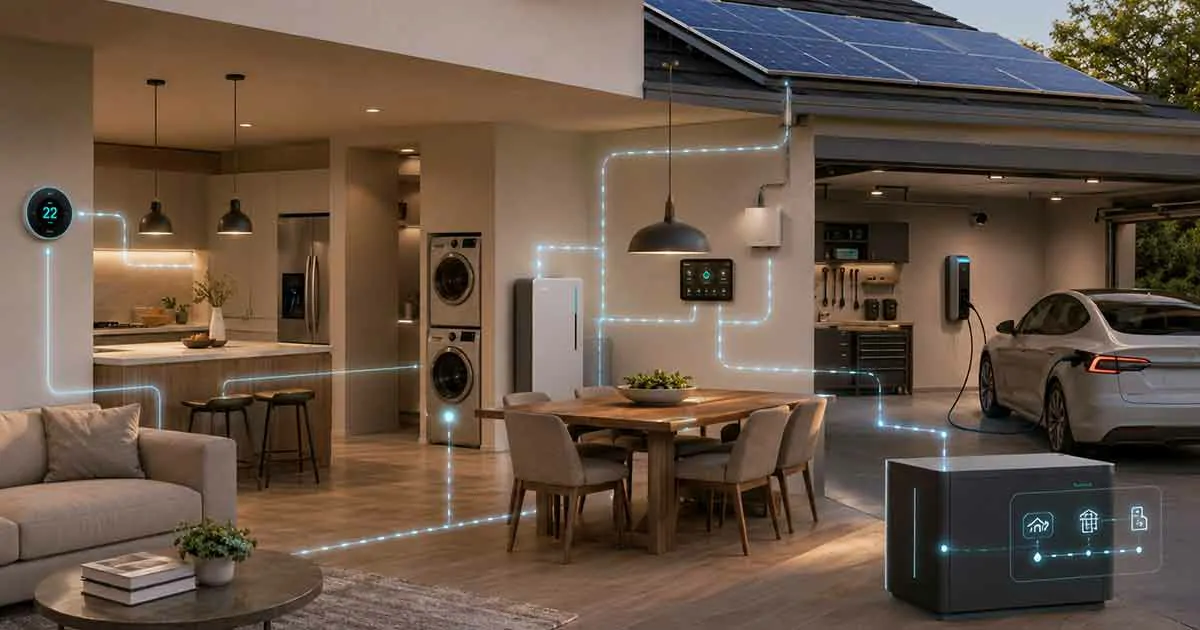
Managing energy at home is no longer limited to turning off lights or adjusting the thermostat manually. Smart home energy management systems use connected devices, sensors, automation, and intelligent controls to help homeowners understand how energy is used and make better decisions about when and how it is consumed.
Unlike a basic energy monitoring system that primarily tracks electricity usage, an energy management system can actively control connected devices and optimize energy consumption according to schedules, occupancy, electricity rates, and household needs.
For homeowners looking to reduce wasted energy, improve efficiency, and create a more automated home, smart energy management can provide a practical way to coordinate multiple systems from a single connected environment.
In this guide, we explain how smart home energy management systems work, what components they use, their benefits and limitations, and how to determine whether one is right for your home.
Table of Contents
What Is a Smart Home Energy Management System?
A smart home energy management system is a connected system designed to monitor, control, and optimize energy-consuming devices and systems throughout a home.
It can coordinate devices such as:
- Smart thermostats
- Smart plugs
- Smart lighting
- Smart appliances
- Electric vehicle chargers
- Heating and cooling equipment
- Solar energy systems
- Battery storage systems
- Water heaters
The goal is not simply to show how much electricity a home is consuming. Instead, the system can use available information to determine when energy should be used, reduced, shifted, or automatically controlled.
For example, a smart system could reduce heating or cooling when nobody is home, delay certain appliances until a lower-cost electricity period, or coordinate an EV charger with household energy demand.
This makes energy management a more active process than simple energy monitoring.
How Smart Home Energy Management Works
Smart energy management generally combines several technologies that communicate with one another.
A typical system includes connected devices, sensors, a central control platform, automation rules, and sometimes information about electricity prices or renewable energy production.
The basic process looks like this:
Collect information → Analyze conditions → Make decisions → Control devices → Optimize energy use
For example, occupancy sensors may detect that everyone has left the house. The energy management system can then adjust the thermostat, turn off unnecessary lighting, and reduce the operation of selected devices.
When occupants return, predefined automation rules can restore normal settings.
Some systems can also respond to changing electricity prices or available solar generation.
Smart Energy Management vs Energy Monitoring
These two concepts are closely related, but they are not identical.
Energy monitoring primarily focuses on measuring and reporting energy consumption.
Energy management goes further by using that information to make decisions and control connected equipment.
For example:
| Energy Monitoring | Energy Management |
|---|---|
| Measures electricity consumption | Measures and analyzes energy use |
| Displays usage data | Uses data to make decisions |
| Helps identify energy waste | Can automatically reduce energy waste |
| Primarily provides information | Can control connected devices |
| Focuses on visibility | Focuses on optimization |
A monitoring system might tell you that your home used significantly more electricity during the afternoon.
An energy management system may use that information to automatically adjust selected devices, shift flexible loads, or change heating and cooling settings.
This distinction is important because a smart home energy management system is intended to actively optimize energy use, not simply report it.
Key Components of a Smart Energy Management System
A complete system can include several different components depending on the home and the homeowner’s goals.
Smart Thermostats
Heating and cooling can represent a significant portion of household energy consumption.
Smart thermostats can use schedules, occupancy information, temperature sensors, and other data to automatically adjust heating and cooling.
For example, the thermostat may reduce heating or cooling when the home is empty and restore a comfortable temperature before residents return.
Smart Plugs
Smart plugs provide a simple way to control certain appliances remotely or automatically.
They can be useful for devices that do not have built-in smart functionality.
Automation rules can turn selected equipment on or off according to schedules, occupancy, or other conditions.
However, smart plugs should only be used with appliances that are compatible with their electrical ratings and intended use.
Smart Lighting
Connected lighting systems allow homeowners to automate when lights turn on and off.
Lighting can be controlled according to:
- Time of day
- Occupancy
- Motion
- Schedules
- Scenes
- Remote commands
This can help reduce unnecessary lighting when rooms are unoccupied.
Smart Window Controls
Smart blinds, shades, and other automated window coverings can become part of a home energy management system.
Depending on the setup, they can respond to:
- Time of day
- Sunlight
- Indoor temperature
- Occupancy
- Smart home routines
This can help manage sunlight and indoor comfort while coordinating window-related actions with heating and cooling.
Smart Appliances
Some modern appliances can communicate with smart home platforms and provide additional control options.
Depending on the appliance, energy management may include scheduling operation during specific periods or coordinating usage with other household systems.
Electric Vehicle Chargers
An EV charger can represent a substantial electrical load.
Smart charging systems can help homeowners schedule vehicle charging instead of automatically charging at maximum power whenever the vehicle is connected.
This can be particularly useful when electricity prices vary throughout the day or when a home generates solar energy.
Solar Panels
Homes with solar panels can potentially use energy management systems to coordinate household consumption with solar production.
For example, flexible loads may be scheduled during periods when solar generation is high.
This can increase the usefulness of locally generated electricity.
Home Battery Storage
Battery systems can store electricity for later use.
When integrated with an energy management system, batteries may be used strategically according to household demand, solar production, or electricity pricing.
The exact capabilities depend on the battery system and its control software.
Benefits of Smart Home Energy Management
Smart energy management can provide several advantages beyond simply knowing how much electricity a home uses.
Lower Energy Waste
Automation can reduce unnecessary operation of devices.
For example, heating, cooling, and lighting can be adjusted when rooms are empty instead of operating according to fixed schedules.
Better Control Over Energy Use
Instead of managing individual devices separately, homeowners can create coordinated automation rules.
A single system can potentially manage multiple types of equipment.
More Convenient Automation
Energy efficiency does not always require constant attention.
Once appropriate automation rules are configured, the system can make certain adjustments automatically.
Improved Use of Renewable Energy
Homeowners with solar panels can use smart controls to schedule flexible energy consumption when renewable energy production is available.
This can help increase the usefulness of generated solar electricity.
Better EV Charging Management
Smart EV charging can prevent vehicle charging from unnecessarily competing with other high-energy appliances.
It can also provide greater control over charging schedules.
More Efficient Heating and Cooling
Smart thermostats and occupancy-based automation can help prevent heating or cooling an empty home.
Because HVAC systems can consume substantial energy, optimization in this area can have a meaningful effect on overall household consumption.
Smart Energy Management and Time-of-Use Electricity Rates
Some electricity providers use time-of-use pricing, where electricity costs vary depending on the time of day.
In these situations, energy management can become especially useful.
Instead of operating every flexible appliance whenever convenient, homeowners may be able to schedule certain activities during lower-cost periods.
Examples include:
- EV charging
- Water heating
- Laundry
- Dishwashing
- Battery charging
- Other flexible electrical loads
The system can potentially coordinate these loads according to predefined schedules or electricity price information.
However, availability and pricing structures vary significantly by location and utility provider.
Smart Energy Management With Solar Power
Solar-powered homes can benefit from coordinated energy management.
Solar production is generally variable throughout the day. A home may produce substantial electricity during certain daylight hours but much less in the evening.
An energy management system can help shift some flexible energy consumption toward periods when solar generation is available.
For example, instead of charging an EV at night, a homeowner could schedule charging during periods of strong daytime solar production.
Other flexible loads may also be coordinated with solar generation.
The objective is to make better use of available renewable energy rather than consuming electricity without considering when it is being produced.
Occupancy-Based Energy Management
One of the most useful forms of smart energy automation is occupancy-based control.
Sensors or connected devices can provide information about whether rooms or the home are occupied.
Automation can then respond to those conditions.
For example:
Nobody home → reduce HVAC → turn off unnecessary lights → adjust selected devices
When residents return, the system can restore appropriate settings.
This approach can be more efficient than relying exclusively on fixed schedules because household routines can change from day to day.
Smart Home Energy Management and Automation
Energy management becomes more powerful when combined with broader smart home automation.
For example, a homeowner could create a rule such as:
If the house is empty for 30 minutes, reduce HVAC operation and turn off selected lights.
Another automation might be:
If solar production is high and the EV is connected, begin scheduled charging.
More advanced systems can combine several conditions before taking action.
This allows energy management to become part of the overall smart home rather than operating as an isolated system.
Smart Windows and Window Energy Management
Windows can have a significant effect on indoor temperature and household energy use. Depending on their design, orientation, glazing, and exposure to sunlight, windows can contribute to heat gain during warmer periods or heat loss during colder weather.
Smart home energy management can address some of these effects by coordinating window-related devices with other systems in the home.
Smart window energy management can include:
- Smart blinds and shades
- Automated window coverings
- Window sensors
- Temperature sensors
- Sunlight-based automation
- Integration with smart thermostats
For example:
Strong afternoon sunlight → smart shades close → indoor heat gain is reduced.
Another automation could be:
Window opens → compatible HVAC routine changes.
Window sensors can also provide useful information to an energy management system. If a window remains open while heating or cooling is operating, the system can potentially use that condition as a trigger for an appropriate automation.
Smart window coverings can also be scheduled according to time of day, sunlight, temperature, or household routines.
However, smart window controls are different from energy-efficient windows. Energy-efficient windows improve the physical thermal performance of the building, while smart window management uses connected technology to control or respond to conditions.
For the best results, homeowners can combine efficient windows with smart shades, sensors, and HVAC automation.
Does Smart Energy Management Require a Smart Home Hub?
Not necessarily.
Some energy management products can operate independently through their own applications and cloud platforms.
Others can integrate with broader smart home ecosystems or hubs.
A hub can be useful when homeowners want different devices to communicate through a centralized platform.
However, compatibility is critical.
Before purchasing equipment, check whether the devices support the same ecosystem, communication standards, or integration methods.
A system that cannot communicate reliably with the devices you already own may provide limited value.
Common Smart Energy Management Strategies
There are several ways homeowners can use smart energy management.
Schedule Flexible Loads
Devices that do not need to operate immediately can be scheduled for specific times.
Reduce Energy Use When Away
Automation can adjust selected systems when nobody is home.
Coordinate Heating and Cooling
Smart thermostats can use schedules and occupancy information to reduce unnecessary HVAC operation.
Manage EV Charging
Charging can be scheduled around household demand, electricity prices, or renewable energy availability.
Use Solar Energy More Effectively
Flexible devices can potentially operate when solar production is higher.
Automate Lighting
Lights can respond to occupancy, schedules, or environmental conditions.
Coordinate Multiple Devices
Instead of controlling each device separately, automation rules can coordinate several systems simultaneously.
Manage Window Coverings
Smart shades can automatically respond to sunlight, temperature, or scheduled routines.
For example:
Strong sunlight → shades close.
Evening → shades open or close according to the household routine.
This can complement HVAC and other energy-saving strategies.
How to Choose a Smart Home Energy Management System
Choosing the right system depends on your home’s equipment, energy goals, and budget.
Check Device Compatibility
Before purchasing, determine which devices and systems need to be integrated.
Consider:
- Smart thermostat compatibility
- Lighting compatibility
- Smart plug compatibility
- EV charger compatibility
- Solar system compatibility
- Battery compatibility
- Smart home platform compatibility
- Smart blinds and shades compatibility
- Window sensor compatibility
- Smart window automation support
Consider Your Energy Goals
Different homeowners have different priorities.
You may primarily want to:
- Reduce electricity consumption
- Lower energy costs
- Improve HVAC efficiency
- Optimize solar usage
- Manage EV charging
- Automate energy-saving routines
Choose a system that directly supports your main objectives.
Look at Automation Features
A system with extensive automation capabilities can be more useful than one that simply provides dashboards and reports.
Look for features such as:
- Scheduling
- Occupancy automation
- Device control
- Energy optimization
- Remote control
- Notifications
- Integration with other smart devices
Consider Ease of Use
An energy management system should make energy control easier, not more complicated.
Look for a clear interface and straightforward automation controls.
If a system is difficult to configure, homeowners may not take advantage of its advanced features.
Evaluate Privacy and Security
Connected energy systems can collect information about household activity and device usage.
Before purchasing, review the manufacturer’s privacy policies and security practices.
Use strong account credentials and enable available security features such as two-factor authentication.
Are Smart Energy Management Systems Worth It?
For some households, smart energy management can provide meaningful value.
It is particularly attractive when a home has multiple controllable energy systems, such as a smart thermostat, solar panels, an EV charger, or battery storage.
However, the value depends on the equipment already installed and how much energy can actually be optimized.
A homeowner with only a few basic appliances may not need a complex energy management platform.
In contrast, a home with solar generation, battery storage, an EV, and automated HVAC may benefit considerably from coordinated control.
The best approach is to identify the largest and most flexible energy loads before investing in additional technology.
Smart Energy Management vs Traditional Energy Saving
Traditional energy-saving strategies usually depend on homeowners changing their habits.
For example:
- Turning off lights
- Adjusting the thermostat
- Unplugging devices
- Running appliances at certain times
These actions can still be effective.
Smart energy management adds automation to those strategies.
Instead of relying on someone to remember every adjustment, connected systems can perform many actions automatically according to predefined conditions.
This does not eliminate the importance of efficient habits, but it can make them easier to maintain consistently.
Limitations of Smart Home Energy Management
Despite its advantages, smart energy management is not a universal solution.
Initial Cost
Some systems require additional devices, controllers, sensors, or professional installation.
Compatibility Problems
Different manufacturers may use different ecosystems and communication technologies.
Setup Complexity
Advanced automation can require time and technical knowledge to configure correctly.
Internet Dependence
Some cloud-based features may depend on an internet connection.
Not Every Load Can Be Automated
Certain appliances or electrical systems may not support smart control.
Savings Are Not Guaranteed
Installing smart technology does not automatically guarantee lower energy bills.
The actual results depend on household behavior, energy prices, equipment efficiency, climate, and how effectively the system is configured.
Smart Home Energy Management Best Practices
To get the most value from an energy management system, start with the largest opportunities.
First, identify major energy-consuming systems such as HVAC, water heating, EV charging, and other high-demand equipment.
Then automate the areas where scheduling or control can realistically reduce unnecessary consumption.
Avoid creating too many complicated rules at once.
Simple automations are often easier to maintain and troubleshoot.
It is also important to periodically review your system and adjust schedules as household routines change.
Windows should also be considered when evaluating household energy use. If rooms become significantly warmer or cooler because of sunlight and window conditions, smart shades and window sensors can complement HVAC automation and provide another layer of energy management.
The Future of Smart Energy Management
Smart energy management is becoming increasingly connected to the broader energy ecosystem.
Future systems are likely to combine more household devices with solar generation, batteries, EVs, utility pricing, and automated demand management.
Artificial intelligence and more advanced optimization algorithms may also allow systems to make increasingly sophisticated decisions based on household patterns and energy conditions.
The long-term goal is a home where energy-consuming devices do not simply operate independently but work together as part of a coordinated energy system.
Final Thoughts
A smart home energy management system can help homeowners move beyond simply monitoring electricity consumption toward actively controlling and optimizing how energy is used.
By coordinating thermostats, lighting, appliances, EV chargers, solar systems, batteries, and other connected devices, these systems can reduce unnecessary energy use while making household energy management more convenient.
However, the best system is not necessarily the one with the most features. It should be compatible with your existing equipment, support your energy goals, and provide automation that is genuinely useful.
For homeowners building a connected home, energy management can become an important part of creating a more efficient, automated, and responsive living environment.