
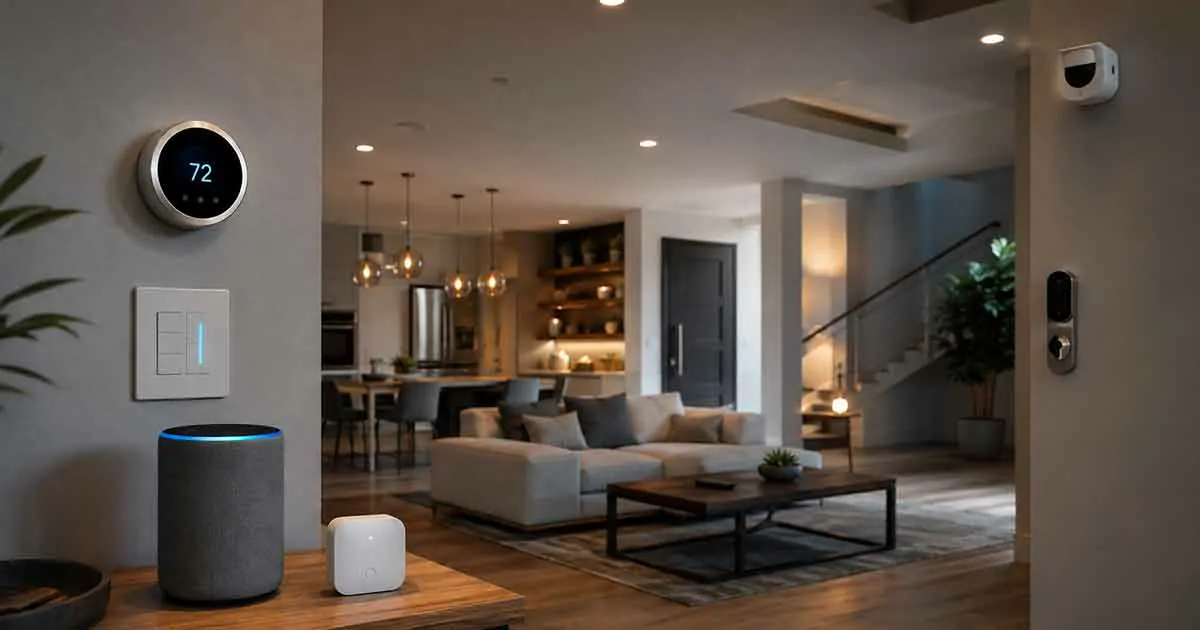
Smart home devices can make everyday life more convenient, improve home security, support energy savings, and give homeowners greater control over their properties.
Unlike renters, homeowners generally have more freedom to install permanent devices, upgrade electrical systems, replace thermostats, install smart locks, and build a connected system that can grow over time.
That makes it possible to create a smart home around long-term needs rather than simply choosing a few portable devices.
The best smart home setup does not necessarily require dozens of products. A well-planned system can combine a few useful devices to automate lighting, security, climate control, energy monitoring, and everyday routines.
This guide covers the best smart home devices for homeowners, what each type does, which features matter, and how to build a practical system without unnecessary complexity.
Table of Contents
What Are Smart Home Devices?
Smart home devices are connected products that can communicate with a home network or smart home platform.
Depending on the device, you may be able to control it through:
- Smartphone apps
- Voice assistants
- Smart home hubs
- Automated routines
- Sensors
- Schedules
- Other connected devices
Common examples include:
- Smart lights
- Smart plugs
- Smart thermostats
- Smart locks
- Security cameras
- Door and window sensors
- Motion sensors
- Smart speakers
- Energy monitoring devices
The main advantage is that these devices can work together instead of operating as completely separate products.
Why Homeowners Should Consider Smart Home Devices
Homeowners can benefit from smart technology in several areas.
Convenience
Automation can reduce repetitive tasks.
For example, lights can turn on automatically when you arrive home, while a thermostat can adjust according to your schedule.
Home Security
Smart locks, sensors, cameras, and lighting can provide additional awareness around the property.
Energy Management
Smart thermostats, plugs, and energy monitoring systems can help identify and reduce unnecessary energy use.
Property Management
Connected devices can help homeowners monitor different parts of the house remotely.
Long-Term Flexibility
Because homeowners are not usually limited by short-term leases, they can install more permanent smart home equipment and build a system gradually.
Best Smart Home Devices for Homeowners
There is no single device that is best for every homeowner.
The right combination depends on the property, budget, existing technology, and goals.
The following categories provide a practical starting point.
1. Smart Thermostats
A smart thermostat is one of the most useful upgrades for a homeowner with compatible HVAC equipment.
It can provide:
- Smartphone control
- Scheduling
- Temperature monitoring
- Energy reports
- Remote access
- Smart home integration
- Compatible sensor support
A smart thermostat can also help automate temperature settings around your daily routine.
For larger properties, remote temperature sensors can be particularly useful.
A thermostat located in a hallway may not represent the temperature in a bedroom or home office.
A compatible remote sensor can provide additional temperature information.
2. Smart Lighting
Smart lighting is another practical starting point.
Smart bulbs, switches, and fixtures can provide:
- Remote control
- Scheduling
- Dimming
- Automated routines
- Voice control
- Occupancy-based automation
Homeowners have more installation flexibility than renters, so smart switches can be especially attractive for permanent installations.
For example:
Motion detected → hallway lights turn on.
Or:
Sunset → exterior lights activate.
Smart lighting can improve convenience while also helping prevent lights from remaining on unnecessarily.
3. Smart Plugs
Smart plugs are inexpensive ways to add automation to existing appliances.
They can allow you to control compatible devices remotely or according to schedules.
Common uses include:
- Lamps
- Fans
- Small appliances
- Decorative lighting
- Chargers
- Seasonal devices
Some smart plugs also provide energy monitoring.
These can be particularly useful for homeowners who want to understand how much electricity specific appliances consume.
4. Smart Locks
Smart locks can provide keyless access and remote control for compatible doors.
Depending on the model, features may include:
- Smartphone unlocking
- Temporary access codes
- Automatic locking
- Activity history
- Remote management
- Integration with other smart home devices
For homeowners, smart locks can be a convenient permanent upgrade.
For example:
Front door unlocks → entry lights turn on.
However, compatibility with the existing door and lock hardware should be checked before installation.
5. Smart Door and Window Sensors
Door and window sensors provide simple open-and-close detection.
They can be used for:
- Security alerts
- Lighting automation
- Energy-related routines
- Activity monitoring
For example:
Window opens → smartphone notification.
Or:
Front door opens after sunset → hallway light turns on.
Because sensors are small and generally wireless, they can be installed throughout a property without adding significant visual clutter.
6. Smart Motion Sensors
Motion sensors can detect movement and trigger connected devices.
They are useful for:
- Lighting
- Security
- Automation
- Occupancy-related routines
A simple automation might be:
Motion detected in hallway → light turns on.
Advanced presence sensors can provide more detailed occupancy information in certain environments.
7. Smart Security Cameras
Security cameras can provide visual monitoring of selected areas around a home.
Potential locations include:
- Front entrance
- Driveway
- Backyard
- Garage
- Side entrances
Before installing outdoor cameras, consider weather resistance, network coverage, power requirements, privacy, and local regulations.
Homeowners can often choose permanent wired installations where appropriate, which may provide advantages over battery-only systems.
8. Smart Doorbells
A smart video doorbell can combine a doorbell with a connected camera.
Depending on the product, it may provide:
- Motion alerts
- Visitor notifications
- Two-way communication
- Video recording
- Activity history
It can be particularly useful for monitoring the main entrance when homeowners are away.
Subscription requirements vary significantly between products, so check which features remain available without a recurring payment.
9. Smart Home Hubs
A smart home hub or controller can help coordinate devices using different protocols.
Depending on the ecosystem, a hub may support:
- Zigbee
- Z-Wave
- Thread
- Matter
- Other device technologies
A hub can become increasingly useful as the number of connected devices grows.
However, homeowners with only a few Wi-Fi devices may not need a dedicated hub.
10. Smart Speakers and Displays
Smart speakers can provide voice control for compatible devices.
For example:
“Turn off the living room lights.”
Smart displays can add visual controls and information.
They can also provide access to:
- Timers
- Weather information
- Smart cameras
- Doorbells
- Home routines
- Connected appliances
A speaker or display can act as a convenient interface for the rest of the smart home.
11. Smart Energy Monitoring Systems
Homeowners interested in reducing energy consumption may benefit from energy monitoring.
Energy monitoring devices can provide information about electricity use at different levels, depending on the system.
They may help identify:
- High-energy appliances
- Unusual consumption
- Daily usage patterns
- Potential energy-saving opportunities
Unlike a smart plug, which may monitor one device, a whole-home energy monitoring system can provide a broader view.
12. Smart Smoke and Carbon Monoxide Detectors
Smart smoke and carbon monoxide detectors can provide alerts when a potentially dangerous condition is detected.
Some models can send notifications to a smartphone, which can be useful when homeowners are away.
These devices should meet applicable safety standards and be installed according to manufacturer instructions and local requirements.
Smart features should complement, not replace, proper smoke and carbon monoxide protection.
13. Smart Water Leak Sensors
Water leaks can cause significant property damage.
Smart leak sensors can provide early warnings when moisture is detected.
Useful locations can include:
- Under sinks
- Near water heaters
- Laundry areas
- Bathrooms
- Basements
- Near appliances that use water
A leak sensor can be particularly valuable for homeowners because they are responsible for maintaining and protecting the property.
14. Smart Water Shutoff Systems
A smart water shutoff system can go beyond detecting a leak.
Depending on the installation, it may automatically close the main water supply when unusual flow or a leak is detected.
This type of system can be especially useful for homeowners who want additional protection while away from the property.
Installation may require professional plumbing work.
15. Smart Garage Door Controllers
A smart garage door controller can allow homeowners to monitor and control a compatible garage door remotely.
Potential features include:
- Open/close notifications
- Remote control
- Automatic routines
- Activity history
- Integration with other smart home devices
A useful automation might close the garage door automatically after a defined period, provided the system and safety requirements support it.
Smart Home Devices for New Homeowners
If you have recently purchased a home, it can be tempting to install everything at once.
A better approach is to prioritize systems that solve immediate problems.
A practical starting sequence is:
- Smart thermostat
- Smart lighting
- Door and window sensors
- Smart lock
- Security devices
- Energy monitoring
- Water protection
- Additional automation
This creates a foundation without requiring a large initial investment.
Smart Home Devices for Existing Homeowners
If your home already has conventional devices, you do not necessarily need to replace everything.
Start by identifying areas where automation would provide the most value.
For example:
- Replace a conventional thermostat with a smart model.
- Add smart switches to frequently used lights.
- Add sensors to important doors and windows.
- Add smart plugs to selected appliances.
- Install leak sensors near vulnerable plumbing areas.
This gradual approach is usually easier to manage than a complete home-wide replacement.
Smart Home Devices for Large Homes
Large homes may benefit from a more structured approach.
Important considerations include:
- Wi-Fi coverage
- Mesh networking
- Multiple HVAC zones
- Remote temperature sensors
- Security camera coverage
- Multiple entry points
- Energy monitoring
A large home may also require additional smart home infrastructure to maintain reliable connectivity.
Do not assume that a single router or hub will provide ideal coverage throughout a large property.
Smart Home Devices for Small Homes
Small homes can benefit from smart devices without requiring a complicated setup.
A compact system might include:
- Smart thermostat
- Smart lights
- Smart lock
- Motion sensor
- Door sensor
- Smart speaker
Because devices may cover a smaller area, fewer products may be needed.
Smart Home Devices for Homeowners Without a Subscription
Many homeowners prefer smart devices that provide useful functionality without recurring fees.
This can reduce long-term ownership costs.
Before buying, check whether important features require a subscription, such as:
- Cloud video storage
- Advanced security monitoring
- Extended activity history
- Premium automation
- Remote services
A device that costs less initially may become more expensive over several years if important features require a monthly payment.
Smart Home Devices That Work Together
The biggest advantage of building a smart home is the ability to combine devices.
For example:
Front door opens → smart lock reports activity → entry lights turn on.
Another routine:
Motion detected → hallway light turns on → light turns off after inactivity.
Or:
Window opens → notification sent → compatible HVAC routine changes.
The value comes from the interaction between devices rather than the number of products installed.
Choosing a Smart Home Ecosystem
Before buying many devices, choose an ecosystem strategy.
Common platforms include:
- Apple Home
- Google Home
- Amazon Alexa
- Samsung SmartThings
- Matter-compatible systems
You do not necessarily need to use only one brand.
However, compatibility should be considered before purchasing devices that need to work together.
A device that works independently may not support the automation features you want in another ecosystem.
Matter for Homeowners
Matter is designed to improve interoperability among compatible smart home devices.
For homeowners building a system over many years, interoperability can be particularly useful.
A Matter-compatible device may provide greater flexibility when choosing compatible platforms.
However, Matter does not automatically guarantee that every advanced feature works across every ecosystem.
Check the specific device’s supported features before purchasing.
Wired vs. Wireless Smart Home Devices
Homeowners have more flexibility to choose between wired and wireless installations.
Wireless Devices
Advantages include:
- Easier installation
- Flexible placement
- Easy relocation
- Less wiring
Wired Devices
Advantages can include:
- Continuous power
- Reliable connection
- Less battery maintenance
- Better suitability for permanent installations
For a long-term smart home, wired devices can make sense for selected permanent systems, while wireless sensors remain useful for flexible monitoring.
Privacy and Security
Smart home devices connect to your network and may collect information about your household.
Before purchasing, consider:
- Account security
- Two-factor authentication
- Data storage
- Cloud dependency
- Local control
- Firmware updates
- Privacy policies
Use strong unique passwords and keep supported devices updated.
For cameras and other privacy-sensitive devices, carefully consider placement and who can access the account.
Common Smart Home Mistakes for Homeowners
Buying Too Many Devices
More devices can mean more maintenance and complexity.
Ignoring Compatibility
Always check whether devices work together before purchasing.
Focusing Only on Price
A cheaper device may not provide the reliability or integration you need.
Ignoring Network Coverage
Large homes may require better Wi-Fi or mesh networking.
Installing Without a Plan
Start with specific problems and build around them.
Forgetting Long-Term Costs
Consider batteries, subscriptions, replacement costs, and maintenance.
How to Choose the Best Smart Home Devices for Your Home
Before buying, ask:
- What problem does the device solve?
- Does it work with your chosen smart home ecosystem?
- Does it require a hub?
- Does it require a subscription?
- Can it work locally if the internet is unavailable?
- How often will it need maintenance?
- Is the installation permanent or removable?
- Can it work with your existing devices?
- Does it improve security, convenience, or energy management?
- Will you still find the device useful several years from now?
These questions can prevent unnecessary purchases and help create a more reliable smart home.
A Practical Smart Home Setup for Homeowners
A balanced starting setup might include:
Core Devices
- Smart thermostat
- Smart lighting
- Smart plugs
- Smart speaker
Security
- Smart lock
- Door and window sensors
- Motion sensors
- Smart doorbell or cameras
Energy
- Smart thermostat
- Energy monitoring system
- Smart plugs with energy monitoring
Protection
- Smart smoke and carbon monoxide detectors
- Water leak sensors
- Smart water shutoff system
You do not need every category immediately.
Build the system around your home’s actual needs.
Are Smart Home Devices Worth It for Homeowners?
Smart home devices can be worthwhile when they provide a clear benefit.
The strongest use cases are usually:
- Home security
- Climate control
- Lighting automation
- Energy monitoring
- Water leak protection
- Remote access
- Everyday convenience
Homeowners can also benefit from permanent installations that are more difficult or inappropriate for renters.
The key is to focus on useful automation rather than simply collecting connected devices.
Final Thoughts
The best smart home devices for homeowners are the ones that solve real problems and work together reliably.
Smart thermostats can improve climate management, smart locks can simplify access, sensors can provide security alerts, smart lighting can automate everyday routines, and energy monitoring devices can provide better visibility into electricity use.
Homeowners also have the advantage of being able to make more permanent upgrades, including wired security devices, smart switches, water shutoff systems, and other property-level improvements.
Start with a few high-value devices, choose a compatible smart home ecosystem, and expand gradually.
A well-designed smart home should make the property easier to manage, more comfortable to live in, and potentially more efficient without becoming unnecessarily complicated.