
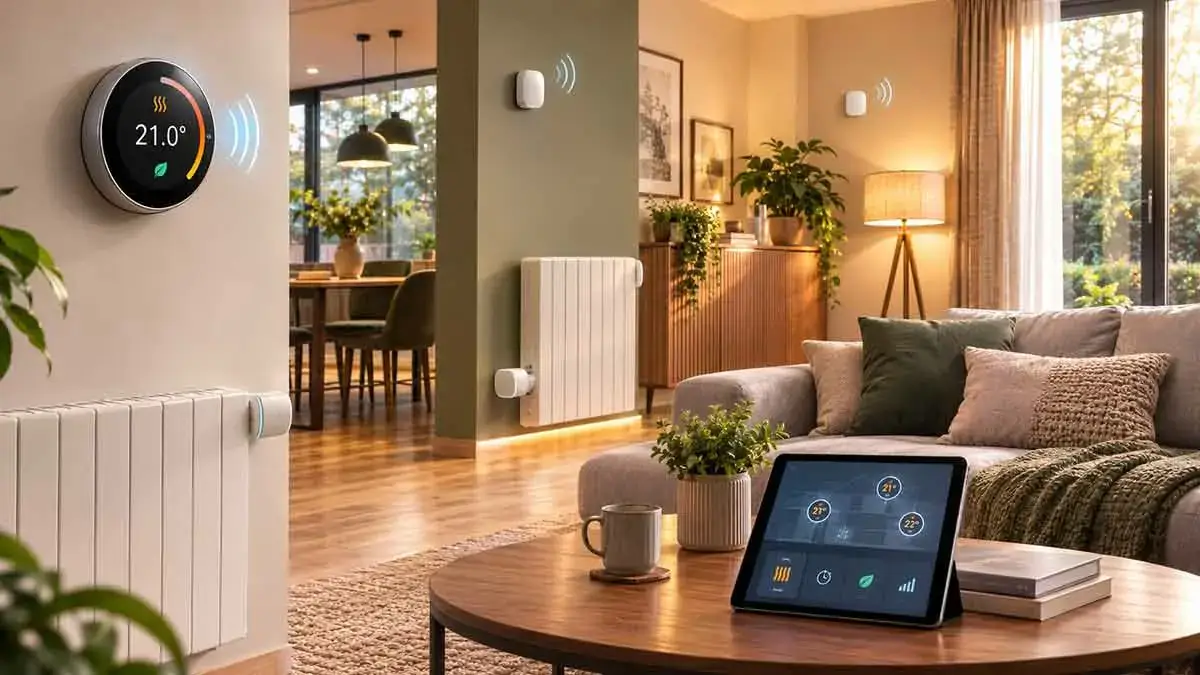
A smart heating system combines heating equipment, temperature controls, sensors, and connected technology to manage indoor comfort more intelligently.
Instead of relying on one thermostat and a fixed schedule, a smart heating system can coordinate different parts of the home according to temperature, time, occupancy, room usage, and other conditions.
A complete system may include a smart thermostat, room sensors, smart radiator controls, heating zones, a boiler or heat pump, and a smart home platform. The exact configuration depends on the type of heating system installed in the property.
The goal is not simply to make heating connected to the internet. A good smart heating system should make temperature control easier, reduce unnecessary heating, improve room-by-room comfort, and provide a practical way to manage energy use.
What Is a Smart Heating System?
A smart heating system is a heating setup that uses connected controls and sensors to automatically manage temperature and heating operation.
A basic system may include:
- Smart thermostat
- Heating equipment
- Temperature sensors
- Mobile app
- Heating schedules
- Smart home integration
A more advanced system can also include:
- Smart radiator valves
- Multiple heating zones
- Occupancy or presence detection
- Window sensors
- Outdoor temperature information
- Energy monitoring
- Heat pump controls
- Boiler controls
The important distinction is that a smart heating system is a complete setup, not just a smart thermostat.
The thermostat is one part of the system. The heating equipment, sensors, controls, and software all work together.
How a Smart Heating System Works
A smart heating system typically follows a simple process.
Step 1: Measure
Sensors measure temperature or other relevant conditions.
Step 2: Compare
The control system compares the current conditions with the desired settings.
Step 3: Decide
The system determines whether heating should start, stop, increase, or decrease.
Step 4: Act
The heating equipment changes its operation.
For example:
Room temperature: 18°C
Target temperature: 20°C
System response: Heating increases until the target condition is reached.
A more advanced setup may also consider whether someone is home, what time it is, and whether another room requires more heat.
Main Components of a Smart Heating System
A complete system can contain several components.
Smart Thermostat
The thermostat provides central temperature control.
Heating Equipment
This may be a boiler, heat pump, furnace, electric heating system, or another type of heating equipment.
Room Sensors
Sensors provide temperature information from different areas of the home.
Smart Radiator Valves
These allow individual radiators to be controlled separately.
Heating Zones
Zones divide the home into areas with independent temperature control.
Smart Home Platform
The platform connects heating with other devices and automations.
Not every home needs all of these components.
Smart Heating Systems vs Traditional Heating
A traditional heating system often relies on:
- One thermostat
- A timer or schedule
- Manual adjustments
- Limited room-level control
A smart system can add:
- Remote control
- More flexible schedules
- Room sensors
- Zoning
- Automation
- Presence information
- Smart home integration
- Energy monitoring
The difference is therefore less about the heating equipment itself and more about how intelligently the system can be managed.
Smart Heating System Types
There is no single smart heating architecture that works for every property.
Smart Boiler Heating
Homes using boilers can combine compatible heating controls with smart thermostats, sensors, and radiator controls.
Heat Pump Heating
Heat pumps can use smart controls to manage heating according to indoor and outdoor conditions while following the operating characteristics of the specific system.
Electric Heating
Electric radiators, panel heaters, and other electric heating equipment can sometimes be controlled individually or through smart thermostats and plugs where appropriate.
Radiator-Based Heating
Radiator systems can benefit significantly from room-level controls and smart valves.
Underfloor Heating
Underfloor heating can use multiple zones with separate temperature controls.
The best smart system depends on the existing heating equipment and the structure of the home.
Smart Boiler Heating Systems
A boiler can become part of a smart heating system when compatible controls are installed.
Depending on the boiler and control system, homeowners may be able to manage:
- Heating schedules
- Temperature
- Hot water
- Individual zones
- Remote settings
- Energy-related information
Compatibility is particularly important with boilers because different systems use different control methods.
Some installations support more advanced communication between the thermostat and boiler than a simple on/off signal.
Before buying a smart thermostat, check compatibility with the specific boiler and existing controls.
Smart Heat Pump Systems
Heat pumps operate differently from many conventional heating systems.
Instead of relying on short, aggressive heating cycles, many heat pump systems are designed to operate more steadily.
Smart control should therefore be based on the characteristics of the heat pump rather than simply copying a boiler-style schedule.
Important considerations include:
- Heat pump type
- Building insulation
- Outdoor temperature
- Heating system design
- Flow temperature
- Manufacturer recommendations
- Underfloor or radiator distribution
A smart control system should support the way the heat pump is intended to operate.
Smart Radiator Heating
Smart radiator controls can give each room its own temperature target.
This is useful when different rooms have different schedules.
For example:
Living room: 20°C during the evening
Bedroom: 18°C at night
Guest room: Lower temperature when unused
Home office: Higher temperature during working hours
This type of room-level control can make the heating system more responsive to how the home is actually used.
Smart Radiator Valves
Smart radiator valves replace or supplement standard thermostatic radiator valves.
They allow individual radiators to be controlled from an app or smart home platform.
Depending on the system, you may be able to create schedules such as:
Bedroom: Lower temperature during the day
Living room: Higher temperature between 5 PM and 10 PM
Bathroom: Higher temperature during morning and evening periods
This can prevent the entire home from being heated to the same level when only certain rooms are occupied.
Zoned Smart Heating
Zoning is one of the most useful concepts in a smart heating system.
Instead of treating the entire property as one heating area, the home is divided into zones.
For example:
Zone 1: Living Areas
Kitchen, dining room, and living room.
Zone 2: Bedrooms
Bedrooms and upstairs areas.
Zone 3: Home Office
A room used primarily during working hours.
Each zone can have its own temperature schedule.
The potential benefit is better comfort with more precise heating control.
Smart Heating for Multi-Story Homes
Multi-story homes often experience uneven temperatures.
Warm air can accumulate upstairs while lower floors remain cooler, or one floor may receive more solar heat than another.
A single thermostat may therefore provide an incomplete picture of the home’s temperature.
A multi-zone smart system can address this by using separate sensors and controls.
For example:
Downstairs: 20°C during the evening
Bedrooms: 18°C overnight
This approach can be more comfortable than using one temperature setting for the entire property.
Smart Heating Sensors
Sensors provide the information that makes intelligent heating decisions possible.
Common sensor types include:
- Temperature sensors
- Humidity sensors
- Motion sensors
- Occupancy sensors
- Door sensors
- Window sensors
A temperature sensor measures the condition of a room.
A motion or occupancy sensor can help determine whether the room is being used.
A window sensor can identify situations where a window is open and heating may be unnecessary.
Combining several types of information can make heating automation more responsive.
Smart Heating and Occupancy
Occupancy-based heating is useful for homes with changing schedules.
A fixed schedule might assume that everyone leaves at the same time every weekday.
An occupancy-aware system can respond to the actual presence of people.
For example:
Everyone leaves → Reduce heating
Someone returns → Restore a comfort setting
The exact behavior depends on the smart home platform and heating equipment.
Occupancy detection should not be treated as infallible, so important heating requirements should have sensible fallback settings.
Smart Heating and Window Sensors
Open windows can cause heating systems to operate unnecessarily.
A smart heating system can use window sensors to identify when a window is open.
For example:
Window opens → Temporarily reduce heating in that room
This can prevent the heating system from continuously trying to maintain a target temperature while outdoor air is entering.
The feature depends on compatible equipment and automation support.
Smart Heating Schedules
Schedules remain one of the most useful smart heating features.
You can create different settings for different periods.
For example:
Morning
Comfortable temperature when the household wakes.
Daytime
Reduced heating in rooms that are normally empty.
Evening
Comfort temperature in living areas.
Night
Lower temperature in bedrooms and common areas.
A smart system makes it easier to change these schedules without manually adjusting the thermostat each day.
Adaptive Smart Heating
Some smart systems can go beyond fixed schedules.
Depending on the product, the system may learn or respond to:
- Household routines
- Temperature changes
- Occupancy
- Weather
- Heating response time
- Room usage
Adaptive control can be more convenient than a rigid timetable.
However, the exact capabilities vary significantly between products.
A system that offers learning features should still be understandable enough that you can see what it is doing and adjust settings when necessary.
Smart Heating and Weather
Outdoor conditions can affect how much heating a home needs.
A modern smart heating system may use outdoor temperature information or weather data as part of its control strategy.
For example, heating requirements on a mild day may be very different from those on a freezing day.
Weather information can improve the control strategy, but indoor temperature remains one of the most important measurements.
The home should ultimately be comfortable based on actual indoor conditions.
Smart Heating and Energy Saving
A smart heating system can support energy efficiency by reducing unnecessary heating.
Potential strategies include:
- Lowering temperatures in unused rooms
- Using schedules
- Adjusting heating when everyone leaves
- Controlling rooms independently
- Avoiding heating while windows are open
- Monitoring energy consumption
- Maintaining appropriate comfort settings
Energy savings depend heavily on the property and how the system is used.
Important factors include:
- Insulation
- Climate
- Building size
- Heating equipment
- Temperature settings
- Occupancy patterns
- Existing heating efficiency
Smart controls are not a replacement for an efficient heating system or well-insulated building.
Smart Heating and Insulation
A smart heating system works best when the home can retain heat effectively.
Poor insulation increases heat loss and can force the heating system to operate more frequently.
Before spending heavily on smart controls, consider the condition of:
- Roof or attic insulation
- Walls
- Floors
- Windows
- Doors
- Draught sealing
Improving the building envelope can reduce the amount of energy needed to maintain comfortable temperatures.
Smart controls then help manage that heating more precisely.
Smart Heating and Hot Water
Some systems combine space heating with domestic hot water.
A connected controller can manage both, depending on the equipment.
For example:
6:00 AM → Prepare hot water
6:30 AM → Increase heating
10:30 PM → Reduce heating and change hot water settings
The correct schedule depends on household use and the type of heating system.
Smart Heating and Underfloor Heating
Underfloor heating can work well with smart zone control because different rooms can be assigned different schedules.
For example:
- Bathroom: Higher temperature in the morning
- Living room: Comfort temperature during the day
- Bedrooms: Lower nighttime setting
Underfloor heating often responds differently from radiators because the system may have greater thermal mass.
For this reason, smart schedules should account for how quickly the floor system heats and cools.
Smart Heating Integration With Smart Home Platforms
A smart heating system can become part of a broader connected home.
Depending on compatibility, heating can work alongside:
- Smart lights
- Smart plugs
- Motion sensors
- Door sensors
- Smart speakers
- Security devices
- Energy monitors
For example:
Everyone leaves → Reduce heating + turn off selected lights
Or:
Arrive home after sunset → Restore heating + turn on selected lights
These integrations can make heating part of a broader household routine.
Smart Heating and Matter
Matter is becoming increasingly relevant to smart home devices and connected heating equipment.
Matter is designed to improve interoperability between supported smart home products and platforms.
When considering a new heating device, Matter compatibility can be useful if you want flexibility across supported ecosystems.
However, the presence of Matter does not guarantee that every advanced heating feature will be available in every platform.
Always check the exact device capabilities before buying.
Local vs Cloud Smart Heating
Some smart heating systems depend heavily on cloud services.
Others can perform important functions locally.
Local control can provide advantages such as:
- Continued operation during some internet outages
- Faster response
- Reduced cloud dependence
Cloud-connected systems can provide:
- Remote access
- Notifications
- Account-based management
- Additional online services
Many systems use a combination of local and cloud functionality.
Before buying, understand which functions continue to work when internet access is unavailable.
Smart Heating System Installation
Installation requirements depend on the system.
Some devices are relatively simple to install.
Others require:
- Electrical work
- Boiler control wiring
- Plumbing
- HVAC modification
- Zone valves
- Professional commissioning
Thermostats and heating equipment should be installed according to manufacturer instructions.
Do not assume that a smart thermostat designed for one type of heating system will work correctly with another.
Where to Install Heating Sensors
Sensor placement can have a major impact on performance.
Avoid placing a temperature sensor near:
- Direct sunlight
- Radiators
- Heat-producing appliances
- Drafty doors
- Windows
- Other unusual heat sources
A sensor should represent the conditions of the space you actually want to control.
In a large home, several sensors may provide a more accurate picture than one central thermostat.
Smart Heating System for Small Homes
A small apartment or compact house may not need a complicated system.
A practical setup could include:
- One smart thermostat
- One or two temperature sensors
- Simple schedules
- A few automation routines
This can provide remote control and better scheduling without requiring extensive room-by-room equipment.
Smart Heating System for Large Homes
Large homes benefit more from zoning and multiple sensors.
A larger setup may include:
- Central smart thermostat
- Room sensors
- Smart radiator valves
- Multiple zones
- Presence detection
- Smart home integration
The larger the home, the more important network reliability and system planning become.
Smart Heating System for Older Homes
Older homes may have more complicated heating requirements.
Common challenges include:
- Uneven insulation
- Older heating equipment
- Large room-to-room temperature differences
- Limited wiring
- Poor sensor locations
- Unbalanced heating systems
Smart controls can help, but they do not automatically fix underlying heating problems.
In some cases, insulation improvements, radiator balancing, or heating-system upgrades may provide greater benefits.
Common Smart Heating Problems
One Room Is Too Cold
Possible causes include poor insulation, radiator problems, airflow, sensor placement, or insufficient zoning.
Heating Runs Too Often
Check thermostat placement, schedules, temperature settings, and heating configuration.
Temperatures Vary Between Floors
Consider additional sensors or separate heating zones.
Smart Controls Lose Connection
Check the network, device power, and communication technology.
Remote Access Stops Working
Cloud-based functions may become unavailable during internet or service outages even if local heating controls continue to work.
How to Make a Smart Heating System Reliable
Keep the system simple enough to understand.
Use accurate sensors.
Avoid creating conflicting automations.
Maintain appropriate manual controls.
Choose compatible hardware.
Keep the home network reliable.
Back up important smart home configurations where appropriate.
Most importantly, design the system around the actual heating equipment rather than adding smart features without considering how the system operates.
Smart Heating System Maintenance
A connected heating system still requires normal heating-system maintenance.
Smart controls do not replace:
- Boiler servicing
- Filter replacement where applicable
- Heat pump maintenance
- Radiator maintenance
- Professional inspections
- Manufacturer-recommended servicing
Also review your automation schedules periodically.
Household routines change, and a schedule that worked well last year may no longer reflect how the home is used.
How Much Does a Smart Heating System Cost?
The cost varies widely.
A simple setup may require only a smart thermostat.
A larger installation may include:
- Multiple thermostats
- Room sensors
- Smart radiator valves
- Zone controls
- Professional installation
- Heating equipment upgrades
- Additional network hardware
The best way to control costs is to identify the rooms and heating problems that matter most.
You can then add additional controls gradually instead of installing a complete system immediately.
Is a Smart Heating System Worth It?
A smart heating system can be worthwhile when the household needs more precise temperature control or frequently adjusts heating settings.
It can be especially useful for:
- Multi-room homes
- Multi-story homes
- Changing schedules
- Homes with unused rooms
- Radiator-based systems
- Homes that already use a smart home platform
The value is lower when the existing heating system already provides excellent zoning and the household rarely changes the settings.
The right question is not whether smart heating is technologically impressive.
It is whether better control solves a real problem in the home.
Final Thoughts
A smart heating system is more than a connected thermostat.
It can combine heating equipment, smart thermostats, room sensors, radiator controls, zoning, schedules, occupancy information, and home automation into one coordinated system.
For a small home, a smart thermostat may be enough.
For a larger property, room sensors and zoning can provide a much more precise approach.
The best system is one that matches the heating equipment, building characteristics, and daily routines of the household.
Start with the biggest heating problem in your home, choose compatible technology, and expand gradually.
When smart controls are combined with efficient heating equipment and good insulation, they can make a home more comfortable, easier to manage, and more efficient to heat.