
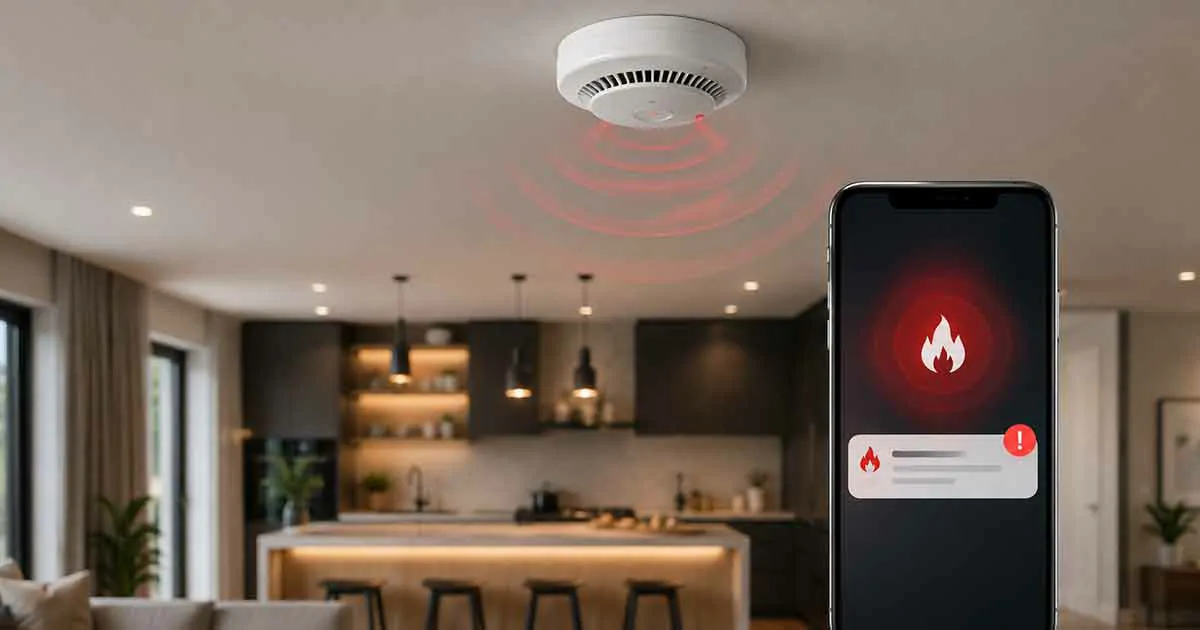
Fire protection has become increasingly connected as smart home technology continues to evolve. A modern smart fire alarm system can combine fire detection, connected sensors, audible alerts, smartphone notifications, and other smart home technologies to help homeowners respond more quickly to potential emergencies.
Traditional fire alarms primarily provide a local audible warning when smoke or excessive heat is detected. Connected systems can add another layer by communicating with smartphones, hubs, and compatible devices.
This can be particularly useful when nobody is home, when household members are in different parts of the property, or when homeowners want additional information about an alarm event.
However, smart fire protection is not simply about connecting a smoke alarm to Wi-Fi. A reliable system should be designed around appropriate detection, dependable power, communication, notification, and regular testing.
In this guide, we explain how smart fire alarm systems work, their main components, important features, connectivity options, installation considerations, and how to build a practical connected fire protection setup.
What Is a Smart Fire Alarm System?
A smart fire alarm system is a connected fire detection and alerting solution that can communicate information about potential fire or smoke events to other devices or services.
Depending on the system, it may combine smoke detection, heat detection, alarms, a central hub, smartphone notifications, and other connected devices.
When a sensor detects a potentially dangerous condition, the system can activate a local alarm and may also send an alert to a smartphone or connected monitoring service.
Some systems can also interact with other smart home equipment.
For example, a compatible system might trigger connected lighting during an emergency or send an alert when smoke is detected while the homeowner is away.
The exact capabilities vary between systems, so homeowners should carefully evaluate what each product actually supports.
How Do Smart Fire Alarm Systems Work?
The basic operating principle is straightforward.
Fire-related sensors continuously monitor the environment for conditions associated with a potential fire. Depending on the device, detection may involve smoke, heat, or other environmental indicators.
When the system detects a dangerous condition, it can respond through several channels.
A typical sequence may look like this:
- A sensor detects smoke or excessive heat.
- The alarm system evaluates the detected condition.
- A local audible alarm is activated.
- Connected devices may receive the alarm signal.
- A smartphone notification may be sent.
- A monitoring service may respond if the system includes professional monitoring.
The purpose of connectivity is not to replace the local alarm. Instead, it can provide additional ways to receive information about an emergency.
Main Components of a Smart Fire Alarm System
A connected fire protection setup can contain several components depending on the size and requirements of the property.
Smoke Detection
Smoke detection is one of the most important functions of a residential fire alarm.
Smoke sensors are designed to identify particles associated with combustion and provide an early warning when smoke is detected.
Different detection technologies have different characteristics, so homeowners should select equipment that is appropriate for residential use and follow the manufacturer’s installation instructions.
Heat Detection
Some systems also use heat detection.
Heat sensors can be useful in locations where smoke detection may be unsuitable or where environmental conditions can cause unwanted smoke alarms.
Examples may include certain garages, utility areas, or other spaces where temperature and airborne particles can vary significantly.
However, the appropriate detector depends on the specific room and applicable safety requirements.
Central Hub
Some connected fire alarm systems use a hub or central controller.
The hub can communicate with compatible sensors and other connected equipment.
Depending on the system, it may also manage smartphone notifications, automation, or communication with a monitoring service.
Not every smart fire alarm requires a separate hub. Some connected alarms contain the necessary communication hardware directly inside the device.
Audible Alarm
A local audible alarm remains an important part of fire protection.
The purpose of the siren is to alert people who are physically inside the property.
Smart connectivity should therefore be considered an additional capability rather than a replacement for a reliable local alarm.
Smartphone Application
A compatible smartphone application can provide remote information about the system.
Depending on the manufacturer, users may be able to:
- Receive fire alerts
- Check alarm status
- Monitor device health
- Receive low-battery warnings
- Test connected devices
- Review notifications
- Manage connected equipment
App functionality varies, so it is important to evaluate the software experience as carefully as the hardware.
Smart Fire Alarm vs Smart Smoke Detector
These terms can sound interchangeable, but they can refer to different concepts.
A smart smoke detector is generally an individual detection device with connected capabilities.
A smart fire alarm system can describe a broader arrangement that includes multiple detectors, interconnected alarms, a controller or hub, notifications, and potentially other connected equipment.
For example, a homeowner may have several connected smoke and heat detectors communicating with a central system.
The distinction becomes especially useful when planning protection for a larger home.
A single smart smoke detector may be appropriate for one location, while a coordinated fire alarm system can provide broader coverage and centralized alerts.
Why Interconnected Fire Alarms Matter
Interconnection can provide an important advantage in a multi-room home.
If one alarm detects smoke, interconnected alarms can potentially sound throughout the property.
This can help alert occupants who are farther away from the source of the problem.
Interconnection can be achieved through wired connections or compatible wireless technology, depending on the system.
Before purchasing equipment, verify that the devices are actually designed to interconnect with one another. Products from different manufacturers are not necessarily compatible simply because they use the same wireless network.
Smartphone Alerts and Remote Notifications
One of the most useful features of a connected fire protection system is remote notification.
Traditional alarms primarily alert people who are close enough to hear the siren.
A connected system can potentially notify a homeowner when an alarm occurs even when they are away from home.
For example, a homeowner could receive a notification while at work indicating that smoke has been detected.
However, smartphone notifications should never be treated as the primary method of fire warning. Internet outages, smartphone settings, battery problems, or communication failures can prevent a remote notification from arriving.
The local alarm remains essential.
Internet Connectivity and Backup Communication
Smart fire alarm systems may rely on Wi-Fi or another communication technology to provide remote connectivity.
Wi-Fi can be convenient because many homes already have wireless internet access.
However, an internet outage can interrupt cloud-based notifications.
Some systems provide additional communication options or backup connectivity.
When evaluating a connected fire alarm, consider:
- Wi-Fi reliability
- Local alarm operation
- Backup power
- Communication redundancy
- Smartphone notification reliability
- System status alerts
The goal is to avoid creating a system that depends entirely on one point of failure.
Battery Backup
Power reliability is particularly important for fire protection.
A system that depends on household electricity should have an appropriate backup strategy.
Some alarms use replaceable batteries, while others may use sealed long-life batteries or backup batteries integrated into connected equipment.
Homeowners should understand:
- How the alarm is powered
- How long backup power lasts
- Whether all functions remain available during an outage
- How battery warnings are communicated
- How batteries should be replaced or maintained
Always follow the manufacturer’s instructions for battery maintenance.
Smart Fire Alarm Integration
A connected fire alarm can potentially interact with other smart home devices.
Depending on compatibility, an alarm event could trigger connected equipment such as:
- Smart lights
- Smart speakers
- Connected home hubs
- Smartphone applications
- Monitoring services
For example, compatible lighting could turn on automatically when a fire alarm is triggered, helping illuminate paths through the home.
However, these integrations should be treated as supplemental features.
A fire alarm should remain capable of providing its essential warning even if the internet connection or smart home platform is unavailable.
Smart Fire Alarms and Home Automation
Fire protection can become part of a broader smart home automation strategy.
For example, a connected system could be configured so that an alarm event activates predefined routines.
A simplified automation could look like:
Fire alarm detected → local sirens activate → connected lights turn on → smartphone notification is sent.
The exact automation capabilities depend on the devices and platforms involved.
Automation should never introduce a dependency that could delay or prevent the basic fire warning.
Safety-critical functions should remain reliable even when other connected services are unavailable.
Where Should Fire Alarms Be Installed?
The correct placement of fire alarms is critical.
Homeowners should follow local fire safety requirements and the manufacturer’s installation instructions.
Common residential locations may include areas near sleeping rooms and on each required level of a home.
Additional detectors may be appropriate depending on the property’s layout and local requirements.
Avoid installing alarms in locations where normal environmental conditions can cause repeated unwanted alarms unless the equipment is specifically designed for that environment.
Potential problem areas can include locations exposed to excessive moisture, dust, steam, or cooking-related particles.
The correct placement depends on the type of detector and the specific environment.
Smart Fire Alarm Installation
Installation requirements depend on the type of system.
Some connected alarms are designed for straightforward homeowner installation, while larger or interconnected systems may require professional installation.
Before installing a system, consider:
- Number of floors
- Number of sleeping areas
- Existing alarm wiring
- Required detection locations
- Wireless signal strength
- Power requirements
- Interconnection requirements
- Local building and fire safety regulations
Do not assume that a wireless alarm can simply be installed anywhere. Signal strength and physical obstructions can affect communication between devices.
Testing a Smart Fire Alarm System
Testing is essential regardless of whether the alarm is smart or traditional.
A connected fire alarm can contain sophisticated electronics, but that does not eliminate the need for regular testing.
Homeowners should follow the manufacturer’s recommended testing schedule and procedures.
Testing should confirm that:
- The local alarm sounds correctly.
- Connected devices respond as expected.
- Smartphone notifications work when supported.
- Batteries are functioning properly.
- The system reports faults or low-battery conditions.
- Interconnected alarms respond correctly when applicable.
If a system has multiple components, test the overall setup rather than assuming every component is working because one device responds.
Maintenance of Smart Fire Alarm Systems
Regular maintenance helps keep the system reliable.
Depending on the equipment, maintenance may include:
- Testing alarms
- Replacing batteries
- Cleaning detectors according to manufacturer instructions
- Checking device status
- Updating firmware
- Reviewing smartphone notifications
- Inspecting mounting points
- Replacing outdated equipment
Never disable a fire alarm simply because it produces unwanted alerts without investigating the cause.
Repeated false alarms can indicate that the detector is installed in an unsuitable location, needs maintenance, or is not appropriate for the environment.
Smart Fire Alarm False Alarms
False alarms can occur for several reasons.
Cooking smoke, steam, dust, aerosols, and environmental conditions may trigger certain types of detection equipment.
To reduce unnecessary alarms:
- Install detectors in appropriate locations.
- Keep detectors clean according to instructions.
- Avoid placing them too close to sources of steam or cooking particles.
- Choose appropriate detector types for different environments.
- Investigate repeated alarms rather than ignoring them.
A high number of false alarms can lead occupants to ignore alerts, which is particularly dangerous in a fire protection system.
Cybersecurity Considerations
Connected fire protection introduces another consideration: cybersecurity.
Because some smart fire alarm systems communicate with smartphones, cloud services, or home networks, homeowners should protect the connected account and network.
Recommended practices include:
- Use a strong, unique account password.
- Enable multi-factor authentication when available.
- Keep apps updated.
- Install firmware updates provided by the manufacturer.
- Secure the home Wi-Fi network.
- Review connected users regularly.
- Remove access for users who no longer need it.
Cybersecurity does not replace physical fire safety, but it can help protect the connected features of the system.
Professional Monitoring for Fire Alarms
Some connected fire alarm solutions can work with professional monitoring services.
If an alarm is triggered, the monitoring provider may receive the event and follow its established procedures.
Professional monitoring can provide an additional layer of response, particularly when occupants are away.
However, homeowners should carefully review the service before subscribing.
Check:
- Monthly fees
- Contract requirements
- Communication methods
- Battery backup
- Response procedures
- Equipment requirements
- Cancellation terms
The exact service provided depends on the monitoring company and the specific system.
Smart Fire Alarm Costs
The cost of a connected fire protection setup varies according to the number and type of devices required.
Potential costs include:
- Smart alarms
- Additional detectors
- Central hubs
- Installation
- Replacement batteries
- Monitoring subscriptions
- Compatible accessories
A small home may require only a few connected alarms, while a larger property may require multiple interconnected devices.
The cheapest system is not necessarily the best value. Fire protection should be evaluated primarily according to reliability, appropriate coverage, compatibility, and long-term maintenance.
How to Choose a Smart Fire Alarm System
Before purchasing a smart fire alarm, consider the following factors.
Detection Type
Determine whether the system uses smoke detection, heat detection, or a combination appropriate for your home.
Interconnection
If you need multiple alarms to communicate with one another, verify exactly how interconnection works.
Local Alarm
Make sure the system provides a reliable local audible warning.
Smartphone Notifications
If remote alerts are important to you, confirm how notifications work and whether they require a subscription.
Backup Power
Check how the system behaves during a power outage.
Connectivity
Understand whether the system depends on Wi-Fi, another wireless protocol, cellular communication, or a combination.
Smart Home Compatibility
If you already use connected devices, verify that the fire alarm supports your preferred smart home platform.
Monitoring
Determine whether professional monitoring is available and what it costs.
Maintenance
Consider battery replacement, firmware updates, testing requirements, and the expected service life of the equipment.
Common Mistakes to Avoid
Relying Only on Smartphone Notifications
A phone notification should supplement the local alarm, not replace it.
Installing Too Few Detectors
Coverage should be based on the home’s layout and applicable safety requirements.
Ignoring Battery Warnings
A low-battery warning should be addressed promptly.
Choosing Based Only on Smart Features
Connectivity is useful, but detection reliability and appropriate installation are more important.
Ignoring Compatibility
Not every smart alarm works with every smart home platform.
Forgetting About Internet Outages
Understand which functions continue working when the home internet connection is unavailable.
Neglecting Testing
A smart alarm still needs regular testing and maintenance.
Smart Fire Alarm System vs Complete Home Security
A fire alarm system and a home security system serve different primary purposes.
A fire alarm is designed to detect conditions associated with fire and provide appropriate warnings.
A broader home security setup may focus on unauthorized entry, intrusion detection, cameras, locks, and other security concerns.
Some modern platforms can combine these functions, but they should not be confused.
A homeowner may use both fire detection and security equipment as separate layers within a broader connected home.
Can Smart Fire Alarms Work Without Wi-Fi?
Some can, depending on their design.
The local alarm function of a properly designed fire alarm does not necessarily depend on an internet connection.
However, features such as remote smartphone notifications may require internet or another communication method.
This distinction is important.
When comparing products, determine which functions work locally and which require cloud connectivity.
A reliable fire protection system should not become completely useless simply because the internet connection fails.
Are Smart Fire Alarm Systems Worth It?
A smart fire alarm system can be worthwhile for homeowners who want additional connectivity and remote awareness alongside conventional fire detection.
The biggest advantages are the ability to receive remote notifications, monitor system status, connect multiple devices, and potentially integrate fire alerts with other smart home functions.
However, smart features should complement—not replace—the fundamental requirements of fire protection.
The most important considerations remain appropriate detector placement, reliable alarms, adequate coverage, dependable power, regular testing, and compliance with applicable safety requirements.
Final Thoughts
A smart fire alarm system combines traditional fire detection with connected technology to provide additional ways to receive and manage alerts.
The system may include smoke or heat detection, interconnected alarms, a central hub, smartphone notifications, backup power, and optional monitoring services.
For homeowners considering connected fire protection, the best approach is to start with the fundamentals: determine where detection is needed, choose appropriate equipment, ensure reliable local alarms, and follow installation and testing requirements.
Smart connectivity can then add useful capabilities such as remote notifications and automation.
The goal is not to build the most complicated smart home system possible. It is to create a dependable fire protection setup that continues to provide essential warnings while giving homeowners additional information and control when connected features are available.