
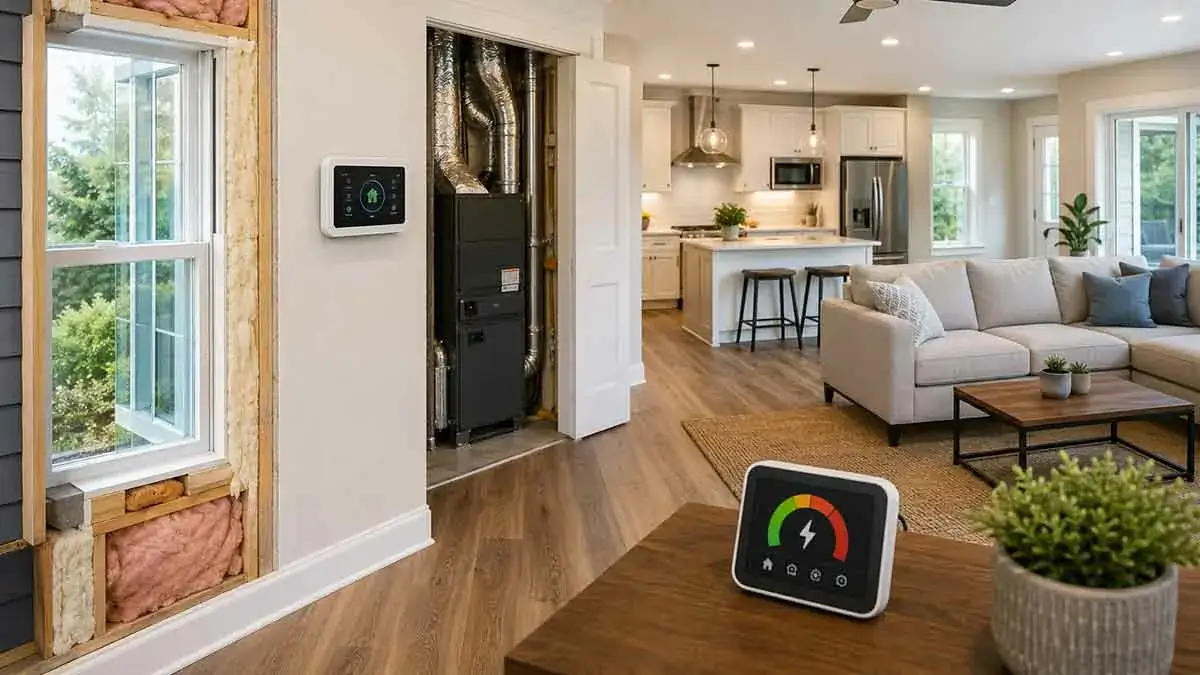
Reducing home energy waste is not only about using less electricity. A significant amount of energy can be wasted when heated or cooled air escapes, insulation is inadequate, HVAC equipment operates inefficiently, ducts leak, appliances consume unnecessary power, or household systems are poorly maintained.
The most effective approach is to identify where energy is being wasted and then address the biggest problems first.
Some improvements are simple, such as adjusting thermostat settings, sealing drafts, replacing inefficient lighting, and maintaining HVAC filters. Other improvements, such as upgrading insulation, sealing ductwork, or replacing major equipment, require more planning and investment.
This guide explains practical ways to reduce home energy waste, how to prioritize improvements, which common mistakes to avoid, and when a professional energy assessment can help.
Table of Contents
What Is Home Energy Waste?
Home energy waste occurs when energy is used without providing a useful benefit or when unnecessary energy is lost through inefficient building systems.
Examples include:
- Heated air escaping through gaps
- Cooling entering poorly insulated spaces
- Leaky HVAC ducts
- Water heated and then left unused
- Lights operating unnecessarily
- Appliances consuming excessive energy
- HVAC equipment operating inefficiently
- Poor insulation increasing heating and cooling demand
Energy waste can occur in both the building envelope and household equipment.
Reducing waste therefore requires more than changing daily habits. It may also require improving the physical condition and performance of the home.
Why Homes Waste Energy
Common causes of home energy waste include:
- Air leakage
- Inadequate insulation
- Poorly sealed windows and doors
- Inefficient HVAC equipment
- Leaky ductwork
- Poor thermostat management
- Inefficient water heating
- Older appliances
- Unnecessary lighting
- Standby electricity consumption
- Excessive hot water use
- Poor ventilation
- Moisture problems
The biggest source of waste varies from one home to another.
For this reason, avoid assuming that one upgrade will solve every energy problem.
1. Reduce Air Leaks
Uncontrolled air leakage can increase heating and cooling demand.
Common leakage locations include:
- Exterior doors
- Windows
- Attic hatches
- Electrical outlets
- Plumbing penetrations
- Utility openings
- Baseboards
- Rim joists
- Duct penetrations
Use appropriate caulking, weatherstripping, or other air-sealing methods for the specific location.
Do not seal required ventilation openings or interfere with combustion-air requirements.
2. Improve Attic Insulation
Heat can move through an underinsulated attic, increasing heating and cooling demand.
Inspect the attic for:
- Thin insulation
- Missing insulation
- Uneven coverage
- Compressed insulation
- Moisture
- Air leaks
Air-seal significant openings before adding insulation.
Insulation should also be installed without blocking required attic ventilation pathways.
3. Check Wall and Floor Insulation
Walls and floors can contribute to energy waste when insulation is missing or inadequate.
Pay particular attention to:
- Exterior walls
- Floors above garages
- Floors above crawl spaces
- Unconditioned basements
- Areas affected by previous renovations
Wall insulation is difficult to inspect in finished homes, so professional assessment may be useful when deficiencies are suspected.
4. Seal Doors and Windows
Drafty doors and windows can increase heat transfer and air leakage.
Inspect:
- Weatherstripping
- Door sweeps
- Window seals
- Caulking
- Frames
- Thresholds
Repairing air leaks may be more cost-effective than immediately replacing otherwise serviceable windows.
5. Use Your Thermostat Efficiently
Thermostat settings directly influence heating and cooling demand.
Avoid unnecessarily heating or cooling an empty home when practical.
A programmable or smart thermostat can help maintain temperature schedules based on occupancy.
However, thermostat adjustments cannot compensate for severe insulation or air-leakage problems.
6. Maintain Your HVAC System
An HVAC system that is dirty, poorly maintained, or operating incorrectly may use more energy than necessary.
Follow the manufacturer’s maintenance recommendations.
Check:
- Filters
- Outdoor equipment
- Indoor equipment
- Thermostat operation
- Condensate systems
- System performance
Professional servicing may be necessary when the system has mechanical problems.
7. Replace Dirty HVAC Filters
Dirty filters can restrict airflow and increase system strain.
Check filters according to the equipment manufacturer’s recommendations.
Use a filter compatible with the HVAC system.
A higher filtration rating is not automatically better if the system cannot maintain appropriate airflow.
8. Seal and Insulate Ductwork
Duct leakage can waste conditioned air, particularly when ducts pass through unconditioned spaces.
Inspect accessible ductwork for:
- Loose connections
- Damaged sections
- Poorly sealed joints
- Missing insulation
- Crushed ducts
Properly sealing and insulating ducts can reduce energy losses from the distribution system.
9. Improve Water Heating Efficiency
Water heating can consume substantial household energy.
Reduce waste by:
- Avoiding unnecessarily high water-heater temperatures
- Fixing hot water leaks
- Using efficient fixtures
- Reducing unnecessary hot water use
- Maintaining the water-heating system
When replacing a water heater, compare systems based on efficiency, household demand, installation requirements, and operating cost.
10. Insulate Hot Water Pipes
Insulating accessible hot water pipes can reduce heat loss in appropriate applications.
This can be particularly useful when hot water pipes pass through unconditioned spaces.
Use insulation appropriate for the pipe and maintain required clearances around heat-producing components.
11. Reduce Hot Water Waste
A significant amount of energy can be wasted by heating water that is never needed.
Practical measures include:
- Taking shorter showers
- Fixing dripping hot water fixtures
- Running dishwashers and washing machines with appropriate loads
- Using efficient fixtures
- Avoiding unnecessary hot water flow
Reducing hot water consumption can lower both water and energy use.
12. Improve Lighting Efficiency
Lighting is an easy area to address.
Consider:
- Replacing inefficient bulbs with LEDs when appropriate
- Turning lights off when they are not needed
- Using timers or occupancy controls where useful
- Matching lighting levels to the task
Avoid replacing functioning equipment solely because it is old if the expected energy savings are minimal.
13. Reduce Standby Power
Some electronics consume electricity while they appear to be turned off.
Review devices such as:
- Televisions
- Game consoles
- Computers
- Printers
- Chargers
- Audio equipment
Power management settings and switched power strips can reduce unnecessary standby consumption.
The potential savings depend on the devices and how frequently they are used.
14. Use Appliances Efficiently
Household appliances can waste energy through inefficient operation or unnecessary use.
Consider:
- Washing full but appropriate loads
- Using efficient cycles when suitable
- Avoiding unnecessary preheating
- Maintaining appliances
- Replacing inefficient equipment when replacement is justified
Energy savings depend on appliance type, age, usage, and efficiency.
15. Maintain Your Refrigerator
Refrigerators operate continuously, making maintenance important.
Check:
- Door seals
- Temperature settings
- Ventilation around the appliance
- Frost buildup
- Operating condition
Clean accessible components according to the manufacturer’s instructions.
A damaged door gasket can allow warm air to enter and increase compressor operation.
16. Reduce Clothes Dryer Energy Waste
Clothes dryers can consume significant amounts of electricity or fuel.
Reduce waste by:
- Cleaning the lint filter after each use
- Keeping the exhaust path clear
- Avoiding unnecessary drying time
- Using appropriate cycle settings
- Ensuring the dryer vents properly outdoors
A restricted or poorly maintained exhaust system can reduce performance and create a safety concern.
17. Improve Cooking Efficiency
Cooking can also contribute to household energy use.
Practical measures include:
- Using appropriately sized cookware
- Covering pots when suitable
- Avoiding unnecessary oven preheating
- Using smaller appliances when appropriate
- Keeping the oven and cooking equipment maintained
The best approach depends on the type of meal and equipment being used.
18. Reduce Cooling Energy Waste
During warm weather:
- Close blinds or shades when solar heat gain is high.
- Reduce unnecessary indoor heat sources.
- Keep doors and windows closed when using air conditioning.
- Maintain HVAC filters.
- Keep outdoor HVAC equipment clear of obstructions.
- Use ceiling or portable fans when appropriate.
Reducing unwanted heat gain can lower cooling demand.
19. Reduce Heating Energy Waste
During cold weather:
- Seal significant drafts.
- Maintain appropriate thermostat settings.
- Keep heating equipment maintained.
- Check attic and floor insulation.
- Inspect exterior doors.
- Avoid heating unused areas unnecessarily when practical.
Do not rely on portable heaters as a substitute for fixing major building-envelope problems.
20. Use Window Coverings Strategically
Window coverings can influence heat gain and heat loss.
During hot weather, shades, blinds, curtains, exterior shading, or other appropriate coverings can reduce unwanted solar heat gain.
During cold conditions, opening coverings when useful sunlight is available and closing them when heat loss is a concern can help manage heat transfer.
The most effective strategy depends on window orientation, climate, and season.
21. Improve Home Ventilation
Energy efficiency should not mean eliminating necessary ventilation.
A home needs appropriate control of:
- Indoor humidity
- Bathroom moisture
- Kitchen exhaust
- Combustion byproducts
- Outdoor air
When significant air sealing is performed, ventilation should be considered as part of the overall building strategy.
22. Control Moisture
Moisture can damage insulation and building materials while contributing to comfort problems.
Look for:
- Roof leaks
- Plumbing leaks
- Condensation
- Foundation moisture
- Damp insulation
- Mold
- Poor bathroom ventilation
Fix moisture sources before installing insulation or sealing affected areas.
23. Check for Thermal Bridging
Thermal bridging occurs when heat moves through portions of a building assembly that have lower thermal resistance than surrounding insulation.
Common examples include:
- Wood framing
- Metal framing
- Structural connections
- Uninsulated sections
- Window and door transitions
Continuous insulation can reduce some thermal bridging depending on the wall or roof assembly.
24. Reduce Energy Waste in the Basement and Crawl Space
Basements and crawl spaces can affect the energy performance of the living areas above.
Inspect for:
- Missing insulation
- Air leaks
- Uninsulated rim joists
- Moisture
- Duct losses
- Foundation problems
The correct insulation location depends on the design of the space.
25. Improve Garage-to-Home Separation
Attached garages can affect energy performance and indoor air quality.
Inspect the shared wall, ceiling, and door between the garage and living space for:
- Gaps
- Air leaks
- Missing insulation
- Unsealed penetrations
The garage should remain properly separated from conditioned living areas.
26. Consider Energy-Efficient Equipment
When major equipment reaches the end of its useful life, compare more efficient replacement options.
Potential candidates include:
- HVAC systems
- Water heaters
- Refrigerators
- Washing machines
- Dishwashers
- Lighting systems
Do not replace functioning equipment solely for an efficiency label.
Consider purchase price, operating cost, expected service life, maintenance, and actual household usage.
27. Monitor Your Energy Consumption
Tracking energy consumption can help determine whether improvements are making a difference.
Compare:
- Monthly usage
- Seasonal usage
- Heating periods
- Cooling periods
- Pre-upgrade consumption
- Post-upgrade consumption
Where possible, compare similar weather and occupancy conditions rather than relying on one month’s bill.
28. Get a Home Energy Audit
If you cannot determine where energy is being wasted, a professional energy audit can provide more detailed information.
Depending on the service, an audit may include:
- Blower-door testing
- Infrared thermal imaging
- Insulation inspection
- Air-leakage assessment
- HVAC evaluation
- Duct inspection
An audit can help identify high-priority problems before you spend money on major upgrades.
How to Prioritize Energy-Saving Improvements
You do not need to complete every improvement at once.
A practical approach is:
Step 1: Fix Moisture Problems
Repair roof leaks, plumbing problems, drainage issues, and other sources of water intrusion.
Step 2: Address Major Air Leaks
Seal significant uncontrolled openings while maintaining required ventilation and safety clearances.
Step 3: Improve Insulation
Upgrade insulation where deficiencies are confirmed.
Step 4: Improve HVAC Distribution
Inspect and seal ductwork, particularly in unconditioned spaces.
Step 5: Maintain HVAC and Water-Heating Equipment
Correct maintenance problems before replacing equipment unnecessarily.
Step 6: Improve Daily Energy Use
Adjust thermostat schedules, reduce unnecessary hot water use, manage lighting, and reduce standby consumption.
Step 7: Replace Equipment When Justified
When equipment reaches the end of its useful life, evaluate efficient replacement options.
This sequence can change depending on climate, home construction, equipment condition, and renovation plans.
Low-Cost Ways to Reduce Energy Waste
Some improvements require little investment.
Consider:
- Turning off unnecessary lights
- Using LED bulbs
- Adjusting thermostat schedules
- Replacing worn weatherstripping
- Sealing minor appropriate air leaks
- Cleaning HVAC filters
- Reducing hot water use
- Cleaning refrigerator seals
- Cleaning dryer lint filters
- Reducing standby power
- Using window coverings strategically
These actions may not produce dramatic savings individually, but several small improvements can add up.
Larger Home Energy Improvements
More substantial projects may include:
- Attic insulation upgrades
- Wall insulation
- Floor insulation
- Basement insulation
- Crawl space improvements
- Duct sealing
- HVAC replacement
- Water-heater replacement
- Window replacement
- Exterior shading improvements
- Comprehensive air sealing
These projects should be evaluated based on expected energy savings, cost, comfort benefits, and the condition of the existing home.
Common Energy-Wasting Mistakes
Replacing Windows Without an Assessment
Windows are not always the largest source of energy loss.
Evaluate air leakage, insulation, and HVAC performance before committing to a major window project.
Adding Insulation Over Moisture Problems
Wet building materials should be investigated and repaired before insulation is added.
Ignoring Air Leakage
High-quality insulation cannot stop air movement through significant gaps.
Setting the Thermostat to Extreme Temperatures
Extreme settings can increase energy demand without necessarily improving comfort.
Ignoring Ductwork
Leaky ducts in unconditioned spaces can waste conditioned air.
Replacing HVAC Equipment Too Early
Maintenance and building-envelope improvements may solve some performance problems without immediate replacement.
Sealing Every Opening
Some openings are necessary for ventilation or equipment safety.
Air sealing should be performed strategically.
Focusing Only on Electricity
Energy waste can also involve natural gas, heating oil, propane, or other energy sources.
Evaluate the entire home’s energy systems.
Home Energy Waste Reduction Checklist
Building Envelope
- Check attic insulation
- Inspect exterior walls where accessible
- Check floor insulation
- Inspect basement or crawl space
- Seal significant air leaks
- Check rim joists
- Inspect windows
- Inspect exterior doors
- Look for thermal bridges
- Check for moisture problems
HVAC
- Check HVAC filters
- Schedule maintenance when needed
- Inspect accessible ductwork
- Seal appropriate duct leaks
- Check duct insulation
- Review thermostat settings
Water Heating
- Check water-heater condition
- Fix hot water leaks
- Review temperature settings
- Insulate appropriate hot water pipes
- Reduce unnecessary hot water use
Lighting and Electronics
- Review lighting
- Use efficient bulbs where appropriate
- Turn off unnecessary lights
- Reduce standby power
- Review power-management settings
Appliances
- Check refrigerator seals
- Maintain major appliances
- Clean dryer lint filters
- Check dryer exhaust
- Use appliances efficiently
- Evaluate replacement when equipment reaches the end of its useful life
Home Performance
- Monitor energy consumption
- Check ventilation
- Control moisture
- Evaluate solar heat gain
- Consider a professional energy audit
When to Hire a Professional
Professional assistance may be appropriate when:
- Energy bills remain unusually high.
- The home has persistent comfort problems.
- Major air leaks are difficult to locate.
- Insulation levels are unknown.
- Moisture problems are present.
- The home has combustion appliances.
- HVAC performance is questionable.
- Extensive insulation work is planned.
- Major equipment replacement is being considered.
- You want diagnostic testing before making large investments.
A qualified professional can evaluate the building envelope and mechanical systems together rather than treating each problem separately.
Final Thoughts
Reducing home energy waste starts with finding where energy is being lost and addressing the highest-impact problems first.
Start with the building envelope by checking air leaks, insulation, windows, doors, basements, crawl spaces, and attic conditions. Then evaluate HVAC equipment, ductwork, water heating, lighting, appliances, and household energy use.
Simple actions such as maintaining filters, sealing drafts, reducing unnecessary hot water use, adjusting thermostat schedules, and managing lighting can help. Larger improvements such as insulation upgrades, duct sealing, and efficient equipment replacement may provide greater benefits when they address confirmed deficiencies.
Avoid treating one upgrade as a universal solution. A home performs as a system, and insulation, air sealing, ventilation, moisture control, HVAC equipment, and occupant behavior all influence energy consumption.
If you are unsure where the largest losses occur, a professional home energy audit can provide the information needed to make better decisions.
The goal is not simply to use less energy. It is to reduce unnecessary energy loss while maintaining a comfortable, healthy, and properly functioning home.