
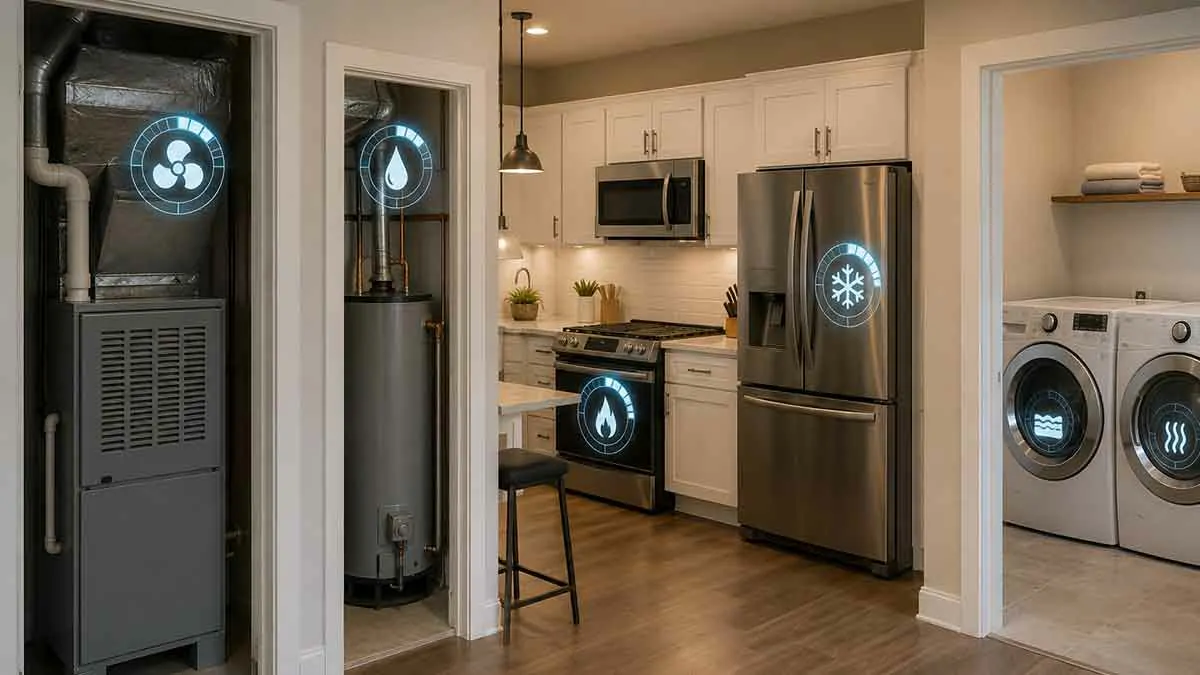
Not all appliances use the same amount of energy. Some equipment consumes large amounts of electricity because it operates at high power, while other devices use significant energy simply because they run for many hours each day.
Understanding which appliances and home systems are the biggest energy users can help homeowners identify practical opportunities to reduce electricity consumption and control utility costs.
Heating and cooling systems, water heaters, clothes dryers, electric cooking equipment, refrigerators, pool equipment, and electric vehicle charging can all contribute significantly to household energy use. However, the actual ranking varies from one home to another based on climate, equipment type, household size, operating habits, and energy source.
This guide explains which appliances and systems typically use the most energy, how to estimate their consumption, how to identify your home’s biggest energy users, and what you can do to reduce unnecessary energy use.
Table of Contents
What Makes an Appliance Energy-Intensive?
An appliance can be considered energy-intensive when it consumes a substantial amount of energy over time.
Two factors are particularly important:
- Power demand: How much electricity the appliance uses while operating.
- Operating time: How long the appliance runs.
An appliance with a high wattage rating may use relatively little energy if it operates for only a few minutes. Conversely, a lower-powered appliance can consume considerable energy if it operates continuously.
For example, an electric space heater may draw substantial power while running, while a refrigerator uses less power at any given moment but operates throughout the day.
This is why energy consumption should be evaluated over time rather than by wattage alone.
How Appliance Energy Use Is Measured
Electricity consumption is commonly measured in kilowatt-hours (kWh).
The basic calculation is:
Energy Use = Power × Operating Time
To estimate consumption:
Watts × Hours of Use ÷ 1,000 = kWh
For example, a 1,500-watt appliance operating for two hours would theoretically consume:
1,500 × 2 ÷ 1,000 = 3 kWh
Actual consumption may be lower because many appliances cycle on and off rather than operating continuously at their maximum rated power.
Energy use can also be affected by:
- Appliance efficiency
- Settings
- Operating temperature
- Household usage
- Maintenance
- Climate
- Appliance age
- Load size
1. Heating and Cooling Systems
Heating and cooling systems are often among the largest energy users in a home.
The amount of energy they consume depends heavily on the climate and the type of system installed. A home in a cold climate may use substantial energy for heating, while a home in a hot climate may use much more electricity for air conditioning.
Energy consumption is influenced by:
- Outdoor temperature
- Home size
- Insulation
- Air leakage
- HVAC efficiency
- Thermostat settings
- Equipment condition
- Operating hours
- Ductwork
A poorly insulated or drafty home can increase heating and cooling demand even when the HVAC equipment itself is reasonably efficient.
How to Reduce HVAC Energy Use
- Maintain heating and cooling equipment.
- Replace or clean filters as recommended.
- Seal major air leaks.
- Improve inadequate insulation.
- Keep supply and return vents unobstructed.
- Use reasonable thermostat settings.
- Seal and insulate ducts where appropriate.
- Reduce unwanted solar heat gain with suitable shading.
Because HVAC systems can represent a large portion of household energy use, improving the building envelope can sometimes reduce energy demand more effectively than replacing equipment alone.
2. Water Heaters
Water heaters can be another major source of household energy consumption.
Energy use depends on:
- Water heater type
- Energy source
- Tank capacity
- Household size
- Hot-water demand
- Temperature settings
- Equipment efficiency
- Pipe insulation
Traditional storage water heaters can consume energy even when no hot water is being used because the system must maintain the temperature of stored water.
Tankless systems avoid the same type of storage standby losses, but their total energy use still depends on how much hot water the household consumes.
How to Reduce Water Heating Energy Use
- Repair leaking hot-water fixtures.
- Avoid unnecessary hot-water use.
- Use an appropriate temperature setting.
- Insulate accessible hot-water pipes where suitable.
- Maintain the water heater according to manufacturer recommendations.
- Consider efficiency when replacing an aging unit.
3. Clothes Dryers
Clothes dryers can consume substantial energy because they generate heat and operate for relatively long cycles.
Energy use depends on:
- Dryer type
- Cycle duration
- Load size
- Moisture level
- Drying temperature
- Washer spin speed
- Vent condition
- Dryer efficiency
A dryer that operates frequently can become a significant household energy load.
How to Reduce Dryer Energy Use
- Clean the lint filter before each load.
- Avoid unnecessarily long cycles.
- Use moisture-sensing settings when available.
- Avoid overloading the dryer.
- Use appropriate drying temperatures.
- Make sure the exhaust system is clean and unobstructed.
- Use the highest practical washer spin setting.
4. Electric Ovens and Ranges
Electric ovens and ranges can draw substantial power while heating.
However, total energy consumption depends heavily on cooking frequency and duration.
Electric ovens can also release heat into the home, which may increase air-conditioning demand during hot weather.
How to Reduce Cooking Energy Use
- Avoid unnecessary preheating.
- Keep the oven door closed while cooking.
- Match cookware size to the heating element.
- Use smaller appliances for suitable cooking tasks.
- Cook multiple items during the same oven cycle when practical.
- Turn off cooking equipment promptly when finished.
5. Refrigerators and Freezers
Refrigerators and freezers operate throughout the day, making their long operating time important.
Modern efficient models can use relatively little electricity compared with older equipment, but an aging or poorly maintained refrigerator may consume substantially more.
Energy consumption can increase because of:
- Damaged door seals
- Excessively low temperature settings
- Poor ventilation around the appliance
- Frequent door opening
- Dirty or poorly maintained components
- Excessive frost in applicable models
How to Reduce Refrigerator Energy Use
- Check the door gasket for proper sealing.
- Keep temperature settings appropriate.
- Allow adequate airflow around the appliance.
- Avoid leaving the door open unnecessarily.
- Maintain the refrigerator according to manufacturer recommendations.
- Replace an inefficient unit when the long-term savings justify the cost.
6. Electric Space Heaters
Electric space heaters can have relatively high power demands for their size.
A portable heater used for several hours every day can consume a significant amount of electricity.
Frequent reliance on a space heater may also indicate an underlying problem such as:
- Poor insulation
- Air leakage
- Uneven HVAC distribution
- Poor room placement
- Inadequate heating capacity
How to Reduce Space Heater Energy Use
Instead of simply using the heater for longer periods, investigate why the room is uncomfortable.
Possible improvements include:
- Sealing drafts
- Improving insulation
- Checking HVAC airflow
- Addressing poorly insulated floors or walls
- Improving room-level temperature control
Always follow the manufacturer’s operating and clearance requirements when using portable heaters.
7. Swimming Pool Equipment
Swimming pools can add substantial electricity consumption to a household.
Major energy users may include:
- Pool pumps
- Filtration equipment
- Pool heaters
- Pool lighting
The largest contributor varies depending on the equipment and how frequently the pool is used.
Pump operating schedules can have a particularly important effect because pumps may operate for several hours per day.
How to Reduce Pool Energy Use
- Use appropriate pump schedules.
- Maintain clean filters.
- Keep pumps and equipment properly maintained.
- Use efficient equipment when replacement is necessary.
- Use a suitable pool cover to reduce heat and water loss.
- Avoid unnecessarily long equipment operating periods.
8. Hot Tubs and Spas
Hot tubs can use considerable energy because they must maintain a relatively high water temperature.
Energy consumption depends on:
- Water temperature
- Outdoor temperature
- Tub insulation
- Cover quality
- Usage frequency
- Pump operation
- Equipment efficiency
A properly fitted cover can reduce heat loss when the hot tub is not being used.
How to Reduce Hot Tub Energy Use
- Keep the cover properly fitted.
- Maintain the cover in good condition.
- Use reasonable temperature settings.
- Maintain pumps and heating equipment.
- Inspect insulation if excessive heat loss is suspected.
9. Dehumidifiers
Dehumidifiers can become significant energy users when they operate continuously or for many hours each day.
A unit that runs constantly may indicate that the home has an underlying moisture problem.
Possible causes include:
- Foundation moisture
- Plumbing leaks
- Poor drainage
- High indoor humidity
- Inadequate ventilation
- Excessive outdoor moisture entering the home
How to Reduce Dehumidifier Energy Use
- Address the source of excessive moisture.
- Maintain the filter and equipment.
- Use an appropriate humidity setting.
- Choose a properly sized unit.
- Keep exterior doors and windows appropriately closed while the unit operates.
Reducing the amount of moisture entering the home can be more effective than simply running a dehumidifier continuously.
10. Portable Air Conditioners
Portable air conditioners can consume substantial electricity when used for long periods.
Their energy consumption and effectiveness depend on:
- Room size
- Outdoor temperature
- Operating hours
- Unit efficiency
- Window sealing
- Exhaust configuration
- Room insulation
- Air leakage
Poor installation can allow cooled air to escape or outdoor heat to enter, causing the unit to run longer.
How to Reduce Portable AC Energy Use
- Seal the window opening around the exhaust system.
- Keep doors and windows closed while cooling.
- Use appropriate temperature settings.
- Reduce solar heat gain where practical.
- Maintain filters.
- Avoid cooling unoccupied rooms unnecessarily.
11. Dishwashers
Dishwashers use electricity for motors, pumps, controls, and often water heating and heated drying.
Their total energy use depends on:
- Number of cycles
- Cycle selection
- Water temperature
- Drying method
- Load size
- Appliance efficiency
How to Reduce Dishwasher Energy Use
- Run full loads when practical.
- Select efficient cycles when suitable.
- Avoid unnecessary pre-rinsing if the manufacturer’s instructions do not require it.
- Use lower-energy drying options when available.
- Clean filters and spray components regularly.
12. Washing Machines
Washing machines generally use electricity for motors, controls, and pumping, but water heating can substantially affect energy consumption in cycles that use hot water.
Energy use depends on:
- Water temperature
- Number of loads
- Cycle length
- Load size
- Machine efficiency
How to Reduce Washing Machine Energy Use
- Wash full loads when practical.
- Use cooler water when appropriate.
- Select efficient cycles.
- Avoid unnecessary extra rinse cycles.
- Follow recommended load sizes.
- Maintain the machine properly.
13. Electric Vehicle Charging
Electric vehicle charging can become one of the largest additional electricity loads in a home.
Consumption depends primarily on:
- Miles driven
- Vehicle efficiency
- Battery capacity
- Charging frequency
- Charging losses
- Charging equipment
A household with high daily driving needs can use considerably more electricity for vehicle charging than a household that drives only occasionally.
How to Manage EV Charging Energy Use
- Monitor charging consumption.
- Use scheduled charging when appropriate.
- Take advantage of suitable time-based electricity rates when available.
- Avoid unnecessary charging.
- Ensure charging equipment is properly installed and maintained.
The electricity used for an EV should be considered part of the household’s overall energy budget rather than treated as a typical appliance load.
14. Home Entertainment Equipment
Individual entertainment devices generally consume less energy than major heating, cooling, or water-heating systems.
However, multiple devices operating for many hours can contribute to household electricity consumption.
Examples include:
- Televisions
- Gaming consoles
- Audio equipment
- Streaming devices
- Receivers
Standby consumption can also add to electricity use when equipment remains connected and powered.
How to Reduce Entertainment Energy Use
- Enable automatic sleep settings.
- Turn equipment off when it is not needed.
- Disconnect equipment that does not need standby power.
- Use smart power strips where appropriate.
15. Computers and Home Office Equipment
Home offices can contain several devices that operate for long periods.
Energy users may include:
- Desktop computers
- Monitors
- Printers
- External drives
- Networking equipment
- Speakers
- Other peripherals
A powerful computer may use substantial electricity during demanding workloads, while networking equipment may consume smaller amounts continuously.
How to Reduce Home Office Energy Use
- Enable sleep settings.
- Turn off monitors when not needed.
- Shut down equipment that does not need to remain active.
- Avoid leaving unnecessary peripherals powered continuously.
- Choose efficient equipment when replacement is necessary.
16. Lighting
Lighting is usually less energy-intensive than major heating and cooling equipment, particularly when a home uses efficient LED bulbs.
However, lighting can still contribute to household consumption when many fixtures operate for long periods.
Energy use depends on:
- Number of lights
- Bulb type
- Operating hours
- Fixture wattage
- Lighting controls
How to Reduce Lighting Energy Use
- Use LED bulbs where appropriate.
- Turn off unnecessary lights.
- Use occupancy sensors or timers where useful.
- Take advantage of natural daylight.
- Use task lighting instead of illuminating an entire room when practical.
What Uses the Most Energy in a Typical Home?
There is no single ranking that applies to every household.
Energy consumption depends on climate, home size, equipment type, fuel sources, household behavior, and operating schedules.
In many homes, major energy users can include:
- Space heating
- Air conditioning
- Water heating
- Clothes drying
- Refrigeration
- Electric cooking
- Pool and spa equipment
- Electric space heating
- Dehumidification
- Electric vehicle charging and other long-duration loads
The ranking can change significantly.
For example, heating may dominate in a cold climate, while air conditioning can become one of the largest electricity loads in a hot climate. A household with an electric vehicle or swimming pool may have a substantially different energy profile.
High Wattage vs High Energy Consumption
A common mistake is assuming that the appliance with the highest wattage necessarily uses the most energy.
These are two different concepts.
High-Wattage Appliances
Examples may include:
- Electric ovens
- Space heaters
- Clothes dryers
- Electric water heaters
These appliances can draw substantial power while operating.
High Energy-Consumption Equipment
Examples may include:
- HVAC systems
- Water heaters
- Refrigerators
- Pool equipment
- Dehumidifiers
- Electric vehicle charging
These systems may consume significant energy because they operate frequently or for long periods.
The most useful measurement is therefore total kWh consumed over a meaningful period, rather than maximum wattage alone.
How to Find the Biggest Energy Users in Your Home
Start by identifying appliances and systems that either use high power or operate for long periods.
You can use:
- Utility consumption data
- Smart meters
- Plug-in energy monitors
- Smart appliance data
- Manufacturer energy labels
- Whole-home energy monitors
- Professional energy assessments
For major hard-wired systems such as central HVAC equipment, professional measurement or whole-home monitoring may be more appropriate than a plug-in meter.
How to Calculate Appliance Energy Consumption
For a basic estimate, use:
Watts × Hours ÷ 1,000 = kWh
For example, if a 1,200-watt appliance operates for three hours:
1,200 × 3 ÷ 1,000 = 3.6 kWh
To estimate the cost, multiply the estimated kWh by your electricity rate.
Energy Cost = kWh × Electricity Rate
For example, if an appliance uses 3.6 kWh and electricity costs $0.15 per kWh:
3.6 × $0.15 = $0.54
Actual costs vary according to the utility rate structure and the appliance’s real operating pattern.
How to Reduce Energy Use From Large Appliances
The most effective approach is usually to focus on the largest sources first.
1. Reduce Unnecessary Operating Time
Turn off equipment when it is not needed and avoid unnecessarily long cycles.
2. Maintain Equipment
Dirty filters, blocked airflow, damaged seals, and neglected maintenance can increase energy consumption.
3. Improve Efficiency
When replacing equipment, compare its expected energy use rather than focusing only on the purchase price.
4. Reduce Heating and Cooling Demand
Improve insulation, air sealing, shading, and other building-envelope components where deficiencies exist.
5. Monitor Actual Consumption
Use utility data or energy-monitoring equipment to determine whether an upgrade is actually reducing energy use.
When to Replace an Energy-Intensive Appliance
Replacing an appliance simply because it consumes energy is not always the most economical decision.
Replacement may make sense when the appliance is:
- Near the end of its useful life
- Frequently requiring repairs
- Significantly less efficient than current alternatives
- Consuming unusually high amounts of energy
- Poorly matched to household needs
Consider:
- Purchase price
- Installation costs
- Expected energy savings
- Maintenance costs
- Remaining useful life
- Available rebates or incentives
- Expected replacement frequency
A moderately inefficient appliance that is rarely used may not justify immediate replacement, while an inefficient appliance operating every day may provide a stronger replacement opportunity.
Common Mistakes When Reducing Appliance Energy Use
Focusing Only on Wattage
High wattage does not automatically mean high annual energy consumption.
Ignoring Operating Time
A device that operates continuously can consume more energy than a high-powered appliance used briefly.
Replacing Appliances Without Comparing Costs
A new appliance may use less energy but still take many years to recover its purchase cost.
Ignoring the Building Envelope
Poor insulation and air leakage can significantly increase HVAC energy demand.
Neglecting Maintenance
Dirty filters, blocked vents, damaged seals, and restricted airflow can increase operating time and energy use.
Focusing on Small Devices First
Reducing electricity use from small electronics may have less impact than addressing HVAC, water heating, or other major loads.
Assuming Every Home Has the Same Biggest Energy User
Climate, household size, equipment, and lifestyle can dramatically change the energy profile of a home.
Energy-Intensive Appliance Checklist
Use this checklist to identify major energy users in your home.
Heating and Cooling
- Central heating system
- Air conditioner
- Heat pump
- Electric space heaters
- Portable air conditioners
Water and Laundry
- Water heater
- Clothes dryer
- Washing machine
- Dishwasher
Kitchen
- Refrigerator
- Freezer
- Electric oven
- Electric range
Specialty Equipment
- Pool pump
- Pool heater
- Hot tub
- Dehumidifier
- EV charger
Electronics
- Television
- Gaming console
- Desktop computer
- Monitors
- Networking equipment
For each item, consider:
- Power rating
- Hours of use
- Frequency of use
- Energy efficiency
- Maintenance condition
- Potential for reducing operating time
Final Thoughts
The most energy-intensive appliances in a home are not necessarily the devices with the highest wattage. Total energy consumption depends on both power demand and how long equipment operates.
Heating and cooling systems, water heaters, clothes dryers, refrigerators, electric cooking equipment, pool systems, space heaters, dehumidifiers, and EV charging can all become significant energy users depending on the household.
The best way to reduce energy consumption is to identify the largest loads in your particular home rather than relying on a generic ranking. Review utility data, estimate appliance consumption, monitor major loads when possible, and address equipment maintenance and building-envelope problems that increase energy demand.
When replacement is necessary, compare the expected energy savings with purchase, installation, maintenance, and operating costs. A targeted approach allows homeowners to focus their time and money on the improvements most likely to make a meaningful difference.