
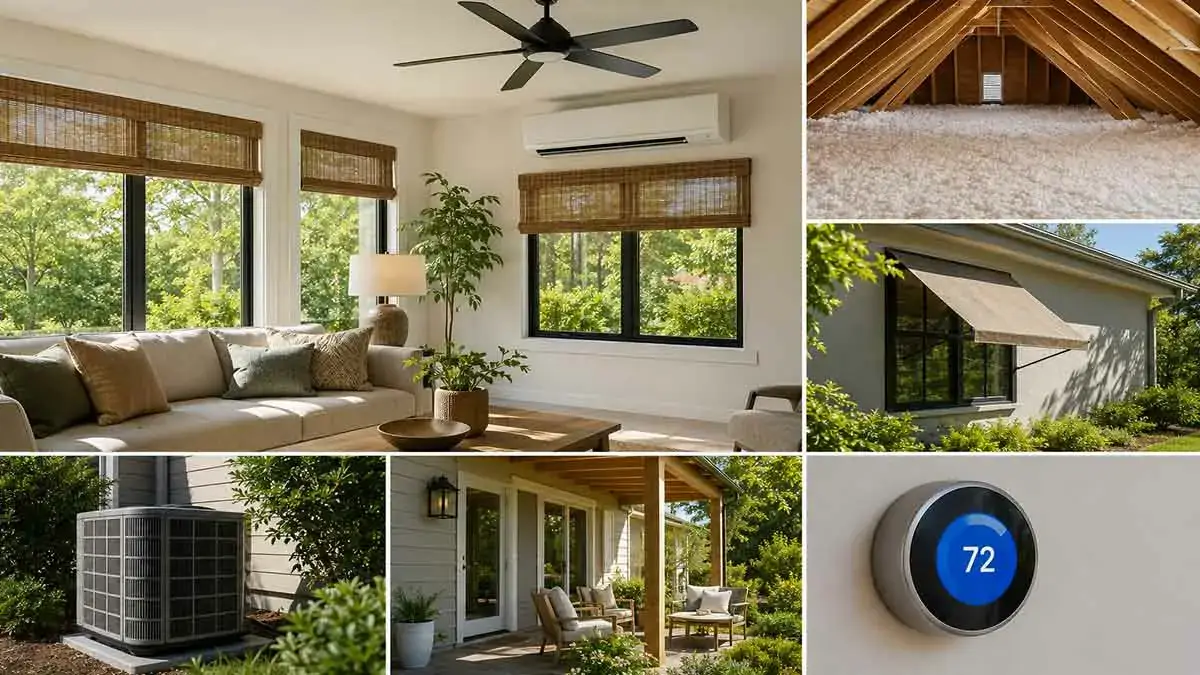
Cooling a home during hot weather can account for a significant portion of household energy use. When an air conditioner or heat pump operates for long periods, electricity consumption can increase quickly, particularly during periods of high outdoor temperatures.
Reducing cooling costs does not always require replacing the entire HVAC system. Improving the building envelope, controlling solar heat gain, maintaining cooling equipment, optimizing thermostat settings, and reducing unnecessary indoor heat can all help lower cooling demand.
The most effective approach is to reduce the amount of heat entering the home while helping the cooling system operate efficiently.
This guide explains practical ways to reduce cooling costs, including improvements you can make without replacing your air conditioner, seasonal strategies, HVAC maintenance, and larger upgrades to consider when existing equipment reaches the end of its useful life.
Table of Contents
Why Cooling Costs Can Be High
High cooling costs can result from several factors rather than the air conditioner alone.
Common causes include:
- Poor attic insulation
- Excessive air leakage
- Direct sunlight through windows
- Inefficient or aging HVAC equipment
- Dirty filters
- Leaking or poorly insulated ducts
- Incorrect thermostat settings
- High indoor humidity
- Unnecessary indoor heat sources
- Poor equipment maintenance
- Incorrect HVAC sizing
The condition of the building envelope can be just as important as the efficiency of the cooling equipment.
If excessive heat enters through the roof, windows, walls, or air leaks, the air conditioner must remove that heat to maintain the desired indoor temperature.
1. Set the Thermostat Appropriately
The thermostat is one of the simplest places to reduce cooling energy use.
Choose a temperature that provides reasonable comfort without unnecessarily overcooling the home.
Avoid setting the thermostat extremely low in an attempt to cool the house faster. A lower target temperature generally does not make the air conditioner cool the home faster. Instead, it requires the system to operate longer before reaching the lower setting.
A practical thermostat setting should balance:
- Comfort
- Outdoor temperature
- Humidity
- Occupancy
- Energy consumption
2. Use a Programmable or Smart Thermostat
Programmable and smart thermostats can help reduce unnecessary cooling when the home is unoccupied.
Depending on the system, useful features may include:
- Temperature scheduling
- Remote control
- Occupancy detection
- Energy-use reports
- Temperature alerts
- Automatic adjustments
Create a schedule that reflects actual household routines rather than relying on frequent manual changes.
Before installing a smart thermostat, confirm that it is compatible with the existing HVAC system.
3. Adjust the Temperature When the Home Is Empty
If the home is unoccupied for several hours, allowing the indoor temperature to rise moderately can reduce the amount of cooling required.
The appropriate adjustment depends on:
- Outdoor temperature
- Indoor humidity
- Building characteristics
- Pets
- Occupancy patterns
Avoid allowing indoor conditions to become excessively hot or humid, particularly when the home contains moisture-sensitive materials or pets.
4. Use Ceiling Fans Correctly
Ceiling fans can improve perceived comfort by increasing air movement across the skin.
This may allow occupants to remain comfortable at a somewhat higher thermostat setting.
However, ceiling fans do not actually lower the air temperature.
Use fans in occupied rooms and turn them off when rooms are empty to avoid unnecessary electricity consumption.
5. Keep HVAC Filters Clean
A dirty or clogged filter can restrict airflow and reduce HVAC performance.
Check the filter regularly and replace or clean it according to the manufacturer’s recommendations.
The appropriate maintenance interval depends on:
- Filter type
- System usage
- Household conditions
- Pets
- Indoor air quality requirements
Use a filter that is compatible with the HVAC equipment rather than choosing one solely because it has a higher filtration rating.
6. Maintain the Air Conditioning System
Regular HVAC maintenance can help identify problems that reduce cooling performance.
Depending on the equipment, maintenance may include:
- Checking airflow
- Inspecting coils
- Cleaning appropriate components
- Checking electrical connections
- Inspecting condensate drainage
- Evaluating refrigerant-related performance
- Checking system operation
Technical HVAC work should be performed by a qualified professional.
Regular maintenance is especially useful before periods of high cooling demand.
7. Keep the Outdoor Unit Clear
Outdoor air-conditioning and heat-pump equipment requires adequate airflow.
Keep the area around the unit free from:
- Leaves
- Grass clippings
- Weeds
- Debris
- Stored objects
Follow the manufacturer’s clearance requirements.
Restricted airflow can reduce system performance and may increase operating stress.
8. Improve Attic Insulation
The attic can become significantly hotter than the living space during summer.
If insulation is inadequate, heat can transfer from the attic into the conditioned part of the home.
Inspect for:
- Thin insulation
- Missing insulation
- Compressed insulation
- Moisture
- Air leakage
- Damaged materials
Repair roof leaks and address major air leaks before adding insulation.
9. Seal Major Air Leaks
Air leakage can allow hot outdoor air to enter the home and increase cooling demand.
Common leakage locations include:
- Exterior doors
- Windows
- Attic penetrations
- Plumbing openings
- Electrical penetrations
- Rim joists
- Utility penetrations
Appropriate air sealing can reduce uncontrolled airflow and help the cooling system maintain indoor conditions more efficiently.
Do not seal required ventilation openings, drainage paths, or combustion-air pathways.
10. Seal and Insulate the Attic Hatch
An attic access hatch can become an overlooked source of air leakage and heat transfer.
Check for:
- Visible gaps
- Poor weatherstripping
- Insufficient insulation
- Loose fitting
- Damaged seals
An appropriately insulated and sealed hatch can improve the overall performance of the attic boundary.
11. Use Exterior Window Shading
Direct sunlight can add significant heat to rooms through windows.
Exterior shading can reduce solar heat gain before sunlight reaches the glass.
Options include:
- Awnings
- Exterior shades
- Shutters
- Overhangs
- Shade structures
- Appropriate landscaping
Exterior shading can be particularly useful for windows exposed to strong afternoon sunlight.
12. Close Blinds and Curtains During Peak Sunlight
Interior window coverings can also help manage solar heat gain.
Close suitable blinds, shades, or curtains during periods of intense sunlight.
The effectiveness depends on the window orientation, glazing, window covering, and outdoor conditions.
Use window coverings strategically rather than keeping every window permanently covered.
13. Improve Window Performance
Old or poorly sealed windows can contribute to heat gain and uncomfortable rooms.
Depending on their condition, improvements may include:
- Replacing damaged weatherstripping
- Repairing window frames
- Sealing appropriate gaps
- Improving window coverings
- Installing efficient replacement windows when necessary
Complete window replacement is not always the first or most cost-effective cooling upgrade.
If existing windows are structurally sound, weatherproofing and shading may provide useful improvements at a lower cost.
14. Use Natural Ventilation When Conditions Allow
Natural ventilation can sometimes reduce cooling demand when outdoor conditions are favorable.
Opening windows may be useful when:
- Outdoor air is cooler than indoor air
- Outdoor humidity is acceptable
- Air quality is good
- Security conditions permit
Close windows when outdoor temperatures or humidity become higher than indoor conditions.
Natural ventilation is not equally effective in every climate, particularly during hot and humid weather.
15. Control Indoor Humidity
High indoor humidity can make warm temperatures feel less comfortable.
Excess moisture can also contribute to:
- Condensation
- Mold growth
- Moisture damage
- Greater cooling demand
Investigate sources such as:
- Plumbing leaks
- Foundation moisture
- Poor drainage
- Inadequate exhaust ventilation
- Moisture entering from crawl spaces
Use appropriate dehumidification when necessary, but investigate the source if a dehumidifier must operate continuously.
16. Reduce Heat From Appliances
Household appliances generate heat while operating.
During hot weather, reduce unnecessary use of major heat-producing appliances when practical.
Examples include:
- Ovens
- Stovetops
- Clothes dryers
- Large electronics
- Incandescent lighting
Using smaller appliances for suitable tasks can reduce indoor heat generation.
17. Use Heat-Producing Appliances Strategically
Cooking and laundry can add unwanted heat to the home.
Consider using:
- Microwave ovens
- Countertop cooking appliances
- Outdoor cooking when practical
- Efficient drying cycles
Run heat-producing appliances during cooler periods when possible.
For example, using a clothes dryer later in the evening may reduce the impact of its heat on the home during the hottest part of the day.
Always maintain and vent appliances according to manufacturer requirements.
18. Inspect and Seal Ductwork
Leaking ducts can allow cooled air to escape before it reaches occupied rooms.
This problem is particularly important when ducts pass through:
- Attics
- Crawl spaces
- Garages
- Other unconditioned areas
Inspect accessible ductwork for:
- Loose connections
- Visible gaps
- Disconnected sections
- Damaged insulation
Professional duct testing can identify leakage that is not visible during a basic inspection.
19. Insulate Ducts in Unconditioned Spaces
Ducts located in hot attics or other unconditioned areas can gain heat as cooled air travels through them.
Appropriate insulation can reduce unwanted heat transfer.
Duct insulation should be suitable for the application and installed according to applicable requirements.
Sealing duct leakage should also be considered because insulation alone does not correct air loss.
20. Keep Supply and Return Vents Clear
Furniture, curtains, rugs, and storage items can restrict airflow.
Keep supply vents and return grilles accessible.
Avoid covering them with:
- Furniture
- Rugs
- Curtains
- Storage containers
If a room remains consistently warmer than the rest of the home, investigate airflow, insulation, windows, and solar exposure instead of simply lowering the thermostat.
21. Improve Airflow Between Rooms
Poor airflow can create temperature differences between rooms.
Potential causes include:
- Blocked return grilles
- Closed interior doors
- Poor duct design
- Insufficient return-air pathways
- Differences in insulation or solar exposure
Persistent temperature differences may indicate a design or building-envelope problem that requires professional evaluation.
22. Use Zoning Where Appropriate
Zoned HVAC systems can provide different temperature settings for different areas of a home.
Zoning may be useful when:
- Different floors have different cooling loads.
- Some areas are rarely occupied.
- Certain rooms receive substantially more sunlight.
- The home has distinct usage patterns.
However, zoning should be designed to match the HVAC equipment and duct system.
Improper zoning can create airflow problems and may not reduce energy consumption.
23. Improve Roof and Attic Performance
The roof and attic play an important role in summer heat management.
Consider:
- Repairing roof leaks
- Maintaining the roof
- Improving attic insulation
- Sealing appropriate air leaks
- Maintaining required attic ventilation
A well-maintained roof protects insulation and structural materials while helping preserve the performance of the building envelope.
24. Use Landscaping for Shade
Appropriate landscaping can reduce solar heat gain around the home.
Shade can be particularly helpful near:
- South- or west-facing windows, depending on the climate
- Sun-exposed walls
- Outdoor living areas
When planting trees or shrubs, maintain appropriate clearance from:
- Foundations
- Roofs
- HVAC equipment
- Utility lines
Landscaping should support energy performance without creating drainage, pest, or maintenance problems.
25. Reduce Unnecessary Indoor Heat Sources
In addition to large appliances, several smaller sources can add heat to the home.
Examples include:
- Incandescent bulbs
- Computers
- Televisions
- Gaming equipment
- Audio systems
- Unused electronics
Turn off equipment that is not needed.
Replacing inefficient incandescent lighting with LEDs can reduce both electricity consumption and heat generation.
26. Upgrade to Efficient HVAC Equipment When Necessary
An aging or inefficient air conditioner may eventually become expensive to operate or maintain.
Replacement may be worth considering when:
- Repairs are becoming frequent.
- Cooling performance is declining.
- Energy consumption is increasing.
- The system is approaching the end of its useful life.
- The equipment cannot maintain comfortable indoor temperatures.
When replacing the system, compare efficiency, capacity, installation quality, operating costs, and compatibility rather than choosing equipment based only on purchase price.
27. Avoid Oversizing the Air Conditioner
A larger air conditioner is not automatically more efficient.
An oversized system may:
- Cycle too frequently
- Provide less effective humidity control
- Create temperature inconsistencies
- Operate less efficiently under some conditions
Proper sizing should account for:
- Climate
- Home size
- Insulation
- Air leakage
- Window characteristics
- Solar exposure
- Occupancy
- Internal heat gains
A professional cooling-load calculation can help determine appropriate equipment capacity.
28. Consider a Heat Pump
Heat pumps can provide both heating and cooling.
When properly selected and installed, a heat pump can provide efficient cooling while also serving as the home’s heating system.
Before switching, evaluate:
- Local climate
- Electricity prices
- Existing heating equipment
- Heat pump efficiency
- Heating demand
- Cooling demand
- Building-envelope condition
A heat pump should be selected based on the home’s actual loads rather than simply replacing an existing system with the same capacity.
29. Maintain Condensate Drainage
Air conditioners remove moisture from indoor air during normal cooling operation.
That moisture must drain properly.
A blocked condensate drain can lead to:
- Water leaks
- System shutdowns
- Moisture damage
- Reduced reliability
Have condensate drainage inspected and maintained according to the equipment manufacturer’s recommendations.
30. Schedule Cooling Maintenance Before Peak Summer
Waiting until the hottest days of the year to discover an HVAC problem can result in discomfort and emergency repair costs.
Schedule recommended maintenance before peak cooling demand when practical.
A professional inspection may identify:
- Airflow problems
- Dirty components
- Drainage issues
- Electrical problems
- Mechanical problems
- Performance concerns
Preventive maintenance does not guarantee lower energy bills, but it can help keep the system operating as intended.
31. Use Energy Monitoring
Monitoring household energy use can help identify unusual cooling patterns.
Depending on the available equipment, useful information may include:
- Total electricity consumption
- HVAC runtime
- Thermostat settings
- Indoor temperature
- Outdoor temperature
Compare energy consumption over similar weather periods rather than comparing isolated days with very different temperatures.
Smart thermostats and home energy-monitoring systems may provide useful data for identifying changes in consumption.
32. Reduce Cooling Costs in an Older Home
Older homes may have multiple sources of heat gain and air leakage.
Instead of immediately replacing the air conditioner, evaluate the home systematically.
A practical sequence is:
- Inspect attic insulation.
- Seal major air leaks.
- Weatherproof windows and doors.
- Inspect ductwork.
- Address moisture problems.
- Maintain the HVAC system.
- Optimize thermostat operation.
- Evaluate equipment replacement only when appropriate.
Improving the building envelope may reduce cooling demand before a new HVAC system is installed.
33. Consider a Home Energy Audit
A professional home energy audit can help identify where cooling energy is being wasted.
Depending on the service, an audit may evaluate:
- Attic insulation
- Air leakage
- Windows and doors
- Ductwork
- HVAC equipment
- Moisture conditions
- Building-envelope performance
Testing such as blower-door testing or infrared imaging may reveal problems that are difficult to identify through a visual inspection alone.
An audit can help prioritize improvements based on the home’s actual condition.
Most Effective Ways to Reduce Cooling Costs
Every home is different, but a practical priority order is:
- Reduce unwanted solar heat gain.
- Improve attic insulation.
- Seal major air leaks.
- Maintain the cooling system.
- Keep filters clean.
- Improve duct performance.
- Optimize thermostat settings.
- Control excessive indoor humidity.
- Reduce unnecessary indoor heat.
- Replace inefficient equipment when replacement is justified.
The goal is to reduce the cooling load before relying on equipment upgrades alone.
Cooling Cost Reduction Checklist
Building Envelope
- Inspect attic insulation.
- Seal major air leaks.
- Seal and insulate the attic hatch.
- Weatherstrip exterior doors.
- Inspect windows.
- Use appropriate window shading.
- Inspect basement and crawl spaces.
- Check roof condition.
HVAC System
- Replace or clean filters as recommended.
- Schedule regular maintenance.
- Keep outdoor equipment clear.
- Inspect condensate drainage.
- Keep supply and return vents unobstructed.
- Inspect accessible ductwork.
- Evaluate aging equipment.
Temperature and Comfort
- Use reasonable thermostat settings.
- Adjust temperature when the home is unoccupied.
- Use ceiling fans in occupied rooms.
- Monitor indoor humidity.
- Improve airflow between rooms.
Daily Habits
- Limit unnecessary oven use.
- Use smaller cooking appliances when practical.
- Run heat-producing appliances during cooler periods.
- Turn off unnecessary electronics.
- Use efficient lighting.
- Close window coverings during intense sunlight.
Outdoor Strategies
- Use exterior shading where appropriate.
- Maintain shade trees.
- Keep HVAC equipment clear.
- Maintain the roof and drainage system.
Common Mistakes That Increase Cooling Costs
Setting the Thermostat Extremely Low
A very low setting does not normally make the air conditioner cool the home faster. It can simply increase the amount of time the system operates.
Ignoring Humidity
A humid home can feel uncomfortable even when the temperature appears reasonable.
Blocking HVAC Vents
Restricted airflow can reduce system performance and create uneven temperatures.
Ignoring Duct Leakage
Cooled air can be lost before it reaches occupied rooms, particularly when ducts run through hot or unconditioned areas.
Replacing Windows Without Evaluating Other Problems
Windows matter, but attic insulation, air sealing, shading, and duct improvements may provide greater benefits in some homes.
Choosing an Oversized Air Conditioner
Oversized equipment may cycle too frequently and provide less effective humidity control.
Ignoring Outdoor Equipment
Vegetation and debris can restrict airflow around the outdoor unit.
Running Heat-Producing Appliances During the Hottest Hours
Cooking, drying clothes, and other activities can add unnecessary heat to the home.
Sealing the Home Without Considering Ventilation
Air sealing should reduce uncontrolled leakage without eliminating required ventilation or combustion-air pathways.
How to Reduce Cooling Costs Without Replacing the AC
You can often reduce cooling costs without installing a new air conditioner.
Start with lower-cost measures such as:
- Cleaning or replacing filters
- Optimizing thermostat settings
- Using ceiling fans
- Closing blinds during strong sunlight
- Sealing appropriate air leaks
- Improving attic insulation
- Weatherstripping doors
- Inspecting ductwork
- Reducing indoor heat sources
- Maintaining the existing HVAC system
These measures can reduce cooling demand and may allow an existing system to operate more effectively.
However, if the equipment is failing, severely inefficient, or near the end of its useful life, replacement may eventually provide a better long-term solution.
How to Reduce Cooling Costs in Summer
During the hottest months, focus on reducing heat gain before it reaches the interior.
A practical summer strategy is to:
- Keep windows shaded during strong sunlight.
- Use ceiling fans in occupied rooms.
- Avoid unnecessary oven use.
- Run heat-producing appliances during cooler periods.
- Keep the thermostat at a reasonable setting.
- Maintain HVAC filters.
- Keep outdoor equipment clear.
- Monitor indoor humidity.
- Keep doors and windows closed when outdoor conditions are hotter or more humid.
- Use natural ventilation only when outdoor conditions are favorable.
Small daily decisions can reduce the cooling load, particularly during extended periods of extreme heat.
Final Thoughts
Reducing cooling costs starts with reducing the amount of heat that enters the home.
Attic insulation, air sealing, window shading, proper ductwork, moisture control, and good building-envelope maintenance can reduce the workload placed on an air conditioner or heat pump.
Combine these improvements with sensible thermostat settings, regular HVAC maintenance, ceiling fans, efficient appliance use, and appropriate equipment upgrades when replacement becomes necessary.
The most cost-effective solution is not always a new air conditioner. In many homes, improving insulation, sealing air leaks, controlling solar heat gain, and maintaining existing equipment can reduce cooling demand without a major HVAC investment.
By improving both the home and the way the cooling system is operated, you can reduce unnecessary energy consumption while maintaining a more comfortable indoor environment during hot weather.