
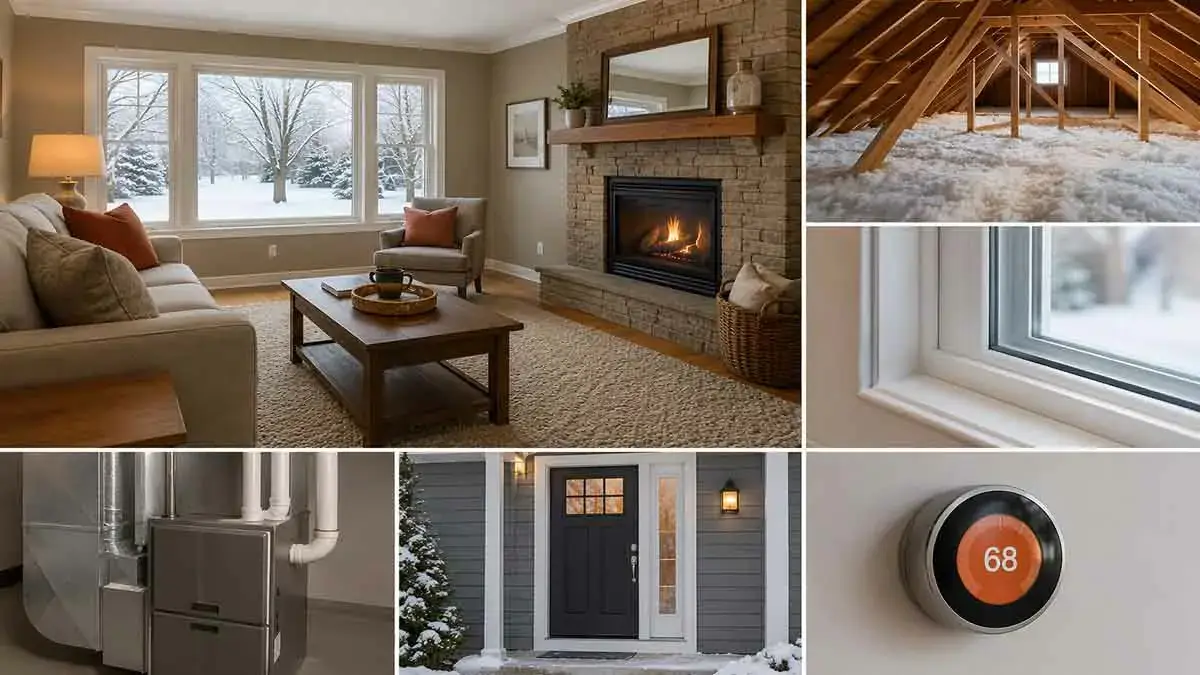
Heating can be one of the largest household energy expenses during cold weather. The cost of keeping a home warm depends on more than the heating system itself. Insulation, air leakage, windows, ductwork, thermostat settings, equipment efficiency, fuel prices, and household habits can all affect how much energy a home requires.
The most effective way to reduce heating costs is usually to lower the home’s heating demand first and then improve the efficiency of the heating system and its controls.
Simple actions such as adjusting thermostat settings and maintaining filters can help, but larger improvements such as attic insulation, air sealing, duct improvements, and efficient heating equipment can have a broader impact.
This guide explains practical ways to reduce heating costs, how to prioritize improvements, and how to avoid common mistakes that can increase energy use without improving comfort.
Table of Contents
What Causes High Heating Costs?
High heating costs can result from several factors working together.
Common causes include:
- Poor insulation
- Excessive air leakage
- Inefficient heating equipment
- Leaky ductwork
- Incorrect thermostat settings
- Poor equipment maintenance
- Drafty windows and doors
- High fuel or electricity prices
- Excessive heating of unused spaces
- Incorrect HVAC sizing
Before making a major upgrade, identify which factors are most important in your home.
A home with excellent insulation but an inefficient heating system may need an equipment upgrade. A home with a newer heating system but severe air leakage may benefit more from air sealing and insulation.
1. Lower Heating Demand Before Upgrading Equipment
The simplest way to reduce heating costs is to reduce the amount of heat the home needs.
Start with the building envelope:
- Attic insulation
- Wall insulation
- Basement insulation
- Crawl-space insulation
- Air sealing
- Window and door weatherproofing
Reducing heat loss can allow the existing heating system to operate for shorter periods.
It can also reduce the required capacity of replacement equipment.
2. Use Appropriate Thermostat Settings
Thermostat settings directly influence heating demand.
During heating season, avoid setting the temperature higher than necessary for comfort.
A lower indoor temperature generally reduces heat loss because the difference between indoor and outdoor temperatures becomes smaller.
Choose a temperature that balances:
- Comfort
- Occupancy
- Energy use
- Household needs
Avoid extreme settings that create discomfort or other building risks.
3. Create a Heating Schedule
If the home is regularly unoccupied for several hours, a heating schedule can reduce unnecessary operation.
A programmable or smart thermostat can automatically adjust temperatures during:
- Sleeping hours
- Work hours
- School hours
- Vacations
- Other predictable periods of low occupancy
The schedule should reflect actual household routines.
A complicated schedule that occupants constantly override may provide little practical benefit.
4. Seal Major Air Leaks
Air leakage can significantly increase heating demand.
Common leakage locations include:
- Attic penetrations
- Window frames
- Exterior doors
- Plumbing openings
- Electrical penetrations
- Rim joists
- Utility penetrations
- Attic hatches
Seal appropriate gaps using materials suitable for the building surfaces.
Do not block required ventilation openings or combustion-air pathways.
5. Improve Attic Insulation
The attic is often one of the most important areas to evaluate in a home with high heating costs.
Inspect for:
- Thin insulation
- Missing insulation
- Compressed insulation
- Uneven coverage
- Air leakage
- Moisture
- Roof damage
Air-seal major penetrations before adding insulation.
Repair roof leaks and moisture problems first.
6. Insulate Walls When Appropriate
Wall insulation can reduce heat transfer, but the correct approach depends on the home’s construction.
Older homes may contain:
- Plaster walls
- Masonry
- Empty cavities
- Existing insulation
- Moisture-sensitive materials
Do not add insulation without understanding how the wall assembly handles moisture.
During major renovations, adding appropriate insulation can be more practical because wall cavities are already accessible.
7. Insulate the Basement or Crawl Space
Uninsulated lower areas can contribute to heat loss and uncomfortable floors.
Before insulating, inspect for:
- Water intrusion
- Condensation
- Dampness
- Air leakage
- Existing insulation damage
Correct drainage and moisture problems before covering the area with insulation.
The appropriate strategy depends on whether the basement or crawl space is conditioned, unconditioned, vented, or part of the home’s thermal boundary.
8. Seal and Insulate Rim Joists
Rim joists can be significant sources of air leakage.
Inspect the perimeter where floor framing meets exterior walls.
Appropriate air sealing and insulation can reduce drafts and improve comfort in rooms above.
Address moisture problems before installing insulation.
9. Improve Windows and Doors
Drafty windows and doors can increase heating demand.
Before replacing them, inspect:
- Weatherstripping
- Door sweeps
- Window seals
- Frames
- Caulking
- Hardware
Simple repairs may improve comfort without the cost of complete replacement.
Window replacement may be appropriate when existing units are damaged, failing, or no longer practical to repair.
10. Use Window Coverings Strategically
Curtains, shades, blinds, and shutters can influence heat transfer and comfort near windows.
During cold weather, use coverings strategically to reduce unwanted heat loss while allowing useful sunlight when appropriate.
Do not assume that keeping all coverings closed all day is always the most efficient strategy.
Consider:
- Window orientation
- Outdoor temperature
- Sun exposure
- Time of day
- Window performance
11. Take Advantage of Winter Sunlight
Solar radiation entering south- or otherwise favorably oriented windows can provide passive heat in some homes and climates.
Open appropriate coverings during useful sunlight periods.
Close them when the sun is no longer contributing heat or when privacy and nighttime heat-loss control are more important.
The benefit depends heavily on climate and window orientation.
12. Maintain the Heating System
Regular maintenance can help keep heating equipment operating properly.
Depending on the system, maintenance may include:
- Filter replacement
- Component inspection
- Cleaning
- Airflow checks
- Electrical inspection
- Combustion safety checks
- Professional servicing
Follow the equipment manufacturer’s maintenance requirements.
13. Replace or Clean HVAC Filters
A clogged filter can restrict airflow and reduce heating-system performance.
Check filters regularly and replace or clean them according to manufacturer recommendations.
The appropriate interval depends on:
- Filter type
- System runtime
- Household conditions
- Pets
- Indoor air-quality requirements
Do not install a filter that is incompatible with the heating system.
14. Inspect and Seal Ductwork
Leaky ducts can allow heated air to escape before it reaches occupied rooms.
Inspect accessible ducts for:
- Loose connections
- Disconnected sections
- Damaged insulation
- Visible gaps
- Poorly sealed joints
Duct improvements are particularly important when ducts pass through:
- Attics
- Crawl spaces
- Garages
- Other unconditioned areas
15. Keep Vents and Registers Clear
Furniture, curtains, rugs, and other objects can interfere with airflow.
Keep supply and return vents accessible.
Do not close large numbers of registers to reduce heating costs unless the HVAC system was specifically designed for that configuration.
Restricting airflow can create pressure and equipment-performance problems.
16. Improve Heating System Controls
Modern controls can help reduce unnecessary heating.
Depending on the system, useful controls may include:
- Programmable thermostats
- Smart thermostats
- Zone controls
- Outdoor temperature controls
- Boiler controls
Controls should be compatible with the heating equipment.
17. Consider a Smart Thermostat
A smart thermostat can automate temperature schedules and provide remote control.
Potential features include:
- Scheduling
- Occupancy detection
- Geofencing
- Remote adjustment
- Energy reports
- Heating alerts
A smart thermostat is most useful when it changes actual heating behavior.
It cannot compensate for severe insulation problems or malfunctioning equipment.
18. Reduce Heat Loss Through the Attic Hatch
An attic hatch can create an air leakage and insulation gap between the living space and attic.
Check for:
- Poor fit
- Missing weatherstripping
- Insufficient insulation
- Visible gaps
An appropriately sealed and insulated hatch can reduce heat transfer.
19. Close Fireplace Dampers When Appropriate
An open fireplace damper can allow conditioned indoor air to escape.
When the fireplace is not in use, keep the damper closed if the fireplace design and safety requirements allow it.
Never close a damper while a fire is burning or when hot embers remain.
20. Reduce Heat Loss From Hot-Water Heating Systems
Homes that use hot water for heating may lose heat through poorly insulated pipes, tanks, or distribution systems.
Potential improvements include:
- Insulating suitable hot-water pipes
- Repairing leaks
- Maintaining boilers
- Improving controls
- Inspecting distribution systems
Follow manufacturer and local safety requirements.
21. Prevent Heating Loss Through Unused Areas
Some spaces may not require the same temperature as occupied living areas.
However, do not simply close vents or shut off heating zones without understanding the system design.
Instead, use appropriate zoning or controls when available.
Protect areas containing plumbing from temperatures that could cause freezing.
22. Improve Home Humidity Management
Humidity affects perceived comfort.
During cold weather, excessively low humidity can make a home feel uncomfortable even when the air temperature is adequate.
At the same time, excessive indoor humidity can contribute to condensation on cold surfaces.
Maintain indoor humidity at an appropriate level for the climate and building.
Do not use humidity controls as a substitute for fixing water leaks or ventilation problems.
23. Reduce Indoor Heat Loss During Cold Weather
Simple operating habits can help reduce unnecessary heat loss.
Consider:
- Keeping exterior doors closed
- Closing fireplace dampers when appropriate
- Closing window coverings at night
- Avoiding prolonged open windows
- Using appropriate draft protection
- Keeping heated rooms reasonably separated from unheated spaces
These measures work best when combined with improvements to the building envelope.
24. Upgrade Inefficient Heating Equipment When Necessary
Replacing heating equipment may be worthwhile when the existing system:
- Is near the end of its useful life
- Requires frequent repairs
- Performs poorly
- Has significantly higher operating costs
- Cannot maintain comfortable temperatures
Do not select replacement equipment based solely on the capacity of the old system.
The home’s current heating load should be evaluated.
25. Consider a Heat Pump
Heat pumps can provide efficient heating by transferring heat rather than generating it directly.
They may be particularly attractive when:
- The home also needs cooling
- Electricity prices are reasonable
- The climate is suitable for the selected equipment
- The building envelope has been improved
- Existing heating equipment is nearing replacement
Compare the expected operating cost with the current heating system before making a decision.
26. Improve Duct Insulation in Unconditioned Areas
Heated air can lose heat when ducts travel through cold areas.
Inspect duct insulation in:
- Attics
- Crawl spaces
- Garages
- Unconditioned basements
Repair damaged insulation and seal appropriate duct joints.
27. Check Heating System Sizing
An oversized or undersized heating system can create performance problems.
Oversized equipment may cycle more frequently, while undersized equipment may struggle during extreme weather.
Proper sizing should account for:
- Climate
- Home size
- Insulation
- Air leakage
- Windows
- Occupancy
- Heating load
A professional load calculation can provide a better basis for equipment selection.
28. Monitor Heating Energy Use
Energy monitoring can help identify changes in heating consumption.
Track, when possible:
- Electricity use
- Fuel consumption
- Heating runtime
- Indoor temperature
- Outdoor temperature
Compare similar weather periods rather than assuming that a colder month necessarily indicates poorer equipment performance.
29. Compare Heating Fuel Costs
The cheapest heating method depends on local energy prices and system efficiency.
Compare:
- Electricity cost
- Natural gas cost
- Propane cost
- Heating oil cost
- Equipment efficiency
- Maintenance requirements
A system with a lower fuel price is not necessarily cheaper to operate if its efficiency is substantially lower.
30. Prioritize Improvements by Cost and Impact
A practical order is:
First: Fix Water and Safety Problems
Address:
- Roof leaks
- Plumbing leaks
- Moisture
- Combustion safety issues
- Major electrical problems
Second: Reduce Heat Loss
Focus on:
- Air sealing
- Attic insulation
- Basement or crawl-space improvements
- Window and door weatherproofing
Third: Improve HVAC Performance
Maintain equipment and repair ductwork.
Fourth: Improve Controls
Use appropriate programmable or smart thermostat strategies.
Fifth: Replace Equipment
Upgrade the heating system when replacement is necessary or economically justified.
How to Reduce Heating Costs in an Older Home
Older homes often have several energy-loss pathways at the same time.
Prioritize:
- Attic inspection
- Air sealing
- Attic insulation
- Rim-joist improvements
- Basement or crawl-space evaluation
- Window and door weatherproofing
- HVAC maintenance
- Duct inspection
Do not add insulation without first investigating moisture and air leakage.
Historic homes may also require specialized approaches to avoid damaging original materials.
How to Reduce Heating Costs Without Replacing the Furnace
You can often reduce heating costs without immediately purchasing new equipment.
Start with:
- Lowering unnecessary thermostat settings
- Creating a heating schedule
- Sealing air leaks
- Improving attic insulation
- Weatherstripping doors
- Maintaining filters
- Sealing accessible ductwork
- Keeping vents clear
- Using window coverings strategically
- Correcting moisture problems
These measures may improve performance while allowing a functional heating system to remain in service.
Common Heating Cost Mistakes
Setting the Thermostat Extremely High
A higher setting does not necessarily make the home heat faster.
Ignoring Air Leaks
Heating equipment may have to operate longer when warm air escapes through the building envelope.
Adding Insulation Over Moisture Problems
Trapped moisture can damage building materials.
Closing Too Many Vents
Restricting airflow can create HVAC problems.
Replacing Equipment Without Checking Heating Load
The new system may be incorrectly sized.
Ignoring Ductwork
Leaky ducts can waste heated air.
Replacing Windows Before Addressing Larger Problems
Air sealing and insulation may provide a better starting point in some homes.
Skipping Maintenance
Poorly maintained equipment may operate less effectively and fail sooner.
Heating Cost Reduction Checklist
Building Envelope
- Inspect attic insulation
- Seal major air leaks
- Check rim joists
- Inspect basement or crawl space
- Weatherstrip doors
- Check windows
- Inspect exterior penetrations
Heating System
- Maintain equipment
- Replace or clean filters
- Inspect airflow
- Check ductwork
- Keep vents clear
- Evaluate equipment condition
Controls
- Use appropriate thermostat settings
- Create heating schedules
- Use smart controls when useful
- Avoid unnecessary temperature changes
Cold-Weather Habits
- Close exterior doors
- Use window coverings strategically
- Take advantage of useful sunlight
- Close fireplace dampers when appropriate
- Protect plumbing from freezing
When to Hire a Professional
Professional help may be appropriate when:
- Heating costs remain unusually high.
- The home has persistent drafts.
- Major insulation work is planned.
- Moisture problems exist.
- Ductwork requires extensive repairs.
- A furnace, boiler, or heat pump needs replacement.
- Combustion equipment is present.
- The home’s heating load needs to be calculated.
- You are planning extensive air sealing.
A professional energy audit can help identify where the largest heating losses occur.
Final Thoughts
Reducing heating costs is usually most effective when you address the amount of heat the home loses before focusing on expensive equipment upgrades.
Start with moisture and safety problems, then improve air sealing and insulation. After that, maintain the heating system, inspect ductwork, improve thermostat control, and consider equipment replacement when the existing system is no longer efficient or reliable.
Do not assume that replacing the furnace is always the first step. A newer heating system can still consume excessive energy when installed in a poorly insulated or leaky home.
By combining building-envelope improvements, proper HVAC maintenance, effective temperature control, and efficient equipment when appropriate, you can reduce unnecessary heating energy use while maintaining a more comfortable home.