
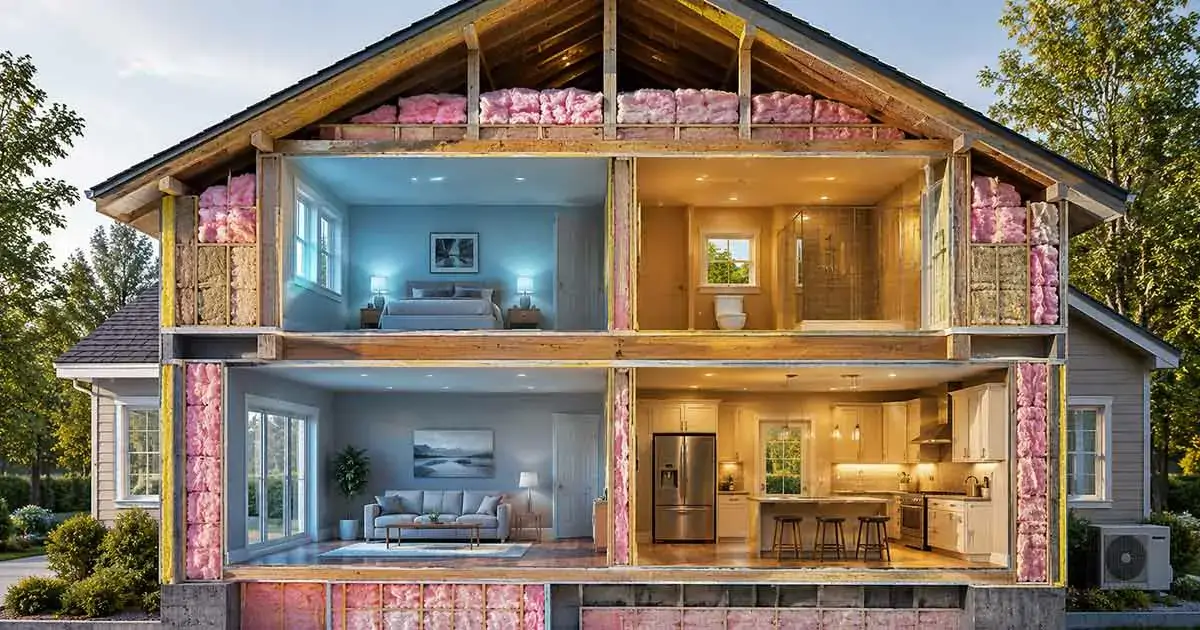
Home insulation is one of the most important components of an energy-efficient and comfortable house. Proper insulation slows heat transfer between the interior and exterior, helping the home stay warmer in winter and cooler in summer.
Insulation can reduce the workload on heating and cooling equipment, improve temperature consistency between rooms, and help reduce energy waste. However, insulation alone does not solve every comfort or efficiency problem. Air leaks, moisture, ventilation, windows, and HVAC performance also affect how efficiently a home operates.
This complete home insulation guide explains how insulation works, where it matters most, the main insulation types, R-value, common signs of inadequate insulation, installation considerations, common mistakes, and practical ways to plan an insulation upgrade.
Table of Contents
What Is Home Insulation?
Home insulation is a material or system designed to slow the movement of heat through a building’s walls, roof, floors, and other components.
Heat naturally moves from warmer areas toward cooler areas. During winter, heat tends to move from the heated interior toward the colder exterior. During summer, outdoor heat can move into a cooler home.
Insulation slows this transfer.
Common insulation materials include:
- Fiberglass
- Cellulose
- Spray foam
- Rigid foam
- Mineral wool
The appropriate material depends on the location, climate, building construction, moisture conditions, budget, and installation requirements.
How Does Home Insulation Work?
Insulation reduces the rate at which heat passes through the building envelope.
A well-insulated home can:
- Reduce heat loss during cold weather
- Reduce heat gain during hot weather
- Improve indoor temperature stability
- Reduce heating and cooling demand
- Improve comfort near exterior walls and ceilings
Insulation does not generate heat or cooling. Instead, it helps the heating and cooling already provided by the HVAC system remain effective for longer.
Why Is Home Insulation Important?
Poor insulation can contribute to unnecessary energy use and uncomfortable rooms.
Common symptoms include:
- High heating or cooling bills
- Cold ceilings or walls
- Hot rooms during summer
- Uneven temperatures
- Rooms that are difficult to heat or cool
- HVAC systems running for long periods
- Drafty areas when insulation problems occur alongside air leaks
Improving insulation can help create a more stable indoor environment and reduce the amount of energy required to maintain comfortable temperatures.
However, the actual savings depend on factors such as the existing insulation level, climate, home size, HVAC efficiency, energy prices, and air leakage.
Insulation vs. Air Sealing
Insulation and air sealing are related but different.
Insulation slows conductive heat transfer through building materials.
Air sealing reduces uncontrolled movement of air through cracks, gaps, joints, penetrations, and openings.
A home can have substantial insulation but still lose conditioned air through gaps around:
- Pipes
- Electrical penetrations
- Attic openings
- Doors
- Windows
- Ductwork
- Plumbing penetrations
For this reason, insulation improvements are often most effective when combined with appropriate air sealing.
Understanding R-Value
R-value measures an insulation material’s resistance to heat flow.
A higher R-value generally indicates greater resistance to heat transfer.
However, the R-value of an insulation material is only one part of its overall performance.
Actual results can also be affected by:
- Installation quality
- Compression
- Gaps
- Thermal bridging
- Moisture
- Air leakage
- Building design
The appropriate insulation level varies by climate and building location, so homeowners should follow applicable local building requirements and energy-efficiency recommendations rather than choosing an R-value based solely on a generic target.
Where Should a Home Be Insulated?
Insulation should be considered as part of the entire building envelope.
Important areas include:
- Attics
- Roof assemblies
- Exterior walls
- Floors over unconditioned spaces
- Basements
- Crawl spaces
- Attached garages
- Areas around conditioned rooms
The highest-priority area depends on the home’s existing construction and insulation condition.
Attic and Roof Insulation
The attic is often one of the most important areas to evaluate, especially when the ceiling separates conditioned living space from an unconditioned attic.
Insufficient attic insulation can allow significant heat transfer through the ceiling.
Potential benefits of improving attic insulation include:
- Better temperature stability
- Reduced heat loss in winter
- Reduced heat gain in summer
- Lower heating and cooling demand
Before adding insulation, inspect the attic for moisture problems, roof leaks, damaged ventilation components, and significant air leakage.
Do not cover active moisture problems with new insulation.
Wall Insulation
Exterior walls separate conditioned indoor space from outdoor temperatures.
Wall insulation helps reduce heat transfer through these assemblies.
Existing homes may have:
- Fiberglass batts
- Blown-in cellulose
- Blown-in fiberglass
- Foam insulation
- Older insulation materials
Adding or replacing wall insulation can be more complicated than attic insulation because walls may require access through interior or exterior surfaces.
A professional assessment can help determine whether wall insulation is missing, damaged, compressed, or insufficient.
Floor Insulation
Floors above unconditioned areas can contribute to heat loss.
Examples include floors above:
- Crawl spaces
- Unheated basements
- Garages
- Exterior spaces
Properly insulating these areas can improve floor temperatures and reduce unwanted heat transfer.
However, installation should account for moisture, pests, plumbing, wiring, and the construction of the floor assembly.
Basement Insulation
Basement insulation can improve comfort and reduce heat transfer through foundation walls and other exposed surfaces.
The correct approach depends on whether the basement is:
- Finished
- Unfinished
- Conditioned
- Unconditioned
- Below grade
- Subject to moisture intrusion
Moisture should be addressed before installing insulation.
Insulating a damp foundation wall without solving the underlying water problem can create additional building-performance issues.
Crawl Space Insulation
Crawl spaces require careful planning because moisture and ventilation conditions vary significantly.
Potential insulation approaches depend on whether the crawl space is designed as:
- Vented
- Conditioned
- Encapsulated
Before adding insulation, evaluate:
- Ground moisture
- Drainage
- Vapor control
- Air leakage
- Plumbing
- Pest activity
- Local building requirements
Do not treat insulation as a substitute for correcting water intrusion or persistent moisture.
Garage and Bonus Room Insulation
An attached garage can affect the temperature of rooms located above or next to it.
Insulating the separating walls, ceilings, and appropriate floor assemblies can help reduce heat transfer.
This is especially important when a conditioned living space is directly adjacent to an unconditioned garage.
Common Types of Home Insulation
Different insulation materials have different characteristics.
Fiberglass Insulation
Fiberglass is widely used in residential construction.
It is available in forms such as:
- Batts
- Rolls
- Blown-in insulation
Advantages include:
- Widely available
- Relatively affordable
- Suitable for many applications
- Familiar installation methods
Its performance depends heavily on correct installation.
Gaps, compression, and poorly fitted sections can reduce its effectiveness.
Cellulose Insulation
Cellulose insulation is commonly manufactured using recycled paper-based materials and is typically treated to improve resistance to fire and pests.
It is available primarily as loose-fill or blown-in insulation.
Potential advantages include:
- Good coverage of irregular spaces
- Useful for existing attics and walls
- High recycled content
Proper installation is important to achieve the intended performance.
Spray Foam Insulation
Spray foam expands and adheres to surfaces, allowing it to fill gaps and create an insulation and air-sealing layer.
Potential advantages include:
- Excellent air-sealing capability
- Ability to fill irregular spaces
- High insulation performance per unit thickness for some formulations
However, spray foam requires careful installation.
It can be more expensive than conventional insulation and may require professional application, particularly for large projects or complex assemblies.
Rigid Foam Insulation
Rigid foam is manufactured in panels that can provide continuous insulation when properly installed.
It can be used in applications involving:
- Exterior walls
- Foundations
- Roof assemblies
- Floors
One advantage is that continuous foam can help reduce thermal bridging in appropriately designed assemblies.
Installation details are important because joints, fasteners, moisture exposure, and fire requirements vary by application.
Mineral Wool Insulation
Mineral wool is made from mineral-based fibers and is available in batts and other forms.
Potential benefits include:
- Good thermal performance
- Resistance to high temperatures
- Useful acoustic properties
- Suitability for various wall and floor applications
The appropriate product should be selected according to the specific application and manufacturer’s requirements.
How to Choose the Right Insulation
There is no single insulation material that is best for every home.
Consider:
Climate
Heating-dominated and cooling-dominated climates have different insulation priorities.
Location
Attics, walls, foundations, and floors may require different materials and installation methods.
Existing Construction
The best approach depends on what insulation is already present.
Moisture Conditions
Wet areas should be corrected before insulation is installed.
Air Leakage
If major air leaks exist, air sealing may need to happen alongside insulation work.
Budget
Compare the initial cost with expected durability, performance, and energy savings.
Installation Requirements
Some materials are relatively simple to install, while others require specialized equipment and professional expertise.
Local Requirements
Follow applicable building codes, fire-safety requirements, and energy-efficiency standards.
Signs Your Home Needs Better Insulation
Several warning signs can suggest inadequate insulation.
High Energy Bills
Higher-than-expected heating and cooling costs may indicate excessive heat transfer, although HVAC efficiency and air leakage can also be responsible.
Uneven Room Temperatures
Rooms that are consistently much colder or hotter than others may have insulation or air-sealing problems.
Cold Ceilings or Walls
Unusually cold interior surfaces can indicate insufficient insulation.
Hot Upper Floors
Upper floors can become significantly warmer when the roof or attic assembly does not adequately limit heat gain.
Drafts
Drafts are often associated with air leaks rather than insulation alone, but both problems can occur together.
HVAC Running Frequently
Long HVAC run times may result from inadequate insulation, air leakage, poor equipment sizing, duct problems, or other issues.
Insulation should therefore be evaluated as part of a broader home energy assessment.
How Insulation Improves Heating Efficiency
During cold weather, heat naturally moves toward colder areas.
Insulation slows this heat loss through:
- Ceilings
- Walls
- Floors
- Foundations
As less heat escapes, the heating system may need to operate less frequently or for shorter periods to maintain the desired temperature.
This can improve energy efficiency and comfort.
How Insulation Improves Cooling Efficiency
Insulation also helps during hot weather.
It slows heat entering the home through the building envelope.
This can reduce the cooling load on the air conditioner or heat pump.
However, insulation does not replace:
- Proper shading
- Air sealing
- Efficient windows
- Adequate ventilation
- Efficient HVAC equipment
The best results come from addressing the building as a complete system.
Insulation and Indoor Comfort
Energy savings are not the only reason to improve insulation.
Proper insulation can help:
- Reduce temperature differences between rooms
- Improve comfort near exterior walls
- Reduce cold floors and ceilings
- Stabilize indoor temperatures
- Reduce HVAC cycling caused by rapid heat gain or loss
Comfort improvements can sometimes be noticeable even when energy savings are difficult to measure immediately.
Insulation and Moisture Control
Insulation and moisture management must be considered together.
Water can enter a building through:
- Roof leaks
- Plumbing leaks
- Foundation problems
- Condensation
- Air leakage carrying moisture
- Poor drainage
Wet insulation may lose performance depending on the material and circumstances, while trapped moisture can contribute to building damage.
Before installing insulation, identify and correct significant moisture sources.
Home Insulation and Air Leaks
Air leakage can undermine insulation performance.
Common leakage locations include:
- Attic penetrations
- Plumbing openings
- Electrical penetrations
- Window and door gaps
- Recessed lighting openings
- Duct penetrations
- Gaps around chimneys and flues
Air sealing these areas can improve the effectiveness of insulation.
However, combustion appliances and ventilation systems require special consideration. Do not seal or modify openings without understanding their purpose and applicable safety requirements.
DIY vs. Professional Insulation
Some insulation improvements may be suitable for experienced homeowners.
DIY Projects
Depending on the situation, homeowners may be able to:
- Add compatible attic insulation
- Install weatherstripping
- Seal small non-hazardous gaps
- Replace damaged insulation in simple accessible areas
Appropriate protective equipment should be used when handling insulation materials.
Professional Projects
Professional installation is often preferable for:
- Large insulation projects
- Spray foam installation
- Wall cavity insulation
- Difficult attic assemblies
- Foundation insulation
- Complex air sealing
- Projects involving electrical or combustion components
- Homes with significant moisture problems
Professional assessment can also help determine whether insulation is actually the main cause of the home’s energy or comfort problems.
How to Plan a Home Insulation Project
A good insulation project starts with an assessment rather than immediately buying materials.
Step 1: Inspect Existing Insulation
Determine where insulation exists and whether it is:
- Missing
- Compressed
- Damaged
- Displaced
- Contaminated
- Unevenly installed
Step 2: Identify Air Leaks
Look for obvious gaps and penetrations in the building envelope.
Step 3: Check for Moisture Problems
Inspect for:
- Roof leaks
- Plumbing leaks
- Condensation
- Damp crawl spaces
- Foundation moisture
Resolve significant moisture issues first.
Step 4: Prioritize High-Impact Areas
In many homes, attic insulation and air sealing are good places to begin, but the best priority depends on the home’s specific condition.
Step 5: Select the Appropriate Material
Consider performance, location, moisture conditions, installation requirements, and budget.
Step 6: Check Local Requirements
Follow applicable building codes and energy-efficiency requirements.
Step 7: Install Correctly
Avoid:
- Gaps
- Compression
- Missing sections
- Improper clearances
- Blocked ventilation paths
Correct installation is essential for achieving the intended performance.
Common Insulation Mistakes
Ignoring Air Sealing
Adding insulation without addressing significant air leakage can limit the improvement.
Installing Insulation Over Moisture Problems
Do not use insulation to hide leaks, condensation, or water intrusion.
Blocking Attic Ventilation
Insulation should not obstruct intentional ventilation paths where the roof assembly requires them.
Compressing Fiberglass Batts
Compression can change the material’s effective performance.
Install insulation according to the manufacturer’s instructions.
Leaving Gaps
Small gaps and poorly fitted sections can reduce overall performance.
Insulating Around Heat-Producing Equipment Incorrectly
Some lighting fixtures, chimneys, flues, and other components require specific clearances.
Follow manufacturer instructions and applicable safety requirements.
Choosing Insulation Based Only on Price
The cheapest material may not provide the best overall value for a particular application.
Consider installation quality, durability, performance, and long-term needs.
Assuming More Insulation Always Solves Comfort Problems
Poor comfort can also result from:
- Air leaks
- Duct problems
- HVAC sizing
- Poor distribution
- Windows
- Moisture
- Solar heat gain
A complete diagnosis is better than simply adding insulation everywhere.
Home Insulation Maintenance
Most insulation requires relatively little routine maintenance once correctly installed.
However, inspect accessible areas periodically for:
- Water damage
- Pest activity
- Displacement
- Compression
- Mold or contamination
- Roof or plumbing leaks
If insulation becomes wet or contaminated, determine the source of the problem before replacing the material.
Also inspect attic ventilation and air-sealing areas after major roof, electrical, or plumbing work.
Frequently Asked Questions
Does insulation reduce electricity bills?
It can. Better insulation can reduce heating and cooling energy demand, which may lower electricity consumption when those systems use electricity.
Actual savings depend on the home’s existing insulation, climate, HVAC system, air leakage, occupancy, and energy prices.
Which part of a home should be insulated first?
There is no universal answer, but attics and other areas separating conditioned space from unconditioned space are often high-priority areas.
A home energy assessment can identify where improvements are likely to provide the greatest benefit.
Is attic insulation worth it?
For many homes, improving insufficient attic insulation can be a cost-effective energy-efficiency upgrade.
The potential benefit is greatest when existing insulation is inadequate and significant heat transfer occurs through the ceiling.
How long does home insulation last?
Many insulation materials can remain effective for decades when properly installed and protected from moisture, pests, and physical damage.
Their useful life varies by material and building conditions.
Can insulation stop drafts?
Insulation itself does not necessarily stop air movement.
Air sealing is the appropriate method for reducing uncontrolled drafts through cracks and openings.
In practice, insulation and air sealing often work together.
Is spray foam better than fiberglass?
Not automatically.
Spray foam can provide excellent air sealing and high insulation performance in certain applications, while fiberglass can be more affordable and practical for many projects.
The best choice depends on the application, budget, building assembly, and installation requirements.
Can insulation prevent mold?
Insulation does not directly prevent mold.
Mold prevention depends primarily on controlling moisture.
If a home has leaks, condensation, or excessive humidity, those problems should be corrected before relying on insulation improvements.
Can insulation improve home value?
Energy-efficient improvements can make a property more attractive to some buyers, but the effect on resale value varies by market and by the quality of the improvement.
Keep documentation of major insulation and energy-efficiency upgrades when possible.
Home Insulation Checklist
Use this checklist when evaluating your home’s insulation:
- Inspect attic insulation
- Check exterior wall insulation where accessible
- Inspect floors above unconditioned areas
- Evaluate basement insulation
- Check crawl-space conditions
- Look for missing or damaged insulation
- Check for air leaks
- Inspect for moisture problems
- Repair roof or plumbing leaks
- Avoid blocking required attic ventilation
- Check insulation around penetrations
- Consider the home’s climate
- Compare insulation materials
- Check applicable local requirements
- Prioritize high-impact areas
- Consider professional assessment for complex projects
- Install insulation according to manufacturer requirements
- Recheck accessible areas after major construction work
Final Thoughts
Home insulation is a fundamental part of an energy-efficient and comfortable home. By slowing heat transfer through attics, walls, floors, foundations, and other parts of the building envelope, insulation can reduce heating and cooling demand while helping indoor temperatures remain more stable.
However, the best insulation strategy is not simply to add as much insulation as possible. Air sealing, moisture control, proper installation, ventilation, windows, and HVAC performance all affect the final result.
Start by identifying where the home is losing energy or experiencing comfort problems. In many cases, attic insulation and air sealing are useful starting points, but the right priority depends on the building’s construction and climate.
Choose insulation based on the location, material properties, moisture conditions, installation requirements, and applicable local standards. When a project involves complex assemblies, hidden wall cavities, spray foam, electrical or combustion components, or persistent moisture problems, professional evaluation can help avoid costly mistakes.
A properly planned insulation upgrade can improve comfort, reduce energy waste, and help the home’s heating and cooling systems operate more efficiently for years to come.