
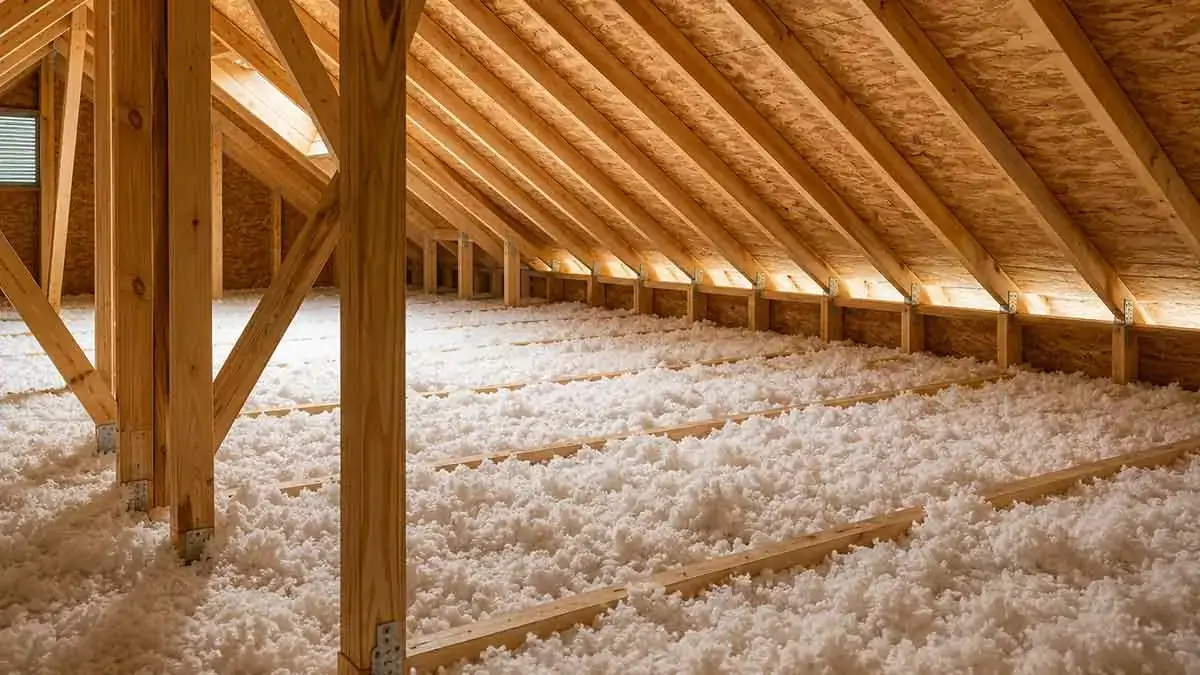
Attic insulation is one of the most important components of an energy-efficient home. Because the attic separates the living space from the roof and outdoor temperatures, inadequate insulation can allow significant heat transfer between the home and the outside environment.
During winter, heat can escape through a poorly insulated ceiling. During summer, heat from the roof can move into the living space, increasing indoor temperatures and making the air conditioning system work harder.
Improving attic insulation can help maintain more consistent indoor temperatures, reduce heating and cooling demand, and improve overall comfort. However, insulation alone is not always enough. Air sealing, moisture control, proper ventilation, and safe installation around electrical and heat-producing equipment are also important.
This attic insulation guide explains how attic insulation works, the main insulation types, R-value, how much insulation an attic may need, where insulation should be installed, common mistakes, and when professional installation makes sense.
Table of Contents
Why Is Attic Insulation Important?
The attic is often one of the highest-impact areas to address when improving a home’s thermal performance.
Heat naturally moves from warmer areas toward cooler areas. Without adequate insulation, this movement can occur more easily through the ceiling and roof assembly.
Proper attic insulation can help:
- Reduce winter heat loss
- Reduce summer heat gain
- Improve indoor comfort
- Reduce heating and cooling demand
- Minimize temperature differences between rooms
- Support more efficient HVAC operation
- Improve the overall energy performance of the home
Insulation does not produce heat or cold. Its primary function is to resist heat transfer.
The effectiveness of an attic insulation system depends not only on the material but also on installation quality, air leakage, moisture conditions, and the home’s overall building envelope.
How Does Attic Insulation Work?
Attic insulation slows the movement of heat between the conditioned living space and the attic or exterior.
In winter, heated indoor air tends to lose heat toward the colder attic. Adequate insulation increases resistance to that heat transfer.
In summer, the roof and attic can become much hotter than the living space below. Insulation helps slow the transfer of this heat into the home.
A properly insulated attic therefore creates a thermal barrier between the conditioned part of the house and the attic environment.
However, insulation should not be viewed as an airtight barrier. Air can still move through gaps around wiring, pipes, fixtures, ducts, and other penetrations.
That is why air sealing and insulation should generally be considered together.
Signs Your Attic Needs More Insulation
Several clues can indicate that an attic may benefit from additional insulation.
Common signs include:
- High heating or cooling bills
- Hot rooms directly below the attic
- Cold ceilings during winter
- Uneven indoor temperatures
- Large temperature differences between floors
- Excessive HVAC operation
- Visible gaps in attic insulation
- Thin or uneven insulation coverage
- Compressed insulation
- Drafts around ceiling penetrations
If the attic can be accessed safely, inspect the insulation without disturbing it unnecessarily.
Look for areas where the insulation is missing, compressed, displaced, wet, or significantly thinner than surrounding areas.
High energy use alone does not prove that insulation is inadequate. Other factors, including air leakage, windows, HVAC efficiency, duct losses, and occupant behavior, can also affect energy consumption.
How to Inspect Existing Attic Insulation
Before adding new insulation, determine what is already present.
Look for:
- Insulation type
- Approximate depth
- Uneven areas
- Compressed sections
- Exposed attic-floor areas
- Moisture
- Water stains
- Mold
- Pest damage
- Disturbed insulation around electrical work
Existing insulation may not need to be removed simply because it is old.
If it is dry, relatively intact, and compatible with additional insulation, adding another layer may be a practical approach.
However, wet, contaminated, severely damaged, or otherwise compromised insulation should be evaluated before covering it with new material.
Air Sealing vs. Attic Insulation
Air sealing and insulation perform different functions.
Air sealing reduces uncontrolled air movement through gaps and penetrations.
Insulation slows heat transfer through building materials.
Common attic air-leak locations include:
- Plumbing penetrations
- Electrical wiring
- Ceiling fixtures
- Recessed lights
- Attic hatches
- Duct penetrations
- Chimney and flue areas
- Wall top plates
- Mechanical equipment penetrations
If air is moving freely through these openings, adding insulation without addressing the leaks may limit the improvement.
For many attic projects, sealing appropriate air leaks before installing additional insulation is an important part of the overall strategy.
Types of Attic Insulation
Several insulation materials are commonly used in attics.
The best choice depends on the attic configuration, climate, budget, installation method, and desired performance.
Fiberglass Insulation
Fiberglass is one of the most widely used residential insulation materials.
It is available as:
- Batts
- Rolls
- Loose-fill insulation
Advantages include:
- Broad availability
- Relatively affordable cost
- Familiar installation methods
- Suitability for many attic applications
Its performance depends heavily on installation quality.
Gaps, compression, poor coverage, and incorrect installation can reduce its effective performance.
Cellulose Insulation
Cellulose is generally made from processed plant-based fibers and is commonly installed as loose-fill insulation.
It can be useful for attics with irregular shapes because blown material can fill spaces that are difficult to cover with standard batts.
Potential advantages include:
- Good coverage
- Suitable for adding insulation to existing attics
- Effective around irregular areas
- Often made partly from recycled materials
Moisture conditions and installation requirements should be considered before using cellulose.
Mineral Wool Insulation
Mineral wool is manufactured from mineral-based fibers and is available in different forms.
It can provide good thermal resistance and may also offer useful fire and sound-resistance characteristics.
Depending on the product and application, it may cost more than conventional fiberglass.
Spray Foam Insulation
Spray foam expands during application and can provide both insulation and air-sealing properties.
It can be useful in difficult-to-seal areas and certain roofline applications.
Potential advantages include:
- Air-sealing capability
- High insulating performance
- Ability to conform to irregular surfaces
However, spray foam is generally more expensive than many conventional insulation options and requires careful installation.
Because attic conditions can involve electrical systems, ventilation, moisture, and roof components, professional installation is often appropriate for complex spray-foam projects.
What Is Insulation R-Value?
R-value measures an insulation material’s resistance to heat flow.
In general, a higher R-value means greater resistance to heat transfer.
However, choosing attic insulation should not be based solely on the highest R-value available.
The appropriate target depends on factors such as:
- Climate
- Existing insulation
- Attic design
- Building construction
- Heating and cooling system
- Local building requirements
Installation quality also matters.
An insulation product with a high rated R-value may perform poorly if it is installed with large gaps, compressed improperly, or combined with unresolved air leaks.
How Much Attic Insulation Do You Need?
There is no single insulation depth that is appropriate for every home.
The amount needed depends on:
- Climate zone
- Existing R-value
- Insulation material
- Attic configuration
- Building-code requirements
- Energy-efficiency goals
Instead of choosing an arbitrary depth, evaluate the existing insulation and determine the appropriate target R-value for the home’s location and construction.
If existing insulation is uneven or shallow, adding material can improve coverage.
The goal should be consistent, properly installed insulation rather than simply maximizing thickness.
Attic Insulation Depth and Coverage
Insulation depth can vary depending on the material because different products provide different thermal resistance per unit of thickness.
When inspecting loose-fill insulation, look for areas where the material has settled or been displaced.
For batt insulation, check for:
- Gaps
- Compression
- Misalignment
- Exposed areas
- Missing sections
Uniform coverage is important.
Do not compress insulation simply to make it fit into a limited space unless the product is specifically designed for that installation method.
Attic Ventilation and Insulation
Attic insulation and attic ventilation serve different purposes and should work together.
Common ventilation components include:
- Soffit vents
- Ridge vents
- Gable vents
- Roof vents
- Intake vents
- Exhaust vents
In a conventional vented attic, insulation should not block intended ventilation pathways.
At the roof edges, ventilation baffles may be used where appropriate to maintain an airflow path from intake vents into the attic.
The correct ventilation arrangement depends on the roof and attic design.
Adding insulation without considering existing ventilation can create unintended problems.
Protecting Soffit and Other Ventilation Openings
One of the common mistakes during attic insulation work is covering soffit or other ventilation openings.
Loose-fill insulation can migrate into ventilation paths, while improperly positioned batts can block airflow.
Before adding insulation:
- Identify intake and exhaust ventilation.
- Determine where airflow pathways need to remain open.
- Install appropriate baffles where required.
- Keep insulation within the intended areas.
- Inspect the finished installation.
If you are unsure whether the attic ventilation system is adequate, have it evaluated before making major changes.
Moisture Problems Before Insulation
Moisture problems should be addressed before adding insulation.
Inspect for:
- Roof leaks
- Water stains
- Wet insulation
- Condensation
- Mold
- Damp wood
- Musty odors
- Plumbing leaks
Adding insulation over an active moisture problem can conceal the source and make future inspection more difficult.
The underlying source of moisture should be corrected first.
Attic moisture can originate from roof leaks, plumbing leaks, indoor air leakage, inadequate ventilation, or other building-envelope problems.
Attic Floor vs. Roofline Insulation
Where insulation should be installed depends largely on whether the attic is conditioned or unconditioned.
Attic Floor Insulation
In a conventional unconditioned attic, insulation is commonly installed at the ceiling level, separating the living space from the attic.
This approach keeps the attic outside the home’s conditioned envelope.
It is often a straightforward strategy for homes where the attic is primarily used for ventilation, equipment access, or limited storage.
Roofline Insulation
Insulation can also be installed along the roofline.
This approach can make sense when the attic is intended to become part of the conditioned space or when the building design requires insulation at the roof assembly.
Roofline insulation requires careful planning because moisture control, air sealing, ventilation, and roof construction all become important.
The appropriate strategy depends on the specific attic and roof design.
Attic Hatch Insulation
An attic access hatch can become a weak point in the ceiling insulation system.
A poorly sealed hatch may allow conditioned air to escape into the attic.
Inspect the hatch for:
- Gaps
- Poor weatherstripping
- Missing insulation
- Loose fit
- Damaged seals
Adding suitable insulation to the hatch and improving its air seal can reduce heat transfer and unwanted air movement.
The hatch should remain accessible and safe to operate.
Insulating Attic Ductwork
HVAC ducts located in attics are exposed to attic temperatures.
Poorly insulated or leaking ducts can lose heating or cooling energy before conditioned air reaches the living space.
Inspect visible ductwork for:
- Damaged insulation
- Missing insulation
- Compression
- Gaps
- Deterioration
- Poorly sealed connections
Improving duct insulation and sealing appropriate duct connections can help reduce energy losses.
Complex duct modifications should be handled carefully to avoid damaging the HVAC system.
Recessed Lights and Heat-Producing Equipment
Attic insulation must be installed carefully around components that generate heat or have specific clearance requirements.
These may include:
- Recessed lighting
- Chimneys
- Flues
- Exhaust systems
- Mechanical equipment
- Electrical components
Do not assume that every insulation material can safely contact every fixture.
Follow the equipment manufacturer’s requirements and applicable installation rules.
If the type or rating of a fixture is unclear, professional evaluation is safer than covering it with insulation.
DIY vs. Professional Attic Insulation
Some straightforward insulation projects may be suitable for experienced homeowners.
For example, adding compatible loose-fill or batt insulation in an accessible attic can be manageable when the installation conditions are simple and safe.
However, attic work can involve:
- Electrical wiring
- Roof structures
- Ventilation
- Moisture problems
- HVAC equipment
- Recessed lights
- Tight spaces
- Difficult access
Professional installation is particularly worth considering when:
- Extensive air sealing is required
- Moisture problems exist
- Spray foam is being installed
- The attic is difficult to access
- Electrical or mechanical equipment is present
- Existing insulation is contaminated or severely damaged
- The roofline will be insulated
The quality of installation can have as much impact as the insulation material selected.
How Much Does Attic Insulation Save?
Potential energy savings vary considerably from one home to another.
Factors include:
- Existing insulation level
- Climate
- Home size
- Air leakage
- HVAC efficiency
- Duct condition
- Heating and cooling habits
- Energy prices
A poorly insulated home with substantial air leakage may have more improvement potential than a home that already has adequate insulation and air sealing.
For this reason, it is better to evaluate the home’s current condition than rely on a universal savings percentage.
How to Improve Attic Insulation Efficiency
For better overall performance, consider attic insulation as part of a complete building-envelope strategy.
A practical approach is to:
- Inspect existing insulation.
- Identify air leaks.
- Address moisture problems.
- Protect ventilation pathways.
- Choose an appropriate insulation material.
- Install insulation consistently.
- Avoid compression and gaps.
- Protect electrical and heat-producing equipment.
- Inspect the completed installation.
This approach can provide better results than simply adding more insulation.
Common Attic Insulation Mistakes
Adding Insulation Without Air Sealing
Air leakage can reduce the effectiveness of insulation.
Blocking Attic Ventilation
Insulation should not obstruct intended ventilation pathways.
Covering Moisture Problems
Wet insulation or roof leaks should be addressed before additional insulation is installed.
Ignoring the Attic Hatch
An unsealed hatch can remain a significant weak point in the ceiling.
Compressing Insulation
Improper compression can reduce the effective thermal performance of some insulation products.
Ignoring Electrical Components
Insulation must be installed according to the requirements of fixtures and equipment.
Choosing Insulation Only by Price
The least expensive material may not be the best option for the attic’s configuration or climate.
Assuming More Insulation Always Means Better Performance
Additional insulation has diminishing practical value if major air leaks, moisture problems, or installation defects remain unresolved.
How Attic Insulation Can Improve Home Comfort
A properly insulated attic can help reduce temperature differences throughout the house.
Potential benefits include:
- Cooler upper floors during summer
- Warmer ceilings during winter
- More stable indoor temperatures
- Reduced heat transfer
- Less demand on heating and cooling equipment
Insulation is most effective when combined with appropriate air sealing and efficient HVAC operation.
Attic Insulation Maintenance
Attic insulation generally does not require frequent maintenance, but periodic inspection is useful.
Check for:
- Water stains
- Roof leaks
- Pest activity
- Displaced insulation
- Compressed areas
- Damaged ventilation components
- New gaps
- Disturbed insulation
Inspect the attic after major roof, electrical, plumbing, or HVAC work because contractors may move or remove insulation during repairs.
When Should You Upgrade Attic Insulation?
An insulation upgrade may be worth considering when:
- Existing insulation is insufficient.
- Insulation coverage is uneven.
- Upper rooms are difficult to keep comfortable.
- Energy use is higher than expected.
- The attic has significant air leakage.
- You are already renovating the attic.
- You are improving the home’s overall energy efficiency.
If you are already planning attic work, combining insulation improvements with air sealing can make the project more effective.
Frequently Asked Questions
What is the best insulation for an attic?
There is no single best material for every attic.
Fiberglass, cellulose, mineral wool, and spray foam can all be appropriate depending on the attic design, climate, budget, moisture conditions, and installation requirements.
What R-value should attic insulation have?
The appropriate R-value depends primarily on climate, building design, existing insulation, and applicable requirements.
Rather than choosing a universal number, determine the recommended target for your home’s location and construction.
Should I remove old attic insulation before adding new insulation?
Not necessarily.
Dry, intact insulation can often remain in place when compatible with the new insulation.
However, wet, contaminated, severely damaged, or otherwise compromised insulation may require removal or remediation first.
Should attic insulation cover soffit vents?
In a conventional vented attic, insulation should not block intended soffit intake ventilation.
Appropriate baffles can help maintain airflow while allowing insulation to reach the desired area.
Is attic insulation enough to lower energy bills?
Insulation can reduce heat transfer and heating and cooling demand, but results depend on the home’s existing condition.
Air sealing, duct performance, windows, HVAC efficiency, and other building-envelope factors also affect energy consumption.
Is spray foam worth using in an attic?
Spray foam can provide strong insulation and air-sealing performance in appropriate applications, but it is usually more expensive than conventional insulation.
The attic design and installation requirements should be evaluated before choosing it.
Can I install attic insulation myself?
Some straightforward projects can be suitable for experienced homeowners.
However, professional installation is often preferable when the project involves moisture problems, difficult access, extensive air sealing, spray foam, electrical equipment, or roofline insulation.
Final Thoughts
Attic insulation is a major part of an energy-efficient and comfortable home. Proper insulation can slow heat transfer, reduce heating and cooling demand, and help maintain more consistent indoor temperatures throughout the year.
Before adding insulation, inspect the existing material and look for air leaks, moisture problems, ventilation restrictions, and potential safety issues. Choosing the right insulation material and appropriate R-value is important, but installation quality is equally important.
For a conventional unconditioned attic, insulation is often installed at the attic floor or ceiling level. Roofline insulation may be more appropriate when the attic is intended to become part of the conditioned space, but this approach requires careful consideration of moisture, ventilation, and building-envelope design.
The most effective attic upgrade is not simply adding the greatest possible amount of insulation. A properly planned combination of air sealing, adequate insulation, moisture control, ventilation, and safe installation can provide better long-term energy performance and comfort.