
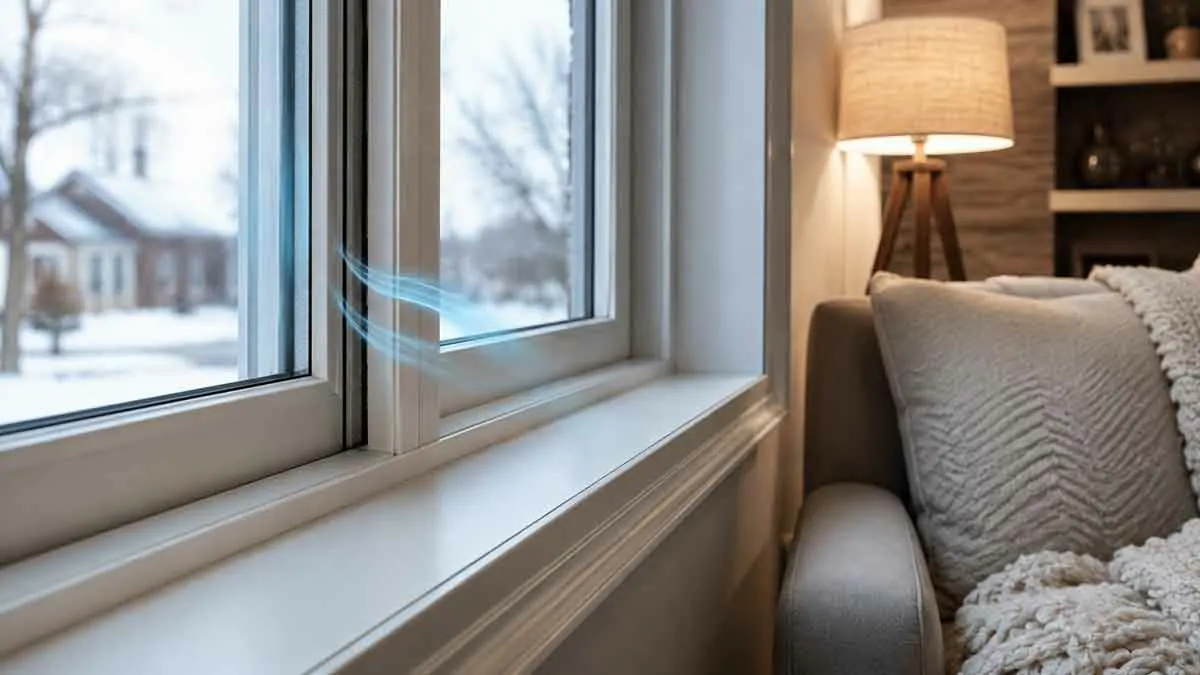
Drafty windows can make a home uncomfortable, increase heating and cooling demand, and contribute to unwanted energy loss. You may notice cold air around a window in winter, warm air entering during summer, or rooms that remain uncomfortable even when the HVAC system is running normally.
Window drafts can have several causes. Worn weatherstripping, deteriorated caulk, gaps around the frame, poorly fitted sashes, damaged window components, and installation problems can all allow uncontrolled air movement. Older single-pane windows may also provide less thermal protection than modern insulated windows.
The good news is that a drafty window does not automatically need to be replaced. In many cases, a simple repair such as replacing weatherstripping, resealing a frame, or adjusting the window can improve its performance.
This guide explains how to identify drafty windows, determine where air is entering, choose the right repair, and decide when window replacement makes more sense.
Table of Contents
What Causes Drafty Windows?
A draft occurs when uncontrolled air moves through or around a closed window.
Common causes include:
- Worn or missing weatherstripping
- Cracked or deteriorated caulking
- Gaps between the window frame and wall
- Poor window installation
- Loose or misaligned sashes
- Damaged window frames
- Warped components
- Damaged window hardware
- Failed insulated glass seals
- Older single-pane construction
The location of the draft provides an important clue.
If air is entering between the moving parts of the window, weatherstripping or sash adjustment may be the problem. If air is coming from around the outside of the frame, the installation or surrounding seal may need attention.
A window can also feel cold without actually leaking air. Cold glass can create a noticeable chill because it transfers heat away from the room.
For this reason, identifying the source of the problem before making repairs is important.
Signs of a Drafty Window
Some window drafts are obvious, while others are difficult to detect.
Common signs include:
- Cold air near a closed window
- Noticeably cold areas around the frame
- Curtains moving when the window is closed
- Uneven temperatures near exterior walls
- Higher heating or cooling demand
- Cracked or missing caulk
- Damaged weatherstripping
- Visible gaps around the frame
- Difficulty closing or locking the window
- Condensation or moisture problems
Pay particular attention to older windows and windows that have not been maintained for several years.
If several windows in the same area have similar problems, the issue may involve installation or the surrounding building envelope rather than individual window components.
How to Find Window Air Leaks
Finding the exact source of a draft should come before choosing a repair.
Start with a visual inspection.
Look for:
- Gaps around the frame
- Cracked sealant
- Damaged weatherstripping
- Loose trim
- Misaligned sashes
- Damaged window components
- Signs of water intrusion
On a windy or cold day, you can carefully move your hand around the perimeter of the closed window to detect noticeable air movement.
A smoke pencil designed for indoor air-leak detection can also help identify airflow around the window.
Avoid using candles, lighters, or other open flames to test for drafts.
If the source is difficult to identify, a professional energy assessment or blower door test can help locate air leakage through the building envelope.
Check the Window Weatherstripping
Weatherstripping creates a seal between moving sections of a window.
Over time, it can become:
- Brittle
- Cracked
- Flattened
- Torn
- Loose
- Missing
Damaged weatherstripping can allow outside air to pass around the sash even when the window is fully closed.
Inspect the entire sealing surface and check whether the window closes tightly.
If the weatherstripping is worn but the window itself is in good condition, replacing it may be one of the simplest and least expensive repairs.
Use replacement weatherstripping designed for the specific window type. Material that is too thick can prevent the window from closing correctly, while material that is too thin may leave gaps.
Inspect Caulking Around the Window
Caulk helps seal the joint between the window frame and surrounding materials.
Over time, sealant can crack, shrink, separate, or deteriorate.
Inspect both the interior and exterior perimeter for:
- Cracked caulk
- Missing sealant
- Shrinking gaps
- Separation between materials
- Water stains
- Visible openings
If the existing sealant has failed, remove loose or deteriorated material, clean the surface, and apply an appropriate replacement sealant.
Exterior caulking is particularly important because the exterior joint must help manage both air and water.
However, do not seal intentional drainage openings or weep paths that are part of the window’s design.
Check Gaps Around the Window Frame
A draft may originate from the space between the window frame and the rough wall opening.
This can happen because of:
- Poor original installation
- Deteriorated insulation
- Aging construction materials
- Previous window replacement work
- Movement or settlement
- Damaged surrounding materials
Small accessible gaps may sometimes be sealed with an appropriate product.
Larger gaps can indicate an installation or building-envelope problem and may require professional evaluation.
Do not assume that every draft comes directly through the window itself.
Inspect the Window Sash
The sash holds the glass and may move depending on the window design.
A sash that is loose, warped, or incorrectly aligned may not create a reliable seal.
Check whether:
- The window closes completely
- The sash sits evenly
- The locking mechanism engages properly
- Gaps are visible
- The window moves excessively
- Operation feels unusually loose or difficult
A simple adjustment may improve the seal when the window is otherwise in good condition.
If the sash or frame is significantly damaged, repair or replacement may be more appropriate.
Check Window Locks and Latches
Window locks help hold the window closed and can improve the seal between the sash and frame.
A damaged or misaligned lock may prevent the window from closing tightly.
Check that the lock:
- Engages completely
- Holds the sash firmly
- Aligns correctly
- Does not show visible damage
If the window seals properly when manually pressed but becomes loose when released, the hardware or sash alignment may need adjustment.
Look for Damaged Window Frames
A damaged frame can cause both air leakage and water intrusion.
Wood frames may develop rot or deterioration after prolonged moisture exposure. Other frame materials can also become cracked, warped, or damaged over time.
Inspect for:
- Cracks
- Rot
- Warping
- Soft wood
- Separation at joints
- Water damage
- Significant gaps
Minor damage may be repairable.
Severe deterioration, especially when it affects the structural integrity or operation of the window, may make replacement more practical.
Check for Moisture and Condensation
Condensation does not necessarily mean that a window is drafty.
Moisture can form when warm indoor air contacts a cold glass surface. Indoor humidity, poor ventilation, and low-performing windows can all contribute.
Look for:
- Water droplets on glass
- Moisture around frames
- Peeling paint
- Mold or mildew
- Damaged wood
- Repeated condensation
If condensation occurs frequently, consider checking indoor humidity and ventilation.
Persistent moisture should be investigated because it can damage window frames and surrounding materials even when there is no significant air leak.
How to Fix Drafty Windows
The appropriate repair depends on where the air leak originates.
Simple problems can often be addressed without replacing the window, while damaged frames or major installation problems may require more extensive work.
Replace Worn Weatherstripping
Replacing damaged weatherstripping is one of the most practical repairs for an otherwise functional window.
The basic process is:
- Remove the old weatherstripping.
- Clean the installation surface.
- Check the window for damage.
- Install compatible replacement material.
- Close the window and verify the seal.
Make sure the new material does not interfere with normal operation.
Recaulk Small Gaps
Caulk can seal small stationary gaps around a window.
It may be appropriate for:
- Interior trim joints
- Exterior frame joints
- Small cracks
- Minor gaps between compatible materials
The surface should be clean and dry before applying new sealant.
Caulk should not be used to hide structural damage or compensate for large gaps caused by improper installation.
Seal Gaps Around the Frame
If air is entering between the window frame and wall opening, the solution may involve improving the perimeter seal.
Depending on the size and location of the gap, appropriate methods may include:
- Compatible sealants
- Backer materials
- Low-expansion insulation products designed for window and door applications
Large gaps should be evaluated carefully because they may indicate a larger installation problem.
When repairing a replacement window, the rough opening, flashing, insulation, and drainage details all need to work together.
Use Window Insulation Film
Interior window insulation film can provide an additional barrier during cold weather.
It is especially useful for older windows that are still functional but have relatively poor thermal performance.
Window film can help reduce drafts around the window assembly when installed correctly.
However, it is generally a supplemental solution rather than a permanent repair for a damaged window or significant air leak.
Install Thermal Curtains or Shades
Insulated curtains and cellular shades can reduce heat transfer through windows and improve perceived comfort.
They can be useful during:
- Cold winter nights
- Hot summer afternoons
- Periods of extreme weather
However, window coverings do not repair an actual air leak.
If air is entering around the frame, address the sealing problem as well.
Consider Storm Windows
Storm windows add another layer of protection over an existing window.
They can be useful when older windows remain structurally sound but have relatively poor thermal performance.
Depending on the design and installation, storm windows may help reduce heat transfer and air leakage without requiring full window replacement.
They are particularly worth considering when the original windows are serviceable but replacement costs are high.
Improve Window Installation
A high-performance window can still perform poorly if it is installed incorrectly.
Proper installation may require:
- Correct positioning
- Proper fastening
- Appropriate flashing
- Perimeter air sealing
- Suitable insulation around the rough opening
- Functional drainage paths
- Correct sash adjustment
If a relatively new window is already drafty, investigate the installation before assuming that the window itself needs replacement.
Single-Pane vs Double-Pane Windows
Single-pane windows contain one layer of glass and generally provide less resistance to heat transfer than modern insulated glazing.
Double-pane windows contain two panes separated by a sealed space.
The additional layer and sealed space can improve thermal performance compared with many older single-pane designs.
However, replacing a window solely because it is single-pane may not always be the most cost-effective first step.
If the existing frame is sound, improvements such as:
- Weatherstripping
- Recaulking
- Storm windows
- Interior insulation film
- Better air sealing
may improve performance while delaying full replacement.
The best option depends on the condition of the existing window, climate, energy costs, and the expected cost of repairs.
Failed Double-Pane Window Seals
Insulated glass units rely on a sealed space between the glass panes.
When that seal fails, moisture can enter the space between the panes.
Common signs include:
- Fogging between panes
- Cloudy glass
- Condensation that cannot be wiped away
- Reduced visibility
A failed insulated glass unit can reduce thermal performance.
Depending on the window design, the glass unit may be replaceable without replacing the entire frame.
This can sometimes provide a more targeted solution than complete window replacement.
Drafty Windows and Energy Bills
Drafty windows can contribute to energy loss by allowing uncontrolled air movement and increasing heat transfer.
During winter, warm indoor air may escape while cold outdoor air enters.
During summer, outdoor heat may enter through gaps and poorly performing glazing.
The impact on energy costs depends on:
- Number of windows
- Window size
- Climate
- Window condition
- Air leakage elsewhere in the home
- HVAC efficiency
- Indoor temperature settings
It is important not to assume that windows are always the main source of high energy bills.
Air leakage through doors, ceilings, walls, attic penetrations, and other parts of the building envelope can also have a significant effect.
How to Improve Window Efficiency Without Replacement
Full window replacement is not always necessary.
Depending on the condition of the existing windows, consider:
- Replacing weatherstripping
- Recaulking deteriorated joints
- Adjusting window hardware
- Repairing minor frame damage
- Sealing appropriate gaps around the frame
- Installing interior insulation film
- Using insulated curtains or shades
- Adding storm windows
- Improving surrounding insulation where appropriate
These measures can improve comfort and reduce air leakage while allowing homeowners to postpone replacement.
When Should You Replace Drafty Windows?
A draft alone does not automatically mean a window needs replacement.
Repair may be appropriate when:
- The frame is structurally sound.
- Weatherstripping is worn.
- Caulking has deteriorated.
- The sash needs adjustment.
- Hardware is damaged.
- The window remains functional.
Replacement may make more sense when:
- The frame is severely damaged.
- The window cannot close or lock correctly.
- Major components have failed.
- Multiple repairs are required.
- Insulated glass seals have failed extensively.
- The window has poor overall performance.
- Repair costs approach the cost of replacement.
Consider the complete condition and expected service life of the window rather than focusing only on the presence of a draft.
Common Window Draft Repair Mistakes
Caulking Over Dirty or Damaged Surfaces
New sealant may fail prematurely if applied over dirt, loose material, or deteriorated surfaces.
Prepare the surface properly before sealing.
Blocking Drainage Paths
Windows often have designed drainage routes that allow water to escape.
Do not seal these openings simply because they look like gaps.
Using the Wrong Sealant
Different surfaces and applications require different sealants.
Use a product appropriate for the location and manufacturer’s requirements.
Installing Excessively Thick Weatherstripping
Weatherstripping that is too thick can make the window difficult to close or prevent the lock from engaging.
Ignoring the Source of the Leak
A draft felt around a window may actually originate from the wall cavity or the space around the rough opening.
Inspect the surrounding area before assuming the window itself is defective.
Replacing Windows Without Checking Installation
A new window can still leak air if the installation is poorly sealed or incorrectly fitted.
Before replacing a relatively new window, investigate installation and perimeter sealing.
Seasonal Window Inspection
Regular inspections can help identify deteriorating seals before they become larger problems.
Before Winter
Check:
- Weatherstripping
- Interior and exterior caulking
- Window locks
- Frame condition
- Visible gaps
- Condensation
- Water damage
Consider installing temporary insulation film or improving window coverings where appropriate.
During Winter
Pay attention to:
- Cold air around frames
- Unusually cold rooms
- Condensation
- Water around window sills
- Drafts that appear during windy conditions
A noticeable change in performance can indicate a deteriorating seal or hardware problem.
Drafty Windows Troubleshooting Checklist
Use this checklist to narrow down the cause:
- Check whether one or several windows are affected.
- Inspect weatherstripping.
- Examine interior and exterior caulking.
- Look for gaps around the frame.
- Check the sash alignment.
- Test the window lock.
- Inspect the frame for damage.
- Look for signs of moisture.
- Test for noticeable air movement.
- Check whether condensation is occurring between glass panes.
- Repair simple sealing problems first.
- Evaluate installation if the window is relatively new.
- Consider storm windows or insulation film for older but functional windows.
- Compare repair costs with replacement costs before replacing the entire window.
When to Call a Professional
Professional help may be appropriate when:
- You cannot identify the source of the draft.
- The frame is severely damaged.
- There is evidence of water intrusion.
- Multiple windows have the same problem.
- The window is difficult to operate.
- The surrounding wall appears damaged.
- A replacement window is still drafty after installation.
- You are considering full window replacement.
An energy auditor can also help determine whether windows are a major source of air leakage or whether other areas of the building envelope should be addressed first.
Final Thoughts
Drafty windows can reduce comfort and contribute to unnecessary energy loss, but replacing the entire window is not always the first or best solution.
Start by identifying where the air is entering. Inspect the weatherstripping, caulking, frame, sash, hardware, and area surrounding the window installation.
Simple repairs such as replacing worn weatherstripping, repairing deteriorated caulk, or adjusting the sash may solve many draft problems. Older but structurally sound windows may also benefit from storm windows, insulation film, or improved window coverings.
When a window has severe frame damage, persistent air leakage, failed components, or poor overall performance, replacement may provide a better long-term solution.
The most effective approach is to diagnose the source of the draft before choosing the repair. This helps avoid unnecessary replacement costs while improving comfort, air sealing, and overall home energy performance.