
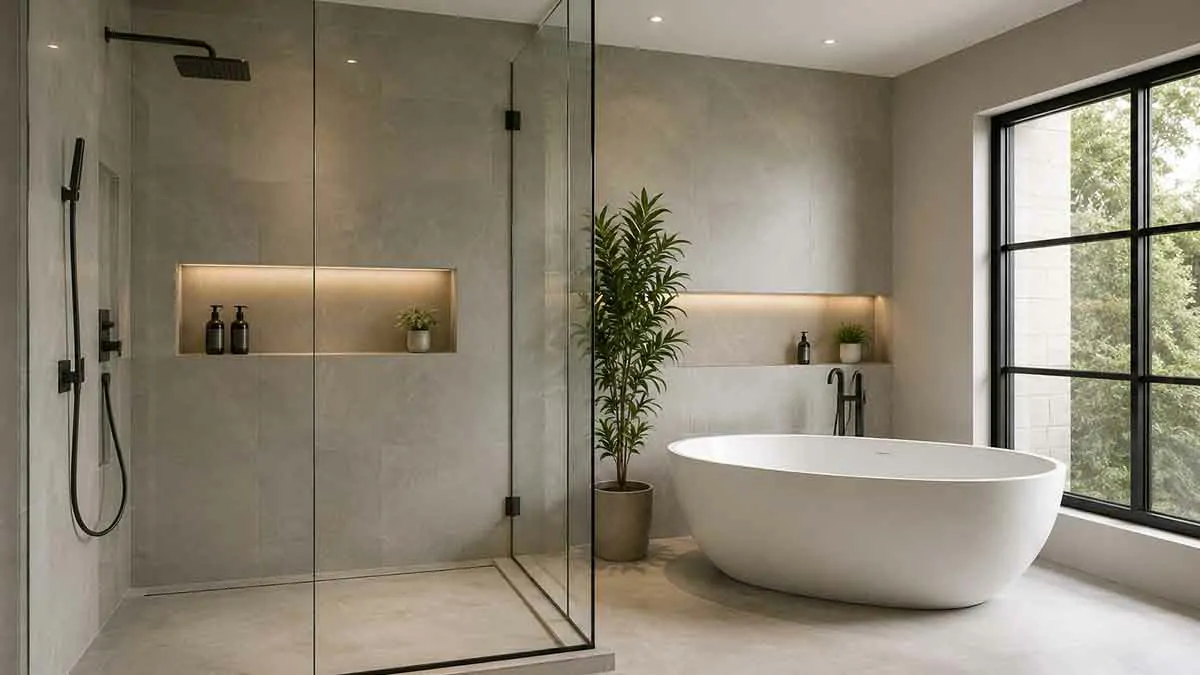
Choosing between a walk-in shower and a bathtub is one of the most important decisions when planning a bathroom renovation. Both options can provide comfortable bathing, but they differ significantly in terms of accessibility, space requirements, installation, maintenance, water usage, and overall bathroom design.
A walk-in shower can make a bathroom feel more open and accessible, while a bathtub can provide a comfortable option for soaking and may be particularly useful for households with young children.
The right choice depends on how you use the bathroom, the available space, your renovation budget, and your long-term needs.
In this guide, we compare walk-in showers and bathtubs to help you determine which option makes the most sense for your bathroom.
Table of Contents
Walk-In Shower vs Bathtub at a Glance
The best choice depends on your priorities.
| Feature | Walk-In Shower | Bathtub |
|---|---|---|
| Space efficiency | Often excellent | Usually requires more floor area |
| Accessibility | Generally easier to enter | Higher step-over can be challenging |
| Soaking | Limited | Excellent |
| Cleaning | Can be relatively easy | Tub surface requires regular cleaning |
| Family use | Suitable for adults | Very useful for young children |
| Design | Open and contemporary | Traditional or contemporary |
| Installation | Can be complex | Often simpler with standard models |
| Water use | Often lower for shorter showers | Depends on tub fill level |
| Long-term accessibility | Can be designed for accessibility | May require additional modifications |
Neither option is automatically better.
The best solution is the one that fits the bathroom and the people who use it.
What Is a Walk-In Shower?
A walk-in shower is a shower area designed for entry without stepping over the high side of a traditional bathtub.
Some walk-in showers have a small threshold, while others are designed as curbless showers with a nearly level transition.
Typical features include:
- Shower floor
- Shower drain
- Showerhead
- Glass enclosure or screen
- Waterproofed walls
- Waterproofed floor
- Shower controls
- Optional built-in niche
- Optional bench
Walk-in showers are available in many sizes and configurations, making them suitable for both compact and large bathrooms.
What Is a Bathtub?
A bathtub is a fixture designed for bathing while sitting or reclining in a basin filled with water.
Common bathtub types include:
- Alcove tubs
- Freestanding tubs
- Drop-in tubs
- Undermount tubs
- Corner tubs
- Soaking tubs
A bathtub can also be combined with a shower, creating a two-purpose bathing area.
Walk-In Shower Benefits
Easier Entry
One of the biggest advantages of a walk-in shower is easier entry.
A low-threshold or curbless design can reduce the need to step over a bathtub wall.
This can be particularly useful for people who have difficulty with balance or mobility.
Efficient Use of Space
A shower can often fit into a smaller footprint than a bathtub.
This makes it a practical option for compact bathrooms where every inch matters.
Modern Appearance
Walk-in showers can create a clean, open appearance.
Clear glass, large-format tile, minimal hardware, and linear drains can contribute to a contemporary design.
Flexible Design
Walk-in showers can be customized in many ways.
You can choose:
- Shower size
- Glass configuration
- Tile
- Showerhead type
- Controls
- Niches
- Bench seating
- Handheld shower
- Threshold design
Convenient for Daily Use
For many adults, a shower is faster and more convenient than filling a bathtub.
This can make a walk-in shower particularly practical for busy households.
Walk-In Shower Drawbacks
More Complex Waterproofing
A properly constructed walk-in shower requires careful waterproofing.
The walls, floor, corners, penetrations, and drain must work together as a moisture-management system.
Poor installation can lead to hidden water damage.
Potentially Higher Installation Cost
Custom showers may require significant labor involving:
- Waterproofing
- Plumbing
- Drainage
- Tile installation
- Glass installation
- Framing
A standard shower can be relatively straightforward, but a custom walk-in shower may become expensive.
Less Suitable for Soaking
A shower does not provide the same bathing experience as a tub.
If you enjoy soaking in a bath, removing the only bathtub may be disappointing.
Water Can Escape
Open walk-in showers can allow water to splash outside the shower area if the layout, glass, showerhead, or drainage is poorly planned.
Bathtub Benefits
Excellent for Soaking
The primary advantage of a bathtub is the ability to sit or recline in warm water.
This can provide a relaxing bathing experience that a standard shower cannot reproduce.
Useful for Young Children
Bathtubs can be practical for bathing young children.
Parents may also prefer having at least one bathtub in a home for family flexibility.
Multiple Design Options
Bathtubs are available in many styles and sizes.
Options include:
- Freestanding
- Alcove
- Soaking
- Drop-in
- Corner
- Whirlpool
This makes it possible to match the tub to many bathroom designs.
Can Include a Shower
A bathtub does not necessarily mean giving up shower functionality.
A tub-shower combination can provide both bathing options in a single footprint.
Bathtub Drawbacks
Higher Entry
Stepping over the side of a bathtub can be difficult for some users.
This can become increasingly important when considering long-term accessibility.
Requires More Vertical Clearance for Entry
The user must step over the tub wall before entering.
This is one of the main differences between a conventional bathtub and a low-threshold walk-in shower.
Can Be More Difficult to Clean
The inside of a bathtub may require bending or reaching to clean the lower surfaces.
The surrounding tile and grout can also require regular maintenance.
Can Occupy More Visual Space
A bathtub can make a small bathroom feel more crowded, particularly when combined with a shower curtain or large enclosure.
Walk-In Shower vs Bathtub for Small Bathrooms
For a small bathroom, a walk-in shower is often an efficient choice because it can use a compact footprint.
A shower can also create a more open visual field, especially when combined with clear glass.
However, a bathtub can still work in a small bathroom if the layout is designed around a standard alcove tub.
Before removing a tub, consider whether the bathroom is the only one in the home with bathing facilities.
Walk-In Shower vs Bathtub for Large Bathrooms
Large bathrooms offer more flexibility.
You may be able to install:
- A large walk-in shower
- A freestanding bathtub
- Both
- A separate shower and tub area
If space and budget allow, installing both can provide the greatest flexibility.
However, adding a tub simply because there is space available is not always necessary.
Choose the fixtures that match how the bathroom will actually be used.
Walk-In Shower vs Bathtub for Families
Families may benefit from having both options.
A bathtub can be useful for young children, while a walk-in shower may be more convenient for adults.
If the home has multiple bathrooms, keeping a bathtub in at least one bathroom can provide greater flexibility.
If there is only one bathroom, carefully consider the household’s current and future needs before removing the tub.
Walk-In Shower vs Bathtub for Children
Bathtubs are generally more practical for bathing young children.
They provide a contained space and make it easier to fill the tub to a suitable level.
As children become older, showers may become more convenient.
If children are likely to use the bathroom for several years, retaining a bathtub can be a practical decision.
Walk-In Shower vs Bathtub for Seniors
A walk-in shower can offer easier entry than a conventional bathtub.
For improved accessibility, a shower can be designed with:
- Low or zero threshold
- Grab-bar reinforcement
- Handheld shower
- Built-in or fold-down seat
- Slip-resistant flooring
- Easy-to-reach controls
Accessibility features should be planned as part of the shower design rather than added as an afterthought.
Walk-In Shower vs Bathtub for Accessibility
Walk-in showers generally offer greater flexibility for accessible bathroom design.
A curbless shower can reduce the height difference between the bathroom floor and shower floor.
However, simply removing a bathtub does not automatically create an accessible bathroom.
An accessible shower may also require careful consideration of:
- Entry width
- Floor slope
- Drainage
- Grab bars
- Seat placement
- Shower controls
- Handheld shower
- Slip resistance
For specific accessibility requirements, follow applicable standards and local regulations.
Walk-In Shower vs Bathtub for Comfort
Comfort depends on the type of bathing experience you prefer.
A walk-in shower can provide:
- Quick daily bathing
- Adjustable water temperature
- Multiple showerheads
- Handheld spray
- Built-in seating
A bathtub provides:
- Full-body soaking
- Relaxation
- Longer bathing sessions
- A comfortable option for children
If relaxation and soaking are important to you, a bathtub may be worth keeping.
Walk-In Shower vs Bathtub for Cleaning
Neither option is maintenance-free.
A walk-in shower may have:
- Glass panels
- Tile
- Grout
- Shower doors
- Niches
A bathtub may have:
- Tub surfaces
- Surround walls
- Caulk joints
- Shower curtains or doors
- Tile and grout
A simple shower with large-format tile and minimal joints may be easier to maintain than a heavily detailed tub surround.
The final maintenance level depends heavily on material selection and design.
Walk-In Shower vs Bathtub Maintenance
Regular maintenance helps prevent moisture and finish problems.
For a walk-in shower:
- Clean glass regularly.
- Inspect grout and sealants.
- Keep the drain clear.
- Check visible joints.
- Maintain ventilation.
For a bathtub:
- Clean the tub surface.
- Inspect caulk around the tub.
- Keep the drain clear.
- Check the shower surround.
- Maintain ventilation.
Good bathroom ventilation is important regardless of which fixture you choose.
Walk-In Shower vs Bathtub Installation
Installation complexity depends heavily on the product and bathroom layout.
Walk-In Shower Installation
A custom walk-in shower may require:
- Framing
- Waterproofing
- Drain installation
- Plumbing
- Floor preparation
- Tile installation
- Glass installation
Curbless showers can require particularly careful floor and drainage planning.
Bathtub Installation
A standard alcove bathtub may be simpler to install, especially when replacing an existing tub with a similar model.
However, installation can still involve:
- Plumbing
- Tub support
- Waterproof wall surround
- Drain connections
- Flooring
- Framing
The existing bathroom layout has a major effect on installation cost and complexity.
Walk-In Shower vs Bathtub Cost
There is no single price that applies to every project.
Cost depends on:
- Fixture type
- Bathroom size
- Labor rates
- Plumbing changes
- Waterproofing
- Drain configuration
- Tile
- Glass
- Cabinetry
- Structural work
- Existing conditions
A basic tub replacement may be less expensive than a custom tiled walk-in shower.
However, a simple prefabricated shower may also be relatively affordable.
When comparing costs, evaluate the entire installation rather than the fixture price alone.
Walk-In Shower vs Bathtub Water Usage
Water consumption depends on how the fixture is used.
A short shower may use less water than filling a bathtub.
However, a long shower with multiple showerheads can use substantial amounts of water.
Water usage depends on:
- Shower duration
- Flow rate
- Number of showerheads
- Tub capacity
- Water level
- User habits
If water efficiency is a priority, choose efficient fixtures and avoid unnecessarily long showers.
Walk-In Shower vs Bathtub Space Requirements
Space requirements depend on the exact fixture dimensions.
A compact shower can work well in a small bathroom.
A standard bathtub usually requires a dedicated rectangular area, particularly for an alcove installation.
A freestanding tub can require additional clearance around the fixture, making it less suitable for some compact bathrooms.
Before choosing either option, draw the bathroom layout and verify:
- Door clearance
- Fixture clearance
- Shower entry
- Toilet clearance
- Vanity clearance
- Walking space
Walk-In Shower vs Bathtub Bathroom Design
A walk-in shower can make a bathroom feel more open, especially when clear glass is used.
A bathtub can become a visual centerpiece, particularly when using a freestanding model.
Design should not be based on appearance alone.
Consider how the fixture interacts with:
- Tile
- Lighting
- Vanity
- Storage
- Windows
- Ventilation
- Bathroom circulation
A well-designed bathroom balances appearance with functionality.
Walk-In Shower vs Bathtub Resale Considerations
There is no universal rule that every bathroom should contain a bathtub.
However, the needs of future buyers can be relevant.
A home with multiple bathrooms may have more flexibility because one bathroom can contain a tub while another contains a walk-in shower.
If the bathroom being renovated is the home’s only full bathroom, removing the only bathtub may reduce flexibility for some future occupants.
Resale considerations should therefore be evaluated alongside your own needs rather than determining the decision by themselves.
Walk-In Shower vs Bathtub for a Primary Bathroom
Primary bathrooms are often used primarily by adults.
For many homeowners, this makes a walk-in shower an attractive option.
A larger shower can include:
- Dual showerheads
- Handheld shower
- Built-in bench
- Multiple niches
- Large glass enclosure
If space permits, a separate bathtub can be added for homeowners who enjoy soaking.
Walk-In Shower vs Bathtub for a Guest Bathroom
A guest bathroom may benefit from a versatile design.
If children or families frequently use the bathroom, a tub-shower combination can be practical.
If the bathroom is mainly used by adults, a compact walk-in shower may be more convenient.
The expected users should guide the decision.
Walk-In Shower vs Bathtub for an Apartment
Apartments often have limited bathroom space.
A walk-in shower can make a compact bathroom feel more open and can be easier for adults to use daily.
However, replacing a bathtub in a rental or apartment may require approval from the property owner or building management.
Before making structural or plumbing changes, verify applicable building rules.
Walk-In Shower vs Bathtub for a Small Bathroom
In a very small bathroom, the priority should be preserving usable floor space.
A compact walk-in shower can provide efficient use of the available area.
A standard alcove tub may still be appropriate if the bathroom layout already accommodates one.
Avoid choosing a large fixture simply because it looks attractive in a showroom.
Measure the room and evaluate circulation first.
Walk-In Shower vs Bathtub and Home Value
The effect on home value depends on the local market, the property, and the overall quality of the renovation.
A well-designed bathroom can improve the home’s appeal regardless of whether it contains a shower or tub.
Instead of focusing solely on resale, consider:
- Functionality
- Quality
- Layout
- Accessibility
- Durability
- Maintenance
- Household needs
A practical bathroom that works well for the current household is often a better investment than an expensive fixture chosen only for resale assumptions.
Walk-In Shower Types
Walk-in showers can be designed in several ways.
Curbless Shower
Provides a minimal transition between the bathroom floor and shower.
Low-Threshold Shower
Uses a small raised threshold while maintaining relatively easy access.
Corner Shower
Uses a corner of the bathroom efficiently.
Three-Wall Shower
Uses existing walls to create a defined shower enclosure.
Open Shower
Uses minimal glass or barriers and requires careful water management.
Large Walk-In Shower
Provides additional room for seating, multiple showerheads, or other features.
Bathtub Types
Alcove Bathtub
Designed to fit between three walls and commonly used in standard bathrooms.
Freestanding Bathtub
Sits independently and can become a major design feature.
Soaking Tub
Designed primarily for deeper, more relaxing bathing.
Drop-In Tub
Installed within a surrounding deck or platform.
Corner Tub
Designed to fit into a corner, although it may require more space than expected.
Tub-Shower Combination
Combines a bathtub and shower in one installation.
Can You Replace a Bathtub With a Walk-In Shower?
Yes, in many bathrooms, a bathtub can be replaced with a walk-in shower.
The project may involve:
- Removing the tub
- Adjusting plumbing
- Preparing the floor
- Installing a shower drain
- Waterproofing the shower
- Installing a shower base or tiled floor
- Installing wall finishes
- Adding a glass enclosure or curtain
The existing plumbing layout can affect the complexity and cost.
A professional should evaluate drainage, waterproofing, and floor conditions before construction begins.
Can You Replace a Walk-In Shower With a Bathtub?
A walk-in shower can also be replaced with a bathtub if the bathroom has sufficient space and the floor and plumbing can accommodate the new fixture.
The project may require:
- Tub installation
- Drain modifications
- Plumbing adjustments
- New wall finishes
- Waterproofing
- Changes to the shower enclosure
The feasibility depends on the existing bathroom design.
Walk-In Shower and Bathtub Combination
If space permits, a combination can provide the greatest flexibility.
For example, a bathroom might include:
- A large walk-in shower
- A separate soaking tub
This arrangement provides a quick shower for daily use and a bathtub for soaking.
However, it also requires more floor space, more materials, and a larger renovation budget.
How to Choose Between a Walk-In Shower and Bathtub
Ask the following questions before making a decision:
Who Uses the Bathroom?
Adults, children, older family members, and guests may have different needs.
How Often Is the Tub Used?
If nobody uses the bathtub, dedicating significant space to one may not be worthwhile.
Is This the Only Bathtub in the Home?
If yes, think carefully before removing it.
How Much Space Is Available?
Measure the room and consider clearances.
What Is Your Renovation Budget?
A custom walk-in shower can require substantial installation work.
What Are Your Long-Term Needs?
Consider accessibility and changing household needs.
How Important Is Soaking?
If bathing is an important part of your routine, keep a tub.
How Important Is Easy Entry?
If accessibility is a priority, a walk-in shower may be the better starting point.
Walk-In Shower vs Bathtub: Pros and Cons
Walk-In Shower Pros
- Easier entry
- Efficient use of space
- Contemporary appearance
- Flexible design
- Convenient for daily showers
- Can support accessibility features
Walk-In Shower Cons
- Can require complex waterproofing
- Custom installations can be expensive
- Less suitable for soaking
- Open designs require careful water management
Bathtub Pros
- Excellent for soaking
- Useful for young children
- Available in many styles
- Can combine with a shower
- Provides flexible bathing options
Bathtub Cons
- Higher step-over
- Can be harder to access
- May use more visual and floor space
- Can be more difficult to clean
- May not suit every compact bathroom
Common Mistakes to Avoid
Choosing Based Only on Appearance
A fixture can look impressive but still be impractical for your bathroom.
Ignoring the Bathroom Layout
Always evaluate door swings, clearances, and circulation.
Removing the Only Bathtub Without Considering Future Needs
Think about children, guests, and future occupants.
Underestimating Waterproofing
A walk-in shower needs a properly designed waterproofing system.
Choosing an Oversized Tub
A large bathtub can make the bathroom difficult to navigate.
Ignoring Accessibility
Consider how easy the fixture will be to use several years from now.
Focusing Only on Fixture Price
Installation, plumbing, waterproofing, tile, glass, and labor can represent a substantial part of the total cost.
Poor Water Management in an Open Shower
Showerhead location, floor slope, drain placement, and glass configuration should work together.
Final Thoughts
The choice between a walk-in shower and a bathtub depends primarily on how the bathroom will be used.
A walk-in shower is often the better choice for homeowners who prioritize easy entry, efficient use of space, modern design, and convenient daily bathing. It can also provide greater flexibility for accessibility when designed correctly.
A bathtub is often the better choice for homeowners who enjoy soaking, have young children, or want to preserve a versatile bathing option.
If space and budget allow, having both can provide the greatest flexibility. If you need to choose only one, consider the users, available space, renovation costs, accessibility, maintenance, and long-term needs before making the decision.
The best bathroom is not the one with the most expensive fixture. It is the one that uses the available space efficiently and provides the right combination of comfort, functionality, durability, and ease of use.