
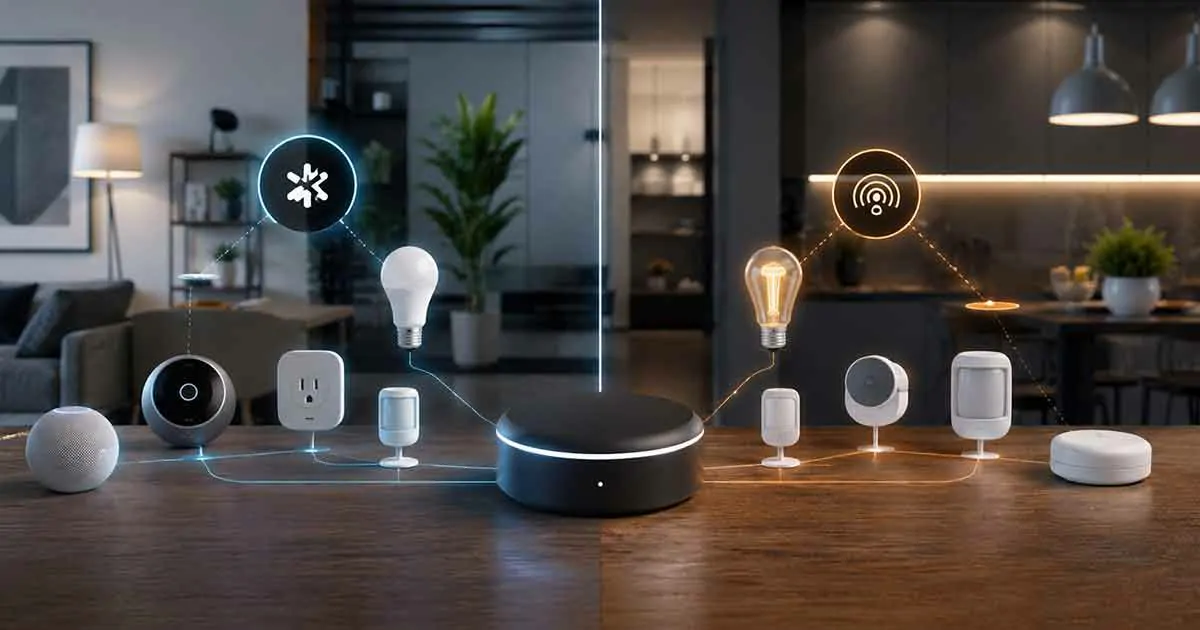
Choosing the right smart home technology can have a major impact on how easily your devices work together.
Two technologies that frequently appear when researching connected homes are Matter and Zigbee. Both are designed to connect smart home devices, but they work in different ways and serve somewhat different purposes.
Matter is a newer, IP-based smart home standard designed to improve interoperability between compatible devices and major smart home platforms. It can operate over Wi-Fi, Ethernet, and Thread, while Bluetooth Low Energy is used for commissioning.
Zigbee is a mature, low-power mesh technology that combines networking and application-level functionality for smart home and IoT devices. Millions of Zigbee products are already deployed, and the technology has a long history in lighting, sensors, security, and energy-management applications.
Table of Contents
So, which is better?
The answer depends on what you are building.
For a new smart home where broad platform compatibility is a priority, Matter is often the better starting point. For established systems, large sensor networks, and users who already have compatible Zigbee hubs and devices, Zigbee can still be an excellent choice.
In many cases, you do not actually have to choose one exclusively.
Matter vs Zigbee at a Glance
| Feature | Matter | Zigbee |
|---|---|---|
| Main purpose | Smart home interoperability | Low-power smart home and IoT networking |
| Network approach | IP-based | Mesh networking |
| Common connectivity | Wi-Fi, Thread, Ethernet | Zigbee radio |
| Device setup | Designed for simplified multi-platform setup | Usually depends on a compatible Zigbee ecosystem or hub |
| Power efficiency | Depends on underlying transport | Designed for low-power devices |
| Multi-brand support | Strong focus | Strong within certified Zigbee ecosystems |
| Existing ecosystem | Growing | Mature |
| Best for | New cross-platform smart homes | Established mesh networks and low-power devices |
| Can they work together? | Yes, through a bridge | Yes, through a bridge |
| Requires native compatibility? | Yes | Yes |
What Is Matter?
Matter is an open smart home connectivity standard developed by the Connectivity Standards Alliance.
Its goal is to make compatible smart home devices easier to use across different ecosystems.
Matter uses existing networking technologies rather than replacing them. It can operate over Wi-Fi, Thread, and Ethernet, while Bluetooth Low Energy can be used during device commissioning.
Matter is therefore best understood as a smart home application and interoperability standard, not simply as a replacement for Wi-Fi or Zigbee.
A Matter-certified smart device can potentially work with multiple supported smart home platforms.
This is particularly useful for homeowners who do not want to be locked into a single manufacturer’s ecosystem.
What Is Zigbee?
Zigbee is a low-power wireless IoT technology that uses mesh networking.
It has been used for years in smart lighting, sensors, security products, energy management, and other connected devices.
Zigbee is based on IEEE 802.15.4 radio technology and can operate in different frequency bands depending on the region and implementation.
One of Zigbee’s important characteristics is its mesh architecture.
Compatible powered devices can act as network nodes and help extend communication throughout the home.
This makes Zigbee particularly useful for networks containing many sensors and other low-power devices.
Matter vs Zigbee: The Biggest Difference
The biggest difference is that Matter and Zigbee operate at different levels of the smart home technology stack.
Matter is an IP-based application protocol designed to provide a common way for compatible smart home devices and platforms to communicate.
Zigbee combines networking and device-level functionality within its own standardized technology stack.
This distinction is important because Matter does not simply replace Zigbee’s radio technology.
Matter can use Thread, Wi-Fi, or Ethernet as its underlying network technologies, while Zigbee uses its own wireless networking technology.
How Matter Works
Matter devices communicate using IP-based networking.
Supported Matter devices can connect through:
- Wi-Fi
- Thread
- Ethernet
Bluetooth Low Energy can be used to assist with commissioning and setup.
A Matter smart home typically includes a Matter controller, such as a compatible smart speaker, display, hub, or other controller.
The controller helps manage Matter devices within the chosen smart home ecosystem.
One of Matter’s major advantages is that supported devices can be shared across compatible platforms through its multi-admin capabilities.
How Zigbee Works
Zigbee uses a mesh network.
A typical Zigbee system can include:
- Zigbee coordinator or hub
- Powered Zigbee devices
- Battery-powered sensors
- End devices
- Mesh routing devices
Powered devices can help relay communication through the network.
This makes Zigbee useful for larger collections of sensors and lighting devices.
The Connectivity Standards Alliance describes Zigbee as a low-power mesh solution with millions of deployed products.
Matter vs Zigbee for Smart Home Compatibility
Compatibility is one of Matter’s strongest selling points.
Matter was specifically designed to improve interoperability between supported products and major smart home ecosystems.
Instead of choosing a device based solely on whether it works with one particular platform, users can look for Matter certification and then check whether their preferred ecosystem supports the device’s category and features.
Zigbee also has strong interoperability, but the experience depends more heavily on the specific Zigbee ecosystem, hub, and certified devices being used.
A Zigbee device may work perfectly within one platform but offer different functionality in another.
Is Matter Better Than Zigbee for New Smart Homes?
For many people starting a smart home today, Matter is an attractive choice.
It can reduce concerns about platform compatibility and provide more flexibility when selecting supported devices.
Matter is particularly useful if you:
- Are starting from scratch
- Want cross-platform compatibility
- Use multiple smart home ecosystems
- Want to avoid unnecessary vendor lock-in
- Expect your system to grow over time
However, Matter does not automatically make every device better.
You still need to check:
- Supported platform
- Device category
- Required controller
- Thread or Wi-Fi requirements
- Available features
- Local control
- Firmware support
Is Zigbee Still Worth Using?
Yes.
Zigbee remains a mature and widely deployed technology.
It can be especially attractive if you already own a Zigbee hub or have a large Zigbee installation.
Zigbee can also be useful for low-power sensors and devices where mesh networking is desirable.
The release of Zigbee 4.0 in 2025 demonstrates that Zigbee continues to evolve rather than simply disappearing because Matter exists. The Connectivity Standards Alliance says Zigbee 4.0 adds improvements related to interoperability, security, range, and reliability.
Therefore, buying Zigbee devices today is not automatically a bad long-term decision.
Matter vs Zigbee for Battery-Powered Sensors
Battery-powered sensors are an important consideration.
Zigbee has a long history as a low-power technology and is widely used for:
- Door sensors
- Window sensors
- Motion sensors
- Temperature sensors
- Leak sensors
Matter devices can also be designed for low-power applications, particularly when they use Thread.
Thread and Zigbee both use IEEE 802.15.4 radio technology, but they use different networking approaches. Thread is IP-based, while Zigbee uses its own protocol stack.
For battery-powered devices, do not judge efficiency solely by the word “Matter” or “Zigbee.”
Look at the actual product’s battery-life specifications and implementation.
Matter vs Zigbee for Smart Lighting
Both technologies are suitable for smart lighting.
Zigbee has a particularly mature smart-lighting ecosystem with many bulbs, switches, and controllers.
Matter is attractive when cross-platform compatibility is a major priority.
If you are starting a new system, Matter-certified lighting can make ecosystem selection easier.
If you already have a reliable Zigbee lighting network, replacing it simply because Matter is newer usually does not make sense.
Matter vs Zigbee for Security Sensors
Both can be used for:
- Door sensors
- Window sensors
- Motion sensors
- Environmental sensors
- Security-related automation
Zigbee has extensive real-world deployment in these categories.
Matter’s supported device categories continue to expand, while the standard’s goal is to create a more unified ecosystem for compatible devices.
For security sensors, reliability, battery life, response time, and ecosystem support may matter more than the protocol name alone.
Matter vs Zigbee for Large Smart Homes
Large smart homes can benefit from both technologies.
Zigbee’s mesh architecture can be useful when many compatible powered devices are distributed throughout a property.
Matter’s advantage is its ability to work across IP-based networks and supported ecosystems.
However, a Matter network using Wi-Fi can place more dependence on the home’s Wi-Fi infrastructure.
Matter devices using Thread require a Thread Border Router.
Therefore, in a large home, network planning remains important regardless of which technology you choose.
Does Matter Replace Zigbee?
No.
Matter does not directly replace Zigbee.
The Connectivity Standards Alliance explicitly states that Matter and Zigbee are different protocols and that there is no native interoperability between them. Instead, Matter supports bridging, allowing Zigbee devices to participate in a Matter ecosystem through compatible bridge devices.
This is an important distinction.
You do not necessarily need to remove an existing Zigbee network when adding Matter devices.
Can Matter and Zigbee Work Together?
Yes, through a compatible bridge.
A bridge translates between the two technologies.
For example:
Zigbee light → Zigbee hub/bridge → Matter ecosystem → Matter controller
From the user’s perspective, a compatible bridged Zigbee device can appear alongside native Matter devices.
The Connectivity Standards Alliance gives this exact type of interoperability as one reason bridging matters.
This makes mixed smart homes practical.
Matter vs Zigbee: Which Has Better Range?
There is no simple winner.
Range depends on:
- Frequency
- Transmission power
- Antenna design
- Building materials
- Device placement
- Network topology
- Number of mesh nodes
Zigbee is well known for mesh networking, allowing compatible powered devices to help extend network coverage.
Matter itself does not have one single radio range because it can operate over Wi-Fi, Thread, and Ethernet.
Thread-based Matter devices form a mesh network, while Wi-Fi Matter devices depend on Wi-Fi coverage.
Therefore, compare the underlying network technology rather than simply asking whether Matter or Zigbee has better range.
Matter vs Zigbee: Which Is More Secure?
Both technologies incorporate security mechanisms, but security depends on the complete implementation.
A secure smart home also requires:
- Strong account credentials
- Secure Wi-Fi
- Updated firmware
- Proper device authentication
- Secure controllers
- Regular software updates
Matter was designed with security as a core part of the standard. The Connectivity Standards Alliance describes Matter as providing secure and reliable connectivity.
Zigbee also has established security mechanisms and a long history of deployment.
For consumers, choosing certified products from reputable manufacturers and keeping them updated is more important than assuming one protocol is automatically secure and the other is not.
Matter vs Zigbee: Which Is Easier to Set Up?
Matter is designed to simplify smart home setup.
The Matter ecosystem uses standardized commissioning and is intended to reduce the compatibility problems that have historically affected smart home products.
Zigbee setup can also be straightforward, particularly when using a modern compatible hub.
However, the experience can vary depending on:
- Hub
- Manufacturer
- App
- Device
- Ecosystem
For a beginner building a new system, Matter can offer a simpler conceptual starting point.
Matter vs Zigbee: Which Has More Devices?
Zigbee has a substantial installed base after years of development and deployment.
The Connectivity Standards Alliance states that Zigbee has millions of products already deployed and a large established ecosystem.
Matter is newer but has expanded rapidly across major smart home platforms and manufacturers.
The number of compatible devices is therefore not the only consideration.
The important question is whether the specific device you need is available with the features and ecosystem support you want.
Matter vs Zigbee: Which Is Better for Beginners?
For someone building a new smart home, Matter is generally easier to recommend as a starting point.
The main reason is not that Matter is universally superior.
It is because Matter is specifically designed around interoperability between supported smart home platforms.
A beginner can focus on choosing a device with the required features and checking its Matter compatibility with their preferred ecosystem.
Zigbee can still be an excellent choice when a specific Zigbee product, hub, or ecosystem offers better functionality or value.
Matter vs Zigbee for Existing Smart Homes
If you already have a Zigbee network that works reliably, there is usually no reason to replace it simply because Matter is newer.
Instead, you can:
- Keep existing Zigbee devices.
- Add compatible Matter devices.
- Use a bridge where appropriate.
- Gradually expand the system.
This can reduce unnecessary spending and preserve devices that already work well.
Which Should You Choose: Matter or Zigbee?
The best option depends on your situation.
Choose Matter If:
- You are building a new smart home.
- Cross-platform compatibility is important.
- You want flexibility between major smart home ecosystems.
- You want to reduce vendor lock-in.
- You are buying new devices and Matter versions are available.
Choose Zigbee If:
- You already have a Zigbee hub.
- You have many existing Zigbee devices.
- You need specific Zigbee products.
- You want a mature low-power mesh ecosystem.
- A Zigbee device provides better features or value for your use case.
Choose Both If:
- You already use Zigbee.
- You are adding new Matter products.
- Your hub supports bridging.
- You want to combine an established mesh network with newer Matter devices.
For many homeowners, this third option may be the most practical.
Matter vs Zigbee: Pros and Cons
Matter Pros
- Strong focus on interoperability
- Works across supported smart home platforms
- IP-based architecture
- Supports Wi-Fi, Thread, and Ethernet
- Designed for simpler consumer setup
- Growing ecosystem
Matter Cons
- Still newer than Zigbee
- Feature support can vary by platform
- Thread devices require appropriate infrastructure
- Not every smart home feature is supported equally
- Compatibility still needs to be checked before purchasing
Zigbee Pros
- Mature technology
- Low-power design
- Mesh networking
- Large installed base
- Strong selection of sensors and lighting
- Proven smart home deployments
Zigbee Cons
- Often requires a compatible hub
- User experience can vary between ecosystems
- Not natively interoperable with Matter
- Less directly focused on cross-platform IP-based interoperability
The Best Strategy for a New Smart Home
If you are starting from scratch, a practical approach is:
Step 1: Choose Your Smart Home Platform
Decide whether your main controller will be based around Apple Home, Google Home, Amazon Alexa, SmartThings, or another supported platform.
Step 2: Prioritize Matter Where Appropriate
For new devices, consider Matter-certified products when they provide the features you need.
Step 3: Use Zigbee When It Makes Sense
Do not reject a good Zigbee product simply because it is not Matter.
A Zigbee sensor or light may still be an excellent choice.
Step 4: Plan the Network
For Matter devices, determine whether you will use Wi-Fi, Thread, or Ethernet.
For Zigbee devices, ensure that the required hub and mesh network are properly positioned.
Step 5: Avoid Unnecessary Replacements
Existing Zigbee devices can remain useful for years.
Use bridges where appropriate instead of replacing functioning equipment.
Final Verdict: Matter vs Zigbee
So, which smart home technology is better?
For a new smart home, Matter is generally the better starting point when interoperability and platform flexibility are your priorities.
However, that does not make Zigbee obsolete.
Zigbee remains a mature, low-power mesh technology with a large installed base and extensive device ecosystem. Matter and Zigbee can also coexist through compatible bridges.
The smartest approach is to choose based on the devices you need, the ecosystem you use, and how you expect your smart home to grow.
For a new installation, prioritize Matter where it provides clear compatibility benefits. For an existing Zigbee system, keep the devices that work well and expand strategically.
In other words, Matter is often the better choice for starting fresh, while Zigbee remains an excellent choice for mature, low-power smart home networks.
The two technologies are competitors in some areas, but they can also be complementary parts of the same smart home.