
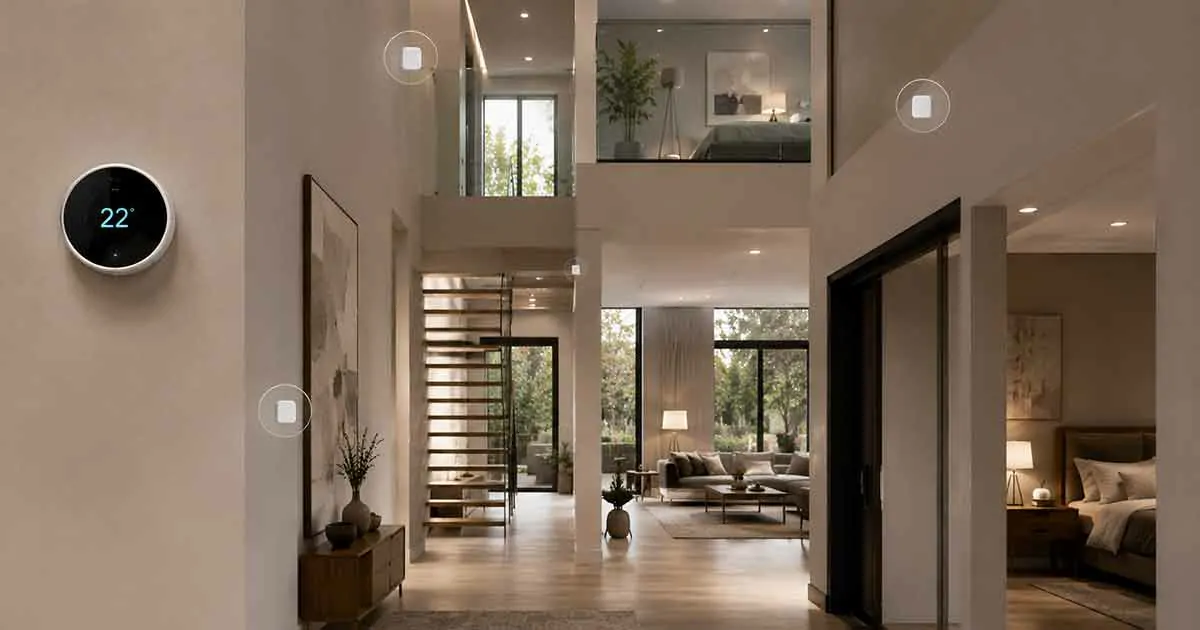
Large homes can be difficult to heat and cool evenly. Rooms located far from the main thermostat may have different temperatures, while bedrooms, upper floors, sun-facing rooms, and poorly insulated areas can require different levels of heating or cooling.
A smart thermostat can help address some of these challenges by combining scheduling, remote control, temperature sensing, occupancy information, and HVAC automation.
For larger properties, however, the most important feature is often not the thermostat itself but its ability to work with remote temperature sensors or multiple HVAC zones.
A thermostat installed in one hallway can only measure conditions at that location. Remote sensors can provide temperature information from bedrooms, living areas, offices, or other important spaces. Research on room-level sensing has found substantial temperature differences between rooms in many homes, which helps explain why a single thermostat reading may not represent the entire property.
This guide explains what to look for when choosing the best smart thermostat for a large home, how remote sensors and zoning work, and which features matter most for comfort and energy management.
Table of Contents
Why Large Homes Need Different Thermostat Features
A small home may be adequately served by a single thermostat located in a central area.
Large homes are different.
They may have:
- Multiple floors
- Several bedrooms
- Large open spaces
- Multiple HVAC systems
- Separate heating and cooling zones
- Rooms with different sunlight exposure
- Long distances between rooms
- Uneven insulation
- Different occupancy patterns
These factors can create temperature differences throughout the property.
A smart thermostat with remote sensors can help provide a better picture of conditions in different areas.
What Makes a Smart Thermostat Good for a Large Home?
The most important features include:
- Remote temperature sensors
- Multi-room temperature monitoring
- Multi-zone HVAC compatibility
- Scheduling
- Occupancy detection
- Smartphone control
- Energy reports
- Strong HVAC compatibility
- Smart home integration
- Reliable wireless connectivity
Not every thermostat supports all of these features.
More importantly, a thermostat that supports remote sensors is not necessarily the same thing as a thermostat that independently controls multiple HVAC zones.
These are two different capabilities.
Remote Sensors vs. Multi-Zone HVAC
This distinction is extremely important when choosing a thermostat for a large home.
Remote Temperature Sensors
A remote sensor measures conditions in another room.
The thermostat system can use that information when determining how to manage the HVAC system.
For example:
Bedroom sensor → temperature information → compatible thermostat adjusts HVAC.
This can improve comfort in rooms that are far from the main thermostat.
Multi-Zone HVAC
A true multi-zone system has separate HVAC zones that can be controlled independently.
For example:
- Zone 1 → downstairs
- Zone 2 → upstairs
- Zone 3 → bedrooms
Each zone may have its own thermostat or control mechanism.
A remote sensor alone does not create a new HVAC zone.
If you have one furnace and one air conditioner serving the entire house, adding sensors does not automatically give you independent temperature control for every room.
Best Smart Thermostat Features for Large Homes
1. Remote Temperature Sensors
This is one of the most valuable features for large properties.
A remote sensor can measure temperature in a room that differs significantly from the thermostat’s location.
Some systems can use multiple sensors and allow you to prioritize different rooms at different times.
For example:
Daytime → living room sensor
Nighttime → bedroom sensor
The exact functionality depends on the thermostat system.
2. Occupancy Detection
Occupancy information can make temperature control more responsive.
If a system knows that a particular room is occupied, it may be able to prioritize that area when supported.
This can be especially useful in large homes where many rooms are not occupied throughout the day.
3. Scheduling
A good schedule can prevent unnecessary heating or cooling.
For example:
Morning → comfortable temperature
Workday → energy-saving setting
Evening → return to comfort setting
Night → bedroom-focused temperature
Scheduling becomes even more useful when combined with remote sensors.
4. Smartphone Control
Remote access allows homeowners to check and adjust the thermostat from anywhere with an internet connection.
This can be useful for:
- Vacation homes
- Large properties
- Unexpected schedule changes
- Pre-conditioning the home before arrival
5. Energy Reports
Energy reports can help identify patterns in heating and cooling use.
They may show:
- HVAC runtime
- Temperature settings
- Historical trends
- Energy-saving opportunities
The exact information varies by manufacturer.
6. HVAC Compatibility
Compatibility should come before smart features.
Before purchasing a thermostat, confirm that it supports your:
- Heating system
- Cooling system
- Heat pump
- Furnace
- Boiler
- Multi-stage equipment
- Auxiliary heating
- Existing wiring
Large homes sometimes have more complex HVAC configurations, making compatibility particularly important.
Best Smart Thermostat Systems for Large Homes
Several smart thermostat systems are designed around remote sensors or multi-room temperature management.
Ecobee Smart Thermostat Systems
Ecobee’s higher-end thermostat systems use remote SmartSensors to measure conditions in additional rooms.
This makes the platform particularly relevant for large homes where the thermostat’s location does not represent the temperature of frequently occupied rooms.
Current comparisons also identify Ecobee’s premium thermostat as a strong option for multi-room sensor management.
The main advantage is the ability to combine the thermostat with additional room-level temperature information.
Honeywell Home T9
The Honeywell Home T9 is another thermostat designed around remote room sensors.
It can be attractive for larger properties where monitoring several rooms is important.
Current product comparisons identify the T9 as an option for homes needing extensive remote sensor coverage.
Before purchasing, verify compatibility with your particular HVAC system and the number of sensors you actually need.
Google Nest Learning Thermostat
Google Nest thermostats are well known for scheduling, learning features, and integration with Google Home.
They can be suitable for large homes when used with compatible sensor and HVAC configurations.
However, homeowners should carefully distinguish between temperature sensing and true multi-zone control.
A large home with multiple independent HVAC zones may require a more specialized configuration than a single smart thermostat.
Smart Thermostats for Multi-Story Homes
Temperature differences between floors are common.
Upper floors can become warmer because of:
- Rising heat
- Sun exposure
- Roof temperatures
- Different insulation
- Airflow differences
A thermostat located downstairs may therefore not accurately represent the temperature upstairs.
A remote sensor in an upstairs bedroom or living area can provide additional information.
For homes with independent HVAC zones, separate zone controls may be more appropriate.
Smart Thermostats for Large Homes With Multiple HVAC Systems
Some large homes have multiple HVAC systems.
For example:
- One system for the first floor
- One system for the second floor
- Another system for an addition
In this situation, a single thermostat may not be sufficient.
Each HVAC system may require its own compatible thermostat or control system.
The goal is to create a coordinated setup rather than assuming that one smart thermostat can control every HVAC system.
Smart Thermostats for Large Homes With Zoning
Zoning divides a home into separate areas that can be heated or cooled according to different requirements.
A typical setup might include:
Zone 1 → living areas
Zone 2 → bedrooms
Zone 3 → upper floor
Zoning can provide more precise control than simply installing additional temperature sensors.
However, creating HVAC zones may require:
- Compatible dampers
- Zone controllers
- Multiple thermostats or sensors
- Professional HVAC installation
- Appropriate ductwork
A thermostat alone cannot transform a conventional single-zone HVAC system into a fully independent multi-zone system.
Remote Sensors and Large Open-Plan Homes
Open-plan homes create a different challenge.
A single thermostat may be located in a central area, while sunlight or cooking can cause temperature differences across the open space.
A remote sensor can provide another measurement point.
However, sensor placement matters.
Avoid placing a sensor:
- In direct sunlight
- Near an HVAC vent
- Next to a kitchen appliance
- Behind furniture
- Near a frequently opened exterior door
The sensor should represent the conditions of the area you want to monitor.
Smart Thermostats for Large Bedrooms
Bedrooms are often priority areas because homeowners may prefer different temperatures at night.
A remote sensor can provide bedroom temperature information.
Some smart thermostat systems can use a bedroom sensor during a scheduled period.
For example:
10 PM → bedroom sensor becomes the priority
7 AM → living-area sensor becomes the priority
The exact feature depends on the thermostat platform.
Smart Thermostats for Home Offices
Home offices can benefit from room-level temperature monitoring.
Computers, monitors, sunlight, and occupancy can make a workspace warmer than surrounding areas.
A remote temperature sensor can help identify these differences.
If the smart thermostat supports occupancy-based routines, the system may also adjust temperature based on whether the office is being used.
Smart Thermostats for Energy Savings in Large Homes
Large homes have more space to heat and cool, so unnecessary HVAC runtime can become expensive.
Smart thermostats can help through:
- Scheduling
- Temperature setbacks
- Occupancy-based adjustments
- Remote control
- Energy reports
- Remote temperature sensors
However, smart technology does not guarantee a specific percentage of savings.
Actual results depend on the home’s insulation, climate, HVAC equipment, previous thermostat settings, occupancy patterns, and other factors. Current testing and comparison sources similarly caution that savings vary by home and system.
Smart Thermostat Scheduling
A large home can benefit from different temperature settings throughout the day.
A practical schedule could be:
Morning
Comfortable temperature during the time the household is getting ready.
Daytime
Reduced heating or cooling when the home is mostly empty.
Evening
Comfortable settings when residents return.
Night
Bedroom-focused settings or a lower-energy temperature.
The goal is to avoid conditioning an empty house unnecessarily while maintaining comfort when rooms are occupied.
Smart Thermostats and Occupancy
Occupancy detection can help determine which areas of a home are being used.
Some thermostat systems use occupancy information from remote sensors.
This can be useful in large properties where several rooms may remain empty for much of the day.
However, occupancy detection is not always perfect.
A room may be occupied by someone sitting quietly, while another area may temporarily register activity.
For important comfort decisions, combine occupancy features with appropriate schedules.
C-Wire Requirements
Many smart thermostats require continuous low-voltage power through a C-wire.
Whether you need a C-wire depends on the thermostat and HVAC system.
Some models provide alternative installation methods or power accessories.
Before purchasing, inspect your existing thermostat wiring and verify compatibility with the manufacturer’s requirements.
Do not assume that a thermostat will work simply because the existing thermostat has similar terminals.
Professional Installation for Large HVAC Systems
Large homes often have more complicated HVAC systems.
Professional installation may be appropriate when the system includes:
- Multiple zones
- Multiple HVAC units
- Heat pumps
- Multi-stage equipment
- Auxiliary heating
- Complex wiring
- Motorized dampers
An HVAC professional can verify compatibility and configure the system correctly.
Incorrect thermostat installation can cause HVAC problems or prevent the equipment from operating as intended.
Smart Thermostats Without a Subscription
A subscription is not necessarily required for basic thermostat operation.
However, some manufacturers may offer optional paid services or advanced features.
Before buying, determine whether the functions you care about require a recurring payment.
Pay particular attention to:
- Remote access
- Historical data
- Advanced reports
- Monitoring services
- Additional cloud features
For a large home, recurring costs can become significant if multiple devices or services are involved.
Smart Thermostats and Smart Home Platforms
Large-home owners should also consider ecosystem compatibility.
A thermostat may integrate with:
- Google Home
- Amazon Alexa
- Apple Home
- Samsung SmartThings
- Matter-supported ecosystems
Current smart thermostat guides emphasize compatibility with major smart home platforms as an important buying consideration.
Choose a thermostat that works naturally with the devices you already own.
Matter and Smart Thermostats
Matter is designed to improve interoperability between compatible smart home products.
A Matter-compatible thermostat may offer more flexibility when using multiple supported ecosystems.
However, compatibility does not mean that every advanced thermostat feature will be available through every platform.
Check the manufacturer’s documentation for supported functions before purchasing.
Smart Thermostats for Large Homes With Heat Pumps
Heat pumps can require more careful thermostat selection than conventional heating and cooling systems.
Compatibility should include:
- Heat pump type
- Auxiliary heat
- Emergency heat
- Stage configuration
- Reversing valve
- Existing wiring
A thermostat that works with a conventional furnace and air conditioner may not support every heat pump configuration.
Smart Thermostats for Large Homes With Boilers
Boiler systems can also require different thermostat compatibility.
Before purchasing, confirm whether the thermostat supports your specific heating configuration.
Do not assume that a thermostat designed for conventional central HVAC will automatically work with a boiler.
Smart Thermostats for Large Homes With Poor Temperature Balance
If one room is consistently too hot or cold, replacing the thermostat may not solve the underlying issue.
Potential causes include:
- Poor insulation
- Ductwork problems
- Blocked vents
- Air leakage
- Inadequate airflow
- Solar heat gain
- Incorrect HVAC sizing
A remote sensor can identify the temperature difference, but it cannot physically correct an insulation or ductwork problem.
Addressing the underlying building or HVAC issue may be more effective.
Common Mistakes When Choosing a Smart Thermostat for a Large Home
Assuming More Sensors Mean More Zones
Sensors measure temperature; they do not automatically create independent HVAC zones.
Ignoring HVAC Compatibility
Complex systems require careful compatibility checks.
Installing Sensors in Poor Locations
A badly positioned sensor can provide misleading information.
Buying Based Only on Energy-Saving Claims
Actual savings vary by home and usage.
Forgetting C-Wire Requirements
Check wiring before purchasing.
Using One Thermostat for Multiple Independent Systems
Separate HVAC systems may require separate controls.
Overcomplicating the System
More devices do not necessarily mean better comfort.
Start with the areas where temperature differences are most noticeable.
How Many Temperature Sensors Does a Large Home Need?
There is no universal number.
The appropriate number depends on:
- Home size
- Number of floors
- HVAC configuration
- Number of occupied rooms
- Temperature differences
- Thermostat capabilities
A large home may benefit from sensors in priority rooms rather than every room.
Start with:
- Main bedroom
- Main living area
- Upper floor
- Home office
- Any room with significant temperature problems
Then expand only if additional data improves comfort or automation.
How to Choose the Best Smart Thermostat for a Large Home
Before purchasing, ask:
- How many HVAC systems does the home have?
- How many independent zones are there?
- Does the thermostat support remote temperature sensors?
- How many sensors can it use?
- Can sensors influence temperature control?
- Does the thermostat support your HVAC equipment?
- Is a C-wire required?
- Does it support heat pumps or boilers if needed?
- Does it integrate with your smart home platform?
- Are important features locked behind a subscription?
These questions are more important than simply choosing the thermostat with the longest feature list.
A Practical Setup for a Large Home
A simple approach is to start with one smart thermostat and a small number of remote sensors.
For example:
Main thermostat → central hallway
Remote sensor → upstairs bedroom
Remote sensor → main living area
If the system supports scheduling, the bedroom sensor can become more important at night while the living-area sensor can be prioritized during the day.
If the home has multiple independent HVAC zones, evaluate each zone separately rather than treating the entire property as one system.
Are Smart Thermostats Worth It for Large Homes?
Smart thermostats can be particularly useful in large homes because temperature differences and HVAC operating costs can become more noticeable as the property grows.
The most valuable features are usually remote sensors, zoning compatibility, scheduling, occupancy awareness, smartphone control, and reliable HVAC compatibility.
However, the best thermostat depends heavily on the existing HVAC system.
A premium thermostat with advanced features is not necessarily the best choice if it cannot properly control your equipment.
Final Thoughts
The best smart thermostats for large homes are not simply the models with the most features. They are systems that can accurately monitor important rooms, integrate with the home’s HVAC configuration, and provide practical control over heating and cooling.
Remote temperature sensors can help address temperature differences between rooms, while true multi-zone HVAC systems provide independent control over separate areas.
Before buying, determine whether you need remote sensing, multiple zones, or both. Then verify HVAC compatibility, wiring requirements, smart home integration, subscription requirements, and sensor support.
For a large home, a well-designed thermostat and sensor system can provide better temperature awareness, more targeted automation, and greater control over HVAC operation without unnecessarily complicating the rest of the smart home.