
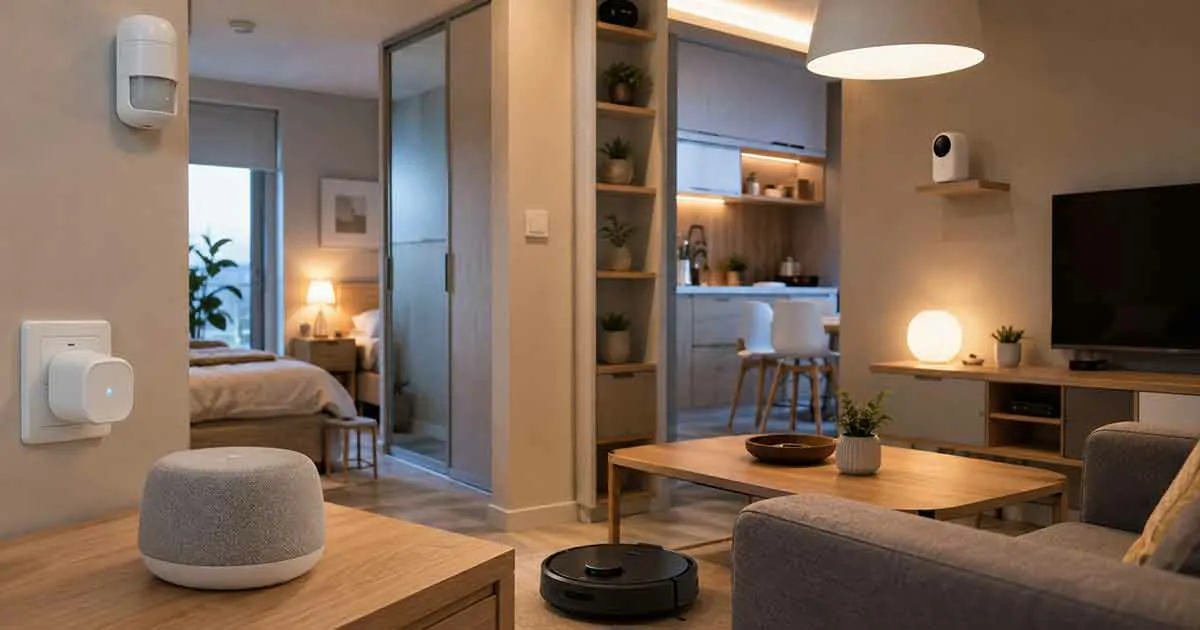
Small homes and apartments can benefit from smart home technology just as much as larger properties. In fact, connected devices can be particularly useful when space is limited because they can automate everyday tasks, improve organization, increase security, and reduce unnecessary energy use.
The challenge is choosing devices that provide real value without creating clutter or requiring complicated installations.
A large smart home does not necessarily need more technology. In a small home, the goal should be to choose compact devices that perform multiple functions, work well together, and fit naturally into the available space.
From compact smart speakers and smart plugs to sensors, smart lighting, security devices, and robot vacuums, there are many ways to build a useful smart home without sacrificing valuable floor or counter space.
This guide covers the best smart home devices for small homes and explains how to choose compact, practical products that make everyday living easier.
Table of Contents
Why Smart Home Devices Are Useful in Small Homes
Limited space often means that every device needs to justify the space it occupies.
Smart home technology can help by reducing repetitive tasks and allowing multiple devices to work together.
For example:
- Smart lights can automate lighting.
- Smart plugs can control appliances.
- Sensors can trigger lights automatically.
- Smart speakers can control multiple devices.
- Robot vacuums can automate floor cleaning.
- Smart thermostats can manage temperature more efficiently.
- Compact security devices can monitor entrances without taking much space.
The best approach is not to fill a small home with connected products. Instead, choose devices that solve specific problems.
Best Smart Home Devices for Small Homes
1. Compact Smart Speakers
A small smart speaker can serve as a central control point for compatible devices without occupying much space.
You can place one on:
- A nightstand
- Kitchen counter
- Desk
- Shelf
- Small side table
Depending on the platform, a smart speaker can control lights, plugs, thermostats, and other connected devices.
Voice control can also be useful when physical space is limited because you do not need to reach for a phone every time you want to adjust a device.
2. Smart Plugs
Smart plugs are among the most practical devices for small homes.
They can turn ordinary appliances into connected devices without replacing the appliance itself.
You can use them with suitable:
- Lamps
- Fans
- Coffee makers
- Small appliances
- Entertainment equipment
- Home office devices
Features may include scheduling, remote control, timers, voice commands, and automation.
Because smart plugs are relatively small, they can provide useful functionality without adding much clutter.
3. Smart Plugs With Energy Monitoring
Energy-monitoring smart plugs are particularly useful when electricity consumption is a concern.
They can show how much energy a connected appliance uses, depending on the model.
This can help you identify:
- Devices that consume more electricity than expected
- Equipment that stays on unnecessarily
- Appliances that operate for long periods
- Opportunities for scheduling
For a small home, monitoring individual appliances can be a practical alternative to installing a more complex whole-home energy monitoring system.
4. Smart Bulbs
Smart bulbs are a simple way to add automation without installing additional wall controls.
Depending on the model, they can provide:
- Dimming
- Scheduling
- Remote control
- Voice control
- Scenes
- Automation
A single smart bulb can often provide several functions without requiring additional hardware.
However, the physical wall switch generally needs to remain on for the bulb to stay connected.
5. Smart Light Switches
Smart switches can be useful when you want to control existing ceiling lights or multiple bulbs from one location.
They can provide:
- Scheduling
- Remote control
- Automatic shutoff
- Voice control
- Smart home routines
Unlike smart bulbs, a smart switch controls the electrical circuit itself.
Installation can require electrical work, so homeowners should follow the manufacturer’s instructions and renters should obtain appropriate permission before modifying wiring.
6. Motion Sensors
Motion sensors are compact devices that can trigger automations without requiring additional controls.
For example:
Motion detected → hallway light turns on.
After a period of inactivity:
No motion → light turns off.
This can be especially useful in small homes because a single sensor can automate a frequently used area.
Motion sensors can also reduce unnecessary lighting use.
7. Occupancy Sensors
Occupancy sensors can provide more advanced room-use information than basic motion sensors.
They can be useful for:
- Small offices
- Bedrooms
- Living rooms
- Kitchens
- Multi-purpose rooms
Depending on the technology and smart home system, an occupancy sensor may help determine whether a room is being used even when someone is relatively still.
This can support more reliable lighting and automation routines.
8. Compact Security Cameras
Small security cameras can provide useful monitoring without taking up much space.
An indoor camera can sit on:
- A shelf
- Desk
- Cabinet
- Entry table
Potential features include:
- Motion detection
- Smartphone alerts
- Live viewing
- Night vision
- Two-way audio
- Activity recording
For small homes, a strategically positioned camera may provide coverage of a main entry area without requiring several cameras.
Always consider privacy when placing indoor cameras.
9. Door and Window Sensors
Smart contact sensors are small and can provide useful security information.
They can notify you when a door or window opens or closes.
They can also act as automation triggers.
For example:
Front door opens → entry light turns on.
Because the sensors are compact, they usually have little impact on the appearance of a small home.
10. Smart Locks
A smart lock can eliminate the need for carrying traditional keys while adding features such as automatic locking and temporary access codes.
This can be especially convenient in a small home or apartment where the main entrance is frequently used.
Potential features include:
- Keypad access
- Smartphone control
- Fingerprint access
- Auto-lock
- Temporary codes
- Access notifications
Before installing a smart lock, verify that it is compatible with your existing door.
Renters should also check their lease and obtain permission when required.
11. Smart Doorbells
A smart doorbell can provide security and convenience without requiring a large amount of space.
Depending on the product, it may provide:
- Motion alerts
- Video
- Two-way communication
- Visitor notifications
- Activity history
For apartments or homes with shared entrances, check building rules and privacy requirements before installing one.
12. Smart Thermostats
A smart thermostat can provide temperature scheduling and remote control while replacing a traditional thermostat.
This can be useful in small homes because temperature control may have a noticeable effect on comfort and energy consumption.
Potential features include:
- Scheduling
- Remote control
- Home and Away modes
- Temperature sensors
- Energy reports
- Smart home automation
Compatibility should always be checked before installation.
13. Smart Temperature and Humidity Sensors
A compact temperature or humidity sensor can provide information about conditions in different areas of a small home.
This can be useful when one thermostat does not accurately represent the conditions in every room.
For example, a bedroom may become warmer or cooler than the main living area.
A compatible sensor can provide additional information for a supported thermostat or automation system.
14. Smart Air Purifiers
Air purifiers can be useful in smaller homes because indoor air quality can become important when there is limited ventilation.
Smart models may provide:
- Remote control
- Scheduling
- Automatic modes
- Air quality monitoring
- Filter reminders
Choose a model appropriately sized for the room or total area you want to treat.
A compact design can help prevent the purifier from becoming another obstacle in a small living space.
15. Smart Air Quality Monitors
A small air quality monitor can provide information about indoor conditions without taking up much room.
Depending on the device, measurements may include:
- Temperature
- Humidity
- Carbon dioxide
- Particulate matter
- Volatile organic compounds
The exact sensors vary between products.
This type of device can help you identify changes in indoor conditions and decide when ventilation or other measures may be appropriate.
16. Robot Vacuums
Robot vacuums can be especially useful in small homes because they automate floor cleaning without requiring a large traditional vacuum to remain accessible.
Many models include:
- Scheduling
- Smartphone control
- Automatic charging
- Cleaning maps
- Room selection
- Voice control
However, consider the size of the charging station and whether there is enough clearance for the robot to operate effectively.
17. Smart Blinds and Shades
Smart blinds can automate window coverings without adding much technology to the room.
Depending on the model, they may support:
- Scheduling
- Remote control
- Sunlight-based routines
- Temperature-based automation
Automated shades can also help manage sunlight and indoor comfort.
For small homes, choose a system that fits the existing window and does not interfere with furniture placement.
18. Smart Power Strips
A smart power strip can consolidate several connected electronics into one organized area.
It can be useful for:
- TV setups
- Desks
- Gaming areas
- Home offices
Some models can schedule or control selected outlets.
This can reduce cable clutter and make it easier to manage several compatible devices from one location.
19. Smart LED Light Strips
Smart LED strips can add accent lighting without taking up floor or table space.
They can be installed around:
- Shelves
- Desks
- Cabinets
- Beds
- TV units
They can provide decorative lighting while remaining relatively unobtrusive.
If you rent, check whether the adhesive mounting method can be removed without damaging the surface.
20. Smart Water Leak Sensors
Water leak sensors are small enough to fit under sinks, near appliances, or in other vulnerable locations.
They can provide alerts when water is detected.
Useful locations may include:
- Under the kitchen sink
- Near a washing machine
- Around a dishwasher
- Near a water heater
- Around plumbing connections
Early notification can help reduce the consequences of a leak.
Best Smart Home Devices for Small Apartments
Small apartments often benefit from devices that combine convenience with minimal installation.
A practical setup could include:
- Compact smart speaker
- Smart plugs
- Smart bulbs
- Door sensor
- Motion sensor
- Indoor security camera
- Smart lock if permitted
- Robot vacuum
- Smart air purifier
- Smart thermostat if compatible
You do not need all of these devices.
Start with the areas where you experience the most inconvenience.
Best Smart Home Devices for Small Bedrooms
For a bedroom, consider:
- Smart bulb
- Compact smart speaker
- Temperature sensor
- Smart plug
- Smart blinds
- Air quality monitor
A simple bedtime routine could turn off selected lights, adjust the thermostat, and switch compatible devices to nighttime settings.
Best Smart Home Devices for Small Kitchens
For kitchens, useful options include:
- Smart plugs
- Smart lighting
- Motion sensors
- Water leak sensors
- Smart speaker
- Air quality monitor
Be careful when using smart plugs with high-power kitchen appliances.
Always verify the electrical rating of the smart plug and the appliance before connecting them.
Best Smart Home Devices for Small Home Offices
A compact home office can benefit from:
- Smart power strip
- Energy-monitoring smart plug
- Smart desk lamp
- Motion or occupancy sensor
- Smart speaker
- Air quality monitor
Energy monitoring can help identify equipment that consumes power outside working hours.
Smart Home Automation for Small Spaces
Automation becomes particularly valuable when space and daily routines are limited.
Automatic Lighting
Motion detected → light turns on.
After inactivity:
Light turns off.
Morning Routine
A morning routine could:
- Turn on selected lights
- Adjust temperature
- Open smart blinds
- Provide a scheduled reminder
Leaving Home
An Away routine could:
- Turn off selected lights
- Switch off suitable appliances
- Adjust the thermostat
- Lock the door if supported
Returning Home
A compatible system could:
- Unlock the door
- Turn on entry lighting
- Adjust the thermostat
The exact actions depend on your smart home platform and device compatibility.
How to Avoid Smart Home Clutter
Smart devices can quickly become another source of clutter if you are not selective.
Use these principles:
Choose Multi-Function Devices
A device that performs several useful functions can be more valuable than several single-purpose products.
Prefer Compact Designs
Look for small plugs, sensors, speakers, and cameras when space is limited.
Hide or Organize Cables
Use cable management around desks, TVs, and charging areas.
Avoid Duplicate Devices
You may not need multiple smart speakers or sensors in a very small home.
Start With High-Value Automations
Automate repetitive tasks rather than adding technology simply because it is available.
Smart Home Devices Without a Hub
Small homes often do not require a complicated hub-based system.
Many Wi-Fi devices can connect directly to your network.
Other products may use Bluetooth, Thread, Zigbee, or Z-Wave.
A hub can become useful when you want:
- More advanced automation
- Multiple communication protocols
- Local control
- A larger device ecosystem
For a small setup, simplicity may be more valuable than having the maximum number of devices.
Smart Home Devices Without a Subscription
Recurring fees can make a small smart home more expensive than necessary.
Many devices provide basic functionality without a subscription.
However, some manufacturers charge for advanced features such as:
- Cloud video storage
- Extended activity history
- Advanced monitoring
- Additional cloud services
Always check the current subscription requirements before purchasing.
Smart Home Devices for Small Homes and Energy Savings
Smart technology can also help reduce unnecessary energy consumption.
Useful options include:
- Energy-monitoring smart plugs
- Smart thermostats
- Smart bulbs
- Smart switches
- Occupancy sensors
- Smart blinds
The goal is not to automate everything.
Instead, identify where energy is being wasted and use smart controls to address that specific problem.
Common Mistakes When Building a Smart Home in a Small Space
Buying Too Many Devices
More devices do not automatically create a better smart home.
Ignoring Compatibility
Products from different ecosystems may not work together as expected.
Choosing Large Hardware
A device that occupies significant counter or floor space may not be practical.
Creating Too Many Automations
Complex routines can become difficult to manage.
Ignoring Network Capacity
A growing number of Wi-Fi devices can increase network demands.
Forgetting Privacy
Cameras, microphones, and connected sensors can collect information about your home.
Review privacy settings and account security.
How to Choose the Best Smart Home Devices for Small Homes
Before buying, consider:
- How much physical space does the device require?
- Does it solve a real problem?
- Does it require permanent installation?
- Does it work with your existing smart home ecosystem?
- Does it require a hub?
- Does it require a subscription?
- How much power does it use?
- Can it be automated?
- Is it easy to remove or relocate?
- Does it add unnecessary complexity?
These questions can help you build a smart home that remains useful instead of becoming cluttered.
A Simple Smart Home Setup for Small Homes
If you are starting from scratch, you can build a useful system with only a few devices.
Step 1: Add Smart Lighting
Start with one or two smart bulbs in frequently used areas.
Step 2: Add Smart Plugs
Use them to automate suitable appliances and lamps.
Step 3: Add a Smart Speaker
Use voice control to manage compatible devices.
Step 4: Add Sensors
Motion and door sensors can provide useful automation triggers.
Step 5: Add Security
Consider an indoor camera or smart lock if needed and appropriate for your home.
Step 6: Add Energy Management
Use energy-monitoring plugs or a smart thermostat if energy savings are a priority.
This gradual approach prevents unnecessary spending and keeps the system manageable.
Are Smart Home Devices Worth It for Small Homes?
Smart home devices can be particularly valuable in small homes when they reduce repetitive tasks without creating additional clutter.
The best products are usually compact, portable, easy to install, and compatible with several other devices.
Smart plugs, smart bulbs, sensors, compact security devices, smart speakers, robot vacuums, and air-quality products can all provide practical benefits.
The key is to focus on functionality rather than the number of devices.
Final Thoughts
The best smart home devices for small homes are those that provide meaningful convenience while taking up very little space.
Smart plugs, smart bulbs, compact speakers, motion sensors, door sensors, security cameras, smart locks, robot vacuums, air purifiers, and smart thermostats can all contribute to a more convenient connected home.
Before purchasing, consider compatibility, installation requirements, subscription costs, privacy, physical size, and the specific problem each device will solve.
A small home does not need a large collection of smart devices. A carefully selected group of compact products can provide useful automation, better security, improved energy management, and a more comfortable living environment without overwhelming the space.