
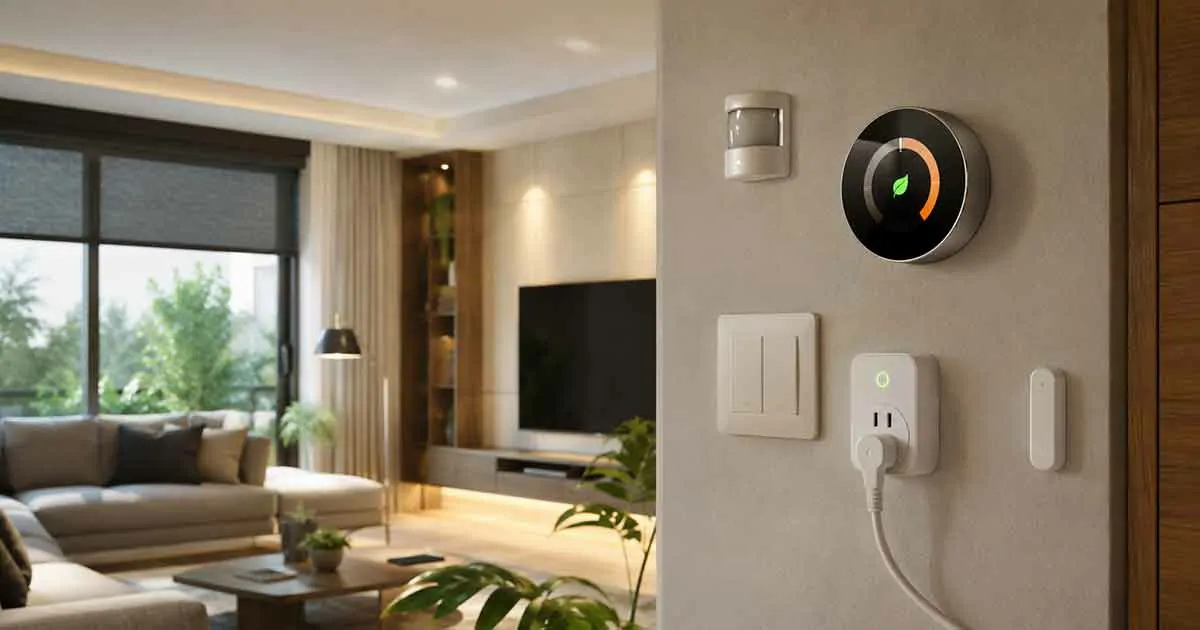
Reducing energy consumption at home does not always require major renovations or expensive upgrades. Smart home energy-saving devices can make it easier to monitor electricity use, automate appliances, control heating and cooling, and prevent energy from being wasted when nobody is home.
The biggest advantage of smart energy devices is automation. Instead of relying entirely on memory or manual habits, connected devices can respond to schedules, occupancy, temperature, and other conditions.
From smart thermostats and energy-monitoring plugs to smart lighting and connected sensors, there are several practical ways to make a home more energy efficient.
In this guide, we cover the best smart home energy-saving devices, how they work, where they provide the most value, and what to consider before buying them.
Table of Contents
How Smart Home Devices Can Save Energy
Smart devices do not automatically make a home energy efficient. Their value comes from providing better information and more precise control.
For example, a smart thermostat can adjust heating or cooling according to a schedule, while a smart plug can prevent a suitable appliance from operating unnecessarily.
Smart energy-saving devices can help you:
- Reduce unnecessary electricity use
- Automate heating and cooling
- Monitor appliance consumption
- Control lighting more efficiently
- Schedule appliances
- Detect unusual energy use
- Adjust devices when nobody is home
- Understand household energy patterns
The actual savings depend on your home, climate, equipment, usage habits, and electricity rates.
Best Smart Home Energy-Saving Devices
Different devices address different sources of energy consumption. The best approach is to prioritize the areas where your home uses the most energy.
1. Smart Thermostats
Heating and cooling can account for a significant portion of household energy use, making smart thermostats one of the most useful energy-saving smart home devices.
A smart thermostat can provide features such as:
- Temperature scheduling
- Remote control
- Home and away settings
- Automatic temperature adjustments
- Occupancy-based control
- Energy reports
- Smart home integration
Instead of maintaining the same temperature throughout the entire day, you can create schedules that match when your home is occupied.
For example, the thermostat can reduce heating or cooling while everyone is away and return to a more comfortable setting before people arrive.
However, compatibility is essential. Some heating and cooling systems may not support smart thermostats.
2. Smart Plugs With Energy Monitoring
Energy-monitoring smart plugs are useful for understanding how much electricity individual appliances consume.
They can measure the electricity used by compatible devices such as:
- Lamps
- Fans
- Televisions
- Entertainment equipment
- Small appliances
- Home office equipment
The data can help you identify devices that operate longer than necessary.
A smart plug can also schedule suitable appliances to turn off during periods when they are not needed.
For example, you could schedule a connected lamp to switch off automatically at bedtime.
3. Smart Light Bulbs
Smart bulbs can reduce unnecessary lighting use by making it easier to schedule and automate lights.
Depending on the model, they may provide:
- Scheduling
- Dimming
- Remote control
- Motion-based automation
- Occupancy-based routines
- Voice control
Smart bulbs are particularly useful when combined with sensors.
For example:
No motion detected → lights turn off after a defined period.
This can prevent lights from remaining on in rooms that are no longer occupied.
4. Smart Light Switches
Smart switches provide another way to automate lighting.
Unlike smart bulbs, they control the electrical circuit from the wall and can allow traditional light fixtures to become part of a smart home system.
Useful energy-saving features can include:
- Scheduling
- Motion-based control
- Automatic shutoff
- Away routines
- Sunrise and sunset schedules
Smart switches can be especially useful when multiple standard bulbs are controlled by the same wall switch.
5. Smart Energy Monitors
A smart energy monitor can provide a broader view of household electricity consumption.
Depending on the system, it may monitor:
- Total household electricity use
- Individual electrical circuits
- Energy consumption over time
- Usage patterns
- Estimated energy costs
This information can help you understand where electricity is being consumed.
Unlike an individual smart plug, a whole-home energy monitor can provide information beyond a single appliance.
Some systems require installation at the electrical panel, so professional installation may be appropriate.
6. Smart Power Strips
Smart power strips can help manage multiple connected electronics.
They can be useful in areas such as:
- Home offices
- Entertainment centers
- Gaming setups
- Workstations
Some models can automatically turn selected outlets off based on schedules or usage conditions.
For example, a power strip could disconnect suitable accessories during periods when the entertainment system is not being used.
However, devices that need continuous power should not be connected to an outlet that is automatically switched off.
7. Smart Motion Sensors
Motion sensors can help reduce wasted lighting and, in some systems, influence heating and cooling routines.
A motion sensor can detect activity and trigger compatible devices.
For example:
Motion detected → lights turn on.
After the room remains unoccupied for a defined period:
No motion → lights turn off.
This can be useful in hallways, bathrooms, closets, laundry rooms, and other areas where lights are often accidentally left on.
8. Smart Occupancy Sensors
Occupancy sensors can provide more advanced information than basic motion sensors.
Some occupancy technologies can detect whether a room is being used even when a person is relatively still.
This can make them useful for:
- Offices
- Bedrooms
- Living rooms
- Meeting areas
- Other frequently occupied spaces
Depending on the smart home system, occupancy information can be used to control lighting or other connected devices.
9. Smart Window and Door Sensors
Door and window sensors are primarily associated with home security, but they can also support energy-saving automation.
For example, a compatible system could notify you when a window remains open while heating or cooling is operating.
Some advanced automations can respond to these conditions, depending on the thermostat and smart home platform.
This can help prevent heating or cooling from operating unnecessarily when windows or doors are open.
10. Smart Ceiling Fans
Smart fans can make it easier to control air circulation according to schedules or room conditions.
A fan does not necessarily replace heating or cooling, but improving air circulation can sometimes improve comfort and allow homeowners to adjust their thermostat settings.
Depending on the model, a smart fan may support:
- Scheduling
- Remote control
- Voice control
- Speed adjustment
- Smart home automation
Choose a fan that is appropriate for the room and compatible with your smart home system.
11. Smart Air Conditioners
Some air conditioners provide connected controls that allow users to manage temperature and schedules remotely.
Smart features can include:
- Remote temperature control
- Scheduling
- Energy monitoring
- Automatic modes
- Room temperature information
- Home and away settings
This can be useful for avoiding unnecessary cooling when nobody is home.
Portable and window air conditioners may offer smart functionality without requiring a central HVAC system.
12. Smart Space Heaters
Smart controls can provide scheduling and remote management for compatible heating equipment.
However, space heaters require particular caution.
High-power heating appliances can place significant loads on electrical outlets and smart plugs. They should only be connected to devices specifically rated for the intended electrical load, and automatic operation should be used only when the equipment and manufacturer instructions allow it.
Energy savings should never come at the expense of electrical or fire safety.
13. Smart Water Leak Sensors
Water leak sensors are not direct electricity-saving devices, but they can help prevent damage and detect problems early.
A leak sensor can send an alert when water is detected near areas such as:
- Water heaters
- Washing machines
- Sinks
- Dishwashers
- Pipes
Some smart systems can also work with compatible water shutoff equipment.
Preventing water damage can protect appliances, building materials, and household equipment while providing broader home-management benefits.
14. Smart Water Heaters
Smart water-heating systems can provide greater control over when hot water is produced and how the system operates.
Depending on the equipment, connected features may include:
- Scheduling
- Remote control
- Energy monitoring
- Temperature management
- Usage information
Compatibility is particularly important because water-heating systems vary considerably.
15. Smart Irrigation Controllers
For homes with outdoor landscaping, smart irrigation controllers can help reduce unnecessary water use.
Some connected irrigation systems can adjust watering schedules according to:
- Weather
- Soil conditions
- Seasonal changes
- Plant requirements
- Rainfall
Although this is primarily a water-saving technology, reducing unnecessary irrigation can also reduce the energy associated with pumping and treating water.
16. Smart Blinds and Shades
Smart blinds can help manage the amount of sunlight entering a home.
Depending on the season and climate, automated shades can be scheduled to open or close according to time, sunlight, or other conditions.
This can help with:
- Reducing solar heat gain
- Managing glare
- Improving comfort
- Supporting heating and cooling strategies
Smart shades work particularly well when integrated into broader home automation routines.
Smart Energy-Saving Devices for Different Areas
You do not need to install every type of smart energy device.
Instead, match devices to the areas where they can provide the most practical value.
Living Room
Consider:
- Smart bulbs
- Smart switches
- Smart plugs
- Smart power strips
- Smart blinds
- Smart thermostat
Kitchen
Consider:
- Energy-monitoring smart plugs
- Smart lighting
- Smart switches
- Smart leak sensors
Be careful when using smart plugs with high-power kitchen appliances and always check electrical ratings.
Bedroom
Consider:
- Smart bulbs
- Smart switches
- Smart thermostat
- Smart blinds
- Occupancy sensors
Home Office
Consider:
- Energy-monitoring smart plugs
- Smart power strips
- Smart lighting
- Occupancy sensors
Laundry Room
Consider:
- Smart leak sensors
- Smart lighting
- Energy monitoring for suitable appliances
Smart Energy-Saving Automations
The real benefit of smart devices comes from combining them into useful routines.
Away Mode
An Away routine can reduce unnecessary energy use when nobody is home.
Depending on your equipment, it could:
- Adjust the thermostat
- Turn off selected lights
- Switch off suitable appliances
- Close smart blinds
- Send notifications about open windows
Nighttime Routine
A nighttime routine could:
- Turn off unnecessary lights
- Adjust the thermostat
- Close smart blinds
- Switch off selected appliances
Occupancy-Based Lighting
Sensors can turn lights on when a room is occupied and turn them off after inactivity.
This is particularly useful in rooms where people frequently forget to switch off lights.
Energy Monitoring Alerts
Some systems can notify you when energy consumption exceeds a selected threshold.
For example, an unusually high reading from a monitored appliance may indicate that it has been running longer than expected.
Daylight-Based Lighting
Smart lighting can be adjusted according to natural daylight.
If enough sunlight is available, automated lighting can remain off.
How Much Energy Can Smart Devices Save?
There is no universal percentage that applies to every home.
Smart devices can reduce energy waste, but the result depends on:
- Existing energy efficiency
- Climate
- Heating and cooling system
- Appliance efficiency
- Household behavior
- Automation settings
- Home insulation
- Electricity rates
A smart thermostat may provide meaningful savings in one household but much less in another.
Similarly, a smart plug may save very little if the connected appliance already operates efficiently and is rarely left running unnecessarily.
The most effective strategy is to identify actual sources of energy waste and automate those areas first.
Smart Devices vs. Energy-Efficient Appliances
Smart functionality and energy efficiency are not the same thing.
A connected appliance is not automatically more efficient than a conventional appliance.
For example, a smart refrigerator may provide remote monitoring and notifications, but its electricity consumption still depends heavily on its design, efficiency, condition, and usage.
Smart technology is most valuable when it improves control and reduces unnecessary operation.
The best results often come from combining efficient equipment with smart automation.
Smart Home Energy-Saving Devices Without a Subscription
Many smart devices provide basic functionality without a monthly subscription.
Examples can include:
- Smart bulbs
- Smart switches
- Smart plugs
- Some thermostats
- Energy monitors
- Sensors
However, subscription policies vary between manufacturers.
Some connected security and cloud-based products may charge for advanced services, historical data, or cloud storage.
If avoiding recurring costs is important, check exactly which features are available without a paid plan before purchasing.
What to Check Before Buying Smart Energy Devices
Electrical Compatibility
Check voltage, current, wattage, and installation requirements.
This is especially important for smart plugs, switches, and high-power appliances.
Smart Home Compatibility
Make sure the device works with the ecosystem you already use or plan to build.
Energy Monitoring
If monitoring is important, check exactly what the device measures.
Do not assume that every smart plug or switch provides energy data.
Connectivity
Check whether the device uses Wi-Fi, Thread, Zigbee, or another technology and whether additional hardware is required.
Automation Support
Look at the available triggers and actions before buying.
A device may be compatible with your platform but offer fewer automation options than expected.
Privacy
Connected devices may collect usage information or other household data.
Review the manufacturer’s privacy practices and device permissions.
Subscription Requirements
Check whether important features require recurring payments.
Common Mistakes When Building an Energy-Saving Smart Home
Buying Devices Without a Plan
Adding random smart products can create a complicated system without producing meaningful savings.
Start with a specific problem.
Focusing Only on Smart Features
A device being “smart” does not mean it is energy efficient.
Look at both the device’s efficiency and its automation capabilities.
Ignoring Existing Energy Waste
Smart technology cannot compensate for major problems such as poor insulation, inefficient HVAC equipment, or damaged windows.
Address significant physical sources of energy loss when possible.
Automating Too Much
Not every appliance needs automation.
Use smart controls where they provide a clear benefit.
Ignoring Electrical Safety
Never exceed the rated load of a smart plug, switch, or power strip.
High-power appliances require particular attention.
A Practical Smart Energy-Saving Setup
A simple system can provide useful energy-management capabilities without becoming complicated.
A beginner-friendly setup could include:
- Smart thermostat
- Energy-monitoring smart plugs
- Smart bulbs or switches
- Motion or occupancy sensors
- Smart power strip
- Whole-home energy monitor if broader tracking is needed
Start with one or two areas where energy waste is easiest to identify.
After reviewing the results, expand the system gradually.
Are Smart Home Energy-Saving Devices Worth It?
They can be, particularly when they address a real source of wasted energy.
The strongest value usually comes from devices that provide both information and control.
An energy monitor can show you where electricity is going.
A smart thermostat can automate heating and cooling.
A smart plug can monitor and schedule selected appliances.
Smart lighting can prevent unnecessary operation.
When these technologies are combined with good energy habits and efficient equipment, they can make energy management much easier.
Final Thoughts
The best smart home energy-saving devices are not necessarily the devices with the most features. They are the products that provide useful control over the areas where your home consumes the most energy.
Smart thermostats, energy-monitoring smart plugs, smart lighting, smart switches, energy monitors, occupancy sensors, smart power strips, and automated blinds can all contribute to a more efficient home when used appropriately.
Before buying, check compatibility, electrical ratings, connectivity, automation capabilities, privacy, and subscription requirements.
Most importantly, use smart technology as a tool for better energy management rather than assuming that connected devices automatically reduce consumption. Identify where energy is being wasted, choose the right device, and automate the solution.