
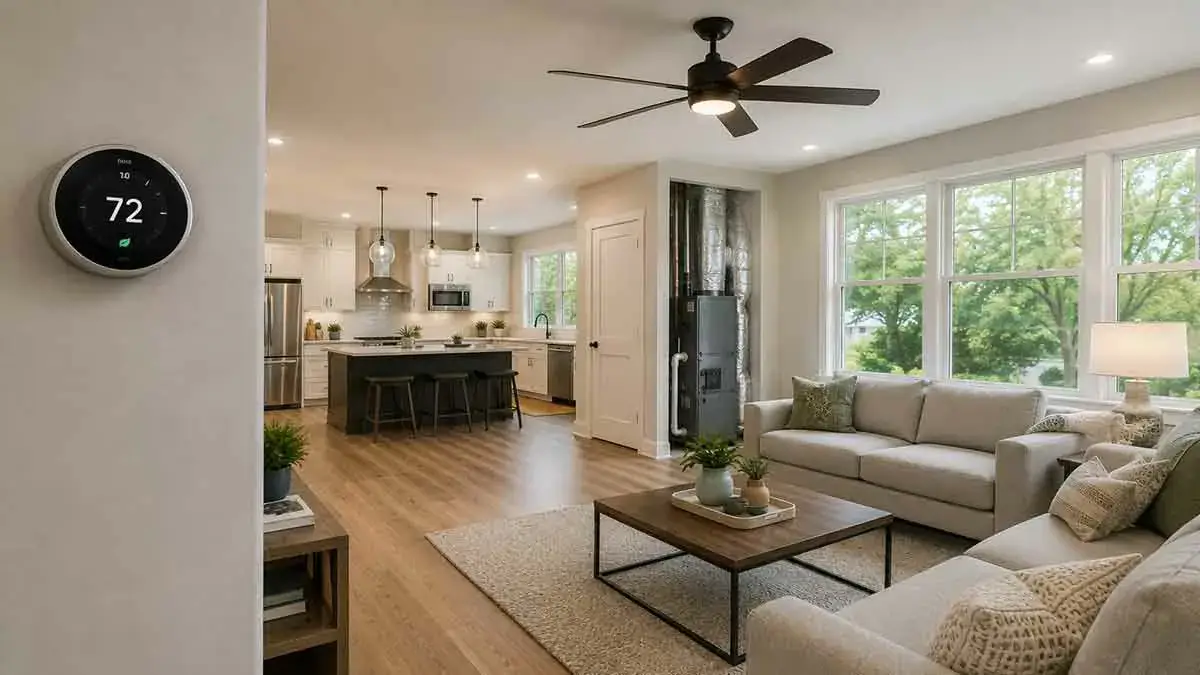
A smart thermostat can help reduce heating and cooling energy use by automatically adjusting indoor temperatures according to schedules, occupancy, weather conditions, and household preferences.
However, installing a smart thermostat does not automatically guarantee lower energy bills. The actual savings depend on the HVAC system, home insulation, air leakage, thermostat settings, climate, occupancy patterns, and how the thermostat is configured.
A smart thermostat is most effective when it is used as part of a broader energy-efficiency strategy. Improving insulation, sealing air leaks, maintaining HVAC equipment, and using appropriate temperature settings can often have a greater impact than the thermostat itself.
This guide explains how smart thermostats can save energy, how to choose and configure one, what features matter, and how to avoid common mistakes that can reduce the expected benefits.
Table of Contents
How Does a Smart Thermostat Save Energy?
A conventional thermostat typically controls temperature according to manual settings.
A smart thermostat can add automated control and monitoring.
Depending on the model and HVAC system, it may provide:
- Programmable schedules
- Automatic temperature adjustments
- Occupancy detection
- Geofencing
- Remote control
- Energy-use reports
- Maintenance reminders
- Equipment alerts
- Learning algorithms
- Weather-related information
These features can reduce unnecessary heating and cooling by preventing the HVAC system from operating at the same settings when the home is empty or when less conditioning is needed.
The thermostat itself does not create energy savings. The savings come from changing HVAC operation.
What Determines Smart Thermostat Energy Savings?
The potential benefit varies significantly between homes.
Important factors include:
- Local climate
- Heating and cooling equipment
- Home insulation
- Air leakage
- Occupancy schedule
- Existing thermostat settings
- HVAC maintenance
- Temperature preferences
- Electricity and fuel costs
- Thermostat compatibility
A household that already uses an effective temperature schedule may see less additional savings than a household that leaves the HVAC system running unnecessarily.
1. Create an Efficient Heating and Cooling Schedule
One of the simplest ways to use a smart thermostat for energy savings is to create a schedule that matches household occupancy.
For example, the thermostat can use different temperature settings for:
- Morning
- Daytime
- Evening
- Sleeping hours
- Unoccupied periods
Avoid creating complicated schedules that do not reflect actual household behavior.
A practical schedule that occupants consistently follow is generally more useful than an aggressive schedule that is frequently overridden.
2. Use Automatic Temperature Setbacks
Temperature setbacks can reduce heating or cooling demand during periods when full comfort is not necessary.
During heating season, a lower indoor temperature generally reduces heat loss from the home.
During cooling season, a higher indoor temperature generally reduces the amount of cooling required.
The appropriate setback depends on:
- Climate
- HVAC technology
- Occupancy
- Comfort requirements
- Building characteristics
Avoid settings that create condensation, freeze-protection problems, or other building risks.
3. Adjust Temperatures When the Home Is Unoccupied
If the home is regularly empty for several hours, maintaining the same temperature throughout the day may result in unnecessary HVAC operation.
A smart thermostat can automatically adjust the temperature during scheduled away periods.
This can be particularly useful for households with predictable work or school schedules.
If occupancy is unpredictable, occupancy sensing or geofencing may provide more practical control.
4. Use Smart Learning Features Carefully
Some smart thermostats can learn household routines and automatically modify temperature settings.
Learning features may consider:
- Temperature adjustments
- Occupancy patterns
- Time of day
- Manual overrides
- Heating and cooling behavior
However, automatic learning should not be assumed to produce savings in every situation.
Review the resulting schedule and make sure it matches your actual preferences.
An automated schedule that repeatedly heats or cools an empty home can waste energy.
5. Choose the Right Thermostat for Your HVAC System
Smart thermostats are not universally compatible with every heating and cooling system.
Before buying one, identify the type of HVAC equipment installed in the home.
Possible systems include:
- Central air conditioners
- Furnaces
- Heat pumps
- Boiler systems
- Electric heating
- Multi-stage HVAC systems
- Zoned systems
The thermostat should support the required control functions.
6. Check HVAC Compatibility Before Installation
Compatibility is one of the most important considerations.
Some systems require specific wiring or control configurations.
Heat pumps, multi-stage equipment, auxiliary heating, and other specialized systems may require thermostat support for additional operating modes.
Before installation, check:
- Existing thermostat wiring
- HVAC equipment type
- Number of heating and cooling stages
- Auxiliary or emergency heat
- Power requirements
- Manufacturer compatibility information
If the wiring or HVAC configuration is unclear, professional installation may be appropriate.
7. Use Geofencing When It Makes Sense
Geofencing allows the thermostat to respond when household members leave or approach a defined geographic area.
Potential benefits include:
- Reducing conditioning while the home is empty
- Restoring comfortable temperatures before occupants return
- Reducing unnecessary manual adjustments
Geofencing is most useful when household schedules vary.
However, it may be less useful when someone is almost always home or when multiple occupants have different schedules.
8. Use Remote Temperature Control
Smart thermostats can often be controlled through a smartphone or other connected device.
Remote control can help prevent unnecessary HVAC operation.
For example, if you accidentally leave the heating or cooling running while away, you may be able to adjust the setting remotely.
Remote access can also help manage unusual schedules without changing the entire programmed routine.
9. Monitor Energy Reports
Many smart thermostats provide reports or estimates related to HVAC operation.
Depending on the model, you may be able to review:
- Runtime
- Heating activity
- Cooling activity
- Temperature trends
- Historical usage
- Comparisons between periods
Use these reports to identify unusual patterns.
For example, a sudden increase in cooling runtime may indicate unusually hot weather, an airflow problem, inadequate insulation, or equipment performance issues.
10. Use Weather-Based Adjustments Carefully
Some connected thermostats provide outdoor weather information and may use it to support temperature recommendations or automated operation.
Weather data can help homeowners understand why HVAC runtime changes.
However, outdoor temperature is only one factor affecting indoor energy use.
Solar exposure, humidity, insulation, air leakage, occupancy, and equipment condition can also affect performance.
11. Avoid Excessive Temperature Changes
A smart thermostat makes it easy to create aggressive temperature schedules.
That does not necessarily mean aggressive settings are better.
Extremely large temperature changes may:
- Reduce comfort
- Increase recovery time
- Cause excessive HVAC operation during recovery
- Interact poorly with certain HVAC systems
Use moderate settings appropriate for the equipment and climate.
12. Improve Heating Efficiency With a Smart Thermostat
During cold weather, smart controls can reduce unnecessary heating by maintaining appropriate temperatures when the home is occupied and reducing conditioning when it is not.
Additional heating-efficiency measures include:
- Improving insulation
- Sealing air leaks
- Maintaining heating equipment
- Keeping vents unobstructed
- Sealing accessible ductwork
- Using appropriate temperature setbacks
The thermostat works best when the home itself has a reasonably efficient building envelope.
13. Improve Cooling Efficiency With a Smart Thermostat
During warm weather, the thermostat can help prevent unnecessary cooling.
Potential strategies include:
- Raising the cooling temperature when the home is unoccupied
- Using schedules
- Using occupancy features
- Combining thermostat control with window shading
- Using ceiling fans when rooms are occupied
- Controlling indoor humidity
Reducing the cooling load can allow the HVAC system to operate less frequently.
14. Use Vacation and Away Modes
Vacation modes can prevent unnecessary HVAC operation when a home will be unoccupied for an extended period.
Before activating a vacation setting, consider:
- Outdoor temperature
- Plumbing freeze risk
- Pets
- Indoor humidity
- Building materials
- Security requirements
Do not set temperatures so aggressively that they create moisture, freezing, or other property risks.
15. Manage Multiple Zones
Some homes have separate HVAC zones.
Smart controls may allow different areas to follow different temperature schedules.
Potential benefits include:
- Less conditioning of unused areas
- Improved comfort
- Better control of occupied spaces
However, zoning must be compatible with the HVAC system.
Incorrect zoning or airflow adjustments can reduce system performance.
16. Combine Smart Controls With Ceiling Fans
Ceiling fans can improve perceived comfort by increasing air movement.
During cooling season, this may allow occupants to tolerate a slightly higher thermostat setting.
Fans should generally be turned off in unoccupied rooms because they consume electricity while operating.
A ceiling fan does not actually reduce the room’s air temperature.
17. Improve Home Insulation and Air Sealing
A smart thermostat cannot compensate for a poorly performing building envelope.
Before expecting major energy savings from thermostat controls, consider:
- Attic insulation
- Wall insulation
- Basement insulation
- Crawl-space insulation
- Air sealing
- Window weatherproofing
- Door weatherstripping
Reducing unwanted heat transfer and air leakage can lower the amount of heating and cooling required.
18. Maintain HVAC Equipment
Thermostat controls cannot correct mechanical problems.
Maintain the HVAC system according to manufacturer recommendations.
Important areas may include:
- Filters
- Airflow
- Outdoor equipment
- Coils
- Electrical components
- Ductwork
- Refrigeration-related components where applicable
A smart thermostat can control an inefficient system, but it cannot make defective equipment efficient.
19. Replace or Clean HVAC Filters
Restricted airflow can affect HVAC performance.
Check the filter regularly and replace or clean it according to manufacturer instructions.
The appropriate interval depends on:
- Filter type
- Household conditions
- System runtime
- Pets
- Indoor air quality requirements
Do not install a filter that is incompatible with the system.
20. Avoid Blocking Vents and Registers
Keep supply and return vents clear.
Furniture, curtains, rugs, and other objects can interfere with airflow.
Do not close large numbers of vents simply because a smart thermostat makes temperature control easier.
Airflow should remain consistent with the HVAC system’s design.
21. Understand Heat Pump Thermostat Settings
Heat pumps require particular attention to thermostat configuration.
Depending on the system, the thermostat may control:
- Compressor stages
- Auxiliary heat
- Emergency heat
- Defrost-related operation
- Fan operation
Incorrect configuration can increase energy consumption or cause comfort problems.
If a heat pump frequently activates auxiliary heat without an obvious reason, have the system and thermostat configuration evaluated.
22. Use Smart Thermostat Alerts
Connected thermostats may provide notifications about unusual conditions.
Possible alerts include:
- Unusual HVAC runtime
- Temperature changes
- Filter reminders
- Connectivity problems
- Equipment-related warnings
Treat these alerts as useful indicators rather than definitive diagnoses.
Persistent abnormal operation should be investigated.
23. Monitor Unusual HVAC Runtime
Longer-than-normal HVAC runtime can have several causes.
Possible explanations include:
- Extreme outdoor temperatures
- Poor insulation
- Air leakage
- Dirty filters
- Blocked airflow
- Duct leakage
- Incorrect equipment sizing
- Mechanical problems
Use the thermostat’s runtime information to identify patterns rather than assuming the thermostat itself is responsible.
24. Place the Thermostat Correctly
Thermostat location affects the accuracy of temperature measurements.
Avoid locations exposed to:
- Direct sunlight
- Drafts
- Exterior doors
- Windows
- Heat-producing appliances
- Supply vents
A thermostat should measure a representative indoor temperature.
If the existing thermostat is poorly located, relocating it may provide a greater improvement than simply replacing it with a smart model.
25. Protect the Thermostat From False Temperature Readings
Even a high-quality smart thermostat can make poor decisions when exposed to abnormal local temperatures.
For example, a thermostat near a sunny window may detect a temperature that is higher than the rest of the home.
Similarly, placing it near a draft can cause unnecessary heating.
Evaluate the surrounding area before installation.
26. Consider Smart Thermostat Scheduling by Season
Heating and cooling requirements change throughout the year.
Review schedules as seasons change.
During Heating Season
Use appropriate lower temperatures during sleeping or unoccupied periods when practical.
During Cooling Season
Use appropriate higher temperatures during unoccupied periods.
During Mild Weather
Avoid unnecessary heating or cooling when outdoor conditions are already comfortable.
Seasonal schedule adjustments can prevent outdated settings from continuing to operate the HVAC system unnecessarily.
27. Understand Standby Energy Use
A smart thermostat requires electricity for its electronics and connected features.
Its own electricity use is generally small compared with the energy used by heating and cooling equipment, but connected features can still be considered when evaluating the overall system.
The important question is whether the thermostat reduces substantially more HVAC energy than it consumes.
28. Does a Smart Thermostat Really Save Money?
It can, but savings are not guaranteed.
A smart thermostat is more likely to provide meaningful savings when:
- The HVAC system runs frequently.
- The home has predictable periods of occupancy and vacancy.
- Existing temperature control is inefficient.
- The thermostat can automate useful setbacks.
- The HVAC system is compatible.
- Household members use the scheduling features consistently.
Savings may be smaller when:
- Someone is home almost all day.
- The existing thermostat is already programmed effectively.
- Heating and cooling demand is low.
- The home has major insulation or air-leakage problems.
- Occupants frequently override the smart schedule.
How Much Energy Can a Smart Thermostat Save?
There is no universal savings percentage that applies to every household.
Potential savings depend on the difference between previous and new HVAC operating patterns.
A useful way to evaluate the thermostat is to compare:
HVAC energy use before installation vs. HVAC energy use after installation
When comparing periods, account for:
- Outdoor temperature
- Heating or cooling degree days where available
- Occupancy
- Changes in thermostat settings
- HVAC maintenance
- Major weather differences
A simple month-to-month comparison without adjusting for weather can be misleading.
Smart Thermostat Energy-Saving Checklist
Before Installation
- Identify HVAC type
- Check thermostat compatibility
- Review existing wiring
- Evaluate current thermostat settings
- Inspect HVAC condition
- Check insulation
- Identify major air leaks
After Installation
- Create a realistic schedule
- Set appropriate temperature ranges
- Enable useful occupancy features
- Review energy reports
- Monitor HVAC runtime
- Keep filters maintained
- Adjust settings seasonally
- Investigate unusual alerts
Common Smart Thermostat Energy-Saving Mistakes
Choosing a Thermostat Without Checking Compatibility
A smart thermostat is only useful if it properly controls the HVAC equipment.
Creating an Aggressive Schedule
Extreme temperature changes may reduce comfort and may not provide the expected savings.
Ignoring the Building Envelope
A smart thermostat cannot compensate for major insulation and air-leakage problems.
Using Geofencing Without Considering Household Schedules
Frequent occupants may cause unnecessary temperature changes.
Ignoring HVAC Maintenance
A smart control system cannot fix dirty filters, restricted airflow, or mechanical problems.
Blocking Vents
Smart control does not eliminate the need for proper airflow.
Assuming Energy Reports Are Exact
Thermostat energy reports may be estimates rather than direct measurements of total HVAC electricity use.
Leaving Old Schedules Active
Review schedules after installation to ensure the thermostat is not operating according to conflicting or outdated settings.
When Should You Replace an Old Thermostat?
Replacing an old thermostat may make sense when:
- It cannot maintain accurate temperature control.
- It does not support useful scheduling.
- It is difficult to operate.
- It has compatibility limitations.
- It is damaged or unreliable.
- You want remote monitoring or control.
- The existing thermostat does not support the HVAC system’s required functions.
If the existing thermostat already provides effective scheduling and the home has very low heating and cooling demand, replacement may produce limited additional energy savings.
When to Consider Professional Installation
Professional help may be appropriate when:
- HVAC wiring is unclear.
- The system uses multiple stages.
- A heat pump is installed.
- Auxiliary heat is present.
- The home has multiple zones.
- The thermostat requires configuration changes.
- The existing system behaves unexpectedly after installation.
Incorrect wiring or configuration can damage equipment or create safety and performance problems.
Final Thoughts
A smart thermostat can be a useful tool for reducing heating and cooling energy use, but it should not be viewed as a standalone energy-efficiency solution.
The greatest benefits usually come when automated temperature control is combined with a well-maintained HVAC system, proper insulation, effective air sealing, appropriate thermostat settings, and sensible household habits.
Before buying a smart thermostat, verify compatibility with your HVAC equipment and consider whether its features address a real problem in your home.
Use scheduling, occupancy controls, remote access, and energy monitoring where they provide practical benefits. Then review actual HVAC runtime and energy use over time.
When properly selected and configured, a smart thermostat can help reduce unnecessary heating and cooling while maintaining a comfortable indoor environment.