
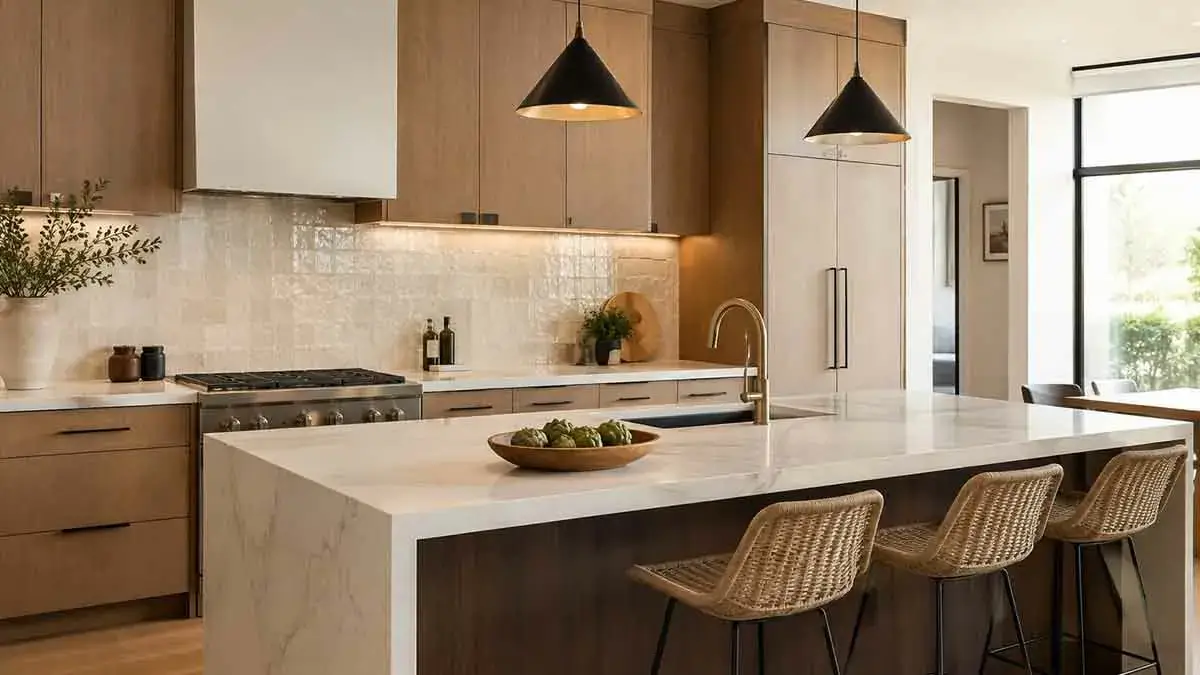
Choosing the right countertop is one of the most important decisions when designing or renovating a kitchen. Countertops affect the room’s appearance, functionality, maintenance requirements, and overall renovation budget.
The best kitchen countertop options depend on how you use your kitchen, how much maintenance you are willing to perform, your preferred design style, and the amount you want to spend.
Some materials prioritize durability and low maintenance, while others offer a natural appearance, unique patterns, or a lower initial cost. There is no single countertop material that is ideal for every kitchen.
This guide explains the most popular kitchen countertop options, their advantages and disadvantages, maintenance requirements, costs, and the factors to consider before making a final decision.
Table of Contents
What Makes a Good Kitchen Countertop?
A kitchen countertop needs to perform several functions at the same time.
A good countertop should provide an appropriate balance of:
- Durability
- Moisture resistance
- Stain resistance
- Heat resistance
- Ease of cleaning
- Appearance
- Maintenance
- Installation requirements
- Cost
The importance of each factor depends on your household.
For example, a homeowner who cooks frequently may prioritize durability and heat resistance, while someone who rarely cooks may place greater importance on appearance and price.
Popular Kitchen Countertop Options
Several countertop materials are widely used in residential kitchens.
The most common options include:
- Quartz
- Granite
- Marble
- Butcher block
- Solid surface
- Laminate
- Porcelain
- Ceramic tile
- Concrete
- Stainless steel
- Soapstone
- Quartzite
Each material has different characteristics.
Before choosing one, compare the material’s practical performance with your design preferences and budget.
Quartz Countertops
Quartz countertops are engineered surfaces made primarily from natural quartz combined with resins and other materials.
They are popular because they offer a consistent appearance and relatively low maintenance.
Advantages of Quartz
Quartz countertops generally offer:
- Wide range of colors
- Consistent patterns
- Low routine maintenance
- Good stain resistance
- No routine sealing in typical applications
- Modern appearance
They can work well in contemporary, transitional, and traditional kitchens.
Disadvantages of Quartz
Potential drawbacks include:
- Higher cost than basic laminate
- Resin content
- Potential sensitivity to high direct heat
- Professional fabrication is generally required
Hot cookware should be handled according to the manufacturer’s recommendations.
Granite Countertops
Granite is a natural stone available in many colors and patterns.
Each slab can have a unique appearance, making granite attractive to homeowners who prefer natural materials.
Advantages of Granite
Granite can provide:
- Strong durability
- Natural stone appearance
- Good scratch resistance
- Good heat resistance
- Wide variety of patterns
Disadvantages of Granite
Potential disadvantages include:
- Heavy weight
- Higher installation requirements
- Some varieties require periodic sealing
- Natural variation between slabs
- More maintenance than some engineered surfaces
Because granite is a natural material, the final countertop may look different from a small sample.
Marble Countertops
Marble is known for its distinctive veining and sophisticated appearance.
It is frequently used when aesthetics are a major priority.
Advantages of Marble
Marble offers:
- Unique natural veining
- Elegant appearance
- A cool surface that can be useful for certain baking tasks
- A wide variety of colors and patterns
Disadvantages of Marble
Marble is relatively susceptible to:
- Scratching
- Etching
- Staining
- Damage from acidic substances
It may require more care than many other countertop materials.
Homeowners should understand that natural patina and surface changes can occur over time.
Butcher Block Countertops
Butcher block countertops are commonly made from wood and provide a warm, natural appearance.
They can complement:
- Farmhouse kitchens
- Traditional kitchens
- Rustic designs
- Transitional interiors
Advantages of Butcher Block
Benefits can include:
- Warm appearance
- Natural texture
- Can often be refinished
- Comfortable visual contrast with stone surfaces
- Potentially lower cost than some premium materials
Disadvantages of Butcher Block
Wood countertops can require:
- Regular maintenance
- Protection from prolonged moisture
- Care around sinks
- Protection from excessive heat
- Periodic refinishing or treatment
Water should not be allowed to remain on the surface for extended periods.
Solid Surface Countertops
Solid surface countertops are manufactured from acrylic or similar materials.
They are available in many colors and patterns and can be fabricated with relatively seamless joints.
Advantages
They can offer:
- Nonporous surfaces
- Easy cleaning
- Wide design choices
- Repairability for some types of damage
- Integrated sink options
Disadvantages
Potential disadvantages include:
- Lower heat resistance than some natural stones
- Greater susceptibility to scratches
- Less natural appearance than stone
- Professional fabrication may be needed
Laminate Countertops
Laminate remains one of the most budget-friendly countertop options.
Modern laminate products are available in many colors and patterns, including designs that imitate:
- Stone
- Wood
- Concrete
- Marble
Advantages
Laminate can provide:
- Lower material cost
- Wide range of designs
- Easy cleaning
- Relatively simple installation
- Lightweight construction
Disadvantages
Potential limitations include:
- Lower resistance to heat
- Greater susceptibility to cuts and scratches
- Damage to seams or edges can allow moisture intrusion
- Lower premium appearance compared with natural stone
Laminate can be a practical choice for budget-conscious kitchen projects.
Porcelain Countertops
Porcelain countertops are made from a highly durable ceramic-based material.
They can provide a modern appearance and may be manufactured in large slabs.
Advantages
Porcelain can offer:
- High resistance to heat
- Good stain resistance
- Resistance to UV exposure
- Wide range of patterns
- Low routine maintenance
Disadvantages
Installation can be demanding because large slabs require careful handling and fabrication.
Edges may also require special attention because the material can be more brittle than some alternatives.
Professional installation is generally recommended.
Ceramic Tile Countertops
Ceramic tile can be used to create highly customizable countertop surfaces.
It can provide:
- Wide design variety
- Relatively affordable material options
- Heat resistance
- Easy replacement of individual tiles
However, grout lines can collect dirt and require maintenance.
The uneven surface can also be less convenient for food preparation compared with continuous slab countertops.
Concrete Countertops
Concrete countertops can provide a highly customized appearance.
They can be shaped, colored, textured, and integrated into unusual kitchen designs.
Advantages
Concrete can offer:
- Custom shapes
- Unique appearance
- Wide design flexibility
- Strong visual character
- Compatibility with modern and industrial kitchens
Disadvantages
Concrete countertops can:
- Crack
- Require sealing
- Require specialized fabrication
- Be heavy
- Need ongoing maintenance
Proper installation and structural support are important.
Stainless Steel Countertops
Stainless steel is commonly associated with professional kitchens but can also be used in residential spaces.
Advantages
Stainless steel offers:
- Strong durability
- Heat resistance
- Easy cleaning
- Resistance to many types of staining
- Hygienic surface
- Modern appearance
Disadvantages
It can show:
- Scratches
- Fingerprints
- Water marks
- Dents
It may also create a distinctly commercial appearance that does not suit every kitchen.
Soapstone Countertops
Soapstone is a natural stone with a soft, matte appearance.
It is often selected for traditional, farmhouse, or distinctive kitchen designs.
Advantages
Soapstone can provide:
- Good heat resistance
- Resistance to many stains
- Unique natural appearance
- Soft matte finish
Disadvantages
It can be:
- More easily scratched than some harder stones
- Heavier
- More limited in color range
- Dependent on periodic oiling for the appearance some homeowners prefer
Minor scratches can sometimes be incorporated into the material’s natural character or repaired.
Quartzite Countertops
Quartzite is a natural stone that is sometimes confused with engineered quartz.
They are not the same material.
Natural quartzite can provide:
- Distinctive natural patterns
- Strong durability
- High heat resistance
- Premium appearance
However, specific characteristics vary by stone, and appropriate sealing and maintenance may be required.
When purchasing quartzite, verify that the slab is actually natural quartzite and understand the recommended care requirements.
Kitchen Countertop Comparison
| Countertop Material | Maintenance | Durability | Heat Resistance | Typical Cost Level |
|---|---|---|---|---|
| Quartz | Low | High | Moderate | Medium–High |
| Granite | Moderate | High | High | Medium–High |
| Marble | High | Moderate | High | High |
| Butcher Block | Moderate–High | Moderate | Low–Moderate | Medium |
| Solid Surface | Low | Moderate | Moderate | Medium |
| Laminate | Low | Moderate | Low | Low |
| Porcelain | Low | High | High | Medium–High |
| Ceramic Tile | Moderate | Moderate | High | Low–Medium |
| Concrete | Moderate–High | High | High | Medium–High |
| Stainless Steel | Low | High | High | Medium–High |
| Soapstone | Moderate | High | High | High |
| Quartzite | Moderate | High | High | High |
Cost levels are relative rather than fixed prices. Actual costs depend on material quality, fabrication, installation, location, and countertop size.
Countertop Durability
Durability is especially important in kitchens that receive heavy daily use.
Consider how the material responds to:
- Scratches
- Impact
- Heat
- Moisture
- Stains
- Daily cleaning
- Heavy cookware
No countertop is completely indestructible.
Even durable materials can be damaged when used outside their intended conditions.
Countertop Maintenance
Different materials require different maintenance routines.
Low-Maintenance Materials
Quartz, solid surface, porcelain, and laminate generally require relatively simple routine cleaning.
Higher-Maintenance Materials
Marble, some granite, butcher block, concrete, soapstone, and quartzite may require additional care depending on the material and manufacturer’s recommendations.
Always follow the specific care instructions provided for the countertop.
Countertop Stain Resistance
Stain resistance matters because kitchen surfaces regularly encounter:
- Coffee
- Tea
- Wine
- Tomato products
- Oils
- Spices
- Food coloring
Nonporous materials generally offer strong resistance to liquid absorption.
Natural stone performance can vary depending on the specific material and whether it has been properly sealed.
Cleaning spills promptly is a useful habit regardless of countertop type.
Countertop Heat Resistance
Kitchen countertops frequently encounter hot cookware.
However, heat resistance varies considerably between materials.
Natural stones such as granite and many quartzites generally have strong heat resistance, while some engineered or resin-based surfaces can be more sensitive to direct heat.
Use trivets or heat protection whenever the manufacturer’s instructions recommend them.
Do not assume that a heat-resistant countertop is immune to thermal damage.
Countertop Water Resistance
Water exposure is especially important around:
- Sinks
- Faucets
- Dishwashers
- Countertop appliances
Pay attention not only to the countertop material but also to:
- Seams
- Edges
- Sink installation
- Backsplash connections
- Cabinet protection
Even a water-resistant countertop can experience problems if installation details allow water to enter vulnerable areas.
Countertop Edge Profiles
The edge profile can influence the overall appearance of a countertop.
Common styles include:
- Straight edge
- Eased edge
- Bullnose
- Beveled edge
- Ogee
- Waterfall edge
Simple edges can provide a clean modern appearance, while decorative profiles may suit traditional kitchens.
More complex edge fabrication can increase the overall cost.
How Countertop Thickness Affects Design
Countertop thickness influences both appearance and installation.
Thicker countertops can create a substantial visual presence, while thinner profiles can look more contemporary.
The appropriate thickness depends on:
- Material
- Cabinet construction
- Sink installation
- Edge treatment
- Design style
- Structural requirements
The fabricator should confirm the appropriate specifications for the selected material.
Countertop Colors and Patterns
Countertop color should coordinate with the rest of the kitchen.
Consider the relationship between the countertop and:
- Cabinets
- Flooring
- Backsplash
- Appliances
- Wall color
- Lighting
Light Countertops
Can create a bright and open appearance.
Dark Countertops
Can add contrast and visual depth.
Patterned Countertops
Can become a focal point but should be balanced with simpler surrounding finishes.
Avoid selecting a countertop based solely on a small sample. Natural stone and some manufactured surfaces can have significant pattern variation across a full slab.
How Much Do Kitchen Countertops Cost?
Kitchen countertop costs vary considerably.
The final price depends on:
- Material
- Countertop size
- Thickness
- Edge profile
- Cutouts
- Sink installation
- Backsplash requirements
- Fabrication
- Removal of existing countertops
- Delivery
- Installation
- Location
Budget materials such as laminate can provide a lower-cost option, while premium natural stone and specialized fabrication can substantially increase the total investment.
When comparing quotes, make sure the estimates include both material and installation costs.
How to Choose the Right Countertop
Use a structured decision process rather than selecting a material based only on appearance.
Step 1: Set Your Budget
Determine how much you can allocate to the countertop, including fabrication and installation.
Step 2: Evaluate Your Kitchen Use
Consider how often you cook and how heavily the countertop will be used.
Step 3: Identify Maintenance Preferences
Decide whether you prefer a low-maintenance surface or are comfortable performing additional care.
Step 4: Compare Durability
Evaluate scratch, stain, heat, and moisture resistance.
Step 5: Consider the Design
Choose a color, pattern, and finish that work with the rest of the kitchen.
Step 6: Check Installation Requirements
Confirm whether the selected material requires specialized fabrication, reinforcement, sealing, or professional installation.
Step 7: Compare Complete Quotes
Review material, fabrication, delivery, installation, sink cutouts, edge treatment, and removal costs.
Step 8: Review Samples in Your Kitchen
If possible, evaluate samples under the actual lighting conditions of your kitchen.
Common Kitchen Countertop Mistakes
Choosing Only Based on Price
The cheapest countertop may not provide the durability or appearance you need.
Choosing Only Based on Appearance
A beautiful material may require more maintenance than you are willing to perform.
Ignoring Installation Costs
Material price is only one part of the total project cost.
Forgetting Sink and Appliance Cutouts
Cutouts and special fabrication can affect the final estimate.
Not Considering Maintenance
Different materials require different cleaning and care routines.
Assuming All Stone Is the Same
Natural stones can vary significantly in hardness, porosity, appearance, and maintenance requirements.
Ordering Without Accurate Measurements
Incorrect measurements can result in expensive fabrication problems.
Ignoring Cabinet Support
Some heavy countertop materials require appropriate cabinet support and installation planning.
Choosing a Pattern Without Viewing a Full Slab
Large natural patterns may look very different across an entire countertop than they do on a small sample.
Using the Wrong Cleaning Products
Some materials can be damaged by harsh chemicals or inappropriate cleaners.
Follow the manufacturer’s care recommendations.
Are Expensive Countertops Worth It?
An expensive countertop can be worthwhile when its durability, appearance, maintenance requirements, or long-term performance match your priorities.
However, a premium material is not automatically the best choice.
For some kitchens, a high-quality mid-range countertop may provide a better balance of:
- Cost
- Durability
- Appearance
- Maintenance
- Functionality
The right countertop is the one that fits the way you use the kitchen rather than simply having the highest price.
Final Thoughts
The best kitchen countertop options vary according to budget, design preferences, maintenance expectations, and daily use.
Quartz, granite, marble, butcher block, solid surface, laminate, porcelain, concrete, stainless steel, soapstone, and quartzite each offer different combinations of appearance, durability, maintenance, and cost.
Start by determining how you use your kitchen and what characteristics matter most. Then compare complete installed costs rather than material prices alone.
Pay attention to fabrication, edge profiles, sink cutouts, maintenance requirements, heat resistance, moisture exposure, and compatibility with your cabinets.
A well-chosen countertop should not only improve the appearance of the kitchen but also provide a practical surface that continues to perform well for years.
Frequently Asked Questions
What is the most popular kitchen countertop material?
Quartz is a widely used option because it combines a broad range of designs with relatively low routine maintenance. However, popularity does not necessarily make it the best choice for every kitchen.
Which countertop material is easiest to maintain?
Quartz, solid surface, porcelain, and some laminate products generally require relatively simple routine care. Always follow the manufacturer’s cleaning recommendations.
Which kitchen countertop is most durable?
Durability varies by material and specific product. Granite, quartzite, porcelain, and stainless steel can provide strong durability when properly selected and installed.
Is quartz better than granite?
Neither material is universally better. Quartz offers consistent patterns and relatively low maintenance, while granite provides natural stone variation and strong heat resistance. The better choice depends on your priorities.
Is marble a good kitchen countertop?
Marble can be an excellent choice when appearance is a high priority and the homeowner accepts greater susceptibility to scratching, etching, and staining.
Are laminate countertops still a good option?
Yes. Laminate can be a practical choice when affordability, design variety, and simple maintenance are important.
Is butcher block good for kitchen countertops?
Butcher block provides warmth and can work well in many kitchen styles, but it requires more care around moisture, heat, and regular maintenance than some stone or engineered surfaces.
Do all stone countertops need to be sealed?
No. Sealing requirements vary by material and product. Some natural stones benefit from periodic sealing, while other surfaces have different maintenance requirements.
How long do kitchen countertops last?
The lifespan depends on the material, installation quality, maintenance, and daily use. Many countertop materials can last for many years when properly cared for.
Should the countertop match the kitchen cabinets?
The countertop does not need to match the cabinets exactly. It should coordinate with the cabinet color, flooring, backsplash, appliances, and overall kitchen design.
How do I choose a countertop for a busy kitchen?
Prioritize durability, stain resistance, maintenance requirements, and resistance to everyday wear. Also consider how much heat, moisture, and food preparation the surface will experience.
Is countertop installation a DIY project?
Some basic countertop materials may be suitable for experienced DIY homeowners, but many stone and large-format materials require specialized measurement, fabrication, transportation, and installation. Professional installation is often the safer option for complex countertops.