
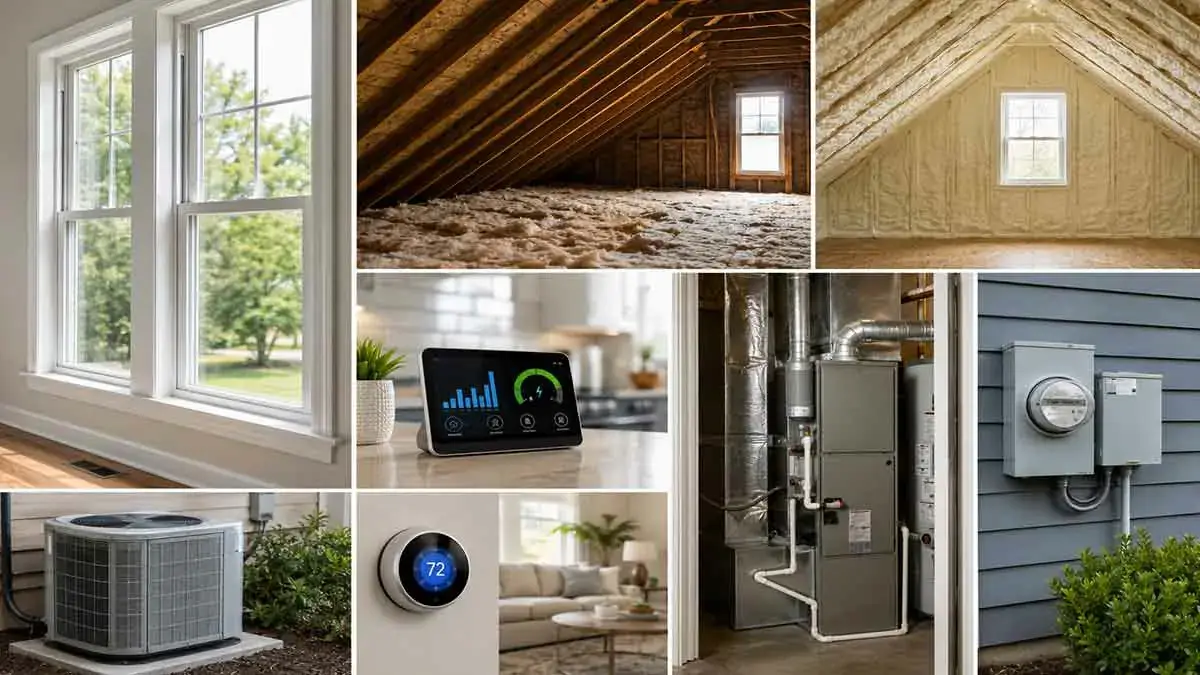
Energy waste can increase household utility costs without providing any meaningful benefit. Heating or cooling an empty room, allowing conditioned air to escape through air leaks, operating inefficient equipment, or leaving unnecessary devices running can all increase energy consumption.
The challenge is that much of this waste is not immediately visible. You may notice a high utility bill without knowing whether the problem comes from the HVAC system, poor insulation, air leakage, appliances, water heating, or everyday habits.
The most effective way to find energy waste is to combine energy-use data with a physical inspection of the home. Start by establishing a normal consumption pattern, then investigate unusual increases, comfort problems, building-envelope deficiencies, HVAC performance, and major electrical loads.
You do not necessarily need expensive equipment or major upgrades to begin. Many sources of energy waste can be identified through utility bills, smart-meter data, basic inspections, and targeted monitoring.
Table of Contents
What Is Energy Waste in a Home?
Home energy waste occurs when energy is consumed without providing a useful service or when more energy is required than necessary to provide that service.
Common examples include:
- Conditioned air escaping through leaks
- Inadequate insulation increasing heating and cooling demand
- Heating or cooling unoccupied spaces unnecessarily
- Inefficient HVAC equipment
- Excessive hot-water consumption
- Appliances operating inefficiently
- Unnecessary lighting
- Electronics consuming unnecessary standby power
- Poorly insulated or leaking ducts
Not every use of energy is wasteful. A refrigerator, water heater, or HVAC system must consume energy to perform its intended function.
The goal is to identify situations where energy consumption is unnecessarily high for the service being provided.
Why Is It Important to Find Energy Waste?
Finding energy waste can help you:
- Reduce unnecessary energy consumption
- Lower utility costs
- Improve indoor comfort
- Reduce HVAC workload
- Identify equipment problems
- Prioritize home improvements
- Understand unexpected energy bills
- Verify whether efficiency upgrades are working
Identifying the source of waste before making an expensive upgrade is especially important.
For example, replacing windows may not be the best first investment if the primary problem is inadequate attic insulation or major air leakage.
1. Start With Your Energy Bills
Your utility bills are one of the easiest places to begin.
Review several months of consumption and, ideally, at least one full year.
Look for:
- Monthly kWh consumption
- Average daily consumption
- Seasonal changes
- Sudden increases
- Gradual increases
- Unusually high billing periods
Focus on energy consumption as well as the dollar amount.
A higher bill does not necessarily mean the home used more energy because electricity rates can change.
2. Establish Your Normal Energy Use
Before searching for waste, determine what normal energy consumption looks like for your household.
Track:
- Monthly kWh
- Average daily kWh
- Seasonal consumption
- Heating demand
- Cooling demand
- Major changes in occupancy
This creates a baseline.
Once you understand normal consumption, unusual patterns become much easier to identify.
3. Look for Sudden Energy Spikes
A sudden increase in electricity consumption deserves investigation.
Possible explanations include:
- Extreme weather
- Increased HVAC operation
- New appliances
- Electric vehicle charging
- Increased occupancy
- Water-heating demand
- Equipment problems
- Changes in household behavior
Do not automatically assume a spike represents energy waste.
First ask:
What changed during this period?
If there is no obvious explanation, investigate further.
4. Look for Gradual Increases
Energy waste can also develop slowly.
A gradual increase over months or years may be associated with:
- Aging HVAC equipment
- Deteriorating insulation
- Increasing air leakage
- Additional appliances
- More electronics
- Changes in household routines
- Increased heating or cooling demand
Long-term energy tracking is useful because gradual changes can otherwise go unnoticed.
5. Check for Air Leaks
Air leakage is a common source of building-envelope inefficiency.
Potential leakage locations include:
- Windows
- Exterior doors
- Baseboards
- Electrical penetrations
- Plumbing penetrations
- Attic openings
- Recessed lighting
- Duct penetrations
- Utility penetrations
Air leaks can allow conditioned air to escape while bringing outdoor air into the home.
Look for visible gaps, damaged seals, drafts, or areas where indoor and outdoor air can move through the building envelope.
Do not seal openings that are intentionally required for ventilation or combustion safety.
6. Inspect Doors and Windows
Drafty doors and windows can increase heating and cooling demand.
Check for:
- Damaged weatherstripping
- Cracked caulking
- Gaps around frames
- Poorly sealed trim
- Damaged door sweeps
- Visible daylight around openings
A draft does not automatically mean the window needs to be replaced.
In some cases, the problem is the seal around the window or door rather than the window itself.
7. Check Attic Air Leakage
The attic can contain numerous hidden pathways through which conditioned air escapes.
Common locations include:
- Attic hatches
- Plumbing penetrations
- Electrical wiring openings
- Recessed lights
- Duct penetrations
- Chimney openings
- Top plates
Air sealing the boundary between the conditioned space and attic can reduce unwanted air movement.
Use appropriate materials and methods, particularly around electrical equipment, chimneys, flues, and other areas requiring specific clearances.
8. Check Attic Insulation
Insulation slows heat transfer between the living space and the attic.
Inspect for:
- Thin insulation
- Uneven coverage
- Compressed insulation
- Missing areas
- Moisture damage
- Exposed sections
If insulation is inadequate, improving it can reduce heating and cooling demand.
However, address significant moisture and air-leakage problems before adding insulation where appropriate.
9. Inspect Basements and Crawl Spaces
Basements and crawl spaces can contribute to energy loss and comfort problems.
Look for:
- Uninsulated walls
- Exposed ducts
- Air leaks
- Unsealed penetrations
- Uninsulated pipes
- Moisture problems
- Gaps around utilities
These areas should be evaluated as part of the home’s overall building envelope.
10. Check Exterior Doors
Exterior doors can become significant air-leakage points when seals deteriorate.
Inspect:
- Door sweeps
- Weatherstripping
- Thresholds
- Frame seals
- Gaps around the door
Replacing worn weatherstripping is often simpler and less expensive than replacing the entire door.
11. Inspect Ductwork
Leaky ducts can waste conditioned air before it reaches occupied rooms.
Pay particular attention to ducts located in:
- Attics
- Crawl spaces
- Garages
- Other unconditioned areas
Look for:
- Loose connections
- Disconnected sections
- Damaged insulation
- Unsealed joints
- Visible gaps
Some duct leakage cannot be identified through visual inspection alone. Professional testing may be appropriate when significant performance problems are suspected.
12. Check HVAC Filters
A dirty filter can restrict airflow and reduce HVAC performance.
Check the filter according to the manufacturer’s recommended schedule.
Replacement frequency depends on factors such as:
- Filter type
- System design
- Household conditions
- Pets
- HVAC usage
Use a filter that is compatible with the equipment.
A filter with excessive resistance is not necessarily better simply because it has a higher filtration rating.
13. Evaluate HVAC Performance
Heating and cooling systems are often among the largest energy consumers in a home.
Look for signs such as:
- Unusually long operating periods
- Poor temperature control
- Uneven cooling or heating
- Increasing energy consumption
- Frequent cycling
- Unusual sounds
- Inadequate airflow
Potential causes can include:
- Poor maintenance
- Duct leakage
- Inadequate insulation
- Air leakage
- Equipment problems
- Incorrect system sizing
Specialized HVAC diagnosis and repair should be performed by a qualified professional.
14. Review Thermostat Settings
Thermostat settings directly affect heating and cooling demand.
Energy consumption can increase when:
- Cooling is set unnecessarily low
- Heating is set unnecessarily high
- HVAC runs while the home is empty
- Schedules do not match occupancy
A programmable or smart thermostat can help align HVAC operation with household routines.
The objective is not to maximize temperature changes but to avoid unnecessary conditioning.
15. Check Rarely Used Rooms
Rooms that are rarely occupied may still be conditioned continuously.
However, do not simply close vents or shut off rooms without considering the HVAC system design.
Restricting airflow can create pressure problems or reduce equipment performance.
If one area of the home is consistently too hot or too cold, investigate the underlying cause instead of relying only on thermostat adjustments.
16. Inspect Water Heating
Water heating can represent a substantial portion of household energy use.
Potential sources of waste include:
- Excessive hot-water use
- High temperature settings
- Poor insulation
- Hot-water leaks
- Inefficient equipment
- Unnecessary continuous recirculation
Evaluate the complete water-heating system rather than focusing only on the tank or heating equipment.
17. Check for Hot-Water Leaks
A leaking faucet, pipe, or valve can waste both water and the energy used to heat it.
Look for:
- Dripping faucets
- Leaking valves
- Damp areas around pipes
- Unexpected water-heater operation
- Unexplained increases in hot-water consumption
A persistent hot-water leak should be repaired promptly.
18. Check Hot-Water Pipes
Hot-water pipes can lose heat as water travels from the water heater to fixtures.
Where appropriate, insulating accessible hot-water pipes can reduce heat loss and improve delivery efficiency.
Follow applicable safety requirements, especially near the water heater and its controls.
19. Inspect the Refrigerator
Refrigerators operate continuously, so their efficiency can matter over time.
Check for:
- Damaged door seals
- Poor ventilation
- Excessive frost
- Incorrect temperature settings
- Dirty accessible components
- Signs of equipment deterioration
Do not automatically replace an older appliance without comparing the expected energy savings with the replacement cost.
20. Check the Freezer
Freezers also operate continuously.
Inspect:
- Door seals
- Frost accumulation
- Temperature settings
- Ventilation
- Overall condition
A damaged seal can allow warm air into the freezer and increase compressor operation.
21. Examine the Clothes Dryer
Electric clothes dryers can consume substantial electricity.
Potential sources of inefficiency include:
- Over-drying
- Long drying cycles
- Restricted exhaust airflow
- Dirty lint filters
- Damaged exhaust ducts
Clean the lint filter after each use and maintain the exhaust system.
A blocked or improperly vented dryer can also create a safety hazard.
22. Review Washing Machine Use
Washing machines generally use less energy than many major household systems, but hot-water cycles can increase energy consumption.
Consider:
- Cold-water cycles when appropriate
- Full loads
- Efficient wash settings
- Avoiding unnecessary repeated cycles
For many washers, the energy required to heat water can be more significant than the electricity used by the machine itself.
23. Check Dishwasher Use
Dishwashers consume energy for washing, heating water, and drying.
Potential improvements include:
- Running full loads
- Using efficient cycles when appropriate
- Using lower-energy drying options when available
- Avoiding unnecessary repeated cycles
The best settings depend on the appliance and household needs.
24. Review Lighting
Lighting can create unnecessary energy consumption when lights remain on in unoccupied spaces.
Check:
- Bedrooms
- Garages
- Outdoor lighting
- Decorative lighting
- Storage areas
LED lighting generally uses substantially less electricity than traditional incandescent lighting.
Automated controls, timers, or occupancy sensors may also help in suitable locations.
25. Look for Standby Energy Use
Some electronics consume electricity even when they appear to be switched off.
Potential examples include:
- Televisions
- Game consoles
- Computers
- Speakers
- Chargers
- Entertainment systems
Standby consumption varies significantly between devices.
Do not assume that every standby load is a major source of waste. Measure important loads before spending money on solutions designed to eliminate them.
26. Check Home Office Equipment
A home office can contain several devices that remain powered for long periods.
Review:
- Computers
- Monitors
- Printers
- Speakers
- Routers
- Chargers
Use sleep modes and power-management settings where appropriate.
Do not shut down equipment that needs to remain operational for networking, security, backups, or other essential functions.
27. Examine Entertainment Systems
Entertainment equipment can consume electricity even when not actively being used.
Potential loads include:
- TVs
- Streaming devices
- Game consoles
- Audio systems
An energy-monitoring plug can help determine whether standby consumption is significant enough to address.
28. Monitor Electric Vehicle Charging
An electric vehicle can become one of the largest electrical loads in a household.
If total electricity consumption increased after adding an EV, separate charging consumption from other household usage.
This prevents normal EV charging from being mistaken for unexplained energy waste.
If the utility uses time-of-use pricing, charging schedules may also affect electricity costs.
29. Use Smart Meter Data
Many utilities provide daily or hourly consumption data through customer portals.
Depending on the utility, you may be able to identify:
- Peak consumption periods
- Overnight usage
- Daily patterns
- Seasonal changes
- Changes after efficiency improvements
Smart-meter data can be useful even without installing additional monitoring hardware.
30. Use a Whole-Home Energy Monitor
A whole-home energy monitor can provide more detailed information about electricity consumption.
Depending on the system, it may show:
- Real-time consumption
- Historical trends
- Energy spikes
- Continuous loads
- Daily patterns
- Estimated costs
This information can help connect changes in energy consumption with household activities.
31. Monitor Individual Appliances
If a particular appliance is suspected of using excessive electricity, an appropriately rated energy-monitoring device can provide useful data.
This can help answer questions such as:
- How much electricity does this refrigerator use?
- How much energy does the entertainment system consume?
- Does this device continue drawing power overnight?
Only use monitoring equipment that is rated for the electrical load.
High-power equipment may require a different monitoring approach.
32. Monitor Energy While You Are Away
A mostly unoccupied home can provide a useful baseline for identifying continuous loads.
If electricity consumption remains unexpectedly high while nobody is home, investigate systems such as:
- Refrigeration
- HVAC
- Water heating
- Pumps
- Security equipment
- Networking equipment
Some continuous consumption is normal.
The goal is to identify loads that are unexpected or substantially higher than necessary.
33. Compare Energy Use With Weather
Weather can dramatically affect household energy consumption.
For example, high electricity use during an unusually hot period may be expected because of air conditioning.
Likewise, cold weather can increase heating demand.
When evaluating energy waste, compare consumption with:
- Outdoor temperature
- HVAC runtime
- Thermostat settings
- Occupancy
This provides a more accurate picture than looking at electricity consumption alone.
34. Compare Before and After Improvements
After correcting a suspected source of energy waste, measure the result.
For example, if you improve attic insulation, compare energy consumption before and after the project.
A simple comparison might look like:
Before improvement: 1,000 kWh
After improvement: 850 kWh
However, the reduction cannot automatically be attributed entirely to the improvement.
Weather, occupancy, thermostat settings, and appliance use may also have changed.
Use multiple comparable periods whenever possible.
35. Look for Comfort Problems
Indoor comfort problems can provide clues about building-performance issues.
Watch for:
- Rooms that are consistently too hot
- Rooms that remain too cold
- Drafts
- Hot ceilings
- Cold floors
- Uneven temperatures
- Areas with unusually poor airflow
Potential causes include:
- Air leakage
- Insufficient insulation
- Duct problems
- Window problems
- HVAC distribution issues
- Solar heat gain
Comfort problems do not always mean energy is being wasted, but they can indicate where further investigation is worthwhile.
36. Check for Moisture Problems
Moisture problems can affect insulation, building materials, and indoor conditions.
Look for:
- Condensation
- Damp insulation
- Water stains
- Musty odors
- Mold growth
- Persistent damp areas
Moisture should be addressed at its source rather than simply treating the visible symptom.
37. Consider Thermal Imaging
Thermal imaging can help identify temperature differences in parts of the building envelope.
It may reveal patterns associated with:
- Missing insulation
- Thermal bridging
- Air leakage
- Uneven HVAC distribution
However, a thermal image does not automatically prove that a specific area is responsible for significant energy waste.
Temperature differences should be interpreted alongside other evidence and, when necessary, professional testing.
38. Consider a Home Energy Audit
If energy consumption remains unexpectedly high and the cause is unclear, a professional home energy audit can provide a more comprehensive assessment.
Depending on the service, an audit may evaluate:
- Insulation
- Air leakage
- Windows and doors
- HVAC equipment
- Ductwork
- Moisture
- Building-envelope performance
Professional testing can identify problems that are difficult to locate through visual inspection alone.
39. Prioritize the Biggest Sources of Waste
Not every energy-saving opportunity has the same impact.
In many homes, it makes sense to investigate major energy loads first:
- Heating and cooling
- Water heating
- Major appliances
- Electric vehicle charging
- Lighting
- Electronics and standby loads
The actual priority depends on the home’s equipment, climate, occupancy, and energy-use pattern.
The key principle is:
Focus on the largest practical opportunities first.
40. Measure Again After Improvements
Finding and correcting a problem is only part of the process.
After making an improvement, continue monitoring energy consumption.
Use this cycle:
Measure → Identify → Improve → Measure Again
For example:
- Establish a baseline.
- Identify an unusually high energy load.
- Correct the underlying problem.
- Compare energy use afterward.
- Adjust the strategy if the expected improvement does not appear.
This approach prevents assumptions from becoming expensive projects.
Common Signs of Energy Waste
Potential warning signs include:
- Unexpectedly high utility bills
- Increasing kWh consumption
- Drafty rooms
- Uneven indoor temperatures
- HVAC running for unusually long periods
- Damaged weatherstripping
- Thin or uneven attic insulation
- Leaky ducts
- Hot-water leaks
- Appliances operating unusually often
- High overnight electricity consumption
- Large unexplained energy spikes
No single sign proves that energy is being wasted.
Several signs occurring together provide stronger evidence that further investigation is needed.
Home Energy Waste Inspection Checklist
Energy Data
- Review utility bills
- Record monthly kWh
- Calculate average daily consumption
- Compare seasons
- Compare similar months
- Check smart-meter data
- Look for unusual spikes
- Look for gradual increases
Building Envelope
- Inspect exterior doors
- Check window seals
- Inspect weatherstripping
- Check attic insulation
- Look for attic air leaks
- Inspect basement areas
- Inspect crawl spaces
- Check for moisture problems
HVAC
- Check filters
- Review thermostat settings
- Monitor HVAC runtime
- Inspect accessible ductwork
- Look for uneven temperatures
- Schedule appropriate maintenance
Water Heating
- Check for leaks
- Review hot-water usage
- Inspect accessible pipes
- Check insulation
- Monitor unusual operation
Appliances
- Refrigerator
- Freezer
- Clothes dryer
- Washing machine
- Dishwasher
- Oven
- Other major electrical loads
Electronics
- TVs
- Computers
- Game consoles
- Chargers
- Networking equipment
- Smart home devices
Common Mistakes When Looking for Energy Waste
Focusing Only on the Dollar Amount
Utility rates can change even when electricity consumption remains similar.
Always examine kWh as well as cost.
Blaming Windows Immediately
Windows can contribute to energy loss, but attic insulation, air sealing, ductwork, or HVAC performance may represent larger opportunities.
Ignoring Air Leakage
Insulation alone cannot solve every building-performance problem.
Uncontrolled air movement can significantly affect heating and cooling demand.
Assuming Every High-Energy Appliance Is Wasteful
A high-power appliance may consume relatively little total energy if it operates for only a short time.
Operating time matters as much as rated power.
Trying to Eliminate Every Standby Load
Some standby consumption is unavoidable, and small loads may have little impact on the total household energy profile.
Measure before taking action.
Ignoring Weather
Extreme temperatures can naturally increase energy consumption.
Compare similar weather conditions whenever possible.
Making Expensive Upgrades Without Identifying the Problem
Do not replace equipment simply because the energy bill is high.
Determine what is actually causing the consumption before selecting a solution.
Ignoring Safety
Electrical panels, HVAC equipment, gas appliances, roofs, and other building systems can present serious hazards.
Use qualified professionals when an inspection or repair requires specialized knowledge or access.
How to Find Energy Waste Step by Step
Step 1: Review Your Energy Bills
Look at several months or a full year of kWh consumption.
Step 2: Establish a Baseline
Determine normal daily, monthly, and seasonal energy use.
Step 3: Identify Unusual Patterns
Look for sudden spikes, gradual increases, or unexpectedly high overnight consumption.
Step 4: Check the Building Envelope
Inspect doors, windows, attic insulation, air leakage, basements, and crawl spaces.
Step 5: Evaluate HVAC Performance
Check filters, thermostat settings, runtime, airflow, and accessible ductwork.
Step 6: Investigate Water Heating
Look for leaks, excessive hot-water use, and unnecessary heat loss.
Step 7: Check Major Appliances
Focus on equipment that consumes significant energy or operates for long periods.
Step 8: Monitor Suspicious Loads
Use smart-meter data, whole-home monitoring, or appropriately rated appliance monitoring when necessary.
Step 9: Compare Consumption With Weather and Occupancy
Determine whether changes in energy use have a reasonable explanation.
Step 10: Fix the Biggest Problems First
Prioritize improvements according to expected energy impact, cost, and practicality.
Step 11: Measure Again
Continue monitoring after improvements to determine whether the change produced meaningful results.
Final Thoughts
Finding energy waste in your home is primarily a process of measurement, investigation, and verification.
Start by reviewing your utility bills and establishing a normal energy-use baseline. Then investigate the building envelope, HVAC system, water heating, major appliances, and electronics for unnecessary consumption.
Pay particular attention to air leakage, inadequate insulation, inefficient heating and cooling, duct problems, hot-water losses, and unusual energy patterns.
Smart-meter data and whole-home energy monitors can make hidden consumption easier to identify, while professional energy audits can provide deeper insight when the source of waste is difficult to locate.
The most effective strategy is simple:
Measure first, identify the largest source of waste, make a targeted improvement, and measure again.
This approach helps you avoid unnecessary upgrades and ensures that your energy-efficiency efforts focus on problems that actually affect your home’s performance and utility costs.