
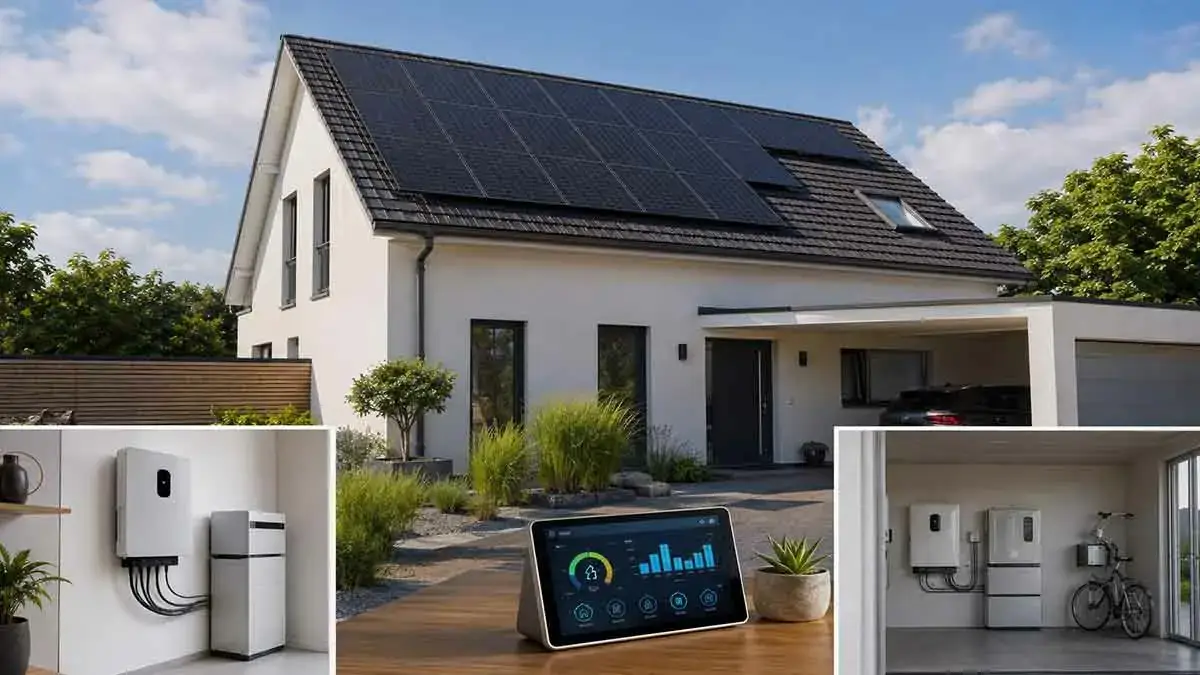
Home solar energy allows homeowners to generate electricity from sunlight and use it to reduce reliance on grid power. A residential solar system can lower electricity purchases, support greater energy independence, and, in some situations, reduce long-term energy costs.
However, solar panels are a long-term investment, and the right system depends on more than the amount of available roof space. Solar production is affected by sunlight exposure, roof orientation, shading, climate, system size, equipment, electricity consumption, utility policies, and installation costs.
Before installing solar panels, homeowners should understand how residential solar works, how much electricity a home needs, how to evaluate a roof, whether battery storage is useful, and how to estimate the financial value of the system.
Table of Contents
What Is Home Solar Energy?
Home solar energy generally refers to using photovoltaic (PV) panels to convert sunlight into electricity for residential use.
A typical residential solar installation may include:
- Solar panels
- Inverters
- Mounting equipment
- Electrical wiring
- Monitoring equipment
- Utility connection equipment
- Optional battery storage
Solar panels generate direct-current (DC) electricity. The inverter converts that electricity into alternating-current (AC) electricity that can be used by household electrical equipment.
The system may be connected to the utility grid, paired with battery storage, or configured according to local electrical and utility requirements.
How Does a Home Solar System Work?
The basic process is:
Sunlight → Solar Panels → Inverter → Home Electrical System
When the panels produce electricity, the home can use that power immediately.
If solar production exceeds household demand, the excess electricity may be stored in a battery or exported to the grid, depending on the system and local utility rules.
When solar production is lower than household demand, electricity can come from the grid or from a battery if one is installed.
Solar production is therefore dynamic. A system may generate substantial electricity during sunny daytime hours but little or none at night.
Why Consider Solar Energy for Your Home?
Homeowners may consider solar for several reasons:
- Reduce electricity purchased from the grid
- Generate renewable electricity
- Potentially lower long-term energy costs
- Increase energy independence
- Reduce exposure to future electricity-price increases
- Support household electrification
- Complement battery storage or backup-power systems
The financial value varies by location and property.
System cost, electricity prices, solar production, incentives, financing, maintenance, and utility compensation policies can all affect the overall economics.
1. Evaluate Your Current Energy Use
Start by understanding how much electricity your home actually consumes.
Review at least 12 months of utility bills when possible.
Record:
- Monthly kWh consumption
- Seasonal changes
- Electricity rates
- Major electrical loads
- Changes in household consumption
This information provides a foundation for estimating an appropriate solar system size.
Avoid sizing a system based only on the average monthly bill. Seasonal consumption patterns can be important, particularly in homes with substantial heating or cooling loads.
2. Understand Your Solar Resource
Solar panels need sufficient sunlight to produce electricity.
Important factors include:
- Local climate
- Roof orientation
- Roof angle
- Shading
- Seasonal sunlight
- Usable roof area
- Nearby buildings and vegetation
A professional solar assessment can provide a more accurate estimate of expected annual production.
3. Check Roof Orientation
Roof direction affects how much sunlight panels receive throughout the day.
The preferred orientation depends on geographic location and the desired production profile.
A roof that does not face the ideal direction is not automatically unsuitable for solar.
Modern system designs can accommodate many roof configurations, but orientation should be included in the production estimate.
4. Evaluate Roof Shading
Shading can significantly reduce solar production.
Potential sources include:
- Trees
- Neighboring buildings
- Chimneys
- Dormers
- Roof structures
- Other nearby obstructions
The effect of shading depends on its timing, location, and the design of the solar system.
If a roof has significant shading, ask the installer to include realistic shading assumptions in the production estimate.
5. Inspect the Roof Condition
Solar panels are designed for long-term operation, so the condition of the roof matters.
Before installation, evaluate:
- Roof age
- Roofing material
- Structural condition
- Existing leaks
- Damaged areas
- Remaining roof life
If the roof is likely to require replacement soon, completing the roofing work before installing solar may avoid the future cost and inconvenience of removing and reinstalling the panels.
6. Determine Available Roof Space
The total roof area is not the same as the usable solar area.
Obstructions may include:
- Skylights
- Chimneys
- Vents
- Dormers
- Roof edges
- Equipment
- Areas affected by shading
Solar designers should determine how much roof space can realistically accommodate panels while maintaining appropriate access and installation requirements.
7. Understand Solar Panel Efficiency
Solar panel efficiency describes how effectively a panel converts available sunlight into electricity.
Higher-efficiency panels can produce more electricity from a given surface area.
However, panel efficiency is only one part of overall system performance.
Also consider:
- Panel output
- Temperature characteristics
- Warranty
- Degradation rate
- Manufacturer reputation
- Available roof space
- Total system cost
A highly efficient panel is not automatically the most cost-effective option for every home.
8. Choose the Right Solar System Size
Solar system capacity is commonly expressed in kilowatts (kW).
A larger system can generate more electricity, but maximum system size is not necessarily the best choice.
Sizing should consider:
- Historical electricity consumption
- Solar resource
- Roof space
- Utility rules
- Future electricity demand
- Budget
- Battery plans
- Export compensation
The objective is to design a system that makes sense for the property’s actual energy needs and financial goals.
9. Consider Future Electricity Needs
Current electricity consumption may change over time.
Future demand may increase after adding:
- An electric vehicle
- A heat pump
- A heat-pump water heater
- Electric cooking equipment
- Additional appliances
- A home addition
If major electrification projects are planned, include their expected electricity demand when discussing solar system sizing.
10. Understand Solar Inverters
Solar panels produce DC electricity, while most household electrical equipment operates using AC electricity.
The inverter converts the generated DC power into usable AC power.
Common residential approaches include:
- String inverters
- Microinverters
- Power optimizers paired with inverters
The appropriate design depends on factors such as roof complexity, shading, system size, equipment selection, and installation requirements.
11. String Inverters
A string inverter connects multiple solar panels into one or more electrical strings.
Potential advantages include:
- Centralized equipment
- Simpler system architecture
- Potentially lower equipment costs
- Easier access to the primary inverter
A limitation is that system performance can be affected by differences between panels within a string, depending on system design and shading conditions.
12. Microinverters
Microinverters are installed at the individual panel level.
Potential advantages include:
- Panel-level power conversion
- Panel-level monitoring
- Greater flexibility for complex roofs
- Potential benefits where shading varies across the roof
Microinverter systems can also involve higher equipment costs.
13. Power Optimizers
Power optimizers operate at the panel level while working with a central inverter.
They can help manage differences in panel performance caused by factors such as:
- Partial shading
- Different roof orientations
- Panel-level performance variation
Whether optimizers are worthwhile depends on the roof and system design.
14. Understand Solar Batteries
Solar batteries store electricity for later use.
Instead of using or exporting all excess solar production immediately, a battery can store some of that energy for periods when solar production is lower.
Battery storage may be useful for:
- Evening electricity use
- Increasing solar self-consumption
- Reducing grid purchases during certain periods
- Backup power, when the system is specifically designed for it
A battery is not required for every solar installation.
15. Solar Without Battery Storage
A grid-connected solar system can operate without battery storage.
During daylight hours, solar electricity can power household loads directly.
If production exceeds demand, excess electricity may be exported to the grid according to local utility rules.
When solar production is insufficient, the home draws electricity from the grid.
This configuration can be simpler and less expensive than adding battery storage.
16. Solar With Battery Storage
Adding a battery can increase the amount of solar electricity available after sunset.
A properly configured battery system may also provide backup power during grid outages.
However, batteries add:
- Equipment costs
- Installation requirements
- Additional system complexity
- Capacity and performance considerations
- Replacement considerations over the system’s life
Battery storage should therefore be evaluated based on both financial and practical objectives.
17. Understand Grid-Tied Solar
Most residential solar systems are connected to the utility grid.
The grid can supply electricity when solar production does not meet household demand.
When solar production exceeds consumption, excess electricity may be exported to the grid depending on local regulations and the utility’s compensation structure.
Grid connection requirements vary by location.
18. Understand Net Metering and Export Compensation
Solar export policies can have a major effect on system economics.
Depending on the location, excess electricity may be handled through:
- Net metering
- Feed-in tariffs
- Export credits
- Other utility compensation programs
The value assigned to exported electricity can differ substantially from the retail price of electricity purchased from the grid.
Always verify the current rules with the relevant utility and authorities before calculating expected solar savings.
19. Understand Solar Self-Consumption
Solar self-consumption means using solar electricity directly in the home rather than exporting it.
For example, homeowners may schedule flexible loads during periods of strong solar production.
Potential loads include:
- EV charging
- Water heating
- Laundry
- Dishwashers
- Other flexible appliances
The financial benefit depends on the difference between the value of using solar electricity directly and the compensation available for exporting it.
20. Monitor Solar Production
Solar monitoring allows homeowners to track system performance.
Depending on the equipment, monitoring may provide:
- Daily production
- Monthly production
- Annual production
- Historical trends
- System alerts
- Consumption information
Monitoring is useful because it establishes a record of system performance and can help identify unexpected changes.
21. Understand Solar Production Variations
Solar production naturally changes throughout the year.
Factors include:
- Day length
- Cloud cover
- Temperature
- Shading
- Dust
- Panel orientation
- Panel angle
- Seasonal weather
A lower-production month does not automatically indicate a system problem.
Production should be evaluated against expected conditions rather than compared only with a single previous month.
22. Understand Solar Panel Degradation
Solar panels gradually lose some generating capacity over their operating life.
Manufacturers generally provide performance warranties describing expected output over time.
When comparing panels, review:
- Product warranty
- Performance warranty
- Expected degradation
- Manufacturer reputation
- Long-term performance terms
Small differences in degradation can become more meaningful when considered over many years.
23. Review Solar Panel Warranties
A solar installation includes multiple components, and each may have different warranty terms.
Review coverage for:
- Solar panels
- Inverters
- Batteries
- Mounting equipment
- Other major components
Do not evaluate a solar proposal based only on the length of the panel warranty.
24. Review Installation Warranties
The installation itself should also have appropriate workmanship coverage.
Before signing a contract, determine:
- What workmanship is covered
- How long coverage lasts
- How warranty claims are handled
- Who is responsible for repairs
- What happens if the installer is no longer operating
Keep contracts, equipment documentation, and warranty records for future reference.
25. Compare Solar Quotes
Obtain multiple detailed proposals before choosing a solar installation.
Compare:
- System capacity
- Estimated annual production
- Panel specifications
- Inverter configuration
- Battery capacity
- Equipment warranties
- Installation warranty
- Total project cost
- Financing terms
- Expected savings
Do not compare quotes solely by system price.
A cheaper system may have lower expected production, weaker warranties, different equipment, or less comprehensive installation coverage.
26. Evaluate the Solar Installer
The installer can have a major effect on long-term system performance.
Look for:
- Appropriate licensing
- Relevant experience
- Professional references
- Transparent pricing
- Detailed contracts
- Appropriate insurance
- Clear warranty procedures
Ask which company performs the actual installation and who is responsible for electrical and roofing-related work.
27. Understand Solar Financing
Solar systems may be purchased using different financing arrangements.
Potential options include:
- Cash purchase
- Solar loan
- Home-equity financing
- Lease
- Power purchase agreement
Availability varies by market.
When comparing financing options, look beyond the monthly payment and calculate the total amount paid over the full term.
28. Compare Cash Purchase and Financing
A cash purchase eliminates loan interest but requires substantial upfront capital.
Financing can reduce the initial cash requirement but may increase total project cost.
Compare:
- Upfront payment
- Interest rate
- Loan term
- Total payments
- Expected energy savings
- Ownership
- Long-term obligations
The best option depends on both financial circumstances and the expected value of the solar system.
29. Understand Solar Leases and PPAs
Some markets offer third-party solar ownership models.
A solar lease generally involves paying for the use of the solar equipment.
A power purchase agreement (PPA) generally involves paying for the electricity produced by the system according to the contract.
These arrangements may reduce upfront costs but can have different implications for:
- Long-term savings
- Property sales
- Contract transfers
- System ownership
- Maintenance responsibilities
Review the complete contract before choosing one of these structures.
30. Calculate the Solar Payback Period
A simplified payback calculation is:
Total Solar Investment ÷ Annual Savings = Approximate Payback Period
For example, if a system costs $15,000 after applicable incentives and produces approximately $1,500 in annual savings:
$15,000 ÷ $1,500 = 10 years
This is only a simple estimate.
Actual results can differ because of:
- Electricity-price changes
- Solar production
- Equipment degradation
- Maintenance
- Financing costs
- Incentives
- Export compensation
For a major investment, use realistic long-term assumptions rather than a simple payback calculation alone.
31. Consider Your Electricity Rate
The price of grid electricity has a direct effect on potential solar savings.
Homes with higher electricity costs may have greater savings potential from reducing grid purchases.
However, the rate structure matters as well.
Consider:
- Energy charges
- Time-of-use pricing
- Fixed charges
- Demand charges where applicable
- Export compensation
A solar system generally does not eliminate every charge on an electricity bill.
32. Consider Your Energy Consumption Pattern
Solar production is usually highest during daylight hours.
A household that uses significant electricity during the day may consume more solar electricity directly.
A household with most of its demand after sunset may rely more heavily on grid electricity or battery storage.
Understanding the timing of consumption can therefore be just as important as understanding total annual consumption.
33. Improve Energy Efficiency Before Going Solar
Energy efficiency can reduce the amount of electricity a home needs.
Potential improvements include:
- Attic insulation
- Air sealing
- Efficient HVAC equipment
- Smart thermostat controls
- Efficient appliances
- LED lighting
- Improved duct performance
Reducing unnecessary energy demand before sizing solar can prevent homeowners from installing a larger system than necessary.
However, planned future electrification should also be considered so efficiency improvements do not lead to an undersized solar system later.
34. Consider Home Electrification
Solar can complement a broader transition toward electric home systems.
Potential electrical loads include:
- Heat pumps
- Heat-pump water heaters
- Electric vehicles
- Induction cooking
- Electric appliances
If these technologies are part of your long-term plans, estimate their electricity demand before finalizing the solar design.
35. Consider Solar for an Electric Vehicle
Home EV charging can significantly increase electricity consumption.
Solar generation can offset some of that additional demand.
The value depends on:
- Annual driving distance
- EV efficiency
- Charging schedule
- Solar production
- Electricity rates
- Export compensation
If possible, charging during periods of strong solar production can increase direct solar self-consumption.
36. Understand Solar Water Heating
Solar photovoltaic systems and solar thermal systems are different technologies.
Photovoltaic solar: generates electricity.
Solar thermal: uses sunlight primarily to heat water or another fluid.
If the objective is household electricity generation, photovoltaic solar is generally the relevant technology.
37. Understand Solar Maintenance
Residential solar systems generally require limited routine maintenance, but they should still be monitored.
Potential maintenance considerations include:
- Dust
- Leaves
- Snow where applicable
- Vegetation
- Inverter operation
- Electrical components
- Mounting hardware
- Roof condition
Maintenance requirements vary according to local climate and system design.
38. Keep Solar Panels Clean When Necessary
Dirt and debris can reduce solar production.
Whether cleaning is necessary depends on:
- Local rainfall
- Dust
- Pollen
- Bird activity
- Roof angle
- Environmental conditions
Do not assume frequent cleaning is always necessary.
Use safe, manufacturer-compatible cleaning methods and avoid damaging the panels or roof.
39. Watch for Changes in Shading
Solar conditions can change after installation.
For example:
- Trees can grow
- New buildings can appear
- Roof structures can change
- Landscaping can affect sunlight
If production declines unexpectedly, investigate whether shading or another environmental factor has changed.
40. Understand Solar Safety
Residential solar systems involve electrical equipment and can present hazards during installation, maintenance, or repair.
Homeowners should not attempt electrical repairs without appropriate qualifications.
Use qualified professionals for:
- Solar wiring
- Inverter replacement
- Electrical panel work
- Battery installation
- Roof-related solar work
- System troubleshooting
Follow the manufacturer’s instructions and applicable electrical and building requirements.
Home Solar Evaluation Checklist
Before Installation
- Review at least 12 months of electricity consumption
- Identify major electrical loads
- Evaluate roof condition
- Check roof orientation
- Assess shading
- Determine usable roof space
- Consider future electricity demand
- Review local utility requirements
- Compare multiple installers
System Design
- Solar panel specifications
- System capacity
- Inverter configuration
- Battery requirements
- Expected annual production
- Monitoring capabilities
- Equipment warranties
- Installation warranty
Financial Evaluation
- Total project cost
- Applicable incentives
- Financing costs
- Estimated annual savings
- Export compensation
- Approximate payback
- Long-term ownership costs
After Installation
- Monitor production
- Review system alerts
- Compare actual production with expectations
- Watch for shading changes
- Keep warranty documentation
- Maintain the system as recommended
Common Home Solar Mistakes
Installing Solar Before Addressing Major Efficiency Problems
If a home has significant energy waste, reducing unnecessary demand first may improve the overall economics of the project.
Choosing the Cheapest Solar Quote
The lowest price does not necessarily represent the best long-term value.
Compare equipment, production estimates, warranties, installation quality, and financing.
Ignoring Roof Condition
Solar panels may remain in place for decades.
Installing them on a roof that needs replacement soon can create additional costs later.
Overlooking Shading
Trees and structures can significantly affect production.
Ask for realistic shading assumptions rather than relying on idealized production estimates.
Assuming Solar Eliminates the Electricity Bill
A grid-connected solar system does not necessarily eliminate all electricity costs.
Grid purchases, fixed charges, taxes, and other fees may remain depending on the utility and system configuration.
Ignoring Future Electricity Demand
An EV, heat pump, or home addition can substantially increase electricity consumption.
Include foreseeable future loads when planning system capacity.
Focusing Only on Panel Efficiency
Panel efficiency matters, but system design, shading, orientation, inverter configuration, and total cost also affect the result.
Ignoring Financing Costs
A low monthly payment can hide a high total project cost.
Always compare the complete financial obligation.
Is Home Solar Energy Worth It?
Home solar can be worthwhile when the system is appropriately designed and the property’s solar resource, electricity costs, system price, and utility policies support the investment.
Important factors include:
- Solar exposure
- Roof condition
- System cost
- Electricity rates
- Household consumption
- Solar production
- Financing
- Incentives
- Export compensation
- Expected ownership period
There is no universal payback period or system size that applies to every home.
A realistic solar evaluation should use actual household electricity consumption and conservative production and financial assumptions.
How to Plan a Home Solar System
A practical planning process is:
Step 1: Review Electricity Consumption
Analyze at least one year of utility data.
Step 2: Identify Future Energy Needs
Consider EV charging, heat pumps, electric water heating, and other planned electrical loads.
Step 3: Improve Energy Efficiency
Address major sources of unnecessary energy consumption before finalizing system size.
Step 4: Evaluate the Roof
Check condition, orientation, shading, and usable space.
Step 5: Estimate Solar Production
Obtain a realistic production estimate based on the actual property.
Step 6: Compare System Designs
Evaluate panels, inverters, battery storage, and monitoring options.
Step 7: Compare Installers
Obtain detailed proposals and review warranties, contracts, and installation practices.
Step 8: Calculate Total Costs
Include equipment, installation, financing, incentives, maintenance, and other relevant costs.
Step 9: Review Utility Requirements
Understand grid connection, export rules, and applicable compensation programs.
Step 10: Install and Monitor
Use qualified professionals and monitor the system after commissioning to verify expected performance.
Final Thoughts
Home solar energy can be a practical way to generate renewable electricity and reduce reliance on grid power, but a successful installation requires careful planning.
Start with your home’s actual electricity consumption. Then evaluate the roof, sunlight exposure, shading, available space, system size, inverter configuration, battery requirements, utility policies, and total project cost.
Energy efficiency should also be part of the planning process. Reducing unnecessary electricity demand can improve the value of a solar system, while future electrification needs should be included so the system is not undersized.
The goal is not simply to install as many solar panels as possible. The better approach is to design a system that matches the home’s energy needs, property conditions, financial objectives, and long-term plans.