
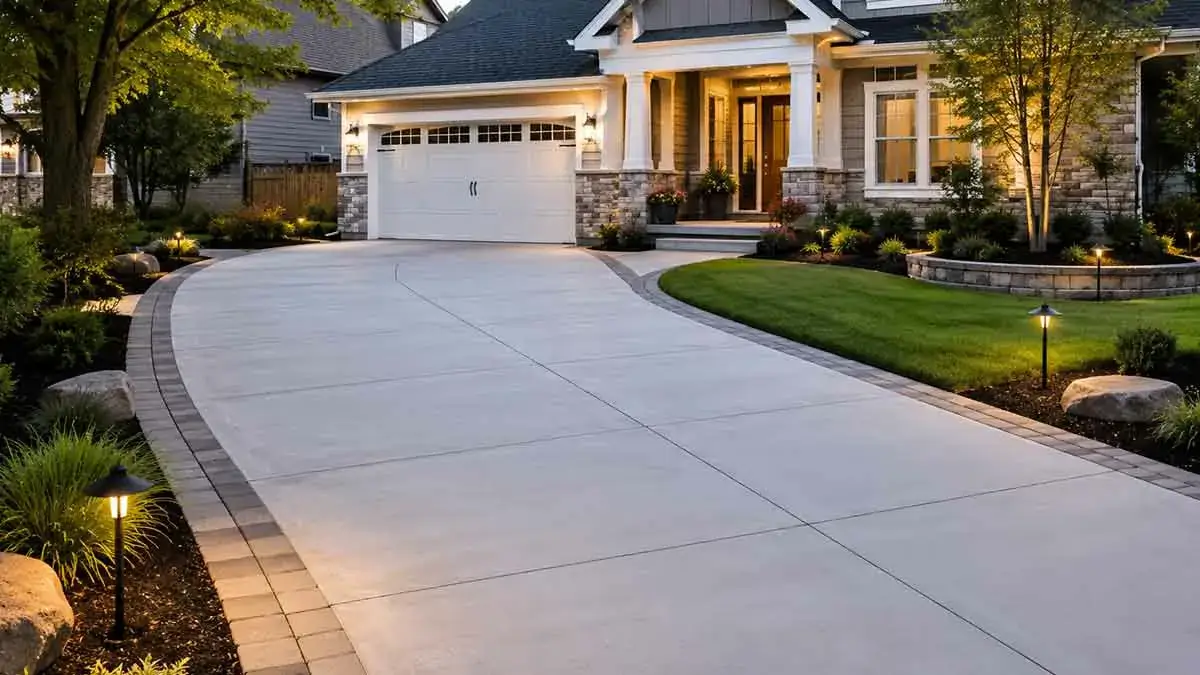
A driveway is one of the first exterior features people notice when approaching a home. Because it connects the street, garage, front entrance, and landscaping, improving it can make the entire property look more finished and functional.
Driveway improvements do not always require complete replacement. Depending on the condition of the existing surface, you may be able to improve the appearance and performance with cleaning, repairs, resurfacing, sealing, new borders, landscaping, lighting, or drainage upgrades.
For driveways with serious structural deterioration, settlement, or drainage problems, a larger renovation or complete replacement may be the better long-term solution.
The right approach depends on the driveway material, existing condition, climate, available space, budget, and architectural style of the home.
This guide covers practical driveway improvement ideas, from inexpensive upgrades to larger renovation projects, and explains how to plan improvements that look good and perform well over time.
Table of Contents
Why Improve Your Driveway?
A driveway has an important practical purpose, but it also has a major effect on the appearance and usability of the front of a property.
Well-planned driveway improvements can:
- Improve curb appeal
- Create a cleaner entrance to the home
- Improve vehicle access
- Increase usable parking space
- Reduce trip hazards
- Improve water drainage
- Repair visible deterioration
- Define the boundary between pavement and landscaping
- Improve nighttime visibility
- Create a more cohesive exterior design
A relatively simple improvement, such as repairing damaged edges and adding landscaping, can sometimes make a noticeable difference without replacing the entire driveway.
Inspect Your Driveway Before Making Improvements
Before choosing an improvement, determine what condition the driveway is actually in.
Inspect the surface for:
- Cracks
- Potholes
- Uneven sections
- Settlement
- Surface deterioration
- Broken edges
- Standing water
- Oil or chemical stains
- Weed growth
- Erosion
- Tree-root damage
- Water flowing toward the garage
The type and extent of damage should determine the project.
For example, isolated cracks may require repair, while widespread cracking combined with settlement may indicate that the underlying base or drainage system needs attention.
Do not cover major structural problems with a cosmetic treatment. Fixing the underlying problem first can prevent the new surface from failing prematurely.
Clean and Refresh the Existing Driveway
Cleaning is one of the simplest driveway improvement ideas and can make an older driveway look significantly better.
Remove:
- Dirt
- Leaves
- Mud
- Moss
- Weeds
- Organic debris
- Oil stains where appropriate
- Surface buildup
The correct cleaning method depends on whether the driveway is asphalt, concrete, pavers, or gravel.
Avoid aggressive cleaning methods or chemicals that can damage the surface or surrounding landscaping.
Cleaning is particularly useful before performing repairs, sealing, resurfacing, or applying other surface treatments.
Repair Cracks, Potholes, and Surface Damage
Small defects should generally be addressed before they become larger problems.
Depending on the driveway material, repairs may include:
- Filling suitable cracks
- Repairing potholes
- Replacing damaged pavers
- Repairing broken concrete areas
- Restoring damaged edges
- Removing weeds from joints
- Addressing localized surface deterioration
Water can enter cracks and contribute to further deterioration, particularly where repeated temperature changes cause expansion and contraction.
The appropriate repair method depends on the material and severity of the damage. If cracking or settlement is widespread, repairing individual defects may only provide a temporary solution.
Resurface an Asphalt Driveway
Resurfacing can be an option when an asphalt driveway has significant surface wear but the underlying structure remains sufficiently stable.
Instead of completely rebuilding the driveway, resurfacing adds a new asphalt layer over the prepared existing surface.
Potential benefits include:
- Smoother appearance
- Improved surface uniformity
- Repair of certain surface-level deterioration
- Longer useful life when the underlying driveway is sound
However, resurfacing is not a solution for major drainage problems, severe settlement, or significant structural failure.
The existing driveway should be evaluated carefully before resurfacing.
Seal an Asphalt Driveway
Sealing is another way to maintain and refresh an appropriate asphalt surface.
A suitable asphalt sealer can help protect the surface from moisture and weather exposure while giving it a more uniform appearance.
Before sealing:
- Clean the driveway thoroughly.
- Repair cracks and other appropriate damage.
- Allow repairs to cure as required.
- Apply the sealer according to the manufacturer’s instructions.
- Keep vehicles off the surface for the specified period.
Sealing should be viewed as maintenance rather than a replacement for structural repairs.
The correct timing and frequency depend on the product, climate, driveway condition, and manufacturer’s recommendations.
Refresh a Concrete Driveway
Concrete can provide a clean, durable driveway surface, but it can develop stains, discoloration, cracks, and surface wear over time.
Possible improvements include:
- Thorough cleaning
- Appropriate crack repairs
- Surface treatments
- Resurfacing
- Decorative staining
- Suitable coatings
- New borders or landscaping
If the concrete has major settlement, extensive cracking, or significant structural deterioration, cosmetic treatments may not be appropriate.
Consider Concrete Resurfacing
Concrete resurfacing can update the appearance of an existing slab when the underlying concrete remains suitable for the treatment.
Depending on the system used, resurfacing may improve:
- Surface appearance
- Minor surface imperfections
- Discoloration
- Texture
- Overall visual consistency
However, resurfacing does not eliminate major structural movement or correct serious problems beneath the slab.
If the concrete continues to move or settle, a new surface may eventually develop the same problems.
Upgrade to a Paver Driveway
Pavers can create a distinctive and more decorative driveway compared with a basic asphalt or concrete surface.
Potential materials include:
- Concrete pavers
- Brick pavers
- Natural stone
- Exterior-rated porcelain pavers where appropriate
Pavers are available in different colors, shapes, textures, and patterns.
One practical advantage of many paver systems is that individual damaged units can be removed and replaced without rebuilding the entire surface.
However, long-term performance depends heavily on proper base preparation, drainage, edge restraint, and installation.
A poorly prepared base can lead to settlement, movement, and uneven surfaces regardless of how attractive the pavers look.
Add a Decorative Driveway Border
A border is a relatively simple way to make a driveway look more defined.
Possible border materials include:
- Brick
- Stone
- Concrete
- Pavers
- Decorative gravel
A border can visually separate the driveway from lawns and planting beds while creating a transition between the driveway and the house.
For the best result, choose a material and color that complements the siding, roof, front door, walkway, and other exterior features.
Improve Driveway Edges
Driveway edges often receive significant wear from vehicle traffic and landscaping equipment.
Broken or poorly defined edges can make the entire driveway appear neglected.
Improvement options include:
- Repairing damaged edges
- Installing paver borders
- Adding landscape edging
- Creating clean transitions to lawn areas
- Adding decorative stone
- Improving drainage along the edges
Strong, clearly defined edges can improve both appearance and long-term surface stability.
Add Landscaping Around the Driveway
Landscaping can prevent a large paved area from dominating the front of the property.
Ideas include:
- Planting low-maintenance shrubs
- Creating planting beds
- Adding ground cover
- Using decorative stone
- Planting appropriate small trees
- Adding seasonal plants
- Installing landscape lighting
Choose plants based on their mature size and root characteristics.
Avoid placing large trees too close to the driveway because roots can eventually affect paving, drainage, and nearby structures.
Plants should also be positioned so they do not obstruct driver visibility when entering or leaving the property.
Install Driveway Lighting
Driveway lighting can improve nighttime visibility while adding an attractive design element.
Consider lighting:
- Driveway edges
- Walkways
- Garage entrances
- Steps
- Landscaping
- Property transitions
Solar pathway lights can be useful for simple installations, while wired outdoor lighting can provide more consistent operation.
Use outdoor-rated fixtures and position lights so they illuminate the path without creating excessive glare for drivers or pedestrians.
Improve Driveway Drainage
Drainage should be treated as a functional priority rather than simply a cosmetic feature.
Poor drainage can lead to:
- Standing water
- Erosion
- Surface deterioration
- Mud around driveway edges
- Water entering the garage
- Settlement
- Damage caused by repeated moisture exposure
Potential solutions may include:
- Adjusting grading
- Improving surface slopes
- Installing drainage channels
- Adding catch basins
- Redirecting downspouts
- Using appropriate permeable paving
- Improving edge drainage
Water should be directed toward an appropriate drainage area without creating problems for neighboring properties, sidewalks, foundations, or other parts of the yard.
Major grading and drainage changes should be carefully planned because an incorrect solution can simply move the water problem to another location.
Consider a Permeable Driveway
Permeable driveway systems are designed to allow water to infiltrate through or between the paving units rather than sending all runoff across the surface.
Examples can include:
- Permeable concrete pavers
- Certain porous pavement systems
- Other approved permeable paving materials
Potential benefits include:
- Reduced surface runoff
- Better stormwater management
- Less standing water in suitable conditions
- Improved infiltration
However, performance depends on soil conditions, drainage design, climate, maintenance, and the specific system.
Permeable paving is not automatically appropriate for every property. Local requirements and site conditions should be evaluated before installation.
Widen the Driveway
Widening a driveway can improve vehicle access and provide additional parking space.
It may be useful when:
- Multiple vehicles need to park
- The existing driveway is difficult to navigate
- Vehicles frequently overlap parked areas
- The garage entrance is difficult to approach
- Additional parking is needed
Before widening, consider:
- Property boundaries
- Local regulations
- Drainage
- Landscaping
- Pedestrian access
- Utility locations
- The relationship between the driveway and garage
A larger driveway should still be proportional to the size and design of the property.
Add a Parking Pad
A parking pad can provide additional parking without extending the entire driveway.
It may be useful for:
- Guest parking
- Additional household vehicles
- Teen drivers
- Recreational vehicles where permitted
- Occasional overflow parking
The parking pad should have a logical connection to the existing driveway and should not interfere with drainage, pedestrian paths, or landscaping.
Improve the Garage Entrance
The driveway and garage are visually connected, so improving one without considering the other can produce an incomplete result.
Consider upgrading:
- Garage door appearance
- Exterior lighting
- House numbers
- Garage trim
- Landscaping
- Entry surfaces
- Transitions between driveway and garage
A clean, well-defined garage entrance can make the entire front elevation appear more organized.
Use Decorative Gravel
Gravel can be used for certain driveway designs or as a border and landscaping material.
Potential advantages include:
- Relatively simple installation
- Flexible appearance
- Multiple color and size options
- Good drainage in appropriate applications
- Potentially lower initial material costs
However, gravel can move under vehicle traffic and may require periodic raking or replenishment.
It can also be less suitable for steep driveways or locations where loose stones could migrate onto roads, sidewalks, or drainage systems.
Choose gravel size and base preparation based on the intended use rather than appearance alone.
Add a Walkway Along the Driveway
A dedicated pedestrian walkway can make the entrance safer and more organized.
Possible materials include:
- Concrete
- Brick
- Pavers
- Natural stone
- Other suitable exterior paving materials
A separate walkway creates a clear distinction between vehicle and pedestrian movement.
It can also provide a more direct route from the sidewalk or street to the front door.
Make the Driveway More Accessible
Accessibility should be considered when designing or improving a driveway and its connection to the home’s entrance.
Evaluate:
- Surface smoothness
- Slopes
- Transitions
- Pathway width
- Lighting
- Changes in elevation
- Connection to the main entrance
Avoid unnecessary abrupt transitions and maintain clear pedestrian routes.
For projects involving specific accessibility requirements, follow applicable local standards and regulations.
Choose Driveway Materials Based on Climate
Climate can affect both driveway material selection and long-term maintenance.
Cold Climates
Consider freeze-thaw cycles, snow removal, ice, drainage, and temperature changes.
Proper base preparation and drainage can be particularly important.
Hot and Sunny Climates
Consider prolonged UV exposure, surface temperatures, material expansion, and color stability.
Wet or Humid Climates
Prioritize drainage, moisture management, surface durability, and appropriate material selection.
Areas With Heavy Rain
Make sure the driveway has appropriate grading and that runoff is directed toward a suitable drainage system.
Coastal Environments
Salt, humidity, wind, and moisture can affect certain materials and metal components.
The climate should influence not only the material but also the installation and maintenance plan.
Match the Driveway to Your Home
A driveway should complement the architecture rather than compete with it.
Traditional Homes
Brick, classic concrete, pavers, and restrained borders can complement traditional architecture.
Modern Homes
Simple concrete, large-format pavers, clean borders, and minimalist landscaping can work well.
Rustic Homes
Natural stone, gravel, and textured materials can reinforce a rustic appearance.
Farmhouse-Style Homes
Simple concrete, gravel, brick, or understated paver designs can complement farmhouse architecture.
The best design also considers:
- Siding
- Roof
- Front door
- Windows
- Walkways
- Landscaping
- Exterior lighting
Creating a consistent palette of materials and colors can make the entire front of the home feel more cohesive.
Driveway Improvement Costs
The cost of a driveway improvement project varies significantly depending on the size, material, condition, and scope of work.
Lower-cost improvements can include:
- Cleaning
- Weed removal
- Minor repairs
- Simple landscaping
- Basic lighting
- Decorative borders
More extensive projects can include:
- Asphalt resurfacing
- Concrete resurfacing
- Full driveway replacement
- Paver installation
- Drainage improvements
- Driveway widening
- New parking areas
Other cost factors include:
- Driveway size
- Existing surface removal
- Site preparation
- Labor
- Material selection
- Drainage requirements
- Grading
- Landscaping
- Access to the property
When comparing estimates, look at the complete installed cost rather than the price of the paving material alone.
DIY vs. Professional Driveway Improvements
Some driveway improvements are suitable for experienced homeowners.
Projects That May Be DIY-Friendly
Depending on your skills and the project, you may be able to handle:
- Cleaning
- Basic weed removal
- Simple landscaping
- Installing solar pathway lights
- Minor maintenance
- Decorative improvements
Projects Better Suited to Professionals
Professional assistance is generally preferable for:
- Full driveway replacement
- Major asphalt work
- Large concrete projects
- Extensive paver installation
- Significant grading
- Drainage construction
- Major structural repairs
Drainage and grading mistakes can create expensive problems, so complex work should be planned carefully.
Common Driveway Improvement Mistakes
Avoid these mistakes when planning a driveway upgrade.
Ignoring Drainage
Improving the appearance of a driveway without correcting water problems can lead to premature deterioration.
Covering Structural Problems
A coating or new surface cannot reliably correct major settlement, unstable base material, or serious structural movement.
Choosing Materials Only for Appearance
Consider durability, climate, maintenance, installation requirements, and long-term cost.
Widening Without Planning
A larger driveway can reduce landscaping space, alter drainage, or create problems with property boundaries and local requirements.
Planting Large Trees Too Close
Tree roots can eventually affect paving, drainage, and underground utilities.
Using Too Many Materials
Combining excessive colors, textures, and paving patterns can make the front of the home look cluttered.
Forgetting the Garage and Walkway
The driveway should be considered as part of the entire entrance rather than as an isolated feature.
How to Plan a Driveway Improvement Project
A systematic approach can help prevent unnecessary spending.
Step 1: Inspect the Existing Driveway
Identify cracks, settlement, drainage problems, damaged edges, and surface deterioration.
Step 2: Determine the Type of Problem
Separate cosmetic issues from structural or drainage problems.
Step 3: Decide Whether to Repair, Resurface, or Replace
Minor deterioration may only require maintenance. More extensive damage may require resurfacing or replacement.
Step 4: Set a Budget
Include materials, labor, preparation, removal, drainage, landscaping, and potential repairs.
Step 5: Choose the Material and Design
Select a material that fits the home’s architecture, climate, maintenance expectations, and budget.
Step 6: Plan Drainage
Make sure water has an appropriate path away from the home and other vulnerable areas.
Step 7: Coordinate Landscaping and Lighting
Plan borders, plants, walkways, and lighting as part of the overall driveway design.
Step 8: Check Local Requirements
Driveway width, drainage, setbacks, paving, and changes to the property may be subject to local requirements.
Step 9: Get Professional Estimates When Needed
For large or technically complex projects, compare detailed estimates from qualified contractors.
Step 10: Plan for Maintenance
Consider how the chosen material will need to be cleaned, repaired, sealed, or otherwise maintained over time.
Final Thoughts
Driveway improvement does not always mean replacing the entire surface. Cleaning, repairing cracks, improving edges, adding landscaping, installing lighting, or upgrading drainage can make a significant difference when the existing driveway is still structurally sound.
For more extensive deterioration, resurfacing or replacement may provide a better long-term solution. Materials such as asphalt, concrete, pavers, brick, stone, and gravel each offer different combinations of appearance, durability, maintenance, and cost.
The best driveway improvement plan starts with the condition of the existing surface. Address drainage and structural problems first, then choose materials and design features that complement the home.
With careful planning, a driveway can become more than a place to park vehicles. It can improve curb appeal, create a safer entrance, increase functionality, and make the entire exterior of the property feel more cohesive.