
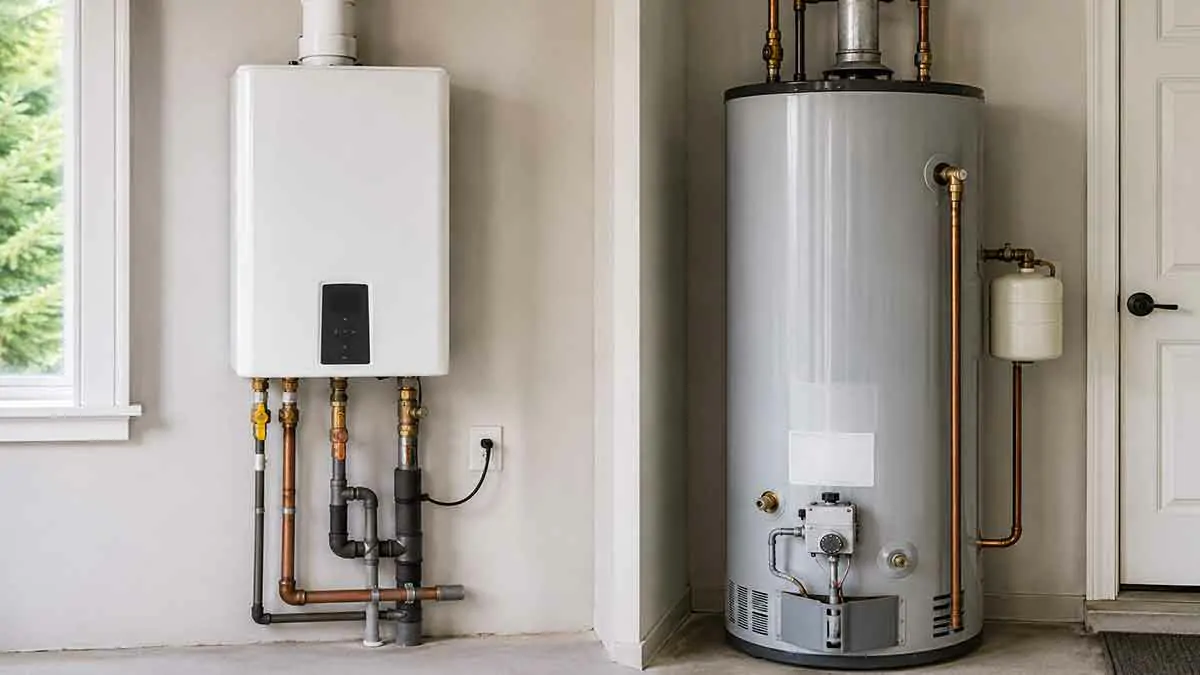
Choosing between a tankless and traditional water heater is an important decision for homeowners. Both systems provide hot water, but they operate in very different ways. A traditional water heater stores and continuously heats a supply of water, while a tankless water heater heats water only when it is needed.
The right choice depends on your household’s hot water demand, available space, energy source, installation requirements, budget, and long-term operating costs.
This guide compares tankless vs traditional water heaters to help you understand how each system works, their main advantages and disadvantages, and which option may be better for your home.
Table of Contents
How Traditional Water Heaters Work
Traditional water heaters, also called storage tank water heaters, keep a supply of heated water inside an insulated tank.
When you use hot water, the system sends stored hot water through your plumbing. Cold water then enters the tank and is heated to replace the water that was used.
The main components typically include:
- A storage tank
- A heating element or gas burner
- A thermostat
- A temperature and pressure relief valve
- Water supply connections
Traditional water heaters are available in different tank sizes. Choosing the right size is important because a tank that is too small may run out of hot water during periods of high demand.
How Tankless Water Heaters Work
Tankless water heaters heat water on demand.
Instead of storing a large amount of hot water, cold water flows through the unit when a hot water fixture is turned on. The system activates its heating components and warms the water as it passes through.
When the hot water demand stops, the heating process stops.
A tankless system usually includes:
- A heat exchanger
- Water flow sensors
- Heating components
- Temperature controls
- Water and energy connections
Because there is no large storage tank, tankless water heaters are generally more compact than traditional systems.
However, their ability to provide hot water depends on the unit’s flow capacity and the incoming water temperature.
Tankless vs Traditional Water Heater: Key Differences
The biggest difference is how each system handles hot water.
A traditional system stores heated water and makes it immediately available until the stored supply is depleted. A tankless system heats water as it flows through the unit.
This difference affects:
- Energy use
- Hot water availability
- Installation requirements
- Space requirements
- Upfront costs
- Maintenance needs
- Long-term lifespan
Understanding these differences can make it easier to determine which type of water heater fits your household.
Energy Efficiency
Tankless water heaters can reduce standby energy losses because they do not need to keep a large tank of water heated continuously.
Traditional tank systems lose some heat through the tank over time, even when no hot water is being used. The system must periodically reheat the stored water.
However, actual energy savings depend on factors such as:
- Household hot water usage
- Fuel type
- System efficiency
- Water temperature
- Incoming water temperature
- Installation quality
A tankless system is not automatically the most economical option in every household. Homes with high simultaneous hot water demand may require a larger unit or multiple units, which can increase installation costs.
Hot Water Supply
Tankless systems can provide a continuous supply of hot water as long as the system’s capacity is not exceeded.
This can be useful for households that frequently use hot water over extended periods.
However, tankless units have flow-rate limits. If multiple showers, appliances, and faucets demand hot water at the same time, the unit may struggle to maintain the desired temperature or supply.
Traditional water heaters can provide high flow from the stored supply until the tank becomes depleted. Once the available hot water is used, the household may need to wait for the tank to recover and heat more water.
The right choice depends heavily on how many people live in the home and how often multiple fixtures are used simultaneously.
Installation Cost
Traditional water heaters are usually less expensive to purchase and install.
Replacing an existing storage tank with a similar model may require relatively simple installation work.
Tankless water heaters often have higher upfront costs. Depending on the model and existing infrastructure, installation may require:
- Upgraded gas lines
- Electrical upgrades
- New venting
- Changes to plumbing connections
These additional requirements can significantly affect the total installation cost.
Before choosing a system, consider both the price of the unit and the full cost of installation.
Space Requirements
Tankless water heaters are compact and can often be installed on a wall.
This makes them useful in homes with limited utility space.
Traditional water heaters require enough room for the storage tank and appropriate service access.
If space is limited, a tankless unit may offer a significant advantage.
However, the installation location must still meet the manufacturer’s requirements for ventilation, clearances, electrical connections, and plumbing access.
Lifespan
Tankless water heaters often have a longer potential service life than traditional storage tank models.
Traditional water heater tanks can eventually fail due to internal corrosion or leaks.
Tankless systems do not have a large storage tank, but internal components can still wear out or develop mineral buildup.
Regular maintenance can affect the lifespan of either system.
Water quality is also important. Homes with hard water may require more frequent maintenance to reduce mineral accumulation.
Maintenance Requirements
Both types of water heaters require maintenance.
Traditional storage tank systems may require:
- Sediment flushing
- Anode rod inspection
- Leak inspections
- Safety component checks
Tankless systems may require:
- Descaling
- Filter cleaning
- Heat exchanger maintenance
- Inspection of water and energy connections
Maintenance needs depend on water quality and the manufacturer’s recommendations.
A system with hard water may need more frequent attention regardless of whether it uses a tank.
Upfront Cost vs Long-Term Cost
Traditional water heaters usually have lower upfront costs.
Tankless systems generally cost more to purchase and install but may offer energy savings and a longer service life in some situations.
The long-term value of each system depends on:
- Purchase price
- Installation expenses
- Energy costs
- Maintenance costs
- Repair costs
- Expected lifespan
For some homeowners, the lower initial cost of a traditional system is the priority. Others may prefer the potential long-term benefits of a tankless system.
It is useful to compare the total cost of ownership rather than focusing only on the initial purchase price.
Performance During High Demand
High hot water demand is one of the most important factors when comparing these systems.
A properly sized traditional tank can handle multiple fixtures for a limited period because it stores hot water in advance.
A tankless system can continue heating water for a long time, but only within its rated flow capacity.
For example, several simultaneous showers may require more hot water flow than a single tankless unit can provide.
Large households may need a high-capacity model or multiple tankless units.
Proper sizing is essential. Choosing the wrong capacity can result in poor performance regardless of the type of water heater.
Climate and Incoming Water Temperature
The temperature of incoming water affects how much work a tankless water heater must do.
In colder climates, groundwater may enter the system at a lower temperature. The water heater must raise the temperature by a larger amount, which can reduce the amount of hot water the unit can deliver at a given flow rate.
Traditional systems are also affected by incoming water temperature, but the impact is different because they store and gradually heat water inside a tank.
When comparing tankless models, consider the expected incoming water temperature and required temperature rise.
Gas vs Electric Options
Both tankless and traditional water heaters are available in gas and electric versions.
Gas systems can provide strong heating capacity, but installation may require proper venting and sufficient gas supply.
Electric systems may be simpler in some homes, but high-capacity electric tankless water heaters can require significant electrical capacity.
Before choosing a system, evaluate your existing energy infrastructure.
The best option may depend on whether your home already has suitable gas service, electrical capacity, or ventilation.
Advantages of Tankless Water Heaters
A tankless water heater may be a good option if you value:
- Compact size
- On-demand water heating
- Reduced standby heat loss
- Potentially longer service life
- Continuous hot water within the unit’s capacity
- Flexible installation options in some homes
Tankless systems can be especially useful for homes with limited space or predictable hot water demand.
Disadvantages of Tankless Water Heaters
Potential disadvantages include:
- Higher purchase costs
- Higher installation costs
- Possible infrastructure upgrades
- Flow-rate limitations
- More complex installation
- Sensitivity to mineral buildup
A tankless system must be properly sized for the household. Choosing a unit based only on the number of bathrooms may not provide an accurate estimate of actual hot water demand.
Advantages of Traditional Water Heaters
Traditional storage tank water heaters offer several benefits:
- Lower upfront cost
- Familiar technology
- Simple replacement in many homes
- Strong short-term flow capacity
- A wide range of tank sizes
They can be a practical choice for homeowners who want a straightforward system with a lower initial investment.
Disadvantages of Traditional Water Heaters
Potential disadvantages include:
- Standby energy losses
- Limited stored hot water
- Larger space requirements
- Potential tank corrosion
- Generally shorter service life
The risk of a tank eventually leaking is also an important consideration, especially if the unit is installed in an area where water damage could affect finished spaces.
Which Water Heater Is Best for Your Home?
There is no single answer that works for every household.
A tankless water heater may be better if:
- You have limited installation space.
- You want on-demand hot water.
- Your household demand fits within the system’s flow capacity.
- You are prepared for potentially higher installation costs.
- You want to prioritize long-term efficiency.
A traditional water heater may be better if:
- You want a lower upfront cost.
- Your existing plumbing is designed for a storage tank.
- You prefer simpler installation.
- You have enough space for a tank.
- You want strong hot water flow during short periods of high demand.
The most important factor is proper sizing.
Evaluate your household’s peak hot water demand, number of simultaneous users, energy source, water quality, and installation requirements before making a decision.
Questions to Ask Before Choosing
Before buying a new water heater, ask:
- How many people live in the home?
- How many showers or appliances may use hot water at the same time?
- How much installation space is available?
- What fuel or energy sources are available?
- Does the home need gas, electrical, or venting upgrades?
- Is the local water supply hard?
- What is the total installation budget?
- How important are long-term energy savings?
Answering these questions can help narrow down the best option.
When to Consult a Professional
A qualified plumber or water heating professional can help determine the correct system size and installation requirements.
Professional advice may be particularly valuable when:
- Replacing a tank with a tankless system
- Upgrading gas or electrical infrastructure
- Installing a system in a new location
- Managing high household hot water demand
- Dealing with hard water
- Planning a complex venting system
Proper installation is essential for safety, efficiency, and reliable performance.
Final Thoughts
The tankless vs traditional water heater decision depends on your home’s needs rather than simply choosing the newer technology.
Tankless water heaters offer compact design, on-demand heating, and potential efficiency advantages. Traditional water heaters provide lower upfront costs, straightforward installation, and reliable access to stored hot water.
Compare the total installation cost, household hot water demand, available space, energy source, maintenance requirements, and long-term operating costs before choosing.
A properly sized and professionally installed water heater can provide reliable hot water for years, regardless of whether you choose a tankless or traditional system.