
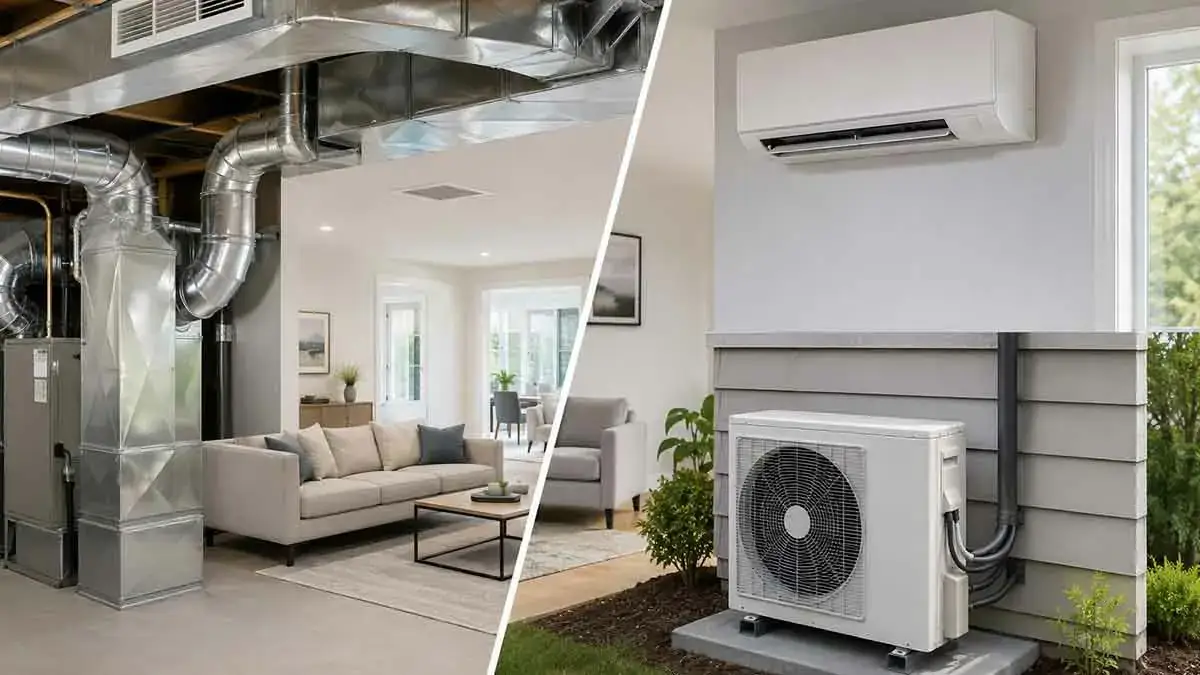
Choosing between central air conditioning and a ductless mini-split system depends on your home’s layout, existing HVAC infrastructure, cooling needs, budget, and energy-efficiency goals. Both systems can provide effective cooling, but they work differently and offer distinct advantages.
Central air conditioning distributes cooled air through a network of ducts, making it a common choice for homes that already have suitable ductwork. Ductless mini-split systems use individual indoor air-handling units connected to an outdoor compressor and do not require traditional air ducts.
This guide compares central air vs ductless mini-split systems, including installation, efficiency, comfort, maintenance, operating costs, zoning, noise, appearance, and the situations where each option may make the most sense.
Table of Contents
Central Air vs Ductless Mini-Split: Quick Comparison
| Feature | Central Air | Ductless Mini-Split |
|---|---|---|
| Distribution | Ductwork | Individual indoor units |
| Best for | Whole-home cooling | Zoned or room-by-room cooling |
| Ductwork required | Yes | No |
| Zoning | Possible with appropriate design | Built into multi-zone configurations |
| Installation | More involved if ducts are absent | Often easier where ducts are unavailable |
| Efficiency | Can be highly efficient with good ductwork | Often very efficient with properly sized equipment |
| Appearance | Mostly hidden vents | Indoor wall, ceiling, or floor units are visible |
| Maintenance | Includes ducts and central equipment | Includes indoor and outdoor units |
| Home additions | May require duct modifications | Often convenient for individual additions |
| Heating capability | Depends on system | Many models provide heating and cooling |
Neither system is automatically better for every home. The best choice depends on the building and how you want to control temperature.
What Is Central Air Conditioning?
Central air conditioning is a whole-home cooling system that uses an outdoor condenser and an indoor coil or air handler to cool air.
The cooled air is distributed through ductwork to rooms throughout the house.
A central air system typically includes:
- Outdoor condenser unit
- Indoor evaporator coil
- Air handler or furnace
- Ductwork
- Supply registers
- Return-air system
- Thermostat
Central air is particularly practical when a home already has properly designed ductwork.
What Is a Ductless Mini-Split?
A ductless mini-split is an air-conditioning system that does not rely on traditional ductwork.
A typical system contains:
- Outdoor compressor or heat-pump unit
- One or more indoor air-handling units
- Refrigerant lines
- Electrical connections
- Control system
The indoor units are installed directly in the rooms or zones they serve.
Many ductless systems are heat pumps, meaning they can provide both cooling and heating.
How Central Air Works
Central air conditioning cools air at a central indoor coil.
The system then uses a blower to distribute conditioned air through the home’s ductwork.
Warm indoor air returns through return registers, passes through the cooling system, and is redistributed through supply vents.
This arrangement allows one central system to condition multiple rooms.
How Ductless Mini-Splits Work
A ductless mini-split transfers heat between the indoor and outdoor units through refrigerant lines.
Indoor units deliver conditioned air directly into the rooms they serve.
A single-zone system generally serves one area, while a multi-zone system can connect several indoor units to one outdoor unit.
Because there are no traditional supply ducts, ductless systems avoid the energy losses associated with poorly sealed or poorly insulated ductwork.
Central Air vs Ductless Mini-Split Installation
Installation requirements are one of the biggest differences between the two systems.
Central air installation can be relatively straightforward when suitable ductwork already exists.
If a home does not have ductwork, installing a complete duct system can involve:
- Opening walls or ceilings
- Creating duct pathways
- Installing supply and return registers
- Modifying existing structures
- Adding insulation around ducts where necessary
A ductless mini-split usually requires much less interior distribution infrastructure.
However, installation still involves refrigerant lines, electrical work, condensate management, equipment mounting, and proper sizing.
Both systems should be installed by qualified HVAC professionals.
Cooling Efficiency
Efficiency depends on equipment quality, sizing, installation, climate, and how the system is operated.
Central air can perform efficiently when:
- Equipment is correctly sized
- Ductwork is properly designed
- Ducts are sealed
- Duct insulation is appropriate
- Filters are maintained
- Airflow is correct
Ductless mini-splits can avoid duct-related losses and often provide efficient zone-based cooling.
However, efficiency should be evaluated using the system’s actual performance ratings and the home’s cooling requirements rather than assuming one technology is always more efficient.
Operating Costs
Operating costs depend on several factors.
Important variables include:
- Equipment efficiency
- Electricity rates
- Climate
- Home insulation
- Air leakage
- Thermostat settings
- System sizing
- Duct condition
- Number of zones being cooled
A ductless system may reduce energy use when you only need to cool occupied rooms.
Central air can be economical for homes where the entire house requires consistent cooling and the existing ductwork is efficient.
Zoning and Temperature Control
Zoning is a major advantage of ductless mini-splits.
Each indoor unit can generally be controlled independently.
For example, you may cool a bedroom at night without cooling an unused room.
Central air can also support zoning, but it usually requires additional equipment and properly designed ductwork.
If individual room control is a high priority, ductless systems may offer a simpler approach.
Cooling Performance
Both systems can provide effective cooling when correctly sized and installed.
Central air distributes cooling throughout the home through the duct system.
Ductless systems deliver cooling directly into designated zones.
The best performance depends heavily on:
- Correct equipment sizing
- Proper installation
- Airflow
- Insulation
- Window exposure
- Building orientation
- Home layout
Oversized or undersized equipment can create comfort and efficiency problems regardless of system type.
Indoor Air Quality
Central HVAC systems can provide opportunities for centralized filtration because air passes through a common return-air system.
Depending on the system, homeowners may also use:
- Higher-efficiency filters
- Air cleaners
- Humidity controls
- Whole-home filtration equipment
Ductless systems have filters within their indoor units and can provide effective filtration of the air that passes through them.
However, neither system automatically solves every indoor air-quality problem.
Ventilation, source control, filtration, and humidity management are separate considerations.
Noise Levels
Modern central air systems can be relatively quiet inside the home because the main compressor is outdoors and indoor air distribution occurs through ducts.
Ductless systems place indoor fan units directly inside living spaces.
The noise level depends on the specific equipment, fan speed, installation quality, and room acoustics.
When choosing a mini-split, check the manufacturer’s published indoor sound ratings if low noise is important.
Appearance and Space Requirements
Central air generally has a visual advantage because most of the distribution system is hidden.
Rooms usually have only supply and return registers.
Ductless mini-splits require visible indoor units unless a concealed installation is used.
Indoor mini-split units can be mounted:
- High on walls
- In ceilings
- Near floors
- Inside concealed spaces with compatible equipment
The best configuration depends on the home’s layout and the equipment selected.
Maintenance Requirements
Both systems require regular maintenance.
Central air maintenance may include:
- Filter replacement
- Outdoor unit cleaning
- Condensate drainage checks
- Coil inspection
- Duct inspection
- Thermostat checks
- Professional seasonal service
Ductless maintenance may include:
- Cleaning indoor filters
- Cleaning indoor coils
- Checking condensate drainage
- Maintaining outdoor equipment
- Inspecting refrigerant lines
- Professional system service
Mini-split indoor units may require more frequent cleaning because dust can accumulate directly on their filters and components.
Reliability and Equipment Life
System longevity depends on equipment quality, installation, maintenance, operating conditions, and usage.
Poor installation or inadequate maintenance can shorten the life of either system.
Regular inspections can help identify:
- Refrigerant problems
- Drainage issues
- Electrical faults
- Airflow restrictions
- Mechanical wear
Manufacturer maintenance recommendations should be followed.
Which System Is Better for Existing Homes?
For an existing home, the first question should be whether suitable ductwork already exists.
If the home already has functional ducts from a furnace or previous central air system, adding or replacing central air may be practical.
If the home has no ductwork, a mini-split can avoid the disruption and expense associated with installing a new duct network.
Which System Is Better for New Construction?
New construction offers more flexibility.
Central air may work well when the home is being designed around a centralized HVAC system and ductwork can be integrated into the building layout.
Ductless systems may be attractive when the design emphasizes:
- Zoned comfort
- Individual room control
- Minimal ductwork
- Efficient heating and cooling
The HVAC design should be determined early because ductwork, electrical requirements, equipment locations, and ventilation need to be coordinated with the building design.
Central Air for Homes With Existing Ductwork
Central air is often a natural choice when a home already has properly designed ductwork.
Advantages may include:
- Familiar distribution system
- Hidden equipment in many areas
- Centralized temperature control
- Whole-home cooling
- Compatibility with existing forced-air equipment
However, old or poorly designed ducts should be evaluated before assuming they are suitable for a new system.
Ductless Mini-Splits for Homes Without Ductwork
Ductless mini-splits can be especially useful in homes where installing ducts would be disruptive.
They may be suitable for:
- Older homes
- Small homes
- Individual rooms
- Home offices
- Converted garages
- Finished spaces
- Home additions
The number and placement of indoor units should be based on the home’s heating and cooling requirements.
Central Air for Whole-Home Cooling
Central air is often well suited to homes where occupants want relatively consistent cooling across many rooms.
One centralized system can distribute conditioned air throughout the building.
However, whole-home cooling should not mean cooling every room identically if the home has substantially different comfort requirements.
A properly designed zoning system may improve comfort.
Mini-Splits for Individual Rooms
A single-zone mini-split can be useful when only one area requires dedicated cooling.
Common applications include:
- Bedrooms
- Home offices
- Garages converted into living spaces
- Sunrooms
- Workshops
- Small additions
This can avoid installing a complete duct system for a relatively small area.
Multi-Zone Mini-Split Systems
Multi-zone systems use multiple indoor units connected to an outdoor unit.
This allows different areas of the home to have individual temperature controls.
Multi-zone systems can be useful when:
- Rooms have different cooling requirements
- Some rooms are used more frequently than others
- The home has no ductwork
- Zoned comfort is important
System design is important because outdoor-unit capacity and indoor-unit combinations must be compatible.
Central Air vs Mini-Split in Older Homes
Older homes often have layouts that make duct installation difficult.
Walls, ceilings, historic finishes, limited mechanical spaces, and additions can make new ductwork expensive or disruptive.
A ductless mini-split may provide a practical alternative.
However, central air can still make sense when the home already has usable ducts or when a major renovation provides an opportunity to install new ductwork.
Central Air vs Mini-Split for Home Additions
A new addition can create an HVAC challenge.
Extending existing central-air ductwork may be practical if:
- The existing system has sufficient capacity
- Ductwork can be extended appropriately
- The addition is integrated into the HVAC design
A mini-split can be attractive when extending the existing system would be difficult.
The addition should be evaluated independently rather than simply adding a vent without confirming that the HVAC system can handle the additional load.
Central Air vs Mini-Split for Small Homes
Smaller homes do not necessarily require smaller versions of the same HVAC design.
A ductless system can be attractive because it avoids installing extensive ductwork.
Central air may still be appropriate if the home already has a suitable forced-air system.
Equipment should be sized according to the actual cooling load rather than the home’s floor area alone.
Central Air vs Mini-Split for Large Homes
Large homes can use either approach.
Central air may simplify whole-home distribution.
Ductless systems can provide multiple zones but may require several indoor units.
For a large home, compare:
- Number of zones
- Equipment capacity
- Installation complexity
- Indoor-unit placement
- Maintenance requirements
- Long-term operating costs
A professional load calculation and HVAC design can help determine the most appropriate configuration.
Installation Cost Considerations
The installation cost of either system varies significantly.
Central-air costs may increase when:
- New ductwork is required
- Electrical upgrades are needed
- Access is difficult
- Structural modifications are necessary
- Existing ducts require repairs
Mini-split costs may increase with:
- Multiple indoor units
- Long refrigerant-line runs
- Difficult mounting locations
- Electrical upgrades
- Complex condensate drainage
The lowest installation price is not necessarily the lowest long-term cost.
Long-Term Cost Considerations
When comparing systems, consider more than the purchase price.
Evaluate:
- Installation
- Electricity consumption
- Maintenance
- Repairs
- Equipment replacement
- Duct repairs
- Indoor-unit cleaning
- Expected usage
A system that costs more initially may provide better value if it matches the home’s actual cooling needs.
Climate Considerations
Climate can influence the best HVAC choice.
In hot climates, cooling efficiency and humidity management are particularly important.
In colder climates, a ductless heat pump may provide both heating and cooling, but its cold-weather performance should be evaluated based on the specific model.
In humid regions, proper sizing and moisture management are especially important.
The system should be selected for the local climate rather than based solely on general efficiency claims.
Heating With a Ductless Mini-Split
Many ductless mini-splits are heat pumps and can reverse the refrigeration cycle to provide heating.
This can make them useful as year-round HVAC systems.
However, heating performance varies by model and outdoor temperature.
When using a mini-split for heating, check:
- Low-temperature performance
- Heating capacity
- Defrost operation
- Backup heating requirements
- Manufacturer specifications
Common Central Air Drawbacks
Central air can have several disadvantages.
Requires Ductwork
Homes without ducts may require substantial installation work.
Duct Energy Losses
Poorly sealed or insulated ducts can reduce efficiency.
Less Direct Zoning
Room-by-room control may require additional zoning equipment.
Larger Installation
Installing ductwork can require more space and structural modification.
Centralized Failure
If one whole-home system fails, cooling may be lost throughout the home.
Common Ductless Mini-Split Drawbacks
Mini-splits also have limitations.
Visible Indoor Units
Wall-mounted units are visible in most installations.
Multiple Units
Large homes may require several indoor units.
Cleaning Requirements
Indoor units need regular filter and surface maintenance.
Installation Appearance
Refrigerant lines and condensate piping need to be routed carefully.
Uneven Room Coverage
A poorly designed system may leave some areas uncomfortable.
How to Choose Between Central Air and Mini-Split
Consider these questions:
- Does the home already have usable ductwork?
- Do you need whole-home or zone-based cooling?
- How much disruption can installation cause?
- Is energy efficiency a major priority?
- Do you want room-by-room temperature control?
- How important is a hidden HVAC appearance?
- Does the system need to provide heating as well as cooling?
- What is the home’s climate?
- How many rooms require conditioning?
- What are the long-term maintenance requirements?
If the home already has good ductwork and requires whole-home cooling, central air may be a practical choice.
If the home lacks ductwork or requires highly targeted temperature control, a ductless mini-split may be more suitable.
Central Air vs Ductless Mini-Split: Pros and Cons
Central Air Pros
- Effective whole-home cooling
- Mostly hidden distribution
- Familiar HVAC configuration
- Can integrate with existing forced-air systems
- Centralized control
- Can support zoning with appropriate design
Central Air Cons
- Requires ductwork
- Duct installation can be disruptive
- Duct losses can reduce efficiency
- Room-by-room control may require additional equipment
- Large system failure can affect the entire home
Ductless Mini-Split Pros
- Does not require traditional ductwork
- Excellent zoning capability
- Useful for additions and individual rooms
- Can be highly efficient
- Many systems provide heating and cooling
- Less structural disruption in many installations
Ductless Mini-Split Cons
- Indoor units remain visible
- Multiple rooms may require multiple units
- Indoor units require regular cleaning
- Installation quality strongly affects performance
- Refrigerant and condensate lines require careful routing
DIY vs Professional Installation
Basic maintenance can often be handled by homeowners, including:
- Cleaning accessible filters
- Keeping outdoor equipment clear
- Checking vents
- Monitoring unusual noises
- Keeping the surrounding area free of debris
Installation and technical repairs should be handled by qualified HVAC professionals.
Central air and mini-split installation can involve:
- Electrical work
- Refrigerant systems
- Equipment sizing
- Condensate drainage
- Ductwork
- Structural considerations
Incorrect installation can reduce efficiency, shorten equipment life, and create safety or performance problems.
Central Air vs Ductless Mini-Split FAQs
Is a ductless mini-split more efficient than central air?
It can be, particularly when zone-based cooling reduces unnecessary conditioning and when central-air ductwork is inefficient. However, actual efficiency depends on equipment, installation, sizing, and operating conditions.
Is central air better for a whole house?
Central air is often convenient for whole-home cooling because one system can distribute conditioned air throughout the house. A properly designed multi-zone mini-split system can also provide whole-home comfort.
Is a mini-split cheaper to install than central air?
It can be, especially when the alternative requires installing new ductwork. However, the cost depends on the number of zones, installation complexity, electrical requirements, and equipment selected.
Can a mini-split replace central air?
Yes, a properly designed ductless system can provide cooling for an entire home. Larger homes may require multiple indoor units or zones.
Can central air work without ductwork?
Traditional central air requires a method of distributing conditioned air. If a home does not have suitable ducts, a new duct system or another distribution approach would be necessary.
Do mini-splits require more maintenance?
They require regular cleaning of their indoor filters and components. Central systems also require maintenance, including filters, coils, condensate drainage, and potentially ductwork.
Which system is better for an addition?
A ductless mini-split is often convenient for an addition when extending the existing central system is difficult. However, the best option depends on the existing HVAC system and the size and design of the addition.
Which system is quieter?
Both can be quiet when properly installed. Central air typically keeps the compressor outdoors and distributes air through ducts, while mini-split indoor units operate inside living spaces. Check manufacturer sound ratings when noise is a major concern.
Can a mini-split heat and cool?
Many mini-splits are heat pumps capable of both heating and cooling. Check the specific model’s heating performance and low-temperature specifications.
Should I choose central air or a mini-split?
Choose based on the home’s existing infrastructure, cooling requirements, zoning preferences, climate, installation constraints, and long-term operating considerations rather than choosing solely by system type.
Final Thoughts
The choice between central air and a ductless mini-split depends primarily on the home rather than on a universal winner.
Central air can be an excellent solution for homes with existing, well-designed ductwork that need consistent whole-home cooling. It provides centralized distribution and keeps most of the HVAC infrastructure out of sight.
Ductless mini-splits are particularly useful when a home lacks ductwork, when individual zones require different temperatures, or when cooling needs to be added to specific rooms or additions without major structural modifications.
Before making a decision, evaluate the home’s cooling load, existing ductwork, insulation, air leakage, climate, electrical requirements, and desired zoning. Proper equipment sizing and professional installation are just as important as choosing the right HVAC technology.
The best system is the one that matches the home’s design, provides the required comfort, and delivers reliable performance without unnecessary installation or operating costs.