
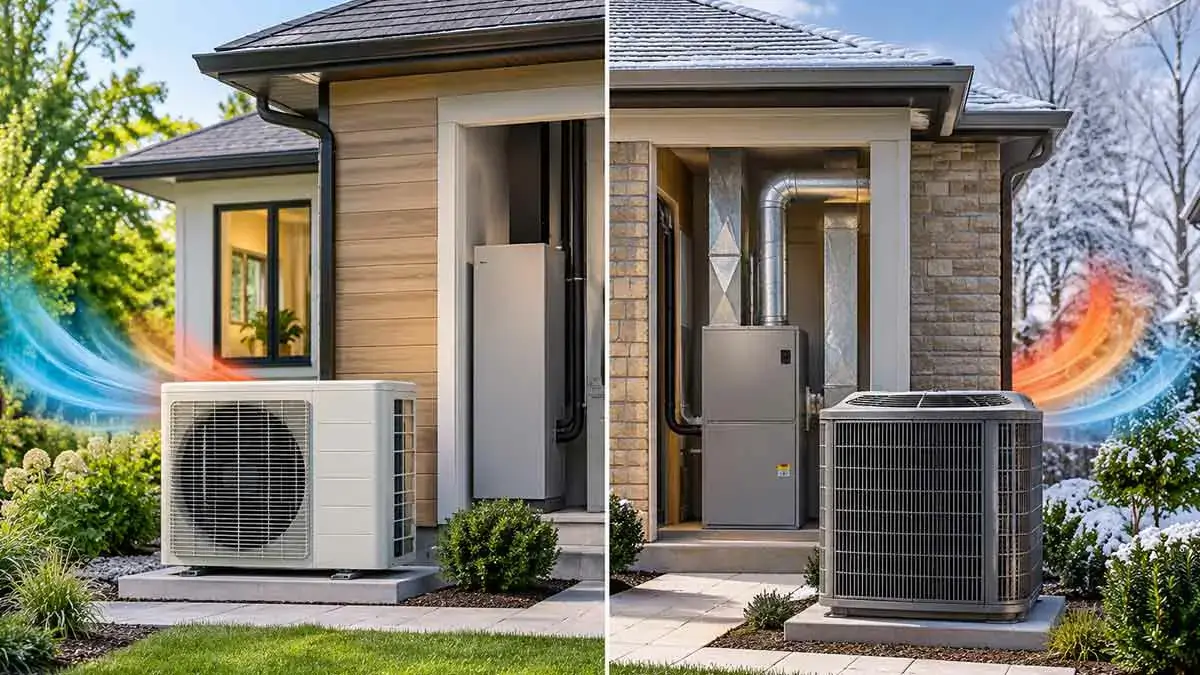
Choosing between a heat pump and a traditional HVAC system depends on your climate, heating and cooling needs, energy costs, existing equipment, and home design. Both approaches can provide reliable indoor comfort, but they use different methods to heat and cool a home.
A heat pump can provide both heating and cooling by transferring heat between the home and outdoors. Traditional HVAC systems often use separate technologies for heating and cooling, such as a gas furnace paired with a central air conditioner.
Understanding the differences between heat pumps and traditional HVAC systems can help homeowners evaluate efficiency, operating costs, heating performance, cooling capability, installation requirements, maintenance, and long-term value.
This guide compares heat pump vs traditional HVAC systems and explains which option may be more suitable for different homes and climates.
Table of Contents
Heat Pump vs Traditional HVAC: Quick Comparison
| Feature | Heat Pump | Traditional HVAC |
|---|---|---|
| Heating | Transfers heat into the home | Often uses combustion or electric resistance |
| Cooling | Transfers heat outside | Usually uses an air conditioner |
| Heating and cooling | One system can provide both | Often separate heating and cooling equipment |
| Energy efficiency | Often highly efficient | Depends strongly on equipment type |
| Cold-weather performance | Depends on model and climate | Furnace systems can provide strong heating in very cold weather |
| Ductwork | Required for ducted systems; not required for ductless models | Depends on system design |
| Zoning | Available with some systems | Available with appropriate equipment |
| Maintenance | Requires heat-pump-specific service | Depends on furnace, boiler, AC, or other equipment |
| Installation | Varies significantly | Varies significantly |
| Best fit | Homes seeking efficient heating and cooling | Homes suited to existing conventional heating/cooling systems |
There is no universal winner. The right choice depends on the home’s climate, existing HVAC infrastructure, energy costs, and heating requirements.
What Is a Heat Pump?
A heat pump is an HVAC system that moves heat rather than generating it directly for heating.
In cooling mode, it removes heat from the home and releases it outdoors.
In heating mode, it reverses the process and transfers available heat from outdoors into the home.
Many residential heat pumps can therefore provide:
- Heating
- Cooling
- Dehumidification during cooling
- Temperature control
Heat pumps can be air-source, ground-source, or configured as part of a dual-fuel system.
What Is Traditional HVAC?
Traditional HVAC is a broad term commonly used to describe conventional heating and cooling arrangements.
A traditional residential system may include:
- Gas furnace
- Electric furnace
- Boiler
- Central air conditioner
- Ductwork
- Thermostat
- Air handler
A common configuration uses a furnace for heating and a separate central air conditioner for cooling.
The exact system varies by home and region.
How Heat Pumps Work
Heat pumps use a refrigeration cycle to transfer heat.
In heating mode, the outdoor unit extracts heat from outdoor air and transfers it indoors.
In cooling mode, the system reverses the direction of heat transfer.
This allows one heat-pump system to provide both heating and cooling.
The efficiency and heating capacity of a heat pump depend on the specific equipment, outdoor temperature, installation, and operating conditions.
How Traditional HVAC Systems Work
Traditional HVAC systems use different methods depending on the equipment.
For example, a gas furnace burns fuel to generate heat and uses a blower to distribute warm air.
A central air conditioner removes heat from indoor air and releases it outdoors.
Other traditional systems may use:
- Electric resistance heating
- Boilers
- Radiant heating
- Packaged HVAC equipment
Because “traditional HVAC” covers several technologies, operating performance varies considerably.
Heating Performance
Heat pumps can provide efficient heating because they transfer heat rather than creating it directly through combustion or electrical resistance.
Traditional furnaces can produce strong and consistent heat, particularly gas furnaces in cold climates.
The important comparison is not simply heat pump versus traditional HVAC, but the actual heating technologies being compared.
For example, an air-source heat pump and a gas furnace have very different operating characteristics.
Cooling Performance
Heat pumps can provide cooling in much the same general way as central air-conditioning systems.
They remove heat from indoor air and transfer it outdoors.
A traditional HVAC setup may use a separate central air conditioner for cooling.
Modern heat pumps can provide highly effective cooling when correctly sized and installed.
Energy Efficiency
Energy efficiency is one of the major reasons homeowners consider heat pumps.
Because a heat pump transfers heat rather than generating it directly during normal operation, it can deliver substantial heating output relative to the electricity it consumes.
Traditional HVAC efficiency varies widely.
For example:
- High-efficiency furnaces can perform very well
- Electric resistance heating is generally less efficient for delivered heat than a heat pump
- Older HVAC equipment may consume significantly more energy than modern equipment
Actual energy savings depend on equipment efficiency, climate, utility rates, insulation, air leakage, and system operation.
Operating Costs
Operating costs depend on both the equipment and local energy prices.
Important factors include:
- Electricity price
- Natural gas price
- Fuel availability
- Heating demand
- Cooling demand
- Equipment efficiency
- Home insulation
- Thermostat settings
A heat pump may have lower operating costs in some climates, particularly where electricity prices are favorable and heating loads are moderate.
A traditional furnace may remain economically attractive in areas with relatively inexpensive natural gas.
Compare annual operating costs rather than relying only on equipment efficiency ratings.
Performance in Cold Weather
Cold-weather performance is an important consideration when evaluating heat pumps.
Modern cold-climate heat pumps are designed to operate at lower outdoor temperatures than many older models.
However, heating capacity and efficiency generally change as outdoor temperatures fall.
When evaluating a heat pump for a cold climate, check:
- Rated heating capacity
- Low-temperature performance
- Efficiency at relevant temperatures
- Defrost behavior
- Backup heating requirements
A conventional furnace can provide dependable high-temperature heat even when outdoor temperatures are extremely low.
Performance in Hot Weather
Heat pumps can provide effective cooling during hot weather.
Cooling performance depends on:
- Equipment sizing
- Efficiency rating
- Outdoor temperature
- Indoor humidity
- Ductwork
- Insulation
- Air leakage
A heat pump should be evaluated for both its heating and cooling performance because it serves both functions.
Heat Pump vs Gas Furnace
A heat pump and gas furnace differ fundamentally in how they provide heat.
Heat Pump
- Transfers heat
- Uses electricity
- Can provide cooling
- Often provides high heating efficiency
- May require backup heat in some conditions
Gas Furnace
- Burns natural gas or another fuel
- Generates heat directly
- Provides strong heating output
- Requires a separate cooling system for air conditioning
- Depends on fuel availability and combustion equipment
The better choice depends on climate, energy prices, existing infrastructure, and homeowner priorities.
Heat Pump vs Electric Furnace
Electric resistance furnaces generate heat by passing electricity through resistance elements.
Heat pumps also use electricity, but they transfer heat rather than producing it directly.
For many applications, a heat pump can provide more heating output per unit of electricity consumed than electric resistance heating.
However, actual performance depends on outdoor conditions and equipment specifications.
Heat Pump vs Central Air Conditioner
A heat pump can provide cooling similar to an air conditioner while also providing heating.
A conventional central air conditioner only provides cooling.
If a home already has a compatible furnace and central air-conditioning system, replacing or modifying the system may require evaluating the existing equipment rather than comparing cooling equipment alone.
Heating and Cooling in One System
One advantage of a heat pump is that the same system can provide both heating and cooling.
This can simplify equipment configuration.
A traditional HVAC arrangement may use:
- Furnace for heating
- Air conditioner for cooling
This can still be an effective and familiar configuration, especially where the home already has suitable ductwork and established fuel infrastructure.
Installation Considerations
Installation complexity varies considerably.
Heat-pump installation may involve:
- Outdoor equipment
- Indoor air handler or compatible furnace
- Refrigerant lines
- Electrical connections
- Condensate drainage
- Thermostat controls
Traditional HVAC installation can involve:
- Furnace or boiler
- Central air conditioner
- Ductwork
- Fuel connections
- Electrical connections
- Venting for combustion equipment
The existing home infrastructure can have a major effect on installation requirements.
Existing HVAC Infrastructure
Existing equipment should be evaluated before selecting a replacement.
If a home already has:
- Functional ductwork
- A suitable air handler
- Central air-conditioning infrastructure
- Electrical capacity
- Gas service
one option may be easier to integrate than another.
However, compatibility should be confirmed by a qualified HVAC professional.
Ductwork Requirements
Ducted heat pumps use ductwork in a similar way to central forced-air systems.
Ductless heat pumps do not require traditional distribution ducts.
Traditional HVAC systems may also use ducts, although boilers and other systems can distribute heat through radiators or hydronic loops.
Poorly designed or leaking ducts can reduce the performance of any ducted HVAC system.
Zoning and Temperature Control
Heat pumps can support zoning depending on the system design.
Ductless mini-split heat pumps can provide particularly direct room-by-room control.
Traditional HVAC systems can also provide zoning through:
- Multiple systems
- Zoned ductwork
- Multiple thermostats
- Appropriate control equipment
Zoning should be designed carefully to avoid airflow and equipment-capacity problems.
Indoor Comfort
Both approaches can provide comfortable indoor temperatures when correctly designed.
Heat pumps may provide longer, lower-intensity heating cycles compared with some furnace systems.
Furnaces can deliver higher-temperature supply air during heating operation.
Comfort depends on more than supply-air temperature, including:
- Equipment sizing
- Airflow
- Insulation
- Building envelope
- Humidity
- Thermostat control
Humidity Management
Cooling systems generally remove some moisture from indoor air.
Heat pumps can therefore help control humidity while operating in cooling mode.
Heating can have different effects depending on the climate and equipment.
If humidity remains too high or too low, the solution may require dedicated humidity-control equipment rather than relying solely on the HVAC system.
Noise Levels
Modern heat pumps and traditional HVAC systems can both operate relatively quietly.
Noise depends on:
- Equipment model
- Fan speed
- Compressor design
- Installation quality
- Indoor unit location
- Outdoor unit location
A heat pump may operate for longer periods at lower output, depending on its design and controls.
Always check manufacturer sound ratings if noise is a major concern.
Maintenance Requirements
Heat pumps require routine maintenance for both heating and cooling operation.
Typical maintenance may include:
- Filter replacement
- Coil inspection
- Condensate drainage checks
- Outdoor-unit cleaning
- Electrical inspection
- Refrigerant-system evaluation
- Control checks
Traditional HVAC maintenance depends on the equipment.
A furnace may require combustion and safety checks, while a central air conditioner requires cooling-system maintenance.
Follow manufacturer requirements and use qualified professionals for technical service.
Equipment Lifespan
Equipment life varies according to:
- Equipment quality
- Installation
- Maintenance
- Climate
- Operating hours
- Environmental exposure
Neither heat pumps nor traditional HVAC systems have a guaranteed lifespan.
Regular maintenance and correct installation can help reduce premature failures.
Reliability
Modern heat pumps can provide reliable heating and cooling when properly selected for the climate.
Traditional systems can also be highly reliable.
Reliability depends heavily on:
- Proper sizing
- Installation quality
- Maintenance
- Equipment age
- Operating conditions
In cold climates, homeowners considering a heat pump should understand its low-temperature operating limits and backup-heating strategy.
Environmental Considerations
Heat pumps can reduce direct on-site combustion because they typically use electricity rather than burning fuel inside the home.
Their overall environmental impact depends partly on how the electricity is generated.
Traditional gas heating involves on-site fuel combustion.
Environmental performance should therefore be evaluated across the equipment’s energy source, efficiency, refrigerant, operating life, and local electricity mix.
Climate Considerations
Climate is one of the most important factors in the decision.
Mild Climates
Heat pumps can be particularly attractive because they can provide efficient heating and cooling throughout the year.
Cold Climates
Cold-climate heat pumps may work well, but low-temperature performance and backup heating need careful consideration.
Hot Climates
Cooling performance and humidity management become especially important.
Mixed Climates
A heat pump can provide both seasonal heating and cooling, potentially reducing the need for separate equipment.
Heat Pump Types
Several heat-pump configurations are available.
Air-Source Heat Pumps
These transfer heat between the home and outdoor air.
They are among the most common residential heat-pump systems.
Ground-Source Heat Pumps
Ground-source systems exchange heat with the ground rather than directly with outdoor air.
They can offer stable performance but generally involve more complex and expensive installation.
Dual-Fuel Heat Pumps
A dual-fuel system combines a heat pump with another heating source, commonly a gas furnace.
The system can select the appropriate heating source based on operating conditions and control settings.
Backup Heating
Some heat-pump installations include backup heating.
Backup options can include:
- Electric resistance heat
- Gas furnace
- Other compatible heating systems
The need for backup heating depends on climate, heat-pump model, home heating load, and homeowner preferences.
Heat Pump Defrost Cycles
Air-source heat pumps can develop frost on the outdoor coil during certain heating conditions.
The system may temporarily enter a defrost cycle to remove accumulated frost.
During defrost, the system may briefly change operating behavior.
This is normal for equipment designed to operate in these conditions.
Frequent or abnormal defrosting, however, should be professionally evaluated.
Heat Pump Performance During Extreme Cold
Extreme cold can reduce the amount of heat available from outdoor air and may reduce a heat pump’s heating capacity.
This does not mean all heat pumps stop working in cold weather.
Modern equipment varies considerably in low-temperature capability.
When choosing a heat pump for a cold region, use the manufacturer’s performance data at the temperatures relevant to your location.
Traditional HVAC Advantages
Traditional HVAC systems can offer several benefits.
Familiar Technology
Furnaces, boilers, and central air conditioners are widely understood by HVAC professionals.
Strong Cold-Weather Heating
Many furnace systems can deliver substantial heating output in very cold conditions.
Existing Infrastructure
Homes may already have compatible equipment, ductwork, and fuel connections.
Flexible Equipment Choices
Homeowners can choose among furnaces, boilers, central air conditioners, and other conventional technologies.
Traditional HVAC Drawbacks
Traditional systems can also have limitations.
Separate Heating and Cooling Equipment
A conventional setup often requires both a heating system and an air conditioner.
Fuel Dependence
Gas or oil systems depend on fuel availability and pricing.
Combustion
Combustion systems require proper venting, safety controls, and maintenance.
Potentially Higher Energy Use
Older or inefficient equipment may consume substantially more energy than modern alternatives.
Heat Pump Advantages
Heat pumps offer several potential benefits.
Heating and Cooling
One system can provide both functions.
High Heating Efficiency
Heat pumps can provide efficient heating under suitable operating conditions.
No On-Site Fuel Combustion
Most residential heat pumps use electricity rather than burning fuel inside the home.
Zoning Options
Ductless heat pumps can offer effective zone-based temperature control.
Year-Round Operation
The same equipment can operate during both heating and cooling seasons.
Heat Pump Drawbacks
Heat pumps also have limitations.
Higher Upfront Cost in Some Installations
Equipment and installation costs vary considerably.
Cold-Weather Performance
Not every heat pump is designed for severe cold.
Backup Heating May Be Needed
Some homes require supplemental heating under certain conditions.
Electrical Requirements
Electrical capacity may need evaluation during installation.
More Complex Refrigeration Equipment
Technical repairs should be handled by qualified professionals.
Which System Is Better for Older Homes?
Older homes require careful evaluation.
Consider:
- Existing heating equipment
- Existing ductwork
- Insulation
- Air leakage
- Electrical capacity
- Available fuel
- Home layout
A heat pump may be attractive when replacing aging equipment, but the building envelope and distribution system should also be evaluated.
Which System Is Better for New Homes?
New construction provides greater flexibility.
A heat pump can be integrated into the home’s design from the beginning.
This allows designers to coordinate:
- Equipment location
- Ductwork
- Electrical requirements
- Insulation
- Air sealing
- Ventilation
- Zoning
Traditional HVAC systems can also be highly effective when incorporated into a well-designed building.
Which System Is Better for Mild Climates?
Heat pumps are often particularly well suited to mild climates because they can efficiently provide both heating and cooling.
However, local electricity prices and the home’s heating demand should still be considered.
Which System Is Better for Cold Climates?
Cold climates require closer attention to heat-pump performance data.
A modern cold-climate heat pump may be an excellent option, but homeowners should evaluate:
- Low-temperature capacity
- Efficiency at design temperatures
- Backup heating
- Electrical requirements
- Local climate conditions
A furnace may remain attractive when extremely high heating output is required or when existing fuel infrastructure makes it economical.
Which System Is Better for Hot Climates?
In hot climates, cooling efficiency and humidity control are major considerations.
A heat pump can provide cooling effectively while also providing heating during cooler periods.
A conventional air conditioner paired with a furnace or other heating system can also be effective.
Installation Cost Considerations
Installation costs vary significantly based on the home and equipment.
Heat-pump costs may increase because of:
- Electrical upgrades
- New indoor equipment
- Refrigerant-line installation
- Difficult equipment locations
- Duct modifications
- Backup heating requirements
Traditional HVAC costs may increase because of:
- New ductwork
- Furnace installation
- Fuel-line work
- Venting
- Electrical modifications
- Separate cooling equipment
Get a detailed installation estimate rather than comparing equipment prices alone.
Long-Term Cost Considerations
The purchase price is only one part of the total cost.
Consider:
- Installation
- Energy use
- Maintenance
- Repairs
- Equipment replacement
- Fuel prices
- Electricity prices
- Expected operating hours
A more expensive system can provide better long-term value if its efficiency and operating characteristics match the home.
Maintenance and Service Considerations
Maintenance requirements should be considered before choosing a system.
Heat pumps may require attention to both heating and cooling components.
Traditional systems may require different service depending on whether they use:
- Gas
- Oil
- Electricity
- Hydronic heating
Qualified service is especially important for refrigerant, combustion, electrical, and safety components.
How to Choose Between a Heat Pump and Traditional HVAC
Consider these questions:
- What is your local climate?
- How cold does it typically get in winter?
- How much cooling does the home require?
- What heating fuel is currently available?
- What are local electricity and fuel costs?
- Does the home already have suitable ductwork?
- Is electrical capacity sufficient?
- Do you need backup heating?
- How important is energy efficiency?
- Are you replacing an entire HVAC system or only one component?
- How long do you expect to remain in the home?
- What are the expected maintenance requirements?
If the home needs both heating and cooling and electricity is a practical energy source, a heat pump may be worth serious consideration.
If the home already has efficient conventional equipment and strong existing infrastructure, replacing it with another traditional system may also be reasonable.
Common Heat Pump Mistakes
Choosing Based Only on the Lowest Price
A low purchase price does not guarantee good long-term value.
Ignoring Climate
Not every heat pump is suitable for every cold-weather environment.
Incorrect Sizing
Oversized or undersized equipment can create comfort and efficiency problems.
Ignoring Backup Heating
Cold-climate homes should have an appropriate plan for periods when additional heating may be required.
Neglecting Building Envelope Problems
Poor insulation and air leakage can undermine HVAC performance regardless of system type.
Common Traditional HVAC Mistakes
Replacing Equipment Without Checking Ductwork
Damaged or poorly designed ducts can reduce the performance of a new system.
Ignoring Efficiency Ratings
Older equipment may consume considerably more energy than modern alternatives.
Delaying Maintenance
Neglected furnaces, boilers, and air conditioners are more likely to develop avoidable problems.
Choosing Equipment by Size Alone
Equipment should be properly sized based on the home’s actual heating and cooling loads.
DIY vs Professional HVAC Work
Homeowners can generally handle basic tasks such as:
- Replacing filters
- Keeping vents clear
- Removing debris around outdoor equipment
- Monitoring thermostat operation
- Checking for visible water leaks
Professional assistance should be used for:
- Equipment installation
- Refrigerant work
- Electrical modifications
- Gas connections
- Combustion systems
- Heat-pump diagnostics
- Major duct modifications
- Safety testing
Incorrect HVAC work can reduce performance and create safety risks.
Heat Pump vs Traditional HVAC FAQs
Is a heat pump better than traditional HVAC?
Neither is universally better. A heat pump can be highly efficient and provide both heating and cooling, while traditional systems may offer advantages in certain climates, existing homes, or fuel markets.
Is a heat pump cheaper to run than a gas furnace?
It depends on electricity and gas prices, equipment efficiency, climate, and heating demand. A comparison should use actual local energy costs and equipment performance.
Can a heat pump replace both a furnace and air conditioner?
Yes. Many heat pumps are designed to provide both heating and cooling, potentially replacing separate furnace and air-conditioning equipment.
Do heat pumps work in cold climates?
Yes, many modern heat pumps are designed for cold climates. However, performance varies by model, so low-temperature capacity and efficiency should be checked carefully.
Does a heat pump need a backup heater?
Not always. Some systems can meet the home’s heating requirements without backup under normal conditions, while other homes may benefit from supplemental heating.
Are heat pumps more efficient than electric furnaces?
Generally, a heat pump can provide more heat per unit of electricity than electric resistance heating under suitable operating conditions.
Is a gas furnace more powerful than a heat pump?
A gas furnace can provide very high heat output and can perform strongly during extreme cold. However, modern heat pumps can also provide substantial heating capacity, especially models designed for cold climates.
Can a heat pump cool a home like central air?
Yes. In cooling mode, a heat pump operates on the same basic refrigeration principle as an air conditioner.
Are heat pumps more expensive to maintain?
Maintenance costs vary. Heat pumps require service for both heating and cooling operation, while traditional systems have maintenance requirements based on their specific equipment.
Should I replace my HVAC system with a heat pump?
Consider the home’s climate, energy prices, electrical capacity, existing equipment, heating requirements, and long-term goals. A professional load calculation and system evaluation can help determine whether a heat pump is appropriate.
Final Thoughts
The choice between a heat pump and traditional HVAC should be based on the home’s actual heating and cooling requirements rather than on a single efficiency claim.
Heat pumps can provide both heating and cooling in one system and may offer significant efficiency advantages under suitable conditions. They can be particularly attractive in mild and moderate climates and are increasingly available in models designed for colder environments.
Traditional HVAC systems remain a practical option, especially where homes already have suitable furnaces, boilers, ductwork, fuel infrastructure, or where very high heating output is a priority.
Before replacing an HVAC system, evaluate the home’s heating and cooling loads, insulation, air leakage, ductwork, electrical capacity, local energy prices, and climate. Proper sizing and professional installation are critical regardless of the technology selected.
The best HVAC solution is the one that matches the home’s climate, infrastructure, comfort requirements, and long-term operating goals.