
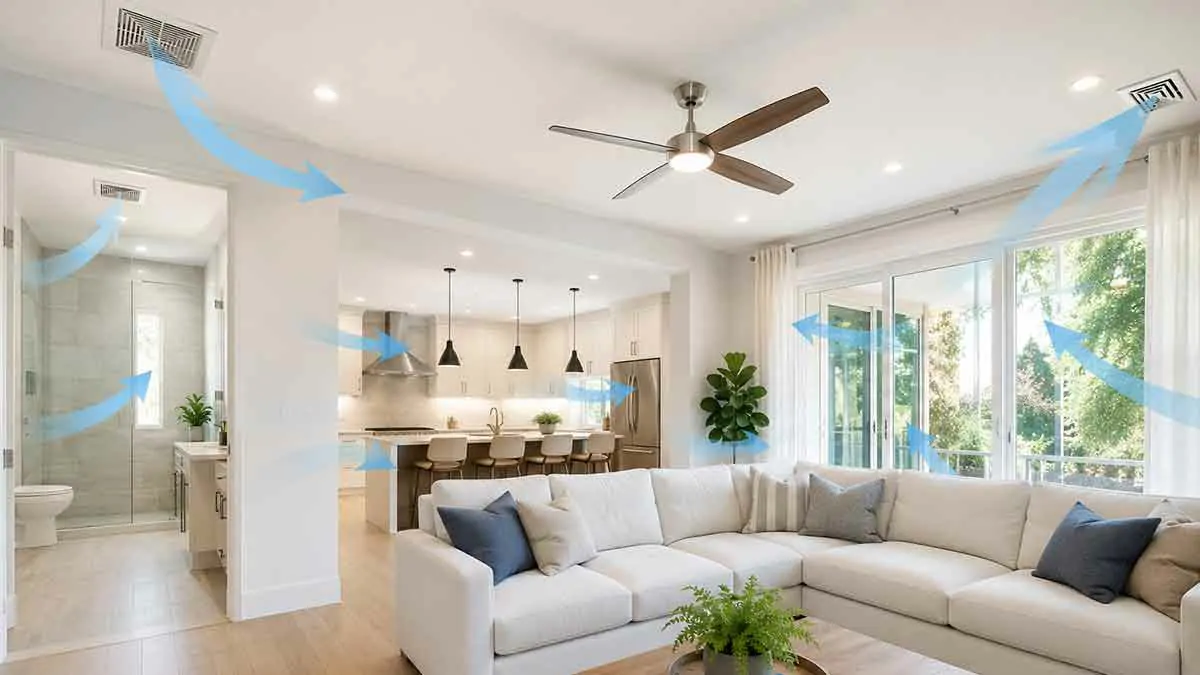
Proper home ventilation helps move stale indoor air out and bring an appropriate amount of fresh outdoor air into the home. Effective ventilation can help control moisture, odors, indoor pollutants, and excess humidity while supporting better indoor air quality and comfort.
Ventilation is not the same as heating, air conditioning, or air filtration. Heating and cooling systems primarily manage temperature, while filtration removes certain particles from air that passes through a filter. Ventilation is concerned with exchanging indoor air with outdoor air.
A well-ventilated home does not necessarily need windows open all day or a large amount of outdoor air. The goal is controlled, appropriate ventilation based on the home’s design, climate, occupancy, and indoor air-quality needs.
This complete home ventilation guide explains how residential ventilation works, the main types of ventilation systems, where ventilation is most important, common problems, maintenance requirements, and practical ways to improve airflow and indoor air quality.
Table of Contents
What Is Home Ventilation?
Home ventilation is the intentional exchange of indoor and outdoor air.
Ventilation systems can remove stale or contaminated indoor air while introducing fresh outdoor air. Depending on the system, ventilation may also help manage moisture and indoor pollutants.
Ventilation can occur naturally through windows and building openings or mechanically through fans, ducts, and dedicated ventilation equipment.
Effective ventilation can help:
- Remove stale air
- Reduce excess moisture
- Control odors
- Dilute indoor pollutants
- Introduce fresh outdoor air
- Reduce condensation risks
- Support better indoor air quality
Ventilation should be considered as part of the home’s overall building and HVAC system rather than as an isolated feature.
Why Is Home Ventilation Important?
Indoor air can accumulate pollutants and moisture from normal household activities.
Common sources include:
- Cooking
- Showering
- Cleaning
- Laundry
- Occupancy
- Combustion appliances
- Household products
- Moisture entering from outside
If indoor air is not exchanged appropriately, moisture and pollutants can accumulate.
Poor ventilation may contribute to:
- Stuffy air
- Persistent odors
- High humidity
- Condensation
- Mold and mildew conditions
- Increased indoor pollutant concentrations
- Uncomfortable rooms
However, excessive ventilation can also increase heating and cooling loads. Good ventilation is therefore about appropriate air exchange, not simply maximizing airflow.
Ventilation vs. HVAC
HVAC stands for heating, ventilation, and air conditioning, but the ventilation portion of an HVAC system is not necessarily present as a dedicated outdoor-air system in every home.
A conventional forced-air heating or cooling system may primarily recirculate indoor air.
For example, an air conditioner can:
- Cool indoor air
- Remove some moisture
- Circulate air through the home
But simply running the HVAC fan does not necessarily mean that a significant amount of outdoor air is entering the home.
A dedicated ventilation system is designed specifically to exchange indoor and outdoor air.
Understanding this distinction helps homeowners avoid assuming that heating or cooling automatically provides sufficient fresh-air ventilation.
Ventilation vs. Air Filtration
Ventilation and filtration solve different problems.
Air filtration removes certain airborne particles from air that passes through the filter. Depending on the filter and system, this can help reduce some dust, pollen, and other particulate matter.
Ventilation exchanges indoor air with outdoor air.
A complete indoor air-quality strategy may combine:
- Source control
- Ventilation
- Air filtration
- Humidity control
- Regular maintenance
One method should not automatically be treated as a replacement for the others.
Natural Ventilation
Natural ventilation uses outdoor conditions and openings in the home to move air.
Examples include:
- Open windows
- Doors
- Passive vents
- Other designed openings
Natural ventilation can work well when outdoor temperatures, humidity, wind, and air quality are favorable.
However, opening windows may be less practical during:
- Extreme heat
- Extreme cold
- High outdoor humidity
- Heavy rain
- Strong winds
- High outdoor pollution
- Smoke events
- Poor outdoor air quality
Natural ventilation is therefore highly dependent on weather and local conditions.
Cross Ventilation
Cross ventilation occurs when outdoor air enters through one part of the home and exits through another.
For example, opening windows on opposite sides of a room or building can create an airflow path when outdoor conditions support it.
Cross ventilation can be effective when there is a suitable breeze and relatively unobstructed airflow.
However, it may not provide consistent ventilation throughout the year.
Mechanical Ventilation
Mechanical ventilation uses fans, ducts, or dedicated equipment to move air.
Common mechanical ventilation approaches include:
- Exhaust ventilation
- Supply ventilation
- Balanced ventilation
- Heat recovery ventilation
- Energy recovery ventilation
The appropriate system depends on factors such as:
- Home size
- Climate
- Building airtightness
- Occupancy
- Existing HVAC equipment
- Indoor moisture conditions
- Local requirements
Exhaust Ventilation
Exhaust ventilation removes indoor air from specific locations.
Common examples include:
- Bathroom exhaust fans
- Kitchen exhaust systems
- Laundry exhaust
- Whole-house exhaust systems
Exhaust ventilation can be relatively simple and effective for removing moisture and pollutants at their source.
However, exhausted air must be replaced by incoming air. In a tightly sealed home, uncontrolled replacement air can affect pressure and system performance.
Supply Ventilation
Supply ventilation uses a fan or dedicated system to introduce outdoor air into the home.
This can provide more controlled fresh-air intake than relying entirely on random air leakage.
However, incoming outdoor air can also bring:
- Heat
- Cold
- Humidity
- Outdoor pollutants
The system should therefore be appropriately designed for the home’s climate and conditions.
Balanced Ventilation
Balanced ventilation supplies outdoor air while exhausting a comparable amount of indoor air.
This provides more controlled air exchange than relying solely on uncontrolled infiltration.
Balanced systems can be particularly useful in homes with relatively airtight building envelopes.
They may also allow more predictable airflow between different areas of the home.
Heat Recovery Ventilation
A heat recovery ventilator, commonly called an HRV, exchanges indoor and outdoor air while transferring heat between the outgoing and incoming air streams.
The two air streams remain separated.
In colder climates, an HRV can reduce some of the energy penalty associated with bringing cold outdoor air into a heated home.
The system still requires proper design, installation, balancing, and maintenance.
Energy Recovery Ventilation
An energy recovery ventilator, or ERV, transfers heat and some moisture between outgoing and incoming air streams.
ERV systems can be useful where humidity management is an important consideration.
The choice between an HRV and ERV depends on:
- Climate
- Indoor humidity
- Home design
- Building airtightness
- Ventilation requirements
Professional evaluation is useful when selecting a whole-house recovery ventilation system.
Bathroom Ventilation
Bathrooms are among the most important areas for mechanical ventilation because showers and baths can generate substantial moisture.
A properly installed exhaust fan can remove:
- Humid air
- Moisture
- Odors
Use the exhaust fan during bathing and continue operating it afterward according to the fan’s design and manufacturer’s recommendations.
Also inspect the bathroom for:
- Persistent condensation
- Slow-drying surfaces
- Musty odors
- Poor airflow
If moisture remains for long periods after normal use, the ventilation system may need inspection.
Kitchen Ventilation
Cooking can generate heat, steam, grease, odors, and airborne particles.
A properly designed range hood or kitchen exhaust system can remove contaminants closer to their source.
When practical, an exhaust hood that discharges outdoors can provide more effective source control than a recirculating hood.
Kitchen exhaust systems should be installed and maintained according to manufacturer instructions and applicable local requirements.
Clean grease filters regularly because accumulated grease can reduce performance and create additional maintenance concerns.
Laundry Room Ventilation
Laundry activities can introduce moisture into the home.
The dryer exhaust system should be installed according to manufacturer requirements and applicable regulations.
Check for:
- Restricted airflow
- Excessive lint
- Damaged ducts
- Loose connections
- Improper termination
Dryer exhaust should not discharge moisture into an attic, crawl space, wall cavity, or other enclosed area where moisture can accumulate.
Bedroom Ventilation
Bedrooms can become stuffy during extended periods of occupancy, particularly overnight.
Possible signs of inadequate ventilation include:
- Stale air
- Persistent stuffiness
- Condensation
- Elevated indoor carbon dioxide
- Uncomfortable humidity
Improving whole-house ventilation, maintaining appropriate return-air pathways, and ensuring adequate outdoor-air exchange can help.
Opening a bedroom window can provide ventilation when outdoor conditions are suitable, but it is not always practical or appropriate.
Basement Ventilation
Basements may have ventilation and moisture challenges because they are below or partially below ground level.
Common concerns include:
- High humidity
- Condensation
- Musty odors
- Foundation moisture
- Poor air circulation
Ventilation may help remove humid air, but it should not be used as the only solution when water is entering through the foundation, floor, or plumbing.
Depending on conditions, a basement may also require:
- Dehumidification
- Drainage improvements
- Waterproofing
- Plumbing repairs
- Foundation repairs
Always address the moisture source rather than relying solely on increased airflow.
Crawl Space Ventilation
Crawl-space ventilation depends heavily on the design of the building and local climate.
A crawl space should not automatically be ventilated simply because it feels damp.
Important factors include:
- Ground moisture
- Foundation design
- Vapor control
- Insulation
- Climate
- Drainage
- Local building requirements
Persistent crawl-space moisture should be professionally assessed before changing the ventilation strategy.
Attic Ventilation
Attic ventilation can help manage heat and moisture when the roof assembly is designed for ventilation.
Common attic ventilation components include:
- Soffit vents
- Ridge vents
- Gable vents
- Other intake and exhaust vents
Ventilation paths should remain appropriately clear.
Do not allow insulation to block designed intake openings.
Persistent attic condensation, frost, wet insulation, or mold-like growth can indicate problems involving:
- Air leakage
- Insufficient ventilation
- Roof leaks
- Insulation
- Moisture sources inside the home
The underlying cause should be identified rather than simply adding more vents.
Whole-House Ventilation
Whole-house ventilation provides controlled air exchange throughout the home.
Possible systems include:
- Exhaust-based systems
- Supply systems
- Balanced systems
- HRVs
- ERVs
Whole-house ventilation can be especially useful in newer or tightly sealed homes where natural air leakage is limited.
A properly designed system can provide more predictable air exchange than relying on windows or uncontrolled infiltration.
How Much Ventilation Does a Home Need?
There is no single ventilation rate that applies equally to every home.
Ventilation requirements can depend on:
- Home size
- Number of occupants
- Building airtightness
- Climate
- Construction type
- Indoor pollutant sources
- Ventilation system
- Local building requirements
Ventilation should be designed and evaluated according to applicable standards, manufacturer requirements, and local regulations.
More ventilation is not automatically better.
Excessive outdoor-air intake can increase:
- Heating demand
- Cooling demand
- Humidity loads
- Energy consumption
The goal is an appropriate and controlled ventilation rate.
Signs of Poor Home Ventilation
Common warning signs include:
- Stale or stuffy air
- Persistent indoor odors
- Condensation on windows
- High indoor humidity
- Bathroom moisture that remains for long periods
- Mold or mildew conditions
- Poor air movement
- Rooms that feel consistently stuffy
- Elevated indoor carbon dioxide
These signs do not always prove that ventilation is the problem.
For example, high humidity may result from a plumbing leak, foundation moisture, or poor building-envelope performance.
Proper diagnosis is therefore important.
How to Improve Home Ventilation
Start with the simplest measures.
1. Use Bathroom Exhaust Fans
Run bathroom exhaust fans during showers and for an appropriate period afterward.
2. Vent the Kitchen
Use an appropriately designed range hood or kitchen exhaust system while cooking.
3. Maintain Dryer Exhaust
Keep the dryer exhaust system clean, properly connected, and unobstructed.
4. Keep Ventilation Openings Clear
Do not block intentional intake, exhaust, or attic ventilation openings.
5. Maintain Filters
Replace or clean filters according to the manufacturer’s recommendations.
6. Control Moisture Sources
Repair plumbing leaks, roof leaks, drainage problems, and other sources of unwanted moisture.
7. Improve Airflow Between Rooms
Maintain appropriate pathways for air to move through the home.
8. Evaluate Airtight Homes
If a home has been heavily air-sealed or renovated, consider whether controlled mechanical ventilation is appropriate.
9. Consider Outdoor Conditions
Adjust natural ventilation practices according to outdoor temperature, humidity, pollution, smoke, and allergens.
10. Seek Professional Assessment for Persistent Problems
If ventilation problems continue despite basic maintenance, a professional evaluation can help identify the actual cause.
Control Indoor Moisture
Ventilation and moisture control are closely connected.
Common sources of indoor moisture include:
- Showers
- Cooking
- Drying clothes
- Indoor plants
- Plumbing leaks
- Basement moisture
- Condensation
Exhaust ventilation can remove some moisture, but it cannot replace repairing an active leak or drainage problem.
A good moisture-management strategy combines:
- Source control
- Exhaust ventilation
- Appropriate outdoor-air exchange
- Dehumidification when necessary
- Building-envelope maintenance
Monitor Indoor Humidity
A simple humidity monitor can help identify persistent moisture problems.
If humidity remains unusually high, investigate possible causes such as:
- Inadequate bathroom ventilation
- Poor kitchen exhaust
- Basement moisture
- Plumbing leaks
- Condensation
- Poor building-envelope performance
Do not assume that increasing ventilation alone will solve every humidity problem.
Maintain Exhaust Fans
Exhaust fans collect dust and, in kitchens, grease.
Clean accessible grilles and components according to manufacturer instructions.
Check whether the fan:
- Starts normally
- Runs without unusual noise
- Produces noticeable airflow
- Exhausts to the intended location
A weak fan may require cleaning, duct inspection, or professional service.
Inspect Ventilation Ducts
Accessible ventilation ductwork should be inspected periodically.
Look for:
- Disconnections
- Damage
- Blockages
- Excessive bends
- Crushed sections
- Improper termination
Moisture-laden exhaust should never be intentionally discharged into an attic, wall cavity, crawl space, or another enclosed location where moisture can accumulate.
Maintain Ventilation Filters
Some mechanical ventilation systems use filters to protect equipment and improve incoming-air quality.
Check filters according to manufacturer recommendations.
A clogged filter can:
- Restrict airflow
- Reduce ventilation performance
- Increase system workload
- Reduce indoor-air filtration effectiveness
Use the filter type and size specified for the system.
Check Outdoor Air Intakes
Mechanical ventilation systems that bring outdoor air into the home require unobstructed intake openings.
Inspect for:
- Leaves
- Dust
- Insects
- Debris
- Snow or ice where applicable
Keep intake locations clear and follow the manufacturer’s maintenance recommendations.
Improve Airflow Between Rooms
Good ventilation depends on appropriate air pathways.
Closed interior doors can sometimes restrict air movement if there are no adequate return-air or transfer pathways.
Possible solutions may include:
- Keeping doors open when practical
- Maintaining transfer pathways
- Improving return-air ducting
- Using appropriately designed transfer grilles
Do not cut doors, walls, or ducts without understanding the home’s HVAC and ventilation design.
Use Ceiling Fans Correctly
Ceiling fans can improve air circulation within a room, but they do not provide outdoor-air ventilation.
They can help distribute conditioned air and reduce localized stagnant areas.
However, a ceiling fan should not be considered a replacement for:
- Bathroom exhaust
- Kitchen exhaust
- Fresh-air ventilation
- Proper moisture control
Improve Ventilation in an Airtight Home
A tightly sealed home can have less uncontrolled air exchange.
This can improve energy efficiency, but it also makes intentional ventilation more important.
If a home has undergone extensive air sealing or energy-efficiency improvements, consider evaluating whether the existing ventilation system still provides adequate outdoor-air exchange.
A balanced ventilation system, HRV, or ERV may be appropriate in some homes.
The correct solution depends on the home’s climate, airtightness, and design.
Consider Outdoor Air Quality
Opening windows or increasing outdoor-air intake is not always beneficial.
Outdoor air may contain:
- Smoke
- Dust
- Vehicle pollution
- Pollen
- Other allergens
- High humidity
During periods of poor outdoor air quality, follow local guidance and use appropriate filtration and ventilation strategies.
Ventilation decisions should consider both indoor and outdoor air conditions.
Home Ventilation and Energy Efficiency
Ventilation affects energy consumption because outdoor air entering the home must often be heated or cooled.
Too little ventilation can reduce indoor air quality.
Too much ventilation can increase HVAC demand.
Energy-efficient ventilation therefore focuses on controlled air exchange.
Recovery systems such as HRVs and ERVs can reduce some of the energy or moisture impacts associated with exchanging indoor and outdoor air.
Proper air sealing can also improve overall building performance, but air sealing should be coordinated with adequate ventilation rather than performed in isolation.
Home Ventilation and HVAC Systems
Ventilation and HVAC systems can work together, but they perform different functions.
An HVAC system may:
- Heat air
- Cool air
- Circulate air
- Filter air
- Dehumidify under certain conditions
A dedicated ventilation system may:
- Introduce outdoor air
- Exhaust indoor air
- Balance air exchange
- Recover heat or energy
Some modern systems integrate these functions, but homeowners should understand which components provide actual outdoor-air exchange.
Common Home Ventilation Mistakes
Relying Only on Open Windows
Natural ventilation depends on weather, outdoor air quality, security, and occupant behavior.
Assuming HVAC Circulation Equals Ventilation
Recirculated indoor air is not the same as exchanging indoor air with outdoor air.
Venting Moist Air Into the Attic
Bathroom and dryer exhaust can introduce significant moisture if improperly terminated.
Ignoring High Indoor Humidity
Persistent humidity can contribute to condensation and moisture damage.
Blocking Attic Ventilation
Insulation and stored items should not obstruct intentional ventilation paths.
Ignoring Exhaust Fan Performance
A fan that runs but moves very little air may not be providing effective ventilation.
Using a Ceiling Fan as a Ventilation System
Ceiling fans circulate indoor air but do not introduce fresh outdoor air.
Over-Ventilating the Home
Excessive outdoor-air exchange can increase heating, cooling, and humidity loads.
Trying to Fix Moisture Problems With Ventilation Alone
Active leaks, drainage problems, and groundwater intrusion require source control.
When to Consider Whole-House Ventilation
A whole-house ventilation system may be worth considering when:
- The home is highly airtight
- Indoor air consistently feels stale
- Natural ventilation is unreliable
- Humidity is difficult to manage
- Indoor pollutants are a recurring concern
- The home has undergone extensive air sealing
- A major renovation is underway
- New construction is being planned
A professional can evaluate the building envelope, existing HVAC equipment, climate, and ventilation requirements before recommending a system.
DIY vs. Professional Ventilation Improvements
Many basic ventilation tasks are suitable for homeowners.
DIY Tasks
Homeowners can often:
- Clean accessible exhaust grilles
- Replace ventilation filters
- Check visible intake openings
- Monitor indoor humidity
- Use bathroom exhaust fans correctly
- Maintain kitchen exhaust filters
- Check accessible duct connections
- Keep attic ventilation openings clear
Professional Tasks
Professional assistance may be appropriate for:
- Installing whole-house ventilation
- Designing ventilation systems
- Installing HRVs or ERVs
- Modifying ductwork
- Electrical work
- Major attic ventilation changes
- Complex crawl-space ventilation
- Diagnosing persistent moisture problems
- Balancing mechanical ventilation systems
Avoid modifying ventilation systems without understanding their effect on the building and HVAC system.
Home Ventilation Maintenance Schedule
A simple maintenance routine can help keep ventilation systems working properly.
Monthly
- Monitor indoor humidity when necessary.
- Check bathroom and kitchen exhaust performance.
- Look for unusual condensation or odors.
Every Few Months
- Clean accessible exhaust grilles.
- Inspect ventilation filters.
- Check outdoor air intakes.
- Look for visible duct damage.
Seasonally
- Inspect attic ventilation.
- Check basement and crawl-space moisture.
- Review natural ventilation practices based on weather.
- Inspect ventilation equipment before periods of extreme heat or cold.
Annually
- Review the overall ventilation strategy.
- Inspect accessible ventilation ductwork.
- Service dedicated ventilation equipment according to manufacturer requirements.
- Investigate recurring humidity, condensation, or indoor-air-quality problems.
Home Ventilation Checklist
Use this checklist as part of your regular home maintenance routine:
- Use bathroom exhaust fans
- Use kitchen exhaust while cooking
- Maintain dryer exhaust
- Clean exhaust grilles
- Check ventilation filters
- Inspect outdoor air intakes
- Check accessible ventilation ducts
- Keep attic ventilation paths clear
- Monitor indoor humidity
- Control indoor moisture sources
- Repair plumbing leaks
- Address foundation moisture
- Maintain appropriate airflow between rooms
- Keep return-air pathways clear
- Use ceiling fans for air circulation
- Monitor outdoor air quality
- Check ventilation after major renovations
- Evaluate ventilation in highly airtight homes
- Maintain HRV or ERV systems when applicable
- Inspect for condensation
- Watch for persistent odors
- Investigate recurring stuffiness
- Schedule professional assessment when problems persist
Final Thoughts
Proper home ventilation helps maintain indoor air quality, control moisture, reduce odors, and create a more comfortable living environment. The most effective approach combines source control, appropriate ventilation, air filtration, and humidity management rather than relying on a single solution.
Start with practical measures such as using bathroom and kitchen exhaust fans, maintaining dryer exhaust, keeping ventilation openings clear, replacing filters when necessary, and monitoring indoor humidity.
If the home remains consistently stuffy, develops persistent condensation, or has recurring moisture problems, investigate the underlying cause instead of simply increasing airflow.
For newer or highly airtight homes, a properly designed whole-house ventilation system may provide more predictable air exchange. HRV and ERV systems can also improve ventilation efficiency in suitable climates and building designs.
The goal is not to ventilate as much as possible. The goal is to provide appropriate, controlled, and effective ventilation for the home’s design, climate, and occupants.