
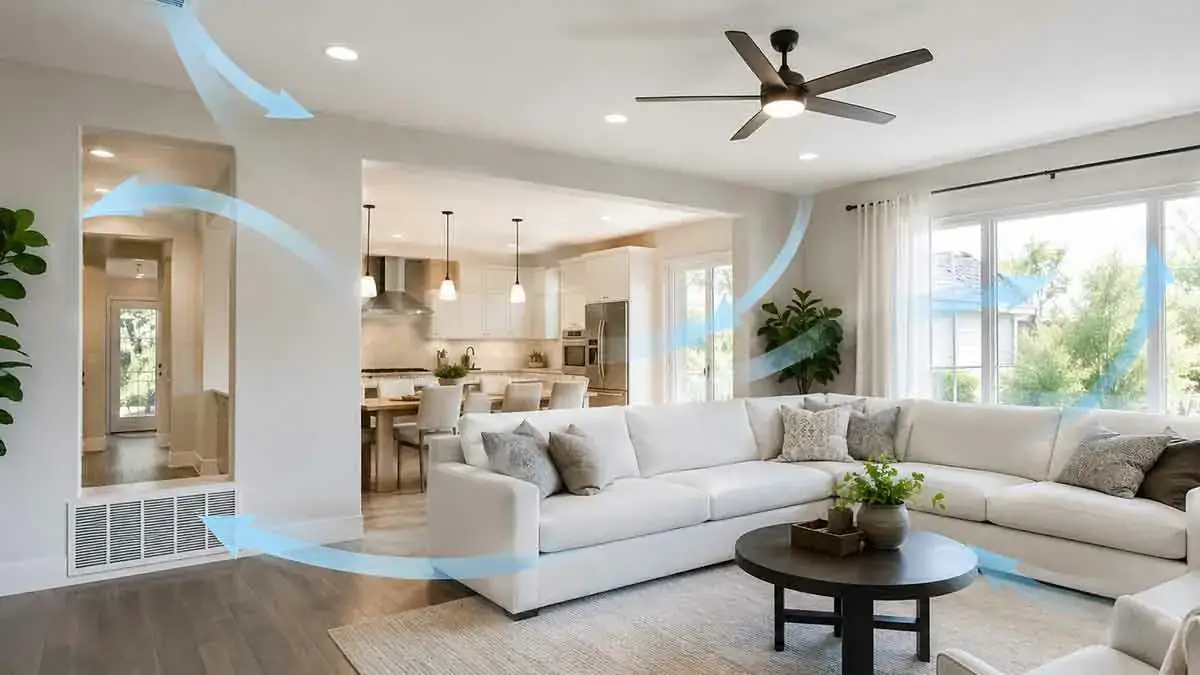
Good indoor airflow helps distribute conditioned air throughout your home, improve comfort, reduce temperature differences between rooms, and support healthy ventilation. When airflow is restricted, some rooms may feel too hot or cold, HVAC systems may run longer, and certain areas can become stagnant or uncomfortable.
Poor airflow does not always mean that the HVAC system itself is failing. Blocked vents, dirty filters, closed dampers, duct restrictions, air leaks, inadequate returns, furniture placement, and building-design problems can all affect how air moves through a home.
Improving indoor airflow starts with identifying where the restriction occurs and determining whether the problem affects one room, several rooms, or the entire HVAC system.
This guide explains practical ways to improve indoor airflow, common causes of poor circulation, simple checks homeowners can perform, and situations where professional HVAC evaluation may be necessary.
Table of Contents
What Is Indoor Airflow?
Indoor airflow refers to the movement and distribution of air throughout a home.
In a typical forced-air HVAC system, conditioned air travels through supply ducts and enters rooms through supply registers. Air then returns through return openings and travels back to the HVAC equipment.
A functional airflow pattern depends on:
- Supply ducts
- Return ducts
- Registers
- Filters
- Blower equipment
- Dampers
- Duct connections
- Room layout
- Building design
Ventilation systems can also introduce or remove air depending on the home’s design.
Why Good Indoor Airflow Matters
Proper airflow can help:
- Improve heating and cooling distribution
- Reduce uncomfortable hot and cold spots
- Support HVAC performance
- Improve air circulation
- Reduce stagnant areas
- Support humidity management
- Improve comfort in bedrooms and living spaces
Airflow is only one part of indoor environmental quality. Moving air around does not automatically remove pollutants or replace the need for appropriate ventilation.
Signs of Poor Indoor Airflow
Common warning signs include:
- Weak air coming from supply vents
- Rooms that remain hotter or colder than others
- Poor airflow from one register
- Strong airflow in some rooms but weak airflow in others
- HVAC systems running for unusually long periods
- Stuffy rooms
- Uneven temperatures between floors
- Excessive noise from vents
- Doors that noticeably affect airflow when closed
The pattern of the problem can provide clues about its cause.
Identify Where the Airflow Problem Occurs
Before changing equipment, determine whether the issue is localized or widespread.
One Room
If only one room has weak airflow, inspect:
- The room’s supply register
- Nearby ductwork
- Door position
- Furniture placement
- Local duct restrictions
Several Rooms
If several rooms have poor airflow, investigate:
- Filters
- Return-air capacity
- Ductwork
- Dampers
- HVAC blower performance
The Entire Home
If airflow is weak throughout the house, the HVAC system may require professional evaluation.
Possible causes include mechanical problems, severe filter restriction, duct restrictions, incorrect system configuration, or other equipment issues.
Check HVAC Filters
A heavily restricted filter can reduce airflow through the entire system.
Check the filter regularly and replace or clean it according to the manufacturer’s instructions.
Make sure the replacement filter:
- Fits correctly
- Is installed in the correct direction
- Matches the equipment requirements
Do not install a filter with excessive resistance simply because it has a higher filtration rating.
Keep Supply Vents Clear
Supply registers should remain unobstructed.
Move furniture, rugs, curtains, or storage items that block airflow.
Avoid placing large objects directly over registers.
Do not permanently close multiple supply vents as a general solution to airflow problems. HVAC systems are designed around specific airflow requirements and may become unbalanced when vents are restricted.
Keep Return Vents Clear
Return vents are essential to the air circulation loop.
Keep them free from:
- Furniture
- Boxes
- Curtains
- Rugs
- Dust accumulation
A blocked return can reduce airflow even when the supply registers appear to be working normally.
Check Closed or Restricted Registers
Make sure registers are open unless the HVAC system was specifically designed for adjustable zoning or another configuration.
If one room receives very little air while others receive normal airflow, the local register or duct may need inspection.
Improve Airflow Around Furniture
Furniture placement can affect air circulation.
Avoid positioning large furniture directly in front of supply or return vents.
In rooms with persistent stagnant areas, allow sufficient space around ventilation openings so air can circulate naturally.
Check Interior Doors
Closed interior doors can sometimes affect airflow, particularly in rooms with supply vents but insufficient return-air pathways.
Signs may include:
- Pressure changes when doors close
- Increased noise around the door
- Reduced airflow from the supply register
- Large temperature differences
Depending on the home’s design, solutions may include undercutting doors appropriately, adding transfer grilles, or improving return-air pathways.
Do not modify doors or walls without understanding the HVAC and building requirements.
Improve Air Movement Between Rooms
Air needs a path to move between rooms and return to the HVAC system.
Homes with isolated rooms may experience poor circulation when doors remain closed.
Possible solutions, depending on the system, include:
- Keeping doors appropriately positioned
- Improving return-air pathways
- Using transfer grilles
- Adjusting the HVAC distribution system
The correct solution depends on the building layout.
Inspect Accessible Ductwork
Accessible ducts can be visually inspected for obvious problems.
Look for:
- Disconnected sections
- Crushed flexible ducts
- Loose connections
- Visible gaps
- Damaged insulation
- Unusual condensation
Do not enter confined or unsafe spaces simply to inspect ductwork.
Look for Duct Restrictions
Ducts can become restricted by:
- Sharp bends
- Crushed flexible duct
- Improper installation
- Debris
- Closed dampers
- Structural obstructions
A restriction can reduce airflow to downstream rooms.
Persistent duct restrictions may require professional testing and correction.
Check for Disconnected Ducts
A disconnected duct can release conditioned air into an attic, crawl space, basement, or other unintended location.
Possible warning signs include:
- Weak airflow at a particular register
- Unusual temperature differences
- Excessive duct noise
- Unexpected energy use
- Visible disconnected duct sections
Repairing a disconnected duct can sometimes produce a noticeable improvement without replacing HVAC equipment.
Inspect Duct Insulation
Duct insulation affects temperature control, particularly when ducts run through unconditioned areas.
Damaged insulation can contribute to:
- Heat gain
- Heat loss
- Condensation
- Reduced comfort
Inspect accessible insulation and repair or replace damaged sections appropriately.
Check the Return-Air System
A home can have adequate supply capacity but still experience poor circulation if return-air capacity is insufficient.
Look for:
- Blocked return grilles
- Undersized return pathways
- Excessive door pressure
- Large temperature differences
- Noisy return airflow
If the return system appears inadequate, professional evaluation may be necessary.
Avoid Blocking Return Vents
Return vents often handle substantial amounts of air.
Keep furniture and storage away from them.
A return vent hidden behind a large cabinet or sofa may not be able to pull air efficiently.
Check the HVAC Blower
The blower moves air through many forced-air HVAC systems.
If airflow has declined throughout the home, the blower or related components may require inspection.
Homeowners should generally avoid disassembling HVAC equipment.
Professional service may be necessary for:
- Blower problems
- Motor issues
- Electrical faults
- Control problems
- Internal contamination
Maintain Outdoor HVAC Airflow
For systems with outdoor units, such as air conditioners and heat pumps, outdoor airflow is important for heat transfer.
Keep the area around the unit free from:
- Leaves
- Grass
- Branches
- Debris
- Storage items
Maintain the clearance specified by the manufacturer.
Check Condensate Problems
Cooling systems produce condensation.
A blocked or malfunctioning condensate system can cause water accumulation and may affect equipment operation.
Look for:
- Water around the indoor unit
- Standing water
- Overflowing pans
- Damp surrounding materials
Persistent condensate problems should be professionally evaluated.
Use Ceiling Fans to Improve Air Movement
Ceiling fans can improve perceived comfort by moving air around occupants.
They do not replace air conditioning or heating.
For best results:
- Use fans when rooms are occupied
- Adjust fan speed according to comfort
- Avoid running fans unnecessarily in empty rooms
- Follow manufacturer recommendations for seasonal direction
Fans are particularly useful for reducing stagnant-feeling air in occupied spaces.
Improve Bathroom Ventilation
Bathroom exhaust fans remove moisture and stale air from the room.
Make sure:
- The fan operates properly
- The grille is reasonably clean
- Air can reach the exhaust area
- Moisture is properly exhausted according to the system design
If a bathroom remains damp long after showers, the ventilation system may need evaluation.
Improve Kitchen Ventilation
Kitchen exhaust systems remove heat, moisture, odors, and cooking byproducts.
Use an appropriately vented range hood when cooking.
Keep exhaust grilles and filters maintained according to manufacturer instructions.
Improve Bedroom Airflow
Bedrooms may feel stuffy when doors remain closed for long periods.
Check:
- Supply register airflow
- Return-air pathways
- Door clearance
- Furniture placement
- Window condensation
- Room temperature
If the bedroom has a supply register but no effective return-air path, professional evaluation may help determine the appropriate solution.
Improve Airflow in Closed Rooms
Guest rooms, offices, storage rooms, and other spaces that remain closed may develop stagnant conditions.
Improve circulation by:
- Keeping supply and return openings clear
- Providing an appropriate return-air path
- Using a ceiling or portable fan when occupied
- Avoiding excessive furniture obstruction
Portable fans can move air locally, but they do not correct a deficient HVAC distribution system.
Improve Basement Airflow
Basements can feel damp or stagnant because they are below ground level and may have limited natural air movement.
Check:
- HVAC supply and return openings
- Humidity
- Dehumidification
- Condensation
- Foundation moisture
Do not use increased airflow as a substitute for repairing water intrusion or excessive humidity.
Improve Attic Airflow and Ventilation
Attic ventilation is different from occupied-room airflow.
An attic generally requires ventilation appropriate to the roof and building design rather than simply adding fans.
Look for:
- Blocked vents
- Moisture
- Condensation
- Frost in cold climates
- Damaged insulation
Do not block intentional attic ventilation openings.
Balance Supply and Return Air
A well-functioning HVAC system needs an appropriate relationship between supply and return airflow.
Symptoms of imbalance may include:
- Uneven room temperatures
- Pressure differences
- Noisy registers
- Doors that are difficult to close
- Weak airflow in certain rooms
HVAC balancing may require measuring airflow at individual registers and adjusting dampers or other components.
Professional balancing is recommended when the problem is widespread or persistent.
Consider HVAC Dampers
Some duct systems use dampers to control airflow to different areas.
Damper settings should match the design of the HVAC system.
Randomly closing or opening dampers can create excessive pressure or reduce airflow elsewhere.
If the system has multiple zones, follow the zoning equipment manufacturer’s instructions or have a professional evaluate the settings.
Check for Building Envelope Problems
Airflow problems can sometimes be confused with building-envelope problems.
A room may feel uncomfortable because of:
- Poor insulation
- Air leakage
- Excessive solar heat gain
- Drafts
- Poor window performance
Increasing airflow may not solve the underlying issue.
For example, a bedroom with a poorly insulated exterior wall may remain cold even when the HVAC system is delivering an appropriate amount of air.
Avoid Overusing Portable Fans
Portable fans can improve local comfort but are not a substitute for proper HVAC airflow.
Use them strategically in occupied spaces.
If multiple rooms consistently have poor airflow, identify the underlying HVAC or building problem instead of adding more fans throughout the house.
When a New HVAC System May Be Necessary
Poor airflow does not automatically mean that the HVAC system needs replacement.
Replacement may be considered when:
- Equipment is near the end of its service life
- Major components repeatedly fail
- The system is incorrectly sized
- Ductwork cannot reasonably support the existing system
- Efficiency and comfort remain poor despite appropriate repairs
Before replacing equipment, investigate filters, ductwork, return-air capacity, system sizing, and building-envelope problems.
Common Indoor Airflow Problems
Weak Airflow From One Vent
Possible causes include a closed register, local duct restriction, disconnected duct, or damaged ductwork.
Weak Airflow Everywhere
Possible causes include a restricted filter, blower problem, return-air restriction, or broader HVAC issue.
One Room Is Always Too Hot
Possible causes include insufficient supply airflow, poor return-air pathways, solar heat gain, insulation problems, or duct imbalance.
One Room Is Always Too Cold
Investigate airflow, insulation, air leakage, windows, and duct distribution.
Airflow Changes When Doors Close
This can indicate inadequate return-air pathways in the room or pressure imbalance.
Common Airflow Improvement Mistakes
Closing Multiple Vents
Restricting supply airflow throughout the home can create system imbalance.
Blocking Return Vents
A blocked return can affect the entire airflow loop.
Adding Fans Instead of Fixing the Cause
Fans can improve local comfort but cannot repair duct restrictions or HVAC problems.
Ignoring Duct Leaks
Leaking ducts can reduce the amount of conditioned air reaching rooms.
Installing the Wrong Filter
An excessively restrictive filter can reduce airflow.
Changing Dampers Randomly
Improper damper adjustments can move the problem from one room to another.
Assuming More Airflow Is Always Better
Excessive airflow can create drafts, noise, or comfort problems. The goal is appropriate, balanced airflow.
DIY vs. Professional Airflow Evaluation
Homeowners can safely handle several basic checks, including:
- Checking filters
- Clearing vents
- Moving furniture away from registers
- Inspecting accessible ducts
- Checking door clearance
- Monitoring room temperatures
- Maintaining ceiling fans
Professional evaluation is appropriate for:
- Persistent whole-house airflow problems
- Blower problems
- Duct testing
- HVAC balancing
- Electrical issues
- Refrigerant-related problems
- Major duct modifications
- System sizing questions
Avoid opening HVAC equipment or attempting repairs involving electrical, refrigerant, combustion, or other specialized components unless properly qualified.
How to Improve Airflow on a Budget
Start with simple improvements before investing in major equipment.
Prioritize:
- Check and replace the HVAC filter when necessary.
- Clear supply and return vents.
- Move furniture away from registers.
- Inspect accessible ductwork.
- Check for obvious disconnected ducts.
- Improve appropriate return-air pathways.
- Maintain reasonable thermostat settings.
- Use ceiling fans in occupied rooms.
- Address obvious air leaks and insulation deficiencies.
- Seek professional evaluation if the problem persists.
These steps can help identify simple restrictions before more expensive work is considered.
Indoor Airflow Checklist
Use this checklist when evaluating airflow problems:
- Check the HVAC filter
- Keep supply vents clear
- Keep return vents clear
- Check registers for obstruction
- Inspect furniture placement
- Check interior door clearance
- Monitor room temperatures
- Inspect accessible ductwork
- Look for disconnected ducts
- Check for crushed flexible ducts
- Inspect duct insulation
- Check return-air pathways
- Monitor HVAC blower performance
- Maintain outdoor-unit clearance
- Check condensate drainage
- Use ceiling fans appropriately
- Maintain bathroom exhaust ventilation
- Maintain kitchen exhaust ventilation
- Monitor basement humidity
- Check attic ventilation
- Avoid unnecessary damper adjustments
- Monitor pressure or airflow changes when doors close
- Address insulation and air-leak problems
- Schedule professional airflow testing when necessary
Final Thoughts
Improving indoor airflow starts with understanding how air moves through your home. Supply registers deliver conditioned air, return openings bring air back to the HVAC system, and ductwork connects the system together. A restriction anywhere in this cycle can affect comfort.
Begin with simple checks such as maintaining filters, clearing vents, improving furniture placement, inspecting accessible ductwork, and ensuring rooms have appropriate return-air pathways. If airflow remains weak or uneven, professional testing can help identify duct restrictions, system imbalance, blower problems, or inadequate return capacity.
The goal is not simply to move more air. The goal is to achieve appropriate, balanced airflow that distributes heating and cooling effectively while maintaining comfort and efficient HVAC operation.