
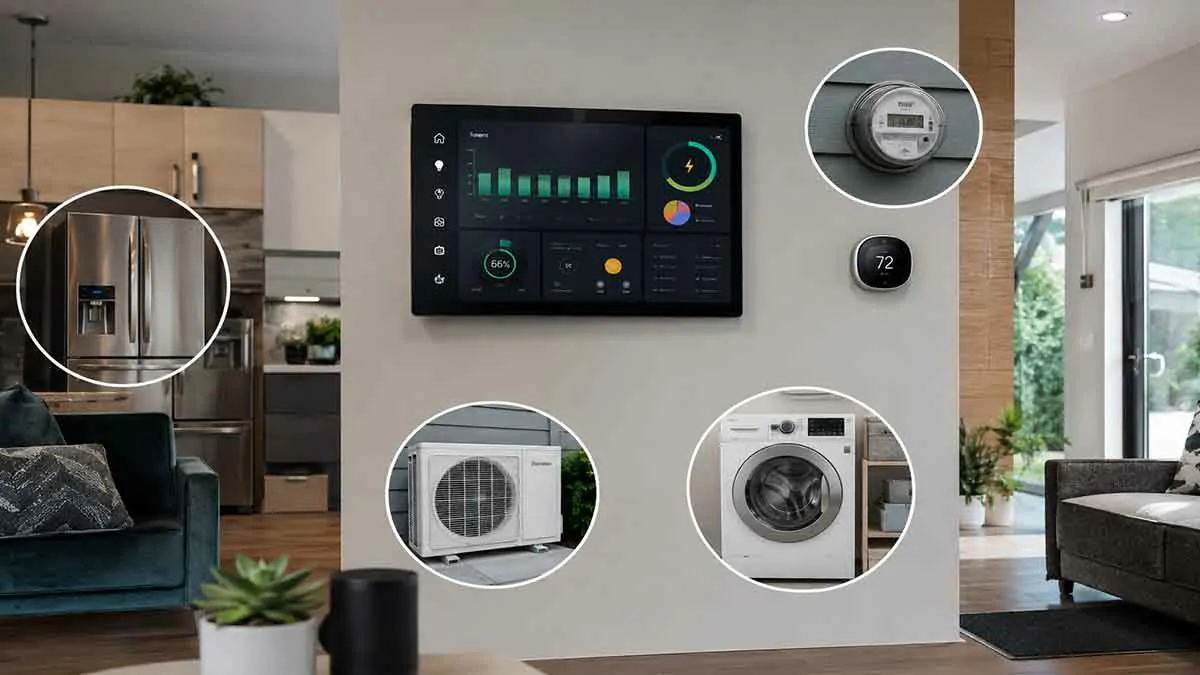
Tracking home energy usage is an effective way to understand where electricity and other household energy are being consumed. A utility bill can show how much energy a home used during a billing period, but it usually does not explain which systems, appliances, or daily habits contributed most to that consumption.
Home energy usage tracking provides a clearer picture by recording consumption over time and comparing it with factors such as weather, occupancy, appliance use, and heating or cooling demand.
The goal is not simply to collect energy data. Effective tracking helps homeowners identify unusual consumption, recognize waste, measure the results of efficiency improvements, and decide which changes are most likely to reduce long-term energy costs.
This guide explains how to track home energy usage, what information to monitor, which household systems deserve attention, and how to turn energy data into practical efficiency improvements.
Table of Contents
What Is Home Energy Usage Tracking?
Home energy usage tracking is the process of recording and analyzing how much energy a household consumes over time.
For homes that use electricity as their primary energy source, consumption is commonly measured in kilowatt-hours (kWh).
Energy tracking can occur at several levels.
Utility-Level Tracking
Utility bills provide information about total electricity consumption during a billing period.
This is the simplest form of energy tracking and requires no additional equipment.
Whole-Home Tracking
A whole-home energy monitor measures electricity entering the property and can provide more detailed information about consumption throughout the day.
Appliance-Level Tracking
Individual devices can sometimes be measured using compatible energy-monitoring plugs or meters.
Circuit-Level Tracking
Circuit-level monitoring can measure major electrical loads such as:
- HVAC systems
- Electric water heaters
- Electric vehicle chargers
- Kitchen circuits
- Laundry equipment
The appropriate tracking method depends on how much detail you need.
Why Track Home Energy Usage?
Energy tracking can help answer questions that a standard utility bill cannot.
For example:
- Which systems use the most electricity?
- When does household consumption peak?
- Is energy use higher than expected?
- Did an HVAC upgrade reduce consumption?
- Does summer cooling dominate electricity use?
- Are appliances consuming energy continuously?
- Did insulation improvements change heating demand?
Tracking turns energy consumption into measurable information that can support better decisions.
What Should You Track?
You do not need to measure every electrical device individually.
Start with information that can influence decisions, such as:
- Monthly kWh consumption
- Daily electricity use
- Time-of-day consumption
- HVAC usage
- Water heating
- Major appliances
- Electric vehicle charging
- Weather conditions
- Household occupancy
- Energy costs
Focus on the largest or most variable energy loads first.
1. Start With Your Utility Bills
Your utility bills are the easiest place to begin.
Review several months of bills and record:
- Billing period
- Total kWh
- Total cost
- Electricity rate
- Fixed charges
- Time-of-use pricing, if applicable
Reviewing at least a full year can reveal seasonal patterns.
2. Record Monthly Energy Consumption
Create a simple record of monthly electricity consumption.
For example:
| Month | Energy Use |
|---|---|
| January | |
| February | |
| March | |
| April | |
| May | |
| June | |
| July | |
| August | |
| September | |
| October | |
| November | |
| December |
This makes seasonal changes easier to identify.
3. Establish an Energy-Use Baseline
Before making major efficiency improvements, establish a baseline.
A baseline represents normal household energy consumption before a change is introduced.
For example:
Before insulation → After insulation
or:
Old HVAC system → New HVAC system
The comparison becomes more useful when similar weather and occupancy conditions are considered.
4. Track Daily Electricity Consumption
Monthly data provides a broad overview, but daily tracking can reveal more specific patterns.
Daily energy use may increase because of:
- Extreme weather
- More occupants at home
- Laundry
- Cooking
- Heating or cooling
- Electric vehicle charging
Look for recurring patterns rather than reacting to a single unusually high day.
5. Monitor Energy Use by Time of Day
Energy consumption often changes throughout the day.
Common periods of higher use include:
- Morning
- Afternoon
- Evening
- Overnight, depending on equipment
Time-of-day information can reveal when major systems operate and whether consumption occurs when the home is normally unoccupied.
6. Track Heating and Cooling Energy
Heating and cooling often represent major household energy loads.
Track HVAC consumption alongside:
- Outdoor temperature
- Thermostat settings
- Occupancy
- Runtime
- Season
If energy use increases significantly without a comparable change in weather or household behavior, further investigation may be worthwhile.
7. Track Water Heater Energy Use
Electric water heaters can consume substantial amounts of electricity.
Tracking can help identify:
- High-demand periods
- Changes in usage patterns
- Effects of water-heating improvements
- Unexpected continuous operation
For homes using gas, propane, or another fuel for water heating, electricity tracking alone will not capture total water-heating energy use.
8. Monitor Major Appliances
Major electrical appliances may include:
- Clothes dryers
- Ovens
- Dishwashers
- Refrigerators
- Freezers
- Washing machines
Do not assume that the appliance with the highest power rating is necessarily the largest energy consumer.
Energy consumption depends on both power and operating time.
9. Track Refrigerator and Freezer Consumption
Refrigerators and freezers operate for long periods and can therefore be useful appliances to monitor.
If consumption appears unusually high, investigate:
- Appliance age
- Door seals
- Temperature settings
- Condenser condition
- Overall equipment condition
Compare potential energy savings with replacement costs before purchasing a new appliance.
10. Monitor Laundry Equipment
Laundry habits can have a measurable effect on household energy use.
Electric dryers typically deserve more attention than washing machines because heating the air requires substantial energy.
Track:
- Number of cycles
- Energy per cycle, if available
- Drying settings
- Frequency of use
Reducing unnecessary dryer operation can lower consumption.
11. Track Kitchen Energy Use
Cooking and food storage can contribute to household electricity consumption.
Potential loads include:
- Electric ovens
- Refrigerators
- Freezers
- Dishwashers
- Microwaves
- Coffee makers
Monitoring can help determine which equipment deserves attention instead of assuming that every kitchen appliance is a major energy consumer.
12. Monitor Home Office Equipment
Home offices may contain equipment that operates for many hours.
Examples include:
- Computers
- Monitors
- Printers
- Networking equipment
- Speakers
- Chargers
Use sleep and power-management settings where practical.
Tracking can reveal whether equipment remains powered when it is not needed.
13. Track Electric Vehicle Charging
Home EV charging can represent a significant electrical load.
If you charge an electric vehicle at home, track:
- Energy per charging session
- Charging frequency
- Monthly charging consumption
- Charging time
If your utility uses time-of-use rates, comparing charging periods with electricity prices can help identify potential cost-saving opportunities.
14. Identify Standby Energy Consumption
Some electronics consume electricity even when they appear to be turned off.
Possible examples include:
- Game consoles
- Televisions
- Computers
- Network equipment
- Smart home devices
- Chargers
The amount of standby consumption varies by device.
Measure it before deciding whether unplugging or replacing equipment is worthwhile.
15. Compare Weekday and Weekend Usage
Household energy use can change significantly depending on occupancy.
Compare weekdays with weekends to identify differences caused by:
- More time spent at home
- Increased cooking
- Laundry
- Entertainment
- HVAC operation
This can reveal behavioral patterns that monthly bills cannot show.
16. Compare Seasonal Energy Use
Seasonal comparisons are particularly useful for homes with substantial heating or cooling demand.
Compare:
- Winter
- Spring
- Summer
- Fall
A large summer increase may indicate cooling demand, while winter increases may be associated with electric heating or other seasonal loads.
17. Compare Energy Use With Weather
Weather is one of the most important factors when interpreting household energy consumption.
For example, higher electricity use during an unusually hot summer week may be expected.
Compare:
Energy use + outdoor temperature + HVAC operation
This creates a more meaningful picture than comparing raw kWh values alone.
18. Track Household Occupancy
Energy use is affected by how often people are at home.
Record major changes such as:
- Working from home
- Vacations
- Guests
- Changes in household size
- School schedules
A sudden change in occupancy can make comparisons between months less meaningful.
19. Monitor Changes After Energy Improvements
Track consumption after making improvements such as:
- Attic insulation
- Air sealing
- HVAC replacement
- Heat pump installation
- Efficient appliances
- Smart thermostat installation
- Window improvements
Whenever possible, compare similar periods before and after the improvement.
20. Compare Similar Periods
A year-over-year comparison can be more useful than comparing consecutive months.
For example:
July 2025 vs July 2026
may provide a better comparison than:
June 2026 vs July 2026
because seasonal conditions are more similar.
Weather and occupancy should still be considered.
21. Understand kWh and Energy Consumption
Electricity consumption is commonly measured in kilowatt-hours (kWh).
A simple relationship is:
Energy Used = Power × Operating Time
For example, a 1-kilowatt device operating for 3 hours consumes approximately:
3 kWh
Actual household consumption is the combined energy used by many systems and appliances.
22. Separate Energy Use From Energy Cost
Using less electricity does not always reduce the total bill by the same percentage.
Your bill may include:
- Energy charges
- Fixed charges
- Taxes
- Delivery charges
- Time-of-use pricing
- Demand-related charges, where applicable
Track both kWh consumption and total cost when evaluating savings.
23. Understand Your Electricity Rate
Electricity pricing may vary depending on your utility plan.
Some rates change according to:
- Time of day
- Season
- Total consumption
- Demand
Understanding the rate structure helps you determine whether reducing consumption or changing the timing of certain loads could have a meaningful financial impact.
24. Identify Unusual Energy Consumption
Unexpected increases in energy use may be caused by:
- HVAC problems
- Water heater issues
- Appliance faults
- Equipment operating continuously
- Changes in occupancy
- Extreme weather
Energy tracking does not automatically identify the cause.
It simply provides a signal that further investigation may be useful.
25. Look for Equipment That Runs Continuously
Some systems are designed to operate frequently or continuously.
Examples can include:
- Refrigeration
- Network equipment
- Pumps
- HVAC components
- Water-heating equipment
If a load appears to operate continuously, determine whether that behavior is normal before attempting to disconnect or modify it.
26. Use Whole-Home Energy Monitoring
A whole-home monitor can provide more detailed information than a utility bill.
Depending on the system, you may be able to see:
- Real-time consumption
- Daily trends
- Historical usage
- Peak consumption
- Estimated energy costs
This can make it easier to identify patterns and unusual changes.
27. Use Smart Plugs for Individual Devices
Energy-monitoring smart plugs can measure compatible devices at the outlet.
They may be useful for:
- Televisions
- Computers
- Lamps
- Entertainment equipment
- Small appliances
Never exceed the electrical rating of the smart plug.
High-power equipment should be monitored using an appropriate method.
28. Consider Circuit-Level Monitoring
Circuit-level monitoring provides more detailed information about major electrical loads.
It may help distinguish consumption from:
- HVAC
- Water heating
- EV charging
- Laundry
- Kitchen circuits
Because installation may require access to the electrical panel, use a qualified professional where electrical work is required.
29. Keep an Energy Usage Log
A simple log can provide useful context.
Record:
- Date
- Energy consumption
- Outdoor temperature
- Major appliance use
- HVAC operation
- Occupancy
- Unusual events
Even a basic spreadsheet can reveal trends after several weeks or months.
30. Use Smart Thermostat Data
Smart thermostats may provide information about:
- Runtime
- Temperature settings
- Heating and cooling schedules
- Indoor temperature
- Historical operation
Use this information alongside electricity consumption rather than treating thermostat runtime as a direct measurement of energy use.
Different HVAC systems can consume different amounts of electricity during the same runtime.
31. Set Energy Consumption Alerts
Some monitoring systems can provide alerts when consumption exceeds a selected threshold.
Useful alerts may include:
- Unusually high daily consumption
- Continuous overnight usage
- Unexpected HVAC operation
- Abnormal changes in energy patterns
Alerts are most useful when they lead to timely investigation.
32. Track Energy Use After HVAC Changes
HVAC upgrades can significantly affect household energy consumption.
After replacing or modifying an HVAC system, track:
- Electricity use
- Runtime
- Outdoor temperatures
- Thermostat settings
- Comfort
- Maintenance requirements
Compare the results with similar periods before the change.
33. Track Energy Use After Insulation Improvements
Insulation improvements can reduce heating and cooling demand.
After improving attic, wall, basement, or crawl-space insulation, monitor energy consumption during comparable weather conditions.
The effect may be difficult to isolate if other changes occur at the same time.
34. Track Energy Use After Appliance Upgrades
When replacing an appliance, track its actual consumption when possible.
This can help determine whether the new equipment is delivering the expected improvement.
Consider both:
Energy savings + purchase cost
rather than assuming that every efficient appliance will provide a fast financial return.
35. Use Energy Data to Prioritize Improvements
Energy tracking is most valuable when it changes decisions.
If HVAC consumption dominates household electricity use, investigate:
- Insulation
- Air sealing
- Equipment efficiency
- Thermostat operation
- Ductwork
If water heating is a major load, investigate water-heating efficiency.
If consumption is concentrated in EV charging, evaluate charging schedules and electricity rates.
Focus on the largest practical opportunities first.
36. Avoid Overinterpreting Short-Term Data
One unusual day or one expensive utility bill does not necessarily indicate an efficiency problem.
Energy consumption can change because of:
- Weather
- Occupancy
- Appliance use
- Holidays
- Maintenance
- Utility pricing
Use longer-term trends whenever possible.
37. Review Energy Trends Regularly
Set a regular schedule for reviewing energy data.
A monthly review can help you:
- Identify changes
- Check progress
- Find unusual consumption
- Evaluate improvements
- Update priorities
The purpose of tracking is to create an ongoing feedback loop rather than a one-time measurement.
Home Energy Usage Tracking Checklist
Basic Tracking
- Save monthly utility bills
- Record kWh consumption
- Record total energy cost
- Establish a baseline
- Track seasonal changes
- Compare similar periods
Detailed Tracking
- Monitor daily consumption
- Review time-of-day usage
- Track HVAC consumption
- Monitor water heating
- Measure major appliances
- Track EV charging
- Check standby loads
Context
- Record outdoor temperature
- Track household occupancy
- Note unusual events
- Record major efficiency improvements
- Consider electricity rate changes
Review
- Look for unusual patterns
- Identify major loads
- Prioritize practical improvements
- Measure results after upgrades
- Review trends regularly
Common Energy Tracking Mistakes
Looking Only at the Monthly Bill
A bill provides useful information but usually does not identify the source of consumption.
Ignoring Weather
HVAC demand can change significantly with outdoor temperatures.
Comparing Unrelated Months
Comparing summer with winter may provide little insight into whether an efficiency improvement worked.
Focusing Only on High-Power Appliances
Operating time matters as much as power demand.
Assuming Runtime Equals Energy Consumption
Two HVAC systems can operate for the same amount of time while consuming different amounts of electricity.
Measuring Everything
Not every appliance needs individual monitoring.
Focus on loads that can influence practical decisions.
Ignoring Occupancy
Changes in how many people are home can significantly affect energy consumption.
Making Expensive Changes Without Measuring Results
Tracking should help determine whether an improvement produced meaningful benefits.
Whole-Home vs Appliance-Level Energy Tracking
Whole-Home Tracking
Best for:
- Overall electricity consumption
- Daily trends
- Seasonal comparisons
- Identifying major changes
Appliance-Level Tracking
Best for:
- Specific devices
- Standby consumption
- Small appliances
- Comparing individual equipment
Circuit-Level Tracking
Best for:
- HVAC systems
- Water heaters
- EV charging
- Major electrical loads
Many homeowners can begin with utility-bill tracking and add more detailed monitoring only when the additional information is useful.
How to Reduce Energy Use Based on Tracking Data
A practical process is:
Step 1: Measure
Record normal household energy consumption.
Step 2: Identify
Find the systems and habits associated with the largest energy loads.
Step 3: Investigate
Determine whether high consumption is expected or indicates an efficiency problem.
Step 4: Prioritize
Choose improvements based on potential savings, cost, and practicality.
Step 5: Implement
Make one or more targeted changes.
Step 6: Measure Again
Compare energy use after the change.
Step 7: Adjust
Keep effective improvements and reconsider measures that provide little benefit.
Final Thoughts
Home energy usage tracking provides a clearer understanding of how a household consumes electricity over time.
Starting with utility bills and monthly kWh data is often enough to identify broad seasonal patterns. More detailed tools, such as whole-home monitors, smart plugs, and circuit-level monitoring, can provide additional information when a specific energy problem needs investigation.
The most useful approach is to combine energy data with weather, occupancy, equipment operation, and electricity rates. This prevents misleading conclusions and makes comparisons more meaningful.
Energy tracking should ultimately support action. By identifying major energy loads, investigating unusual consumption, prioritizing practical efficiency improvements, and measuring results afterward, homeowners can make better decisions about reducing unnecessary energy use and controlling long-term household energy costs.