
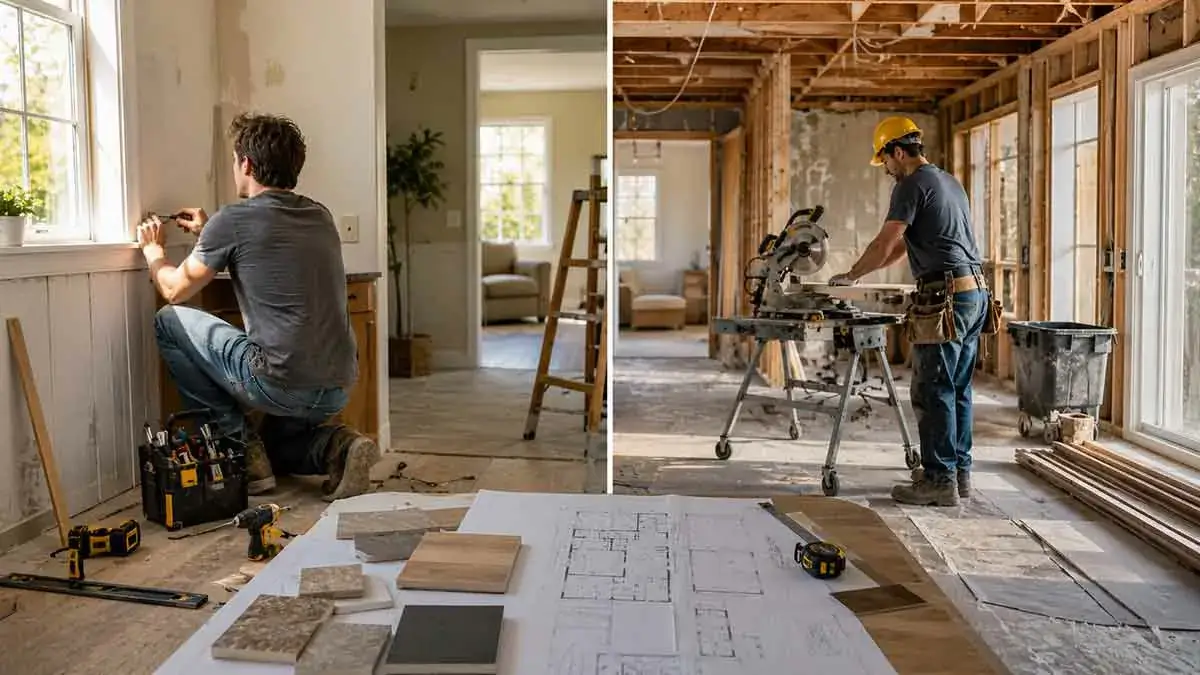
When planning a home renovation, one of the most important decisions is whether to complete the work yourself or hire a professional.
DIY home renovation can reduce labor costs, provide greater control over the project, and give homeowners the opportunity to develop practical skills. Professional renovation, on the other hand, provides specialized expertise, professional equipment, efficient project management, and experience with complex construction work.
The right choice depends on the type of renovation, your skills, available time, budget, tools, safety risks, and the complexity of the work.
Some projects are well suited to DIY, while others are better handled by qualified professionals. In many cases, the most practical solution is a combination of both approaches.
This guide explains DIY vs professional home renovation, compares the advantages and disadvantages of each option, and shows which approach may be more appropriate for different types of home improvement projects.
Table of Contents
What Is DIY Home Renovation?
DIY, or “do it yourself,” means completing renovation work yourself rather than hiring a professional for that specific task.
Common DIY home renovation projects include:
- Painting
- Installing simple shelves
- Replacing cabinet hardware
- Basic decorating
- Some flooring projects
- Minor landscaping
- Assembling furniture
- Certain finishing tasks
With DIY renovation, the homeowner is responsible for planning the work, purchasing materials, obtaining any required approvals, completing the project, and correcting mistakes.
DIY does not necessarily mean completing every part of a renovation without professional assistance.
A homeowner can perform appropriate low-risk tasks while hiring qualified professionals for work that requires specialized knowledge, equipment, licensing, or technical expertise.
What Is Professional Home Renovation?
Professional home renovation involves hiring qualified contractors or tradespeople to complete some or all of the renovation work.
Depending on the project, professionals may include:
- General contractors
- Electricians
- Plumbers
- HVAC technicians
- Carpenters
- Roofers
- Tile installers
- Painters
- Flooring installers
- Structural engineers
- Architects
Professional assistance becomes particularly valuable when a renovation involves structural changes, complex building systems, significant safety risks, or regulatory requirements.
DIY vs Professional Renovation: Quick Comparison
| Factor | DIY | Professional |
|---|---|---|
| Labor cost | Lower | Higher |
| Time commitment | High for homeowner | Lower for homeowner |
| Skill requirement | Homeowner provides skills | Professional provides expertise |
| Project control | High | Shared |
| Specialized work | Limited | Strong |
| Tools | Must own or rent | Usually provided |
| Risk of mistakes | Potentially higher | Generally lower |
| Scheduling | Flexible | Contractor-dependent |
| Complexity | Best for simpler projects | Better for complex projects |
| Permits | Homeowner responsibility where applicable | Contractor may assist |
| Warranty | Usually limited | May be available |
| Convenience | Lower | Higher |
The best choice should be made based on the individual task rather than treating the entire renovation as either DIY or professional.
How to Decide Between DIY and Professional Renovation
Before choosing an approach, evaluate the project realistically.
Do You Have the Necessary Skills?
Basic familiarity with tools does not necessarily mean you are prepared for complex renovation work.
Consider whether you understand:
- Materials
- Construction methods
- Installation techniques
- Safety procedures
- Building requirements
- Required preparation
- Potential failure points
If you are unsure how a system works or how a mistake could affect the rest of the home, professional assistance may be appropriate.
Do You Have Enough Time?
DIY can reduce labor costs but require a significant amount of your personal time.
A professional may complete a task in a day that could take a homeowner several weekends.
Consider both the physical work and the time required for:
- Research
- Shopping
- Transportation
- Preparation
- Installation
- Cleanup
- Troubleshooting
Do You Have the Right Tools?
Some renovation projects require specialized tools.
You may need to:
- Buy equipment
- Rent equipment
- Learn how to use it
- Transport it
- Maintain it
Include these expenses when comparing DIY and professional renovation.
What Happens If You Make a Mistake?
The consequences of a mistake vary greatly between projects.
A painting mistake may be relatively inexpensive to correct.
A mistake involving plumbing, electrical systems, waterproofing, HVAC, or structural components can result in significant repair costs.
Is the Work Dangerous?
Safety should be one of the most important factors in the decision.
If the project involves substantial electrical, structural, roofing, gas, or other hazards, professional assistance may be the safer option.
Advantages of DIY Home Renovation
Lower Labor Costs
The primary financial advantage of DIY renovation is reducing or eliminating professional labor costs.
Your direct expenses may include:
- Materials
- Tools
- Equipment
- Permits where applicable
- Disposal
However, the value of your time and the possibility of mistakes should also be considered.
Greater Control
DIY gives you direct control over:
- Work pace
- Materials
- Design decisions
- Installation details
- Schedule
You can make adjustments without coordinating every small decision with a contractor.
Flexible Scheduling
DIY work can often be completed around your personal schedule.
You may work:
- Evenings
- Weekends
- Holidays
- During available free time
This flexibility can be useful for small projects.
Personal Satisfaction
Completing part of a renovation yourself can provide a strong sense of accomplishment.
It can also give you a better understanding of how your home is constructed and maintained.
Opportunity to Learn
DIY projects can help homeowners develop practical skills in:
- Painting
- Carpentry
- Flooring
- Basic maintenance
- Decorating
- Home improvement
These skills can be useful for future projects.
Disadvantages of DIY Home Renovation
It Takes Time
The homeowner must manage much more than the physical work.
You may need to:
- Research the correct method
- Measure spaces
- Purchase materials
- Transport supplies
- Prepare surfaces
- Complete the installation
- Clean the area
- Correct mistakes
The total time can be substantially greater than expected.
Mistakes Can Be Expensive
An incorrect installation can create additional costs.
You may have to:
- Replace materials
- Hire a professional
- Repair damage
- Remove incorrectly installed work
- Redo completed work
A small initial saving can disappear if a mistake requires professional correction.
Quality May Vary
Professional tradespeople perform specialized tasks regularly.
A homeowner may need significantly more time and practice to achieve the same level of consistency.
Tools Can Become Expensive
Buying specialized tools for a single project may reduce the expected savings.
Tool rental can also add to the total project cost.
Permits and Requirements Can Be Complicated
Homeowners are still responsible for complying with applicable local requirements when performing their own work.
Depending on the location and project, permits, inspections, or specific professional qualifications may be required.
Advantages of Hiring Professionals
Specialized Expertise
Professionals bring technical knowledge and experience to complex projects.
This is especially valuable for:
- Electrical work
- Plumbing
- HVAC
- Structural work
- Roofing
- Waterproofing
Faster Completion
Experienced professionals generally work more efficiently because they have established procedures, specialized tools, and experience solving common problems.
Better Coordination
A general contractor can coordinate multiple trades and schedule them in the correct sequence.
A renovation may involve:
- Electricians
- Plumbers
- Carpenters
- Drywall installers
- Painters
- Flooring installers
Coordinating these trades independently can be challenging for a homeowner.
Professional Equipment
Contractors typically have access to tools and equipment designed for their specific work.
This can improve efficiency and reduce the need for homeowners to purchase or rent specialized equipment.
Greater Accountability
A reputable contractor may provide:
- Written agreements
- Insurance
- Work warranties
- Documentation
- Defined responsibilities
The exact protections depend on the contractor, contract, project, and local requirements.
Disadvantages of Hiring Professionals
Higher Upfront Cost
Professional labor can represent a significant portion of a renovation budget.
You are paying not only for physical labor but also for experience, equipment, project management, and business overhead.
Less Direct Control
You may have less control over the exact daily schedule than when doing the work yourself.
Contractor Availability
Qualified contractors may have busy schedules, which can delay the start of a renovation.
Communication Problems
Poor communication can lead to:
- Misunderstandings
- Incorrect materials
- Schedule problems
- Unexpected costs
- Work that does not match expectations
Contractor Quality Varies
Hiring a professional does not automatically guarantee excellent work.
Research, references, licensing where applicable, insurance, written contracts, and previous projects should still be evaluated.
DIY vs Professional: Painting
Painting is one of the most accessible home renovation tasks for capable DIY homeowners.
DIY painting may make sense when:
- Walls are in reasonable condition
- The room is straightforward
- You have enough time
- You can prepare surfaces properly
- You are comfortable achieving the desired finish
A professional painter may be better when:
- Walls require extensive repairs
- Many rooms must be painted
- Ceilings are difficult to access
- Detailed preparation is required
- A highly consistent finish is important
- The project needs to be completed quickly
Preparation often has as much impact on the final result as the paint itself.
DIY vs Professional: Flooring
Some flooring products are designed for relatively straightforward installation.
DIY may be appropriate for certain:
- Laminate floors
- Click-lock vinyl
- Floating floors
- Simple small-room installations
Professional installation may be preferable when the project involves:
- Uneven subfloors
- Complex patterns
- Hardwood
- Large areas
- Staircases
- Extensive subfloor preparation
The condition of the subfloor can be more important than the flooring material itself.
DIY vs Professional: Kitchen Renovation
Kitchen renovation often combines several different types of work.
DIY may be suitable for:
- Painting walls
- Painting cabinets
- Replacing cabinet hardware
- Installing simple organizers
- Certain decorative tasks
Professional assistance is generally more appropriate for:
- Electrical modifications
- Plumbing relocation
- Structural changes
- Gas-related work
- Complex cabinetry
- Countertop installation
A hybrid approach can reduce labor costs while keeping specialized work in professional hands.
DIY vs Professional: Bathroom Renovation
Bathrooms combine water, plumbing, electrical systems, waterproofing, finishes, and sometimes structural modifications.
DIY may be suitable for:
- Painting
- Replacing accessories
- Installing simple hardware
- Certain cosmetic updates
Professional assistance is often valuable for:
- Plumbing modifications
- Waterproofing
- Electrical work
- Structural changes
- Complex tile installation
Waterproofing deserves particular attention because installation failures can remain hidden until significant damage occurs.
DIY vs Professional: Electrical Work
Electrical work requires particular caution.
The work homeowners are legally permitted to perform varies by jurisdiction and project.
Professional assistance is especially appropriate for:
- New circuits
- Electrical panel modifications
- Major rewiring
- Service upgrades
- Complex electrical installations
Always check applicable local requirements before performing electrical work yourself.
DIY vs Professional: Plumbing
Plumbing ranges from relatively simple maintenance to major modifications of the home’s water and drainage systems.
A capable homeowner may be comfortable with certain minor tasks.
Professional assistance is generally more appropriate for:
- Moving plumbing lines
- Major leaks
- Drain modifications
- Sewer work
- New supply lines
- Extensive bathroom or kitchen plumbing
Improper plumbing work can cause leaks, water damage, mold, and additional repair costs.
DIY vs Professional: HVAC
HVAC systems require specialized knowledge and equipment.
Professional HVAC technicians are generally better suited for:
- Equipment replacement
- Refrigerant-related work
- Duct modifications
- System sizing
- Complex installations
- Major electrical connections
Incorrect HVAC work can affect efficiency, comfort, equipment performance, and safety.
DIY vs Professional: Structural Renovation
Structural work should not be approached like an ordinary cosmetic DIY project.
Examples include:
- Removing load-bearing walls
- Modifying structural beams
- Foundation work
- Major framing changes
- Structural additions
These projects may require engineering, permits, inspections, and qualified contractors.
Before modifying a structural component, determine exactly what supports the building and what requirements apply to the project.
DIY vs Professional: Roofing
Roofing can involve substantial fall and weather-related safety risks.
Professional roofing services may be appropriate for:
- Roof replacement
- Structural roof repairs
- Significant leaks
- Flashing problems
- Complex roof designs
A homeowner may be able to handle limited maintenance depending on the situation, but major roofing work should be evaluated carefully.
DIY vs Professional: Windows and Doors
Replacing interior doors can be relatively accessible to capable DIY homeowners.
Exterior windows and doors are more demanding because proper installation affects:
- Weather resistance
- Air leakage
- Water management
- Energy efficiency
- Structural performance
Professional installation can be worthwhile when precise fitting, flashing, weatherproofing, or structural modifications are involved.
How Much Can DIY Renovation Save?
DIY can reduce labor expenses, but the actual savings depend on the project.
A useful way to think about the cost is:
DIY Cost = Materials + Tools + Equipment + Your Time + Mistake Risk
Professional renovation can be represented as:
Professional Cost = Materials + Labor + Contractor Overhead + Applicable Fees
If you already own the required tools and have the necessary skills, DIY can provide meaningful savings.
If you need expensive equipment, extensive training, or professional correction after mistakes, the financial advantage may be much smaller.
How to Calculate the Value of Your Time
Your time has value even when you are not paying yourself an hourly wage.
Suppose a professional can complete a project in two days while you expect it to take several weekends and evenings.
Consider:
- How much time the project will require
- What other responsibilities will be delayed
- Whether you could use that time for paid work
- How much you value your free time
- How important a fast completion is
DIY is not truly free simply because there is no contractor invoice.
When DIY Is Usually the Better Choice
DIY may be appropriate when:
- The project is low risk
- You have the necessary skills
- You have enough time
- Mistakes are relatively easy to correct
- The work does not involve complex systems
- You enjoy the process
- You already own the required tools
Examples include:
- Painting
- Basic decorating
- Cabinet hardware
- Simple shelving
- Certain flooring projects
- Minor cosmetic updates
When Hiring a Professional Is Usually Better
Professional help is generally more appropriate when:
- Safety risks are significant
- Specialized knowledge is required
- Structural systems are involved
- Complex electrical work is needed
- Plumbing systems must be relocated
- HVAC systems require modification
- Waterproofing is critical
- Permits or inspections are required
- The project has a tight deadline
- A mistake could cause significant property damage
The Hybrid Approach: DIY + Professional
You do not have to choose a single approach for the entire renovation.
A hybrid renovation combines homeowner-performed tasks with professional services.
For example:
Homeowner Tasks
- Painting
- Appropriate demolition
- Cabinet hardware
- Basic cleanup
- Decorating
- Simple finishing work
Professional Tasks
- Electrical work
- Plumbing
- Structural work
- HVAC
- Complex flooring
- Waterproofing
- Specialized installations
This approach can reduce labor costs while keeping technically demanding work with qualified professionals.
How to Work With Contractors While Doing DIY
If you plan to combine DIY and professional work, define responsibilities before construction begins.
Establish:
- Who purchases materials
- Who prepares surfaces
- Who performs demolition
- Who removes debris
- Who completes each installation
- Who handles permits
- Who coordinates inspections
- Which homeowner-performed work must be completed before the contractor arrives
Do not assume that a contractor will automatically repair or redo homeowner-performed work.
The division of responsibilities should be clear in the project agreement whenever possible.
Common DIY Renovation Mistakes
Underestimating the Time Required
A project that looks simple in a tutorial may take considerably longer in a real home.
Skipping Preparation
Poor preparation can lead to poor results, damaged materials, and additional work.
Buying the Cheapest Materials
Low-cost materials are not always the best value if they are difficult to install or have poor durability.
Ignoring Building Requirements
Renovation work may be subject to local building codes, permits, inspections, or other requirements.
Attempting High-Risk Work
Some tasks are inappropriate for inexperienced homeowners because the consequences of mistakes can be severe.
Focusing Only on Labor Savings
A lower labor cost does not automatically make DIY the better financial decision.
Quality, durability, time, tools, and potential repair costs should also be considered.
Common Mistakes When Hiring Professionals
Choosing Only by Price
The lowest estimate is not necessarily the best value.
Not Checking References
Previous work can provide useful information about quality and reliability.
Failing to Define the Scope
A vague scope can create disagreements about what is included.
Not Getting Agreements in Writing
Important details should be documented, including scope, payment terms, responsibilities, and changes.
Making Frequent Changes
Changes during construction can increase costs and extend the schedule.
Failing to Verify Qualifications
Where licensing, insurance, or specialized qualifications apply, verify them before work begins.
Questions to Ask Before Choosing DIY
Ask yourself:
- Do I understand the entire process?
- Do I have the necessary tools?
- Can I safely perform the work?
- Do I have enough time?
- Are permits or inspections required?
- What happens if I make a mistake?
- How difficult will the work be to correct?
- Will the final result meet my expectations?
- Could the work affect another home system?
- Would hiring a professional provide better overall value?
If several answers raise concerns, professional assistance may be the better option.
Questions to Ask a Professional Contractor
Before hiring a contractor, consider asking:
- Are you licensed where required?
- Are you insured?
- Do you have experience with this type of project?
- Can you provide references?
- What is included in the estimate?
- Who obtains permits?
- What materials are included?
- What is the expected schedule?
- How are changes handled?
- What warranty is provided?
- Who handles cleanup?
- Who coordinates subcontractors?
Get important answers and project responsibilities in writing whenever possible.
Final Decision: DIY or Professional?
There is no universal answer to DIY vs professional home renovation.
The right choice depends on the project, your capabilities, available time, budget, and the consequences of a mistake.
A practical rule is:
DIY simple, low-risk, cosmetic work.
Hire professionals for complex, high-risk, specialized, or regulated work.
For many homeowners, a hybrid approach provides the best balance.
You can handle suitable tasks yourself to reduce labor costs and remain involved in the renovation, while professionals handle work that requires specialized expertise, equipment, safety knowledge, or regulatory compliance.
The goal should not be to complete the entire renovation yourself.
The goal is to complete the project safely, efficiently, within budget, and to an acceptable standard of quality.
Frequently Asked Questions
Is DIY renovation cheaper than hiring a professional?
DIY can be cheaper because you avoid professional labor costs, but the actual savings depend on your skills, tools, time, materials, and the risk of mistakes.
What home renovations are easiest to DIY?
Painting, cabinet hardware, basic decorating, simple shelving, and some flooring projects are often more accessible to capable homeowners.
What renovation work should I not DIY?
Complex electrical, plumbing, HVAC, structural, roofing, gas-related, and waterproofing work may require specialized expertise and should be evaluated carefully before attempting DIY.
Is it better to renovate a house yourself or hire someone?
It depends on the project. DIY can work well for simple, low-risk tasks, while professional contractors are generally better suited to complex or high-risk work.
Can I save money by doing my own demolition?
Potentially, but demolition can expose hidden wiring, plumbing, structural elements, hazardous materials, and disposal requirements. Only perform demolition that you can safely and legally handle.
Should I hire a professional for a kitchen renovation?
A kitchen renovation can benefit from a hybrid approach. Homeowners may handle cosmetic tasks while professionals handle complex plumbing, electrical, structural, gas-related, or specialized installation work.
Should I hire a professional for a bathroom renovation?
Professional assistance is often worthwhile for plumbing, waterproofing, electrical, structural, and complex tile work because mistakes can lead to expensive damage or safety problems.
How do I know if a contractor is reliable?
Review relevant experience, references, insurance, licensing requirements, written estimates, contracts, and previous work before making a decision.
Can I do part of a renovation myself and hire professionals for the rest?
Yes. A hybrid approach is often an effective way to control labor costs while ensuring specialized work is handled appropriately.
Is DIY renovation worth it?
DIY can be worthwhile when the project matches your skills, available time, budget, and risk tolerance. It is less attractive when the work is complex, dangerous, highly specialized, or difficult to correct.