
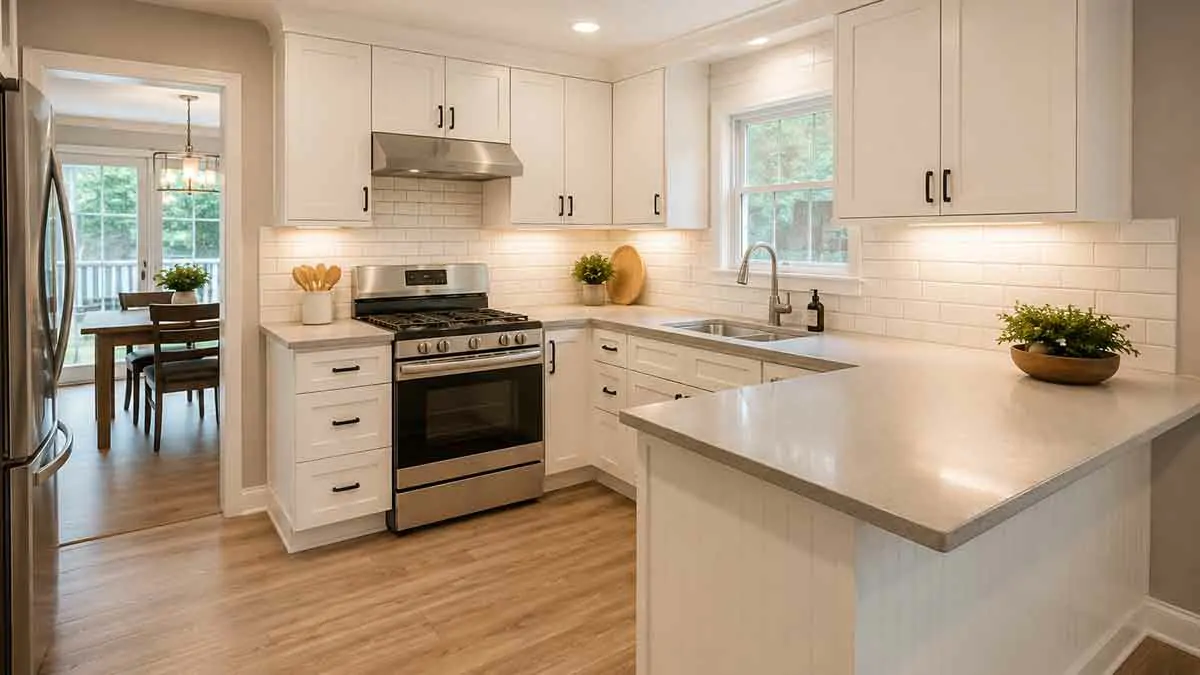
A budget kitchen renovation can improve the appearance, functionality, storage, and comfort of your kitchen without the expense of a complete high-end remodel.
Many homeowners assume that renovating a kitchen requires replacing cabinets, changing the layout, buying new appliances, and installing expensive countertops. In reality, some of the most noticeable improvements can come from smaller, carefully selected upgrades.
Painting existing cabinets, replacing hardware, improving lighting, updating the faucet, adding a backsplash, improving storage, or replacing a worn countertop can significantly change a kitchen while keeping construction costs under control.
The key is to determine which improvements provide the greatest benefit and avoid spending money on components that are still functional.
This guide explains how to plan a budget kitchen renovation, where to spend and save, which upgrades provide the greatest visual impact, how to control labor and material costs, and what mistakes to avoid.
Table of Contents
What Is a Budget Kitchen Renovation?
A budget kitchen renovation focuses on improving an existing kitchen without completely rebuilding the room.
Instead of replacing every component, homeowners prioritize upgrades that improve appearance, functionality, or durability while preserving as much of the existing kitchen as possible.
Common budget renovation projects include:
- Painting or refinishing cabinets
- Replacing cabinet hardware
- Updating lighting
- Installing a backsplash
- Replacing a worn countertop
- Updating the faucet
- Improving cabinet organization
- Repainting walls
- Refreshing flooring
- Replacing selected appliances
The objective is not simply to spend less money.
The objective is to get the most useful improvement from the available renovation budget.
If the existing cabinets, plumbing locations, electrical system, and layout are still suitable, keeping them can eliminate much of the cost associated with a complete kitchen remodel.
How Much Does a Budget Kitchen Renovation Cost?
There is no single price for a budget kitchen renovation because projects can vary from a simple cosmetic refresh to a substantial partial remodel.
The total cost depends on:
- Kitchen size
- Existing condition
- Cabinets
- Countertops
- Flooring
- Appliances
- Lighting
- Plumbing
- Electrical work
- Backsplash
- Labor
- Material quality
- Location
- Project scope
A kitchen that only needs paint, hardware, and lighting can have a very different budget from one that requires new countertops, flooring, appliances, plumbing, and electrical work.
For early planning, it is more useful to define the scope of work and estimate each component separately than to rely on a single average renovation price.
Always consider additional costs such as:
- Delivery
- Installation
- Demolition
- Disposal
- Permits where required
- Repairs discovered during construction
- Contractor labor
- Contingency funds
Keeping approximately 10% to 20% of the planned budget available for unexpected expenses can provide useful financial protection, particularly in older kitchens.
How to Set a Kitchen Renovation Budget
Before choosing materials, establish the maximum amount you are comfortable spending.
Then divide the project into three categories.
Essential Improvements
These address problems that affect safety, durability, or basic functionality.
Examples include:
- Plumbing leaks
- Damaged flooring
- Unsafe electrical components
- Poor ventilation
- Water damage
- Severely damaged cabinets
These items should generally be addressed before cosmetic improvements.
High-Impact Improvements
These changes can make the kitchen look and function significantly better without requiring a complete remodel.
Examples include:
- Cabinet painting
- New hardware
- Improved lighting
- New backsplash
- Countertop replacement
- Faucet replacement
Optional Improvements
These are features that can be added when the budget allows.
Examples include:
- Premium appliances
- Custom storage
- Decorative shelving
- Designer fixtures
- Specialty finishes
This approach helps prevent optional upgrades from consuming money needed for essential repairs.
Budget Kitchen Renovation: Where to Spend and Where to Save
One of the most important decisions is determining which components deserve more of the budget.
Spend More on High-Use Components
It can make sense to allocate more money to components that receive frequent use, such as:
- Faucets
- Countertops
- Cabinet hardware
- Flooring
- Frequently used appliances
Durability can provide better long-term value than choosing the cheapest available product.
Save on Cosmetic Components When Possible
Some decorative elements can be upgraded without purchasing premium products.
Examples include:
- Cabinet hardware
- Wall paint
- Simple backsplash tile
- Decorative shelving
- Light fixtures
A coordinated design can often look more expensive than the materials actually cost.
Keep the Existing Kitchen Layout
Keeping the existing layout is one of the most effective ways to control a kitchen renovation budget.
Moving a sink, dishwasher, refrigerator, or cooking area may require changes to:
- Plumbing
- Electrical wiring
- Gas connections
- Ventilation
- Flooring
- Cabinets
- Walls
These changes add labor and can create additional repair work.
If the existing layout functions reasonably well, consider upgrading the finishes instead.
For example, keeping the current cabinet arrangement while painting the cabinets, replacing the countertop, upgrading the hardware, and improving lighting can create a substantial transformation without relocating major utilities.
Paint or Refinish Kitchen Cabinets
Cabinets often dominate the visual appearance of a kitchen, making them one of the most important areas to consider in a budget renovation.
If the cabinet boxes and doors are structurally sound, painting or refinishing them may cost considerably less than replacing them.
Before starting, inspect:
- Cabinet doors
- Cabinet boxes
- Hinges
- Drawer slides
- Shelves
- Areas near sinks and dishwashers
Painting is a good option when the cabinets have an acceptable layout and do not have significant water damage.
Proper preparation is essential.
A durable cabinet finish generally requires thorough cleaning, surface preparation, appropriate primer, and a coating designed for cabinet use.
Simply applying ordinary wall paint over dirty or poorly prepared cabinets can lead to peeling, chipping, and an uneven finish.
Cabinet Refacing vs. Cabinet Replacement
Cabinet refacing can be another option when the cabinet structure is sound but the doors and visible surfaces look outdated.
Refacing generally involves updating the visible cabinet surfaces rather than removing the entire cabinet system.
It can make sense when:
- The existing layout works
- Cabinet boxes are structurally sound
- Storage is adequate
- You want a different appearance
Complete replacement may be more appropriate when:
- Cabinets are damaged
- Storage is inadequate
- The layout is inefficient
- Water damage is extensive
- The cabinet structure has deteriorated
The right choice depends on condition, desired appearance, and available budget.
Replace Cabinet Hardware
Replacing knobs and pulls is one of the simplest kitchen upgrades.
New hardware can make older cabinets appear more modern without changing the cabinet boxes.
Before purchasing replacements, check:
- Existing hole spacing
- Hardware dimensions
- Screw length
- Cabinet door thickness
- Overall style
Using the same mounting dimensions can simplify installation and avoid unnecessary holes or repairs.
Choose a Budget-Friendly Countertop
Countertops can have a major visual effect, but premium materials can consume a significant part of a renovation budget.
If the existing countertop remains functional and attractive enough, keeping it may allow you to spend money on more important improvements.
When replacement is necessary, compare materials based on:
- Material price
- Installation cost
- Durability
- Maintenance
- Heat resistance
- Stain resistance
- Expected lifespan
Remember that the final countertop cost can include more than the material itself.
Additional expenses may include:
- Removal of the old countertop
- Sink cutouts
- Edge treatments
- Delivery
- Installation
- Plumbing adjustments
Compare the complete installed cost rather than only the advertised material price.
Install an Affordable Kitchen Backsplash
A backsplash can provide a strong visual update without requiring a major renovation.
Budget-friendly options can include:
- Ceramic tile
- Porcelain tile
- Simple subway tile
- Small-format tile
- Peel-and-stick backsplash products where appropriate
Simple patterns are generally easier to install than complicated layouts.
If the budget is tight, concentrate the backsplash on the most visible areas rather than covering every available wall.
The goal is to create a finished appearance without adding unnecessary material and labor.
Improve Kitchen Lighting
Lighting can make a major difference in both appearance and functionality.
A practical kitchen lighting plan can combine:
- Ambient lighting
- Task lighting
- Accent lighting
Under-cabinet lighting is particularly useful because it improves visibility on work surfaces.
Replacing an outdated ceiling fixture can also provide an immediate visual improvement.
When new wiring, circuits, or other electrical modifications are required, use an appropriately qualified professional and follow applicable local requirements.
Replace the Kitchen Faucet
A faucet is one of the most frequently used components in a kitchen.
Replacing an old faucet can improve both appearance and everyday usability.
Before purchasing, check:
- Number of sink holes
- Faucet-hole configuration
- Spout reach
- Faucet height
- Sink compatibility
- Spray function
- Finish durability
A new faucet combined with new cabinet hardware can create a noticeable update without requiring extensive construction.
Improve Kitchen Storage
A kitchen does not necessarily need new cabinets to become more functional.
Existing storage can often be improved with:
- Drawer organizers
- Pull-out shelves
- Shelf risers
- Tray dividers
- Pantry organizers
- Corner organizers
- Vertical storage
- Door-mounted organizers
These upgrades can increase usable storage while preserving the existing cabinet layout.
For a budget renovation, improving the organization of existing cabinets can provide more practical value than replacing cabinets simply for appearance.
Update Kitchen Walls
Painting the kitchen walls is a relatively simple way to refresh the room.
Choose a durable paint appropriate for an area exposed to cooking activity, cleaning, and occasional moisture.
Before painting:
- Clean the walls.
- Repair holes and cracks.
- Prepare damaged surfaces.
- Protect cabinets and countertops.
- Apply appropriate primer where necessary.
- Apply the finish coats.
The color should work with the cabinets, countertop, flooring, and backsplash rather than being selected in isolation.
Replace or Refresh Kitchen Flooring
Flooring does not always need to be replaced during a budget kitchen renovation.
If the existing floor is structurally sound and can be cleaned, repaired, or refinished effectively, keeping it may free money for higher-priority improvements.
When replacement is necessary, compare flooring based on:
- Material cost
- Installation cost
- Durability
- Moisture resistance
- Maintenance
- Expected lifespan
Consider the total installed cost rather than only the purchase price.
A low-cost material that requires frequent replacement may provide worse long-term value than a moderately priced durable option.
Upgrade Appliances Strategically
Appliances can consume a large part of a kitchen renovation budget.
If existing appliances work reliably and meet your needs, replacing them purely for appearance may not be the best use of limited funds.
When replacement is necessary, consider:
- Purchase price
- Energy efficiency
- Capacity
- Reliability
- Warranty
- Installation requirements
- Long-term operating costs
You do not necessarily need to replace every appliance at the same time.
Replacing the most outdated or inefficient appliance first can make the renovation more financially manageable.
Budget Kitchen Renovation Cost Breakdown
A useful way to organize your budget is to separate each project component before purchasing anything.
| Renovation Area | Estimated Cost | Priority |
|---|---|---|
| Cabinet repair or painting | — | High |
| Cabinet hardware | — | Medium |
| Countertop | — | Medium |
| Backsplash | — | Medium |
| Lighting | — | High |
| Faucet | — | Medium |
| Storage upgrades | — | Medium |
| Flooring | — | Medium |
| Appliances | — | Depends on condition |
| Plumbing | — | High if needed |
| Electrical | — | High if needed |
| Painting | — | Low |
| Labor | — | High |
| Disposal and delivery | — | Medium |
| Contingency | Additional reserve | High |
The actual amount assigned to each category depends on your kitchen, location, material choices, and project scope.
DIY vs. Professional Kitchen Renovation
Doing selected tasks yourself can reduce labor costs, but DIY is not appropriate for every renovation activity.
Suitable DIY Projects
Depending on your skills and experience, you may be able to handle:
- Wall painting
- Cabinet painting
- Cabinet hardware
- Simple shelving
- Organization upgrades
- Basic cosmetic preparation
Work Better Left to Professionals
Professional assistance is generally appropriate for:
- Electrical work
- Gas connections
- Major plumbing changes
- Structural modifications
- Complex countertop installation
- Major ventilation work
A mistake involving electrical, gas, plumbing, or structural systems can create safety risks and expensive repairs.
How to Save Money on a Kitchen Renovation
Keep the Existing Layout
Avoid relocating plumbing, electrical connections, and major appliances unless the current layout creates a genuine functional problem.
Reuse Functional Components
If cabinets, appliances, flooring, or fixtures remain in good condition, consider keeping them.
Paint Instead of Replace
Cabinet painting can provide a substantial visual change without the cost of complete cabinet replacement.
Choose Standard Sizes
Standard cabinets, fixtures, hardware, and appliances are often easier to source and install than custom products.
Compare Installed Costs
Do not compare products based only on their retail price.
Include:
- Delivery
- Installation
- Removal
- Disposal
- Additional materials
Renovate in Phases
If the complete project does not fit your budget, divide it into stages.
For example:
Phase 1: Repairs and safety issues
Phase 2: Cabinets and lighting
Phase 3: Countertop and backsplash
Phase 4: Flooring and optional upgrades
Shop Strategically
Compare prices from multiple suppliers and consider sales, clearance products, and discontinued finishes when they meet your quality requirements.
High-Impact Budget Kitchen Renovation Ideas
When money is limited, focus on improvements that change the appearance or usability of the room without major construction.
High-impact options include:
- Paint existing cabinets.
- Replace cabinet hardware.
- Improve ceiling lighting.
- Add under-cabinet lighting.
- Replace an outdated faucet.
- Install a simple backsplash.
- Repaint the walls.
- Improve cabinet organization.
- Replace a damaged countertop.
- Upgrade one or two outdated appliances.
You do not need to complete every improvement.
Select the upgrades that address the biggest problems in your kitchen.
Common Budget Kitchen Renovation Mistakes
Spending the Entire Budget on Appearance
Do not prioritize decorative improvements over leaks, unsafe electrical systems, damaged flooring, or poor ventilation.
Changing the Layout Without a Strong Reason
Moving plumbing and electrical systems can quickly increase the project cost.
Replacing Good Cabinets
If the existing cabinets are structurally sound and functional, replacement may provide less value than refinishing or refacing.
Choosing Materials Only by Price
The cheapest product is not necessarily the least expensive option over its useful life.
Consider durability, installation, maintenance, and replacement costs.
Forgetting Labor
Material prices are only part of the renovation budget.
Installation can represent a substantial portion of the total cost.
Ignoring Delivery and Disposal
Large materials and old fixtures may involve additional delivery, removal, and disposal charges.
Buying Materials Before Final Measurements
Incorrect measurements can result in wasted materials and expensive returns.
Changing the Design During Construction
Late decisions can increase labor, waste, delays, and change-order costs.
Skipping the Contingency Fund
Unexpected plumbing, electrical, moisture, or structural problems can appear after demolition.
How to Plan a Budget Kitchen Renovation Step by Step
Step 1: Evaluate the Existing Kitchen
Identify what works, what needs repair, and what you want to improve.
Step 2: Set a Maximum Budget
Determine the maximum amount you can spend and reserve part of it for unexpected costs.
Step 3: Prioritize Essential Repairs
Address safety, plumbing, electrical, moisture, ventilation, and structural problems before cosmetic improvements.
Step 4: Decide What to Keep
Identify cabinets, appliances, flooring, fixtures, and other components that can remain.
Step 5: Preserve the Existing Layout
Avoid moving major utilities unless the current layout genuinely limits the kitchen.
Step 6: Select High-Impact Upgrades
Choose improvements that provide the greatest visual and functional benefit for the money available.
Step 7: Compare Materials
Compare purchase price, installation requirements, durability, maintenance, and expected lifespan.
Step 8: Decide What You Can DIY
Take on suitable cosmetic tasks while hiring professionals for specialized work.
Step 9: Get Detailed Quotes
For contractor work, compare multiple estimates with clearly defined scopes.
Step 10: Track Every Expense
Record material, labor, delivery, disposal, and unexpected costs throughout the renovation.
Step 11: Review the Finished Kitchen
After the essential work is complete, evaluate whether optional upgrades are still necessary.
Is a Budget Kitchen Renovation Worth It?
A budget kitchen renovation can be worthwhile when the existing kitchen has a usable layout and reasonably sound structure.
You may not need a completely new kitchen to achieve meaningful improvements.
A combination of cabinet refinishing, new hardware, improved lighting, better storage, updated fixtures, and carefully selected finishes can significantly improve the space.
The strongest budget renovations focus on function first, high-impact improvements second, and decorative upgrades last.
This approach helps ensure that limited money produces practical improvements rather than simply making the kitchen look newer.
Final Thoughts
A budget kitchen renovation is about making strategic improvements rather than trying to replace everything.
Keeping the existing layout, reusing functional components, refinishing cabinets, replacing hardware, improving lighting, choosing practical materials, and upgrading only the appliances that actually need replacement can significantly reduce costs.
Before beginning, establish a realistic budget and separate essential repairs from optional improvements. Compare complete installed costs, not just material prices, and maintain a contingency reserve for unexpected problems.
Most importantly, do not assume that an expensive remodel is necessary to create a better kitchen.
With careful planning, a limited budget can still produce a kitchen that is more attractive, functional, comfortable, and practical for everyday use.
Frequently Asked Questions
What is the cheapest way to renovate a kitchen?
Keeping the existing layout and reusing functional cabinets, appliances, flooring, and fixtures are among the most effective ways to reduce renovation costs. Painting cabinets, replacing hardware, improving lighting, and updating the faucet can also create noticeable improvements at relatively low construction cost.
Is it cheaper to paint or replace kitchen cabinets?
When existing cabinets are structurally sound, painting or refinishing them is generally less expensive than complete replacement. Replacement may make more sense when cabinets are damaged, poorly configured, or no longer provide adequate storage.
What should I renovate first in a kitchen?
Address safety, plumbing, electrical, moisture, ventilation, and structural problems first. After essential repairs, prioritize improvements that have a strong effect on functionality and appearance.
Should I keep my existing kitchen layout?
Keeping the existing layout can reduce costs because moving sinks, dishwashers, appliances, electrical connections, and plumbing can require additional construction and labor.
How can I make an old kitchen look better on a budget?
Painting cabinets, replacing hardware, improving lighting, updating the faucet, adding a backsplash, repainting walls, and improving storage can create a substantial visual improvement without a complete remodel.
Should I replace appliances during a budget kitchen renovation?
Not necessarily. If existing appliances work reliably and meet your needs, keeping them can free money for more important improvements. Replace appliances when they are damaged, inefficient, unreliable, or no longer suitable for the kitchen.
What kitchen upgrades add the most value on a budget?
Practical improvements such as updated cabinets, improved lighting, durable countertops, better storage, functional fixtures, and addressing maintenance problems can provide meaningful value without requiring a luxury remodel.
Is a backsplash worth it in a budget renovation?
A backsplash can provide a strong visual improvement while protecting walls behind sinks and cooking areas. Choosing simple, readily available materials and limiting the installation area can help control costs.
Can I renovate my kitchen myself?
Some cosmetic projects, such as painting walls, painting cabinets, installing hardware, and organizing storage, may be suitable for DIY. Electrical, gas, major plumbing, structural, and other specialized work should generally be handled by appropriately qualified professionals.
How much should I keep aside for unexpected kitchen renovation costs?
A contingency reserve of around 10% to 20% of the planned budget can help cover unexpected repairs, material changes, delivery problems, or hidden conditions. Older kitchens may require a larger reserve depending on their condition.
Is a budget kitchen renovation worth it?
Yes, particularly when the existing kitchen has a functional layout and components that can be reused. Strategic upgrades can improve appearance and functionality without the cost and disruption of a complete kitchen remodel.