
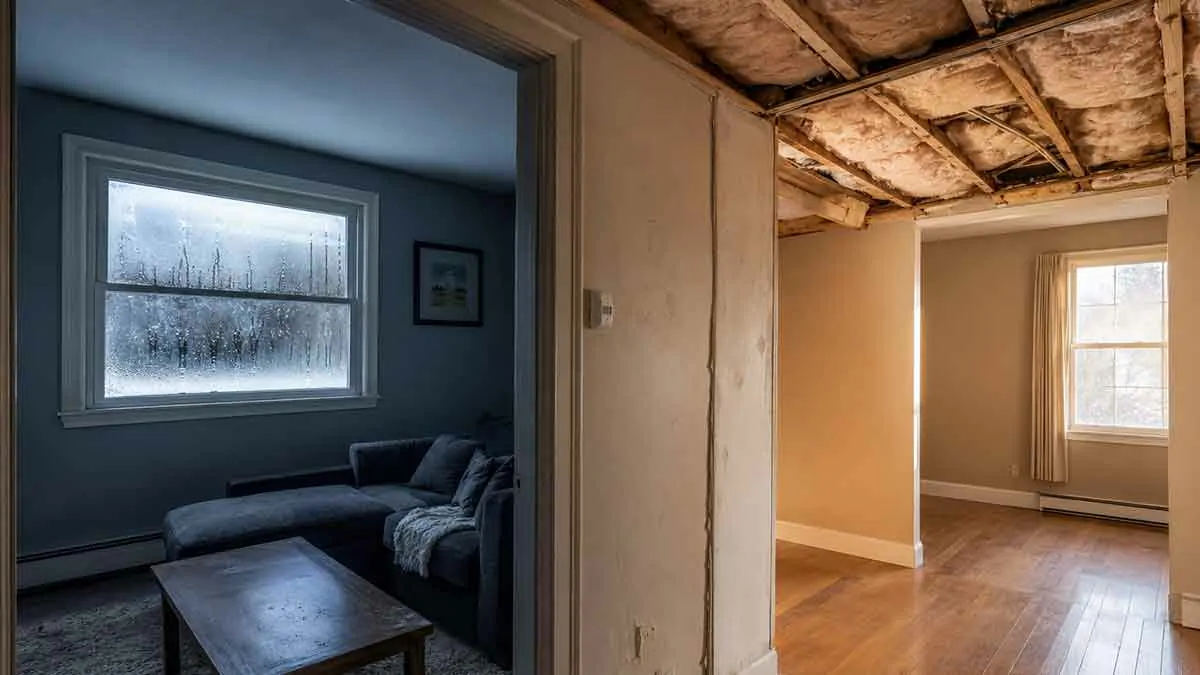
Good insulation helps slow heat transfer between your home and the outdoors. When insulation is missing, damaged, compressed, poorly installed, or inadequate for the home’s construction, you may notice changes in comfort, indoor temperatures, and energy use.
However, not every uncomfortable room or high energy bill means the insulation is the problem. Air leaks, inefficient windows, HVAC issues, moisture, ductwork, and solar heat gain can produce similar symptoms.
Learning the common signs of inadequate insulation can help you decide whether your home needs an insulation inspection, an energy assessment, or a broader building-envelope evaluation.
This guide explains the most common signs your home may need better insulation, where to check first, how to distinguish insulation problems from other issues, and what to do before investing in an upgrade.
Table of Contents
Why Proper Insulation Matters
Insulation slows the movement of heat through the building envelope.
During winter, it helps reduce heat escaping from conditioned spaces. During summer, it can reduce unwanted heat entering the home.
Proper insulation can help:
- Improve indoor comfort
- Reduce temperature fluctuations
- Lower heating and cooling demand
- Reduce heat transfer
- Improve temperature consistency
- Support better building-envelope performance
Insulation works best when combined with effective air sealing, properly installed windows and doors, adequate moisture control, and efficient HVAC distribution.
1. Your Energy Bills Are Unusually High
Unusually high heating or cooling costs can be a reason to investigate insulation.
Poor insulation can increase heat transfer, forcing the HVAC system to operate longer to maintain the desired indoor temperature.
However, high energy bills can have many causes, including:
- Inefficient HVAC equipment
- Air leakage
- Poor ductwork
- Older windows
- Changes in thermostat settings
- Changes in energy prices
- Increased household usage
- Extreme outdoor temperatures
If energy consumption is consistently higher than expected, evaluate insulation together with air sealing, HVAC performance, and other building-envelope components.
2. Some Rooms Are Much Colder Than Others
Large and persistent temperature differences between rooms can indicate an insulation problem.
You may notice that:
- Bedrooms are colder than living areas
- One side of the house feels colder
- Upstairs rooms become excessively warm
- Exterior rooms are uncomfortable
- Rooms above garages have cold floors
Insufficient insulation can contribute to these differences, but HVAC distribution and air leakage can also be responsible.
If one room remains uncomfortable despite normal HVAC operation, inspect the insulation and air-sealing conditions serving that area.
3. Your Floors Feel Cold
Cold floors can indicate inadequate insulation beneath the living space.
This is especially common over:
- Crawl spaces
- Unconditioned basements
- Garages
- Porches
- Other exterior or unconditioned areas
If the underside of the floor is accessible, inspect for:
- Missing insulation
- Compressed insulation
- Sagging materials
- Moisture
- Gaps
- Poor installation
Air leakage can also make floors feel cold, so both insulation and air sealing should be considered.
4. Exterior Walls Feel Cold
Interior wall surfaces that feel unusually cold during winter may indicate insufficient or inconsistent insulation.
However, cold walls can also result from:
- Air leakage
- Thermal bridging
- Poor windows
- Exterior exposure
- Moisture
- Furniture blocking normal heat circulation
An infrared inspection can sometimes reveal temperature differences that suggest missing or uneven insulation.
The temperature of a wall surface alone is not enough to confirm an insulation problem.
5. The Attic Has Very Little Insulation
The attic is often one of the easiest areas to inspect.
If you can safely access the attic, look for:
- Thin insulation
- Bare areas
- Uneven coverage
- Compressed insulation
- Settled insulation
- Insulation displaced from edges
- Moisture
- Air leaks around penetrations
Before adding more insulation, inspect for roof leaks and significant air leakage from the living space.
Air sealing the ceiling plane before adding insulation can improve the overall performance of the attic assembly.
6. You Can See Exposed Wall Cavities
Remodeling and repair work can reveal empty or partially insulated wall cavities.
If a wall is already open, inspect the entire cavity before installing new insulation.
Look for:
- Missing insulation
- Gaps
- Compressed materials
- Moisture damage
- Plumbing
- Electrical wiring
- Fire blocking
- Other obstructions
Choose an insulation system that is compatible with the existing wall assembly rather than simply filling the cavity with any available material.
7. Your Home Feels Drafty
A draft is often more directly related to air leakage than insulation.
Common draft locations include:
- Windows
- Exterior doors
- Electrical outlets
- Plumbing penetrations
- Attic hatches
- Rim joists
- Floor penetrations
- Utility openings
A poorly insulated wall can still be relatively airtight, while a well-insulated wall can perform poorly if significant air leaks remain.
For this reason, insulation improvements should often be accompanied by targeted air sealing.
8. Rooms Heat Up Quickly During Summer
Rooms that become significantly hotter than the rest of the house may have insufficient insulation or other building-envelope problems.
This is especially common in:
- Upper floors
- Attic rooms
- Rooms beneath poorly insulated roofs
- Rooms with large exterior walls
- Rooms with significant west-facing windows
Possible causes include heat transfer through the roof and walls, solar heat gain through windows, and air leakage.
Inspect attic insulation and ventilation before assuming that wall insulation is the primary problem.
9. Your Home Loses Heat Quickly in Winter
If indoor temperatures drop noticeably soon after the heating system stops operating, the home may have significant heat loss.
Possible causes include:
- Poor insulation
- Air leakage
- Inefficient windows
- Poorly sealed doors
- Duct losses
- HVAC problems
- Large areas of exposed building envelope
A professional energy assessment can help determine which factors contribute most to the heat loss.
10. Your HVAC System Runs for Long Periods
An HVAC system that runs for long periods does not automatically mean your home needs more insulation.
Other possible causes include:
- Undersized equipment
- Oversized equipment with poor cycling behavior
- Dirty filters
- Poor ductwork
- Thermostat problems
- Equipment maintenance issues
- Refrigeration-system problems
- Extreme outdoor temperatures
- Air leakage
If the HVAC system runs excessively while rooms still struggle to reach the desired temperature, evaluate both the building envelope and HVAC system.
11. You Notice Large Temperature Differences Between Floors
Some temperature variation between floors is normal, but large or persistent differences deserve investigation.
For example:
- The second floor is much hotter than the first.
- The basement is significantly colder.
- Bedrooms above a garage are uncomfortable.
- One floor requires substantially different thermostat settings.
Potential causes include:
- Attic insulation
- Floor insulation
- Air leakage
- Ductwork
- Solar heat gain
- Building orientation
- HVAC zoning
Insulation may be part of the solution, but it should not be assumed to be the only cause.
12. Your Attic Is Unfinished or Poorly Insulated
An unfinished attic can make insulation deficiencies easier to identify.
Inspect the attic floor for adequate and consistent insulation coverage.
Also check:
- Attic hatches
- Plumbing penetrations
- Electrical wiring
- Ductwork
- Recessed fixtures
- Chimney areas
- Roof leaks
- Ventilation pathways
If additional insulation is installed, make sure required attic ventilation remains unobstructed.
13. The Insulation Is Damaged or Compressed
Existing insulation may no longer perform as intended if it has become:
- Wet
- Compressed
- Torn
- Displaced
- Contaminated
- Pest-damaged
- Settled
Fiberglass batts, for example, can lose effectiveness when significantly compressed.
If insulation has been damaged by water or pests, identify and correct the underlying cause before installing replacement material.
14. You Have Water Damage Near Insulated Areas
Water damage near insulation should be investigated before any insulation upgrade.
Warning signs include:
- Ceiling stains
- Wall stains
- Damp insulation
- Mold
- Peeling paint
- Musty odors
- Deteriorated wood
Possible sources include:
- Roof leaks
- Plumbing leaks
- Window leaks
- Foundation moisture
- Condensation
- Exterior water intrusion
Do not simply cover wet or damaged materials with new insulation.
Repair the moisture source first and evaluate whether affected materials need to be removed or replaced.
15. Your Home Is Older
Older homes are more likely to have insulation that is missing, incomplete, settled, or below current energy-efficiency expectations.
Depending on the construction period, an older home may have:
- Little wall insulation
- Thin attic insulation
- Uninsulated floors
- Poorly sealed openings
- Older windows
- Damaged insulation
Age alone does not prove that insulation is inadequate.
It does, however, make a building-envelope inspection worthwhile, especially if the existing insulation level is unknown.
16. You Have Recently Renovated
Renovations can reveal hidden insulation deficiencies.
Whenever walls, ceilings, floors, or siding are opened, inspect the existing insulation before closing the assembly again.
Areas worth checking include:
- Exterior walls
- Attic areas
- Rim joists
- Basement walls
- Crawl spaces
- Floors over unconditioned areas
Improving insulation and air sealing while an assembly is already open is often easier than performing a retrofit later.
17. Rooms Above Garages Are Cold
Rooms above garages can be difficult to keep comfortable because the garage is usually outside the home’s conditioned space.
Possible causes include:
- Missing floor insulation
- Air leakage
- Poorly sealed garage-to-house connections
- Ductwork problems
- Insufficient insulation around the garage
- Gaps around plumbing and electrical penetrations
Inspect the floor assembly and surrounding walls where accessible.
Air sealing is particularly important because the connection between the garage and living space should also limit unwanted air movement.
18. Your Crawl Space Is Uninsulated
A crawl space can strongly influence the temperature of the rooms above it.
If the floor above a crawl space is poorly insulated, occupants may notice:
- Cold floors
- Drafts
- Uneven temperatures
- Increased heating demand
Before adding insulation, inspect the crawl space for:
- Moisture
- Standing water
- Mold
- Pest damage
- Poor drainage
- Damaged insulation
The correct insulation location depends on whether the crawl space is vented or designed as an encapsulated or conditioned space.
19. Your Basement Walls Are Bare
Bare concrete or masonry basement walls can transfer heat to and from the surrounding ground.
If the basement is intended to be part of the home’s conditioned space, foundation wall insulation may improve comfort and thermal performance.
Before insulating, investigate:
- Water intrusion
- Foundation leaks
- Condensation
- Drainage problems
- Damp materials
The insulation system should be compatible with the basement’s moisture-control strategy.
20. You Notice Cold or Hot Spots Around Outlets
Electrical outlets on exterior walls can sometimes reveal temperature differences.
If an outlet feels significantly colder than the surrounding wall during winter, possible causes include:
- Air leakage around the electrical box
- Missing insulation
- Thermal bridging
- Poorly sealed wall penetrations
Any air sealing around electrical components should be performed safely and according to applicable electrical requirements.
Do not modify electrical boxes or wiring in ways that could create a safety hazard.
21. Your Home Is Difficult to Keep Comfortable
Persistent discomfort is an important practical reason to investigate the building envelope.
If you frequently adjust the thermostat or rely on portable heaters and fans to compensate for certain rooms, consider evaluating:
- Insulation
- Air leakage
- Windows
- Doors
- HVAC distribution
- Solar heat gain
- Moisture
The objective should be to identify the underlying cause rather than automatically adding insulation everywhere.
22. Your Ceiling Feels Unusually Cold
A cold ceiling beneath an attic can indicate inadequate attic insulation or air leakage.
Potential warning signs include:
- Uneven ceiling temperatures
- Condensation
- Drafts around fixtures
- Cold spots
- Moisture stains
- Ice buildup in cold climates
Inspect the attic insulation and the ceiling air barrier before deciding on an insulation upgrade.
23. Your Home Has Ice Dams in Winter
In cold climates, recurring ice dams can sometimes indicate heat escaping from the conditioned space into the attic.
Warm air and heat entering the attic can raise roof temperatures, causing snow to melt and later refreeze near colder roof edges.
However, ice dams can have several contributing factors.
A proper evaluation may include:
- Air sealing the attic floor
- Improving attic insulation
- Maintaining appropriate attic ventilation
- Reviewing roof and eave details
Simply removing ice does not address the underlying building-envelope problem.
24. You Hear a Lot of Outdoor Noise
Insulation can contribute to sound reduction in some wall, floor, and ceiling assemblies.
If outdoor noise is unusually noticeable, possible factors include:
- Thin wall assemblies
- Poorly insulated cavities
- Air gaps
- Older windows
- Exterior doors
- Lightweight construction
Thermal insulation is not the same as complete soundproofing.
If acoustic performance is the main goal, evaluate the entire wall or floor assembly rather than selecting insulation based only on its thermal rating.
25. An Energy Audit Shows Significant Heat Loss
A professional energy audit can provide stronger evidence of insulation deficiencies than comfort symptoms alone.
Depending on the service, an assessment may include:
- Blower-door testing
- Infrared imaging
- Attic inspection
- Insulation inspection
- Duct evaluation
- Air-leakage testing
These methods can help identify where heat loss and air leakage are occurring and which improvements are likely to provide the greatest benefit.
How to Tell if Insulation Is Really the Problem
Many signs of poor insulation overlap with other building problems.
Before upgrading insulation, consider the following.
Air Leakage
Large air leaks can create drafts and cold spots even when insulation levels are adequate.
Windows and Doors
Poorly performing or damaged windows and doors can cause significant heat transfer and air leakage.
HVAC Problems
Equipment problems, poor ductwork, or inadequate distribution can cause uneven temperatures.
Moisture
Damp materials and condensation can affect comfort and building performance.
Solar Heat Gain
Large or poorly shaded windows can cause excessive summer heat that insulation alone will not solve.
A broader assessment can prevent you from spending money on insulation when another problem is responsible for the symptom.
Where Should You Check First?
For many homes, a practical inspection sequence is:
- Attic
- Major air leaks
- Basement or crawl space
- Exterior walls
- Floors over unconditioned areas
- Windows and doors
- HVAC ducts
This is a general starting point rather than a universal rule.
The best priority depends on the home’s construction, climate, condition, and existing insulation.
What to Do if Your Home Needs Better Insulation
Once an insulation deficiency has been identified, select a solution based on the specific building assembly.
Potential improvements include:
- Adding attic insulation
- Sealing attic air leaks
- Improving exterior wall insulation
- Adding floor insulation
- Insulating basement walls
- Improving crawl space insulation
- Sealing rim joists
- Insulating appropriate ductwork
- Improving window and door seals
Always address active water intrusion before installing new insulation.
Where possible, combine insulation with air sealing rather than treating the two as completely separate projects.
Common Insulation Upgrade Mistakes
Adding Insulation Without Air Sealing
Air can bypass poorly installed insulation through gaps and penetrations.
Ignoring Moisture
Wet insulation can contribute to larger building problems.
Focusing Only on R-Value
The performance of the complete wall, roof, or floor assembly matters more than the insulation rating alone.
Insulating the Wrong Location
The correct insulation boundary depends on the home’s construction and whether a space is conditioned or unconditioned.
Blocking Ventilation
Do not obstruct required attic or crawl space ventilation pathways.
Replacing Windows Without an Assessment
Windows may not be the largest source of energy loss, and air sealing or insulation improvements elsewhere may provide greater benefits.
Adding Insulation Over Damaged Materials
Water-damaged or contaminated insulation should be evaluated before being covered.
When to Hire a Professional
Professional evaluation is useful when:
- You cannot determine whether insulation is present.
- The home has persistent moisture problems.
- Existing walls require retrofit insulation.
- The attic has complicated ventilation.
- The home has historic construction.
- Major air leakage is suspected.
- HVAC and insulation problems appear connected.
- You are planning a whole-house insulation upgrade.
An energy professional can help identify the highest-priority improvements and distinguish insulation deficiencies from other building-envelope or HVAC problems.
Signs Your Home Needs Better Insulation Checklist
Use this checklist when evaluating your home:
- ☐ Unusually high heating or cooling bills
- ☐ Large differences between room temperatures
- ☐ Cold floors
- ☐ Cold exterior walls
- ☐ Drafty rooms
- ☐ Rooms that become excessively hot during summer
- ☐ Very little attic insulation
- ☐ Missing, compressed, or damaged insulation
- ☐ Moisture or water damage near insulation
- ☐ Older home with unknown insulation levels
- ☐ Cold rooms above garages
- ☐ Uninsulated crawl space
- ☐ Bare basement walls
- ☐ Excessive HVAC runtime
- ☐ Unusually cold ceilings
- ☐ Recurring ice dams in cold climates
- ☐ Significant outdoor noise
- ☐ Energy audit showing substantial heat loss
One sign alone does not necessarily mean that the entire home needs new insulation. Several signs occurring together provide a stronger reason to investigate.
Final Thoughts
Knowing the signs your home needs better insulation can help you identify building-envelope problems before investing in major upgrades.
Cold rooms, high energy bills, uncomfortable floors, uneven temperatures, damaged insulation, cold ceilings, and attic deficiencies can all justify a closer inspection. However, similar symptoms can result from air leaks, windows, HVAC systems, ductwork, moisture, or solar heat gain.
Start by evaluating the attic, major air leaks, basement or crawl space, exterior walls, and floors over unconditioned areas. Then address the problems that have the greatest effect on comfort and energy performance.
The best insulation upgrade is not necessarily the one that adds the most material. It is the one that improves the right part of the building envelope while working with effective air sealing, moisture control, appropriate ventilation, windows, doors, and HVAC performance.
A targeted and properly designed insulation upgrade can make a home more comfortable and efficient without unnecessary work or expense.