
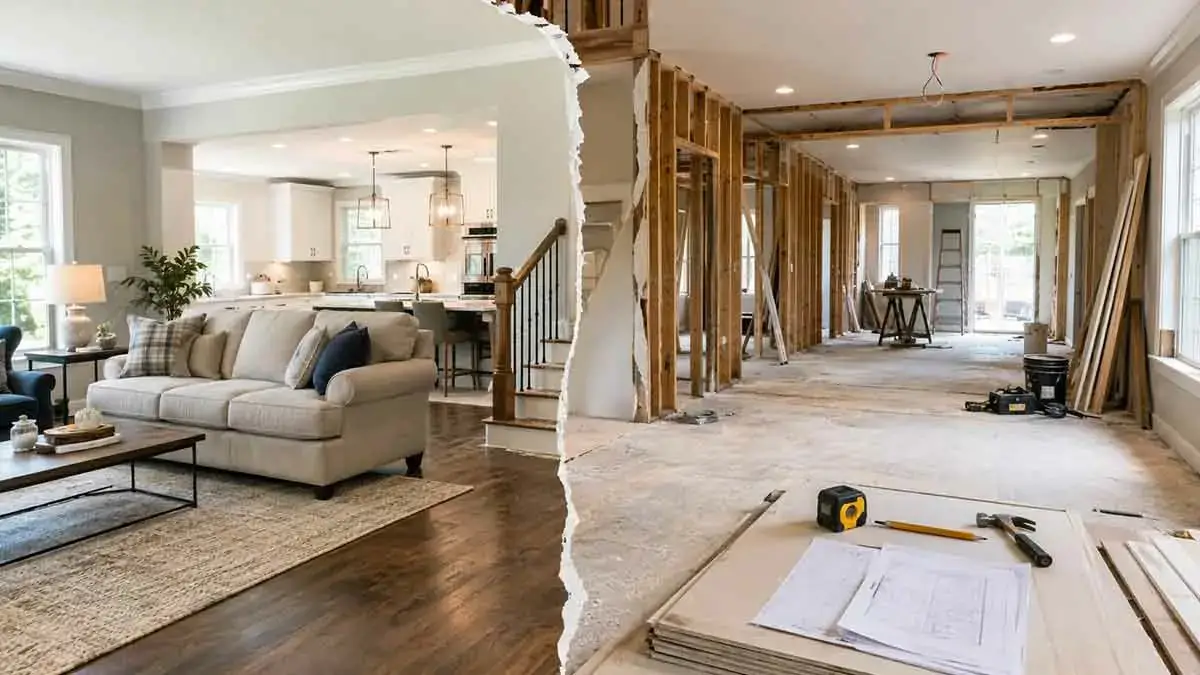
Understanding home renovation vs remodeling can help you make better decisions before starting a home improvement project. Although the terms renovation and remodeling are often used interchangeably, they can describe different levels and types of change.
In general, a home renovation focuses on repairing, updating, restoring, or improving an existing space while keeping its basic purpose and layout. Remodeling usually involves a more substantial change to the layout, structure, design, or function of a space.
The distinction is not absolute. Contractors, homeowners, and real estate professionals may use the terms differently, and many projects combine renovation and remodeling work.
The most useful way to understand the difference is to focus on what is changing, why it is changing, how complex the work is, and what that means for cost, permits, and timeline.
This guide explains home renovation vs remodeling, provides practical examples, compares costs and timelines, explains permitting considerations, and helps you determine which approach is better for your home.
Table of Contents
What Is Home Renovation?
A home renovation generally involves repairing, updating, restoring, or improving an existing space without fundamentally changing its purpose or overall configuration.
Renovation can be cosmetic, functional, or related to the condition and performance of existing components.
Common renovation projects include:
- Painting walls
- Replacing flooring
- Refinishing or replacing cabinets
- Replacing countertops
- Updating light fixtures
- Replacing worn doors
- Updating bathroom fixtures
- Replacing windows
- Improving insulation
- Repairing damaged finishes
- Updating hardware
For example, replacing kitchen cabinets, countertops, flooring, and lighting while keeping the existing kitchen layout would generally be considered a renovation.
Renovation does not necessarily mean that the project is inexpensive or simple. Replacing major systems or repairing extensive damage can still require significant planning, labor, and investment.
The defining characteristic is generally that the existing space remains fundamentally the same in purpose and configuration.
What Is Home Remodeling?
Home remodeling generally involves changing the layout, structure, design, or function of an existing space.
A remodel can include renovation work, but it usually goes further by changing how the space is arranged or used.
Examples include:
- Removing walls
- Expanding a kitchen
- Reconfiguring a bathroom
- Combining two rooms
- Relocating plumbing fixtures
- Creating an open-concept layout
- Converting a garage into living space
- Finishing an unfinished basement
- Converting an attic
- Changing the function of a room
For example, removing a wall between a kitchen and dining room to create a larger combined space would generally be considered remodeling.
Remodeling does not always require major structural reconstruction. Even a relatively focused change to the layout or function can fall within the broader concept of remodeling.
Home Renovation vs Remodeling at a Glance
The practical difference can be summarized as follows:
| Home Renovation | Home Remodeling |
|---|---|
| Updates or restores an existing space | Changes the space itself |
| Usually preserves the basic layout | May significantly change the layout |
| Often focuses on finishes, repairs, or upgrades | Often involves reconfiguration or functional changes |
| May involve existing systems | May require relocating or modifying systems |
| Can often be completed with less disruption | Usually creates more construction disruption |
| May require fewer approvals depending on the work | More likely to involve permits when structural or system changes occur |
| Examples include painting and flooring | Examples include removing walls or changing room functions |
This is a practical distinction rather than a universal legal definition.
The terminology used by a contractor or homeowner does not determine whether a permit is required. The actual work being performed and local building requirements are what matter.
Renovation Examples
Looking at common projects makes the difference easier to understand.
Kitchen Renovation
Suppose your kitchen has a functional layout but looks outdated.
A renovation might include:
- Replacing cabinets
- Installing new countertops
- Updating appliances
- Replacing flooring
- Improving lighting
- Installing a backsplash
- Painting the walls
If the locations of the major walls, plumbing, and appliances remain substantially the same, the project would generally be considered renovation.
Bathroom Renovation
A bathroom renovation might include:
- Replacing the vanity
- Installing a new sink
- Replacing the toilet
- Updating tile
- Replacing flooring
- Installing new lighting
- Updating shower fixtures
- Repainting
If the basic bathroom configuration remains unchanged, the project is primarily an update to the existing space.
Bedroom Renovation
A bedroom renovation could include:
- New flooring
- Fresh paint
- Closet improvements
- Updated lighting
- New trim
- Replacement doors
- Minor window improvements
The room remains a bedroom, and its fundamental configuration does not change.
Exterior Renovation
Exterior renovation can include:
- Replacing siding
- Repainting exterior surfaces
- Repairing a deck
- Replacing exterior doors
- Replacing windows
- Updating exterior lighting
- Repairing damaged finishes
These improvements can substantially improve the appearance and condition of a home without changing its basic structure.
Remodeling Examples
Remodeling becomes more apparent when the project changes how a space is organized or used.
Kitchen Remodel
A kitchen remodel might involve:
- Removing a wall
- Expanding the kitchen
- Relocating the sink
- Moving appliances
- Changing plumbing
- Adding or relocating electrical circuits
- Creating a new island
- Reconfiguring cabinets
The result is not simply an updated version of the old kitchen. The space has been substantially reconfigured.
Bathroom Remodel
A bathroom remodel could involve:
- Expanding the bathroom
- Removing or adding walls
- Moving the shower
- Relocating the toilet
- Changing the room’s configuration
- Combining two smaller spaces
- Creating a larger accessible bathroom
Moving plumbing and modifying walls can increase both construction complexity and cost.
Basement Remodel
An unfinished basement can be remodeled into:
- A bedroom
- Home office
- Entertainment area
- Guest space
- Gym
- Additional living area
The project may involve framing, insulation, electrical work, HVAC, flooring, drywall, lighting, and potentially plumbing.
Because the space is being converted into a substantially different usable area, this is generally considered remodeling.
Garage Conversion
Converting a garage into living space is another common remodeling project.
Depending on the design and local requirements, the work may involve:
- Insulation
- Flooring
- Electrical systems
- HVAC
- Windows
- Doors
- Drywall
- Plumbing
- Structural modifications
Additional requirements may apply if the conversion changes the property’s occupancy or creates habitable space.
Renovation vs Remodeling: Which Costs More?
There is no universal price difference because project scope matters more than the label.
However, remodeling is often more expensive than a straightforward renovation because it can involve additional demolition, structural work, engineering, plumbing relocation, electrical changes, HVAC modifications, and finishing work.
A basic renovation might involve:
- Materials
- Installation
- Painting
- Minor repairs
A larger remodel might require:
- Demolition
- Framing
- Structural engineering
- Plumbing relocation
- Electrical modifications
- HVAC changes
- Architectural or design services
- Permits and inspections
- New finishes
For example, replacing kitchen cabinets while keeping the existing layout is usually less complex than removing a wall, relocating plumbing, changing electrical circuits, and redesigning the entire kitchen.
However, the reverse can also happen. A high-end renovation using expensive materials can cost more than a modest remodel.
The correct approach is therefore to estimate the actual scope of work, rather than assuming one category always has a fixed price advantage.
Renovation vs Remodeling: Which Takes Longer?
Renovations are often faster when they preserve the existing layout and major systems.
Painting, replacing flooring, updating fixtures, or replacing cabinets can often be completed without extensive structural construction.
A major remodel can take longer because it may require several dependent stages:
- Design
- Planning
- Permit applications
- Demolition
- Structural work
- Plumbing
- Electrical
- HVAC
- Insulation
- Drywall
- Flooring
- Cabinets
- Fixtures
- Painting
- Final inspections
The actual timeline depends on project size, contractor availability, material lead times, inspections, and unexpected conditions.
A complex renovation can also take longer than a simple remodel, so the terms themselves should not be used to predict the schedule.
Do Renovations Require Permits?
Not every renovation requires a permit.
Minor cosmetic work such as painting or some finish replacements may not require permits in many jurisdictions.
However, renovation work can require permits when it affects regulated building systems.
Depending on local rules, permits may be required for:
- Structural changes
- Electrical modifications
- Plumbing work
- HVAC modifications
- Major exterior changes
- Additions
- Changes affecting occupancy or habitable space
The word renovation does not automatically mean that a project is exempt from permitting.
Always verify requirements with the relevant local building authority before beginning work.
Do Remodels Require Permits?
Remodeling projects are often more likely to require permits because they can involve structural, electrical, plumbing, mechanical, or occupancy changes.
For example, removing a load-bearing wall may require structural evaluation, engineering, permits, and inspections.
Moving plumbing fixtures may require plumbing permits.
Converting a garage into living space may involve requirements for insulation, electrical systems, heating, ventilation, windows, emergency exits, and occupancy.
Permit requirements vary by location and project scope.
The important principle is that the work itself determines the permitting requirements, not whether you call the project a renovation or a remodel.
Renovation vs Remodeling: Which Is Better for Your Home?
Neither approach is automatically better.
The right choice depends on the problem you are trying to solve.
A renovation may be appropriate when:
- The existing layout works
- The structure is sound
- The main problems are outdated finishes
- Existing room functions are suitable
- You want to improve appearance
- You want to upgrade efficiency
- You want to reduce disruption
Remodeling may make more sense when:
- The existing layout is inefficient
- You need more usable space
- You want to change room functions
- Walls need to be moved
- Plumbing locations no longer work
- Storage is inadequate
- You want a substantially different floor plan
The most important question is not whether a project is called a renovation or remodel.
It is whether the planned work solves the actual problem with the home.
When Renovation Makes More Sense
Renovation can be a practical choice when the underlying structure and layout already meet your needs.
Consider a kitchen with:
- Adequate room size
- Convenient appliance locations
- Sufficient storage
- Good traffic flow
If the main issue is that the kitchen looks dated, replacing cabinets, countertops, lighting, flooring, and finishes may provide a significant improvement without changing the layout.
Renovation can also be useful when you want to improve the home gradually.
Instead of changing the entire structure, you can target the components that are worn, outdated, inefficient, or no longer meet your expectations.
When Remodeling Makes More Sense
Remodeling is more appropriate when cosmetic improvements will not solve the underlying problem.
For example, remodeling may be worth considering if you have:
- A kitchen that is too small
- An inefficient bathroom layout
- Several small rooms that no longer suit your needs
- Insufficient storage
- An unused formal dining room
- An unfinished basement with potential living space
- A garage that you want to convert
- A floor plan that does not suit your lifestyle
In these situations, replacing finishes may make the space look better without making it work better.
A remodel can address the function and configuration of the home.
Can a Project Be Both a Renovation and a Remodel?
Yes.
Many real-world projects contain both renovation and remodeling elements.
For example, a kitchen project could involve:
- Removing a wall
- Relocating plumbing
- Installing new cabinets
- Replacing flooring
- Updating lighting
- Painting
- Installing new countertops
Removing the wall and relocating plumbing are remodeling-type changes because they alter the configuration of the space.
The flooring, painting, cabinets, countertops, and fixture updates are renovation-type improvements.
This overlap is why homeowners should focus on the scope of work rather than spending too much time trying to assign one label to the entire project.
Renovation vs Remodeling for Older Homes
Older homes require additional planning before choosing between renovation and remodeling.
Before investing heavily in cosmetic improvements, evaluate the condition of:
- Electrical wiring
- Plumbing
- Roof
- Foundation
- Insulation
- Windows
- HVAC
- Structural components
A home may appear to need only cosmetic renovation while also having underlying problems that require attention.
For example, installing new flooring over an unresolved moisture problem can hide the visible symptom without addressing the source.
Similarly, renovating a kitchen without evaluating outdated electrical infrastructure can leave an important safety or functionality issue unresolved.
For older properties, the condition of the underlying systems should therefore be considered before deciding how much to invest in finishes or layout changes.
How to Choose Between Renovating and Remodeling
Ask a series of practical questions before defining the project.
Does the Current Layout Work?
If the layout works and the main issue is appearance, condition, or efficiency, renovation may be sufficient.
If the layout creates ongoing functional problems, remodeling may be more appropriate.
Is the Structure Sound?
If there are concerns about the foundation, framing, roof structure, or other major components, address those concerns before focusing on cosmetic improvements.
Are the Existing Systems Adequate?
Consider the condition and capacity of:
- Electrical
- Plumbing
- HVAC
- Insulation
- Ventilation
A new finish cannot compensate for a failing underlying system.
Do You Need More Space?
If you need additional usable space or a different room configuration, remodeling may provide a better solution than cosmetic renovation.
What Is Your Budget?
A project involving structural changes and system relocation generally requires more financial planning than a basic finish update.
Your budget should account for the full scope, professional services, permits where applicable, labor, materials, and unexpected costs.
How Much Disruption Can You Tolerate?
Remodeling can involve demolition, construction noise, dust, temporary loss of rooms, and a longer construction period.
If minimizing disruption is a major priority, a renovation that preserves the existing configuration may be easier to manage.
How to Plan a Renovation or Remodel
Regardless of the approach, good planning can reduce unnecessary costs and delays.
1. Define the Problem
Start with the reason for the project.
Ask:
- What is not working?
- What needs repair?
- What needs to change?
- What would improve the home’s functionality?
2. Inspect the Existing Home
Evaluate the condition of major systems and structural components before finalizing the scope.
3. Define the Scope
Write down exactly what will and will not be included.
This reduces the risk of continuously adding new work during construction.
4. Establish a Realistic Budget
Include:
- Materials
- Labor
- Professional services
- Permits
- Demolition
- Waste disposal
- Temporary expenses
- Contingency
5. Develop the Design
For remodeling projects, finalize major layout decisions before construction begins.
6. Check Permit Requirements
Confirm local requirements before starting regulated work.
7. Select Qualified Professionals
Choose contractors and specialists based on relevant experience, references, insurance, licensing requirements, and the quality of their written proposals.
8. Compare Detailed Estimates
Compare proposals based on the actual scope rather than the total price alone.
Check:
- Materials
- Labor
- Allowances
- Permits
- Disposal
- Timeline
- Payment schedule
- Warranty
- Exclusions
9. Select Materials Early
Major material decisions can affect both cost and schedule.
10. Create a Construction Sequence
Complete hidden systems and major construction before installing finished surfaces.
11. Maintain a Contingency
Unexpected conditions can occur once demolition begins, especially in older homes.
Common Mistakes to Avoid
Assuming Renovation Is Always Cheaper
A renovation can become expensive when it involves extensive repairs, premium materials, or major system upgrades.
Assuming Remodeling Means Rebuilding the Entire House
A remodel can be limited to one room or one major configuration change.
Ignoring Hidden Problems
Cosmetic improvements should not take priority over serious structural, moisture, electrical, or plumbing issues.
Choosing the Label Before Defining the Scope
Do not decide what the project is called before determining what actually needs to change.
Focusing Only on Appearance
A visually attractive home can still have serious functional or maintenance problems.
Changing the Design During Construction
Late changes can increase labor, material costs, waste, and project duration.
Forgetting Permit Requirements
Calling something a renovation does not eliminate local permit requirements.
Choosing a Contractor Based Only on Price
The cheapest initial estimate may exclude important work or use different assumptions from competing proposals.
Final Thoughts
The difference between home renovation vs remodeling is primarily a difference in the extent and nature of the changes being made.
A renovation generally updates, repairs, restores, or improves an existing space while preserving its basic purpose and configuration.
Remodeling usually involves changing the layout, structure, design, or function of the space.
The distinction is not absolute, and many projects combine both approaches. A kitchen, for example, can be remodeled by changing its layout while also being renovated through new cabinets, flooring, lighting, and finishes.
If the existing layout works and your main goals are to improve appearance, condition, comfort, or efficiency, renovation may be the more practical approach.
If the layout no longer meets your needs, you need more usable space, or the function of the home needs to change, remodeling may provide a better solution.
Ultimately, the right choice is determined by the problem you need to solve, the condition of the property, the scope of work, your budget, and your long-term plans.
Frequently Asked Questions
What is the main difference between renovation and remodeling?
Renovation generally updates, repairs, or restores an existing space while preserving its basic configuration. Remodeling usually changes the layout, structure, design, or function of the space.
Is renovation cheaper than remodeling?
Often, a straightforward renovation costs less than a comparable remodel because it may require less structural and system-related work. However, project scope and material quality are more important than the label.
Does remodeling always involve structural changes?
No. Remodeling can involve a meaningful change to the layout, design, or function without requiring major structural reconstruction.
Is replacing a kitchen considered renovation or remodeling?
Replacing cabinets, countertops, flooring, fixtures, and lighting while keeping the existing layout is generally considered renovation. Changing walls, relocating plumbing, or substantially reconfiguring the kitchen is generally remodeling.
Is a bathroom renovation the same as a bathroom remodel?
Not necessarily. Updating fixtures and finishes while preserving the existing layout is generally renovation. Expanding the room or relocating major fixtures is more consistent with remodeling.
Which adds more value, renovation or remodeling?
Neither automatically adds more value. The result depends on the property’s condition, location, local market, quality of the work, buyer expectations, and whether the project solves a meaningful problem.
Can I renovate and remodel at the same time?
Yes. Many projects combine both. A kitchen can undergo a layout change while also receiving new cabinets, flooring, countertops, fixtures, and paint.
Should I renovate before selling my home?
It depends on the property’s condition and the local market. Necessary repairs and targeted improvements may be worthwhile, while expensive remodeling projects do not always provide enough additional value to justify their cost.
Should I renovate or remodel an older house?
Start by assessing the condition of the structure and major systems. Address significant safety, moisture, structural, plumbing, electrical, and HVAC problems before investing heavily in cosmetic improvements.
Do renovations and remodels require permits?
Some do and some do not. Permit requirements depend on the work being performed and local regulations. Structural, electrical, plumbing, HVAC, occupancy, and major alteration projects are more likely to require permits.
Which is better for a limited budget: renovation or remodeling?
If the existing layout works, renovation can often provide meaningful improvements with less construction complexity. If the layout is the main problem, however, a focused remodel may be more effective than spending money on cosmetic changes that do not solve the underlying issue.