
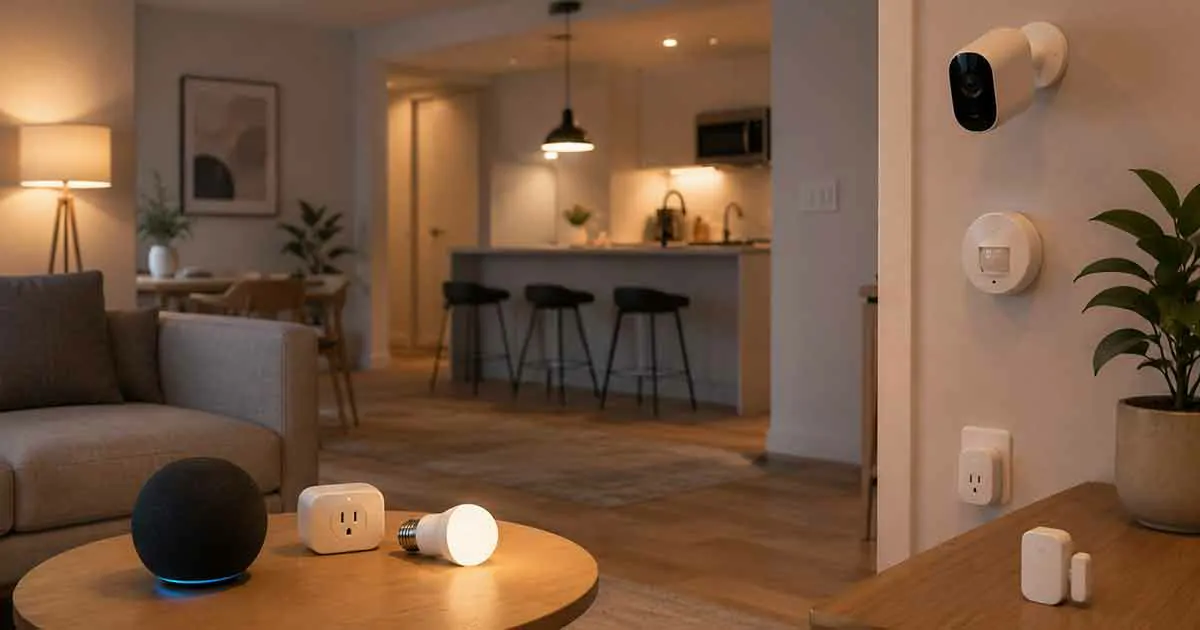
Smart home technology is no longer limited to homeowners. Renters can also use connected devices to improve convenience, security, lighting, energy management, and everyday comfort.
The main challenge is choosing devices that do not require permanent modifications to the property.
Renters usually need to avoid drilling, rewiring, replacing electrical fixtures, or making changes that could violate a lease agreement. Fortunately, many smart home devices are designed for simple installation and can be removed when it is time to move.
From smart plugs and bulbs to wireless security cameras and sensors, there are many ways to build a useful smart home without making permanent changes.
This guide covers the best smart home devices for renters, what to look for before buying, and how to create a flexible setup that can move with you.
Table of Contents
What Makes a Smart Home Device Good for Renters?
The best renter-friendly smart devices usually share several characteristics.
They are:
- Easy to install
- Easy to remove
- Portable
- Compatible with standard outlets or existing fixtures
- Less dependent on permanent wiring
- Useful without structural modifications
Before installing any connected device, renters should also review their lease and building rules.
A device may be physically easy to install but still require permission from the landlord.
Best Smart Home Devices for Renters
1. Smart Plugs
Smart plugs are among the easiest smart home devices for renters.
They plug directly into an existing electrical outlet and provide connected control for compatible appliances.
You can use them with:
- Lamps
- Fans
- Coffee makers
- Entertainment devices
- Small appliances
- Home office equipment
Depending on the model, features can include:
- Remote control
- Scheduling
- Timers
- Voice control
- Automation
- Energy monitoring
Because installation usually does not require electrical modifications, smart plugs are an excellent starting point for a rental.
2. Smart Bulbs
Smart bulbs can provide connected lighting without replacing the existing electrical wiring.
Simply replace a compatible bulb with a smart bulb and connect it to the appropriate app or smart home platform.
Features may include:
- Dimming
- Scheduling
- Remote control
- Voice commands
- Color adjustment
- Lighting scenes
- Automation
One important consideration is that smart bulbs generally need continuous power to remain connected.
If someone switches off the physical wall switch, the bulb may become unavailable.
For renters, smart bulbs are particularly useful because they can usually be removed and taken to the next home.
3. Smart Light Strips
Smart light strips can add decorative or task lighting without permanent electrical installation.
They can be useful behind:
- Desks
- TVs
- Beds
- Shelves
- Cabinets
Many models use adhesive backing, but renters should be careful when removing adhesive products from painted walls or furniture.
Check the manufacturer’s installation and removal recommendations.
4. Smart Speakers
Smart speakers can provide voice control and serve as central interfaces for compatible smart devices.
Depending on the platform, you can use them to:
- Control lights
- Control smart plugs
- Set timers
- Play music
- Create routines
- Ask questions
- Manage compatible devices
Because they simply require power and network connectivity, smart speakers are easy to move between properties.
5. Smart Displays
A smart display can provide the same type of voice control as a smart speaker while adding a screen.
Depending on the ecosystem, it can display:
- Smart camera feeds
- Timers
- Weather information
- Calendars
- Smart home controls
- Other compatible information
A smart display can be useful in kitchens, bedrooms, and home offices.
6. Smart Thermostats
Smart thermostats can help renters automate heating and cooling, but they require more consideration than plug-in devices.
Some rental properties allow thermostat replacement, while others do not.
Before replacing an existing thermostat:
- Check your lease
- Ask the landlord if required
- Confirm HVAC compatibility
- Keep the original thermostat
- Follow the manufacturer’s installation requirements
If installation is approved, a compatible smart thermostat can provide scheduling, remote control, and temperature automation.
If modification is not allowed, portable temperature sensors or other non-invasive devices may be more appropriate.
7. Smart Air Conditioners
Some portable and window air conditioners provide smart connectivity without requiring changes to central HVAC equipment.
Depending on the model, you may be able to:
- Adjust temperature remotely
- Create schedules
- Monitor operation
- Control the device through an app
- Integrate it with compatible smart home systems
For renters in properties without central air conditioning, a connected portable appliance can be a practical option.
8. Smart Fans
Smart fans can improve convenience without requiring permanent installation in many cases.
A connected fan may support:
- Remote control
- Scheduling
- Speed adjustment
- Voice commands
- Automation
A smart fan can also work with other devices to create routines based on time or occupancy.
9. Battery-Powered Security Cameras
Security cameras can be particularly useful for renters who want additional visibility without drilling into walls.
Battery-powered models can often be mounted using renter-friendly methods, depending on the product and mounting surface.
Potential features include:
- Motion detection
- Smartphone notifications
- Live viewing
- Night vision
- Two-way audio
- Activity recording
However, check your lease and building rules before installing a camera outside your apartment or pointing one toward shared spaces.
Privacy considerations are particularly important in multi-unit buildings.
10. Indoor Security Cameras
An indoor camera is often easier to use in a rental because it can simply sit on a shelf, desk, or other suitable surface.
It can provide visibility into:
- Entry areas
- Living rooms
- Home offices
- Pet areas
Some models include privacy shutters or software controls that can disable the camera when you are home.
11. Door and Window Sensors
Smart contact sensors can be installed on doors and windows without changing the electrical system.
They can notify you when a door or window opens or closes.
Potential uses include:
- Entry monitoring
- Window monitoring
- Security notifications
- Automation triggers
For example:
Door opens → entry light turns on.
These sensors can usually be removed when moving.
12. Motion Sensors
Motion sensors can improve both convenience and automation.
They can detect movement and trigger compatible smart home devices.
Examples include:
Motion detected → hallway light turns on.
Or:
No motion → selected light turns off.
Battery-powered sensors are especially suitable for rentals because they do not require electrical installation.
13. Smart Locks
Smart locks can provide keyless entry, but they require more caution than plug-in devices.
Renters should first determine whether the lease permits lock replacement.
If approved, a retrofit smart lock may be preferable because some models modify the interior mechanism while preserving the exterior hardware.
Before installation, check:
- Door compatibility
- Lease requirements
- Existing lock type
- Backup access
- Battery life
- Smart home compatibility
Keep the original lock hardware so it can be restored when necessary.
14. Smart Doorbells
Video doorbells can provide notifications and visibility around an apartment entrance.
However, apartment buildings can make installation complicated.
Before installing one, check whether:
- You are allowed to modify the door
- The building permits doorbell cameras
- The camera would capture shared hallways
- Other residents could be recorded
- The building already has an intercom system
A wireless or removable solution may be more appropriate if installation is permitted.
15. Smart Smoke and Carbon Monoxide Detectors
Connected smoke and carbon monoxide detectors can provide alerts through a smartphone or compatible system.
For renters, the biggest consideration is whether replacing the existing detectors is permitted.
Do not remove or disable required safety equipment without understanding the property’s safety requirements.
If you replace an existing detector with a smart model, keep the original device if the landlord requires it to be restored later.
16. Smart Water Leak Sensors
Water leak sensors are small devices that can provide early warnings when water is detected.
They can be placed near:
- Sinks
- Washing machines
- Dishwashers
- Water heaters
- Toilets
- Pipes
They are particularly useful in apartments because a water leak can cause significant damage to both your unit and neighboring properties.
Battery-powered sensors are usually easy to install and move.
17. Smart Air Quality Monitors
Indoor air quality monitors can help renters understand conditions inside their homes without requiring permanent installation.
Depending on the model, they may measure:
- Temperature
- Humidity
- Carbon dioxide
- Particulate matter
- Volatile organic compounds
The exact measurements vary by device.
This information can help you understand when ventilation or other indoor-air improvements may be useful.
18. Smart Humidity Sensors
Humidity sensors can help monitor moisture conditions inside a rental.
High indoor humidity can contribute to condensation and mold-related problems, while excessively dry air can also reduce comfort.
A smart humidity sensor can provide notifications when humidity moves outside a selected range.
19. Smart Blinds
Smart blinds and shades can provide automated control over window coverings.
For renters, the most suitable options are often models designed for easy installation without permanent structural changes.
Depending on the product, you may be able to automate blinds based on:
- Time
- Sunlight
- Temperature
- Smart home routines
They can also improve convenience and help manage sunlight and indoor comfort.
20. Smart Air Purifiers
A smart air purifier can combine air cleaning with connected controls.
Depending on the model, features may include:
- Remote control
- Scheduling
- Air quality monitoring
- Automatic operating modes
- Filter notifications
Because the device is portable, it can move with you when you change apartments.
21. Smart Robot Vacuums
Robot vacuums are particularly renter-friendly because they do not require installation.
Many connected models provide:
- Scheduling
- Smartphone control
- Cleaning maps
- Room selection
- Automatic charging
- Voice control
They can be useful in apartments where regular cleaning is important but floor space is limited.
22. Smart Kitchen Appliances
Some countertop appliances offer smart controls through an app or connected platform.
Examples can include:
- Coffee makers
- Air fryers
- Multicookers
- Electric kettles
However, smart functionality does not automatically make an appliance safer.
Do not remotely operate an appliance unless the manufacturer explicitly supports that type of use.
23. Smart Energy-Monitoring Plugs
Energy-monitoring smart plugs can help renters understand electricity consumption without installing a whole-home energy monitor.
They can be useful for monitoring:
- Home office equipment
- Entertainment systems
- Fans
- Lamps
- Selected kitchen appliances
The data can help identify devices that operate longer or consume more electricity than expected.
24. Smart Power Strips
A smart power strip can control multiple suitable electronics from one device.
This can be useful for:
- Desks
- Entertainment centers
- Gaming areas
- Workstations
However, avoid automatically cutting power to equipment that needs to remain continuously powered.
Renter-Friendly Smart Home Devices by Installation Type
One useful way to choose devices is to consider how much installation they require.
No Installation
Examples include:
- Smart speakers
- Smart displays
- Smart plugs
- Smart air purifiers
- Robot vacuums
- Indoor cameras
These are generally the easiest options.
Minimal Installation
Examples include:
- Smart bulbs
- Battery-powered sensors
- Battery-powered cameras
- Smart light strips
- Some smart blinds
These may use existing fixtures or removable mounting methods.
Possible Permanent Modification
Examples include:
- Smart switches
- Smart thermostats
- Some smart locks
- Wired doorbells
These should generally be discussed with the landlord before installation.
Best Smart Home Devices for Renters on a Budget
You do not need to build an expensive smart home.
A simple setup can start with:
- Smart plugs
- Smart bulbs
- A smart speaker
- Motion sensors
- A door or window sensor
These devices can provide useful automation without major installation work.
For example:
Motion detected → hallway light turns on → light turns off after inactivity.
This type of automation can improve convenience while keeping the setup relatively simple.
Best Smart Home Devices for Renter Security
If security is your primary concern, prioritize devices that provide useful alerts without permanent modifications.
A practical combination could include:
- Indoor security camera
- Door sensor
- Window sensor
- Motion sensor
- Smart lock if permitted
- Smart doorbell if permitted
Make sure cameras respect the privacy of neighbors and other residents.
Best Smart Home Devices for Renter Energy Savings
For energy management, consider:
- Smart plugs with energy monitoring
- Smart bulbs
- Smart switches if permitted
- Smart thermostat if permitted
- Smart blinds
- Smart air conditioners
- Smart fans
The best starting point is usually the device that addresses a specific source of energy waste.
Building a Portable Smart Home
One of the biggest advantages of renter-friendly devices is portability.
When moving to a new apartment, you can often take the following devices with you:
- Smart bulbs
- Smart plugs
- Sensors
- Cameras
- Smart speakers
- Smart displays
- Air purifiers
- Robot vacuums
- Smart power strips
This makes it possible to build a smart home gradually without investing heavily in property-specific installations.
Smart Home Platforms for Renters
Before buying multiple devices, choose an ecosystem that fits your needs.
Compatibility can make it easier to control devices together and create routines.
Check whether the products you choose work with your preferred platform and whether important features require additional hubs or subscriptions.
A compatible ecosystem can reduce the complexity of managing multiple smart home products.
Do Renters Need a Smart Home Hub?
Not necessarily.
Many smart home devices can connect directly through Wi-Fi or use other technologies that do not require a traditional dedicated hub.
However, some Zigbee, Z-Wave, and Thread-based setups may require compatible controllers or border routers.
A hub can also provide a central way to connect multiple devices and create automations.
For a small rental setup, a hub-free system may be simpler. For a larger smart home, a hub-based ecosystem may provide more flexibility.
Smart Home Privacy for Renters
Privacy is especially important in apartments.
Connected cameras, microphones, sensors, and smart locks can collect information about activity inside or around your home.
Before buying a device, review:
- Data collection practices
- Cloud storage
- Account security
- Camera privacy controls
- Microphone controls
- User permissions
- Data-sharing policies
For indoor cameras, consider models with physical privacy controls when possible.
Common Mistakes Renters Should Avoid
Installing Devices Without Permission
Always check your lease before making physical changes.
Using Permanent Adhesives Without Checking the Surface
Some mounting products can damage paint or walls.
Forgetting to Keep Original Hardware
Keep original locks, thermostats, switches, and other replaced equipment when appropriate.
Buying Incompatible Devices
Check electrical, mechanical, and smart home compatibility before purchasing.
Installing Cameras Without Considering Privacy
Avoid capturing neighboring apartments or shared spaces unnecessarily.
Building an Overly Complicated System
Start with a few devices that solve real problems.
How to Choose the Best Smart Home Devices for Renters
Before purchasing, consider these questions:
- Does the device require permanent installation?
- Does the lease allow the installation?
- Can the device be removed easily?
- Can you take it to your next apartment?
- Does it work with your smart home ecosystem?
- Does it require a subscription?
- Does it require a hub?
- Does it collect sensitive household data?
- Does it provide a useful benefit?
- Is the device safe for the intended use?
These questions can help prevent unnecessary purchases and installation problems.
Are Smart Home Devices Worth It for Renters?
Yes, especially when you focus on portable devices that solve specific problems.
Smart plugs, smart bulbs, sensors, cameras, speakers, air purifiers, and other removable devices can improve convenience without requiring major changes to the property.
The best strategy is to start small.
For example, you might begin with smart lighting and a few sensors. Later, you can add energy monitoring, security cameras, a smart lock, or other devices if your lease and building rules allow them.
Final Thoughts
The best smart home devices for renters are portable, easy to install, and useful without requiring permanent changes to the property.
Smart plugs, smart bulbs, sensors, cameras, smart speakers, air purifiers, and robot vacuums are among the easiest options to add to a rental.
Devices such as smart locks, switches, thermostats, and wired doorbells can provide additional benefits, but they may require landlord approval or more careful installation.
Before buying anything, check your lease, consider your building’s rules, and prioritize devices that can move with you.
A renter-friendly smart home does not need to be complicated. Start with a few practical devices, build compatible automations, and expand the system only when each new device provides a clear benefit.