
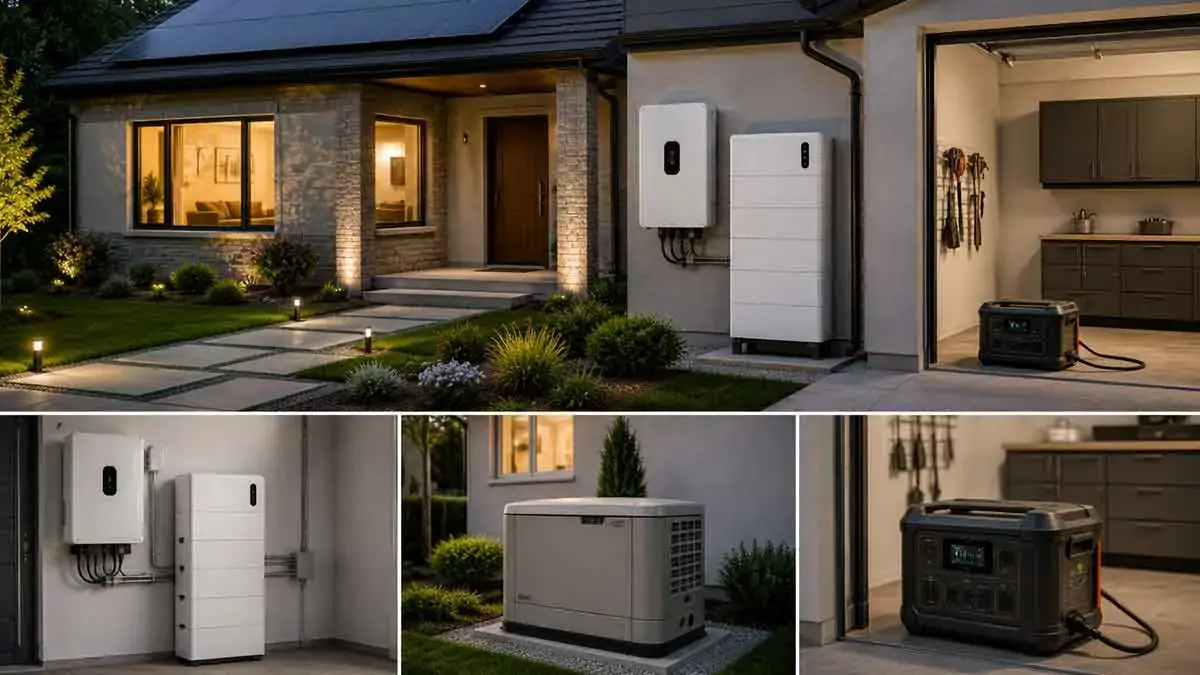
Power outages can happen because of severe weather, grid failures, equipment problems, or other unexpected events. Even a short outage can interrupt lighting, refrigeration, internet access, heating and cooling, and other essential systems.
Fortunately, homeowners have more home backup power options than ever before. Depending on your needs, you can use a portable power station, portable generator, home battery system, standby generator, solar-plus-battery system, or a combination of technologies.
The best choice depends on more than the amount of power a system can produce. You should also consider how long outages typically last, which appliances need backup power, installation requirements, fuel availability, maintenance, noise, and your budget.
This guide explains the main home backup power options and how to choose the right solution for your home.
Table of Contents
What Is Home Backup Power?
Home backup power is a system that provides electricity when the normal utility supply is interrupted.
Some systems are designed to power only a few essential devices, while others can automatically provide electricity to most or all of a home’s electrical system.
Common backup power solutions include:
- Portable power stations
- Portable generators
- Standby generators
- Home battery backup systems
- Solar battery systems
- Solar-plus-battery systems
- Hybrid battery and generator systems
- Electric vehicle backup power systems
Each option has different strengths and limitations.
The most important question is not simply, “How much power can I get?”
Instead, ask:
What do I need to keep running, and for how long?
Why Home Backup Power Matters
A power outage can affect much more than lights and televisions.
Depending on your home and climate, an outage may interrupt:
- Refrigerators and freezers
- Heating and cooling
- Internet and Wi-Fi
- Security systems
- Sump pumps
- Well pumps
- Garage doors
- Medical equipment
- Cooking appliances
- Computers and work equipment
- Phones and communication devices
- Home automation systems
For households that depend on electrically powered medical equipment, maintaining reliable backup electricity can be particularly important. The CDC recommends planning ahead for emergency lighting, backup power sources, communications equipment, and other essential needs.
A backup system therefore becomes a resilience tool rather than simply a convenience.
Main Home Backup Power Options
There is no single best backup system for every house. The following options cover most residential needs.
1. Portable Power Stations
A portable power station is a rechargeable battery system with multiple electrical outlets and charging ports.
Unlike a fuel generator, it does not produce electricity by burning fuel. It stores electricity in a battery and releases that energy when needed.
Many modern units can provide:
- AC outlets
- USB ports
- DC outputs
- Battery charging
- Solar charging
- Multiple charging methods
Portable power stations are particularly useful for short outages and essential electronics.
They can power devices such as:
- Phones
- Laptops
- Wi-Fi routers
- LED lights
- Small fans
- Televisions
- Small appliances
- Some refrigerators, depending on capacity and startup requirements
Advantages of Portable Power Stations
- Quiet operation
- No gasoline required during use
- No exhaust emissions
- Easy to move
- Simple to store
- Can often be recharged from solar panels
- Useful for both emergencies and outdoor activities
Limitations
The biggest limitation is battery capacity.
Once the stored energy is depleted, the power station must be recharged. Large appliances with heating elements, compressors, or motors can also consume battery capacity quickly.
A portable power station is therefore usually better for essential loads and shorter outages than for running an entire home indefinitely.
2. Portable Generators
Portable generators use fuel to produce electricity.
Depending on the model, they may run on gasoline, propane, or other approved fuels. They are available in a wide range of power levels.
Portable generators can be useful when you need more sustained power than a small battery can provide but do not want the cost of a permanent standby system.
They can potentially operate:
- Refrigerators
- Freezers
- Lights
- Fans
- Routers
- Selected kitchen appliances
- Some pumps
- Other essential equipment
However, the generator must be operated correctly and connected safely.
Advantages of Portable Generators
- Relatively low initial cost compared with whole-home systems
- Can operate for extended periods with an adequate fuel supply
- Available in many power levels
- Suitable for emergency use
- Can provide substantial power for essential appliances
Limitations
Portable generators require fuel and regular maintenance.
They can also be noisy and must be operated outdoors in a safe location. Fuel storage creates additional planning requirements.
Most importantly, never operate a fuel-burning generator inside a home, garage, basement, shed, or other enclosed area.
Carbon monoxide is colorless and odorless and can build up to dangerous levels. Generators should also be positioned away from doors, windows, and ventilation openings.
3. Standby Generators
A standby generator is permanently installed outside the home and connected to the electrical system through appropriate transfer equipment.
Unlike a portable generator, a standby generator can automatically detect a power outage and start without requiring the homeowner to move or manually start the unit.
Standby generators are designed for homeowners who want a more automatic backup solution.
Depending on the system and installation, a standby generator can power:
- Essential circuits
- Heating and cooling equipment
- Refrigerators and freezers
- Pumps
- Lighting
- Appliances
- Large portions of the home’s electrical system
Some systems can support the entire house when properly sized.
Advantages
- Automatic operation
- High power output
- Long runtime when connected to an appropriate fuel supply
- Suitable for longer outages
- Can support large appliances
- No need to move the generator during an emergency
Limitations
- Higher installation cost
- Requires professional installation
- Requires periodic maintenance
- Uses fuel
- Produces exhaust
- Creates noise
- Requires appropriate outdoor placement
Standby generators can be an excellent option for homes where outages are frequent, prolonged, or particularly disruptive. Consumer Reports notes that permanent standby generators generally provide more convenience and power than portable generators, although they cost more.
4. Home Battery Backup Systems
A home battery system stores electricity and supplies it to the home when utility power is unavailable.
Unlike a generator, a battery does not continuously produce electricity. It uses energy that has already been stored.
Depending on the installation, a battery can automatically take over when the grid fails.
Home batteries can be used to power:
- Refrigerators
- Lighting
- Internet equipment
- Security systems
- Selected appliances
- Heating or cooling equipment
- Other critical circuits
The amount of time a battery can operate depends on its usable capacity and the home’s electrical load.
Advantages
- Quiet operation
- No combustion during operation
- Automatic backup is available with appropriate equipment
- Low routine maintenance compared with fuel generators
- Can work with solar panels
- Can provide energy-management benefits beyond outages
Limitations
- Higher upfront cost than many portable generators
- Limited stored energy
- Large loads can drain the battery quickly
- Battery capacity may need to be expanded for longer outages
- Installation may require electrical upgrades
Battery systems are particularly attractive for homeowners who prioritize quiet operation, automatic backup, and integration with solar energy. Current comparisons generally frame batteries as a strong option for shorter outages and generators as an advantage when long-duration fuel-backed operation is the priority.
5. Solar Plus Battery Backup
A solar-plus-battery system combines solar panels with energy storage.
During normal operation, solar panels can produce electricity for the home and charge the battery. During a grid outage, properly designed equipment can use stored energy to keep selected circuits or the home operating.
The major advantage is that solar energy can potentially recharge the battery during an extended outage.
This changes the backup strategy from:
Store energy → use energy → battery eventually runs out
to:
Generate energy → store energy → use energy → generate more energy
Actual performance depends on sunlight, system size, battery capacity, inverter capabilities, household consumption, and system configuration.
Benefits
- Renewable energy source
- Can recharge batteries during suitable daylight conditions
- Quiet operation
- Can reduce dependence on fuel
- May provide energy savings during normal operation
- Useful for long-term energy resilience
Limitations
- Higher upfront investment
- Solar production depends on weather and daylight
- Battery storage is still limited
- Requires proper system design
- Installation can be more complex
Solar-plus-storage is particularly attractive for homeowners who want backup power while also using solar energy as part of their everyday electricity strategy.
6. Hybrid Battery and Generator Systems
A hybrid system combines battery storage with a fuel-powered generator.
The battery can handle short outages and smaller loads, while the generator can provide additional power when the outage lasts longer.
For example, a battery could provide quiet electricity for several hours. If the outage continues and the battery reaches a predefined level, the generator could start and provide additional power.
This approach combines two different strengths:
Battery: quiet, fast, low-maintenance backup.
Generator: extended runtime when fuel is available.
A hybrid system can be particularly useful for homes that experience both short interruptions and occasional multi-day outages. Some modern backup architectures are specifically designed around this combination.
7. Electric Vehicle Backup Power
Some electric vehicles can potentially provide electricity to a home through bidirectional charging technology.
Instead of viewing the vehicle only as transportation, the battery can become another source of stored energy.
Depending on the vehicle, charger, and electrical system, an EV may be able to supply selected home circuits during an outage.
However, this is not available with every electric vehicle.
Before relying on an EV for emergency backup, homeowners should verify:
- Vehicle compatibility
- Bidirectional charging capability
- Compatible charging equipment
- Electrical-panel requirements
- Installation requirements
- Local electrical rules
This option is becoming increasingly relevant as bidirectional charging technology develops.
How to Choose the Right Home Backup Power Option
The best way to choose a backup system is to start with your home’s electrical needs rather than starting with a particular product.
Step 1: Identify Your Essential Loads
Make a list of everything you would want to operate during an outage.
Separate the list into two categories:
Essential Loads
These might include:
- Refrigerator
- Freezer
- Lights
- Internet router
- Security system
- Phone chargers
- Medical equipment
- Sump pump
- Well pump
- Heating controls
Optional Loads
These might include:
- Large televisions
- Electric ovens
- Clothes dryers
- Swimming pools
- Hot tubs
- Nonessential lighting
- Large entertainment systems
This distinction can significantly reduce the size and cost of the backup system you need.
Step 2: Determine How Much Power You Need
Electrical appliances have different power requirements.
You need to consider both:
- Running watts
- Starting or surge watts
Motors and compressors can require substantially more power when they start.
A refrigerator, pump, air conditioner, or other motor-driven appliance may therefore require more inverter or generator capacity than its normal running consumption suggests.
For this reason, do not choose a backup system based solely on a single appliance’s advertised wattage.
Step 3: Estimate How Long the Backup Must Last
Think about your typical outage scenario.
Short outages
If outages normally last less than a few hours, a portable power station or home battery may be sufficient.
Several-hour outages
A larger battery, portable generator, or standby generator may be more appropriate.
Multi-day outages
Fuel generators, larger battery systems combined with solar, or hybrid systems may provide greater resilience.
The longer the expected outage, the more important energy replenishment becomes.
Step 4: Decide Whether You Need Automatic Backup
Some homeowners are comfortable manually connecting and starting equipment.
Others want the system to operate automatically.
If automatic operation is important, consider:
- Standby generators
- Permanently installed battery systems
- Certain integrated solar-plus-storage systems
Portable equipment generally requires more manual involvement.
Step 5: Consider Fuel and Recharging
Generators depend on fuel.
Batteries depend on stored electricity and must eventually be recharged.
Solar systems depend on sunlight.
Consider what will be available during a major emergency.
For example, a fuel generator may provide long runtime if fuel is available, while a battery system may become more difficult to sustain during a prolonged outage without solar or another charging source.
Home Backup Power Options Compared
| Backup Option | Best For | Runtime | Noise | Automatic Backup | Solar Compatible |
|---|---|---|---|---|---|
| Portable Power Station | Electronics and essential devices | Limited by battery | Very low | Usually no | Often |
| Portable Generator | Essential appliances | Long with fuel | Moderate to high | Usually no | Indirectly |
| Standby Generator | Whole-home or large loads | Long with fuel supply | Moderate | Yes | Not normally required |
| Home Battery | Essential circuits and selected loads | Limited by capacity | Very low | Yes, with proper installation | Yes |
| Solar + Battery | Long-term energy resilience | Potentially extended with solar | Very low | Yes | Built in |
| Hybrid Battery + Generator | Short and long outages | Extended | Low to moderate | Yes | Often |
| EV Backup | Homes with compatible EV systems | Depends on vehicle battery | Very low | Depends on system | Potentially |
Battery vs. Generator for Home Backup
The battery-versus-generator decision is one of the most common choices homeowners face.
A battery stores electricity and supplies it quietly. Its runtime is limited by the amount of stored energy and the home’s load.
A generator produces electricity from fuel. Its runtime can be extended by supplying additional fuel, making it particularly useful for long outages.
Choose a battery when:
- Quiet operation matters
- You want low routine maintenance
- You have solar panels
- Your outages are usually short
- You want automatic backup
- You want to avoid fuel storage
Choose a generator when:
- Outages can last for several days
- You need substantial continuous power
- Fuel is readily available
- You want extended runtime
- You need to support large electrical loads
Consider a hybrid when:
- You want quiet battery backup for normal outages
- You also want fuel-powered backup for extended emergencies
- You want additional flexibility
- Your home has significant electrical loads
There is no universal winner. The right choice depends on outage duration, electrical demand, installation conditions, and budget.
How Much Home Backup Power Do You Need?
The answer depends on what you want to operate.
A homeowner who only wants to keep a phone, router, lights, and refrigerator operating needs much less capacity than someone who wants to run central air conditioning, electric heating, pumps, and cooking appliances.
A practical sizing process is:
- List essential appliances.
- Record their running power.
- Identify appliances with high startup demand.
- Estimate how many hours each appliance must operate.
- Calculate the approximate total energy requirement.
- Add a reasonable capacity margin.
- Compare the result with the usable output and capacity of the backup system.
Do not assume that a system advertised as a certain battery capacity or generator output will automatically run every appliance in your home.
System sizing should account for real loads and installation limitations.
What Can a Home Backup System Run?
A small backup system may be suitable for:
- Phones
- Tablets
- Laptops
- LED lights
- Wi-Fi routers
- Small electronics
A medium-sized system may support:
- Refrigerators
- Freezers
- Lighting
- Internet equipment
- Televisions
- Fans
- Selected kitchen appliances
A larger system may be designed for:
- Central HVAC
- Well pumps
- Sump pumps
- Electric ranges
- Multiple refrigerators
- Larger household circuits
- Most or all home loads
The actual capability depends on power output, surge capability, battery capacity, generator size, electrical configuration, and load management.
Home Backup Power Safety
Safety should be part of the decision from the beginning.
Never Use a Fuel Generator Indoors
Never operate a gasoline, propane, diesel, or other combustion generator inside a home or enclosed structure.
Do not place it in:
- Garages
- Basements
- Crawl spaces
- Sheds
- Enclosed patios
Carbon monoxide can accumulate quickly and cause poisoning or death.
Generators should be positioned outdoors and away from doors, windows, and vents.
Avoid Unsafe Electrical Connections
Never attempt to power household wiring by plugging a generator into a standard wall outlet.
Improper connections can create dangerous backfeeding, potentially exposing utility workers and occupants to energized electrical lines.
A generator connected directly to a home’s electrical system should use appropriate transfer equipment and professional installation.
Follow Manufacturer Instructions
Always follow the installation, operating, charging, and maintenance instructions provided for the specific system.
Do not exceed the rated output.
Do not overload circuits.
Inspect cables and connectors regularly.
Keep fuel, batteries, and electrical equipment in the locations specified by the manufacturer.
Home Backup Power Maintenance
A backup system is only useful if it works when the power fails.
For generators
Regular maintenance may include:
- Oil changes
- Filter replacement
- Battery checks
- Fuel-system maintenance
- Periodic testing
- Inspection of electrical connections
For batteries
Maintenance is generally simpler, but homeowners should still:
- Monitor system status
- Check alerts
- Keep equipment within recommended environmental conditions
- Maintain compatible firmware when applicable
- Inspect visible wiring and equipment
- Follow manufacturer service requirements
For portable power stations
Keep the unit:
- Charged according to manufacturer recommendations
- Stored in an appropriate environment
- Protected from moisture
- Away from excessive heat
- Ready for emergency use
The goal is to discover problems before an outage occurs.
How Much Does Home Backup Power Cost?
The cost of backup power varies significantly.
A small portable power station can cost far less than a permanently installed whole-home system.
Portable generators generally provide another relatively affordable entry point, while standby generators and whole-home battery systems require substantially greater investment because of equipment, installation, electrical work, and other project costs.
Instead of comparing equipment prices alone, consider the total installed cost.
This may include:
- Backup equipment
- Electrical installation
- Transfer equipment
- Batteries
- Solar panels
- Inverters
- Fuel connections
- Permits
- Electrical-panel upgrades
- Maintenance
- Fuel or charging costs
A cheaper system is not necessarily better if it cannot operate the loads you actually need.
Common Home Backup Power Mistakes
Buying Based Only on Wattage
A large advertised wattage number does not tell you how long a battery will last or whether the system can handle startup surges.
Ignoring Starting Loads
Motors and compressors can have significant startup demands.
Trying to Power Everything
Running every appliance during an outage can dramatically increase the size and cost of the system.
Prioritizing essential loads is often more practical.
Forgetting About Fuel
A generator is only useful for extended operation if you can obtain and safely store the required fuel.
Ignoring Installation Requirements
Permanent backup systems often require professional electrical work.
Do not treat electrical installation as a simple DIY project.
Waiting Until the Outage Happens
Power outages are exactly when generators, batteries, fuel, extension cords, and other emergency supplies may be difficult to obtain.
Prepare before you need the system.
Best Home Backup Power Option for Different Situations
Best for Small Emergency Needs
Portable power station
Ideal for phones, internet equipment, lights, laptops, and other small loads.
Best for Budget-Conscious Backup
Portable generator
A practical choice when you need more power than a small battery can provide and are comfortable with manual operation and fuel management.
Best for Automatic Whole-Home Backup
Standby generator
A strong option for homeowners who want automatic operation and substantial power during extended outages.
Best for Quiet Backup
Home battery
A good choice when silent operation and automatic backup are important.
Best for Solar Homes
Solar-plus-battery system
Particularly useful when homeowners want both everyday solar energy and backup capability.
Best for Long and Unpredictable Outages
Hybrid battery and generator system
Combines battery power for immediate backup with generator runtime when stored energy is depleted.
A Simple Home Backup Power Strategy
You do not necessarily need the biggest system available.
A practical strategy is to divide your home’s electrical needs into priorities.
Tier 1: Critical
- Medical equipment
- Refrigerator
- Freezer
- Heating or cooling controls
- Security system
- Communication equipment
- Essential lighting
Tier 2: Important
- Internet equipment
- Television
- Computers
- Fans
- Selected kitchen appliances
- Garage door
Tier 3: Optional
- Electric oven
- Clothes dryer
- Hot tub
- Pool equipment
- Large entertainment systems
- Other high-power loads
This approach allows you to design the backup system around what truly matters during an outage.
Frequently Asked Questions
What is the best backup power option for a home?
There is no single best option. Portable power stations work well for smaller loads, generators provide fuel-based long-duration power, batteries offer quiet automatic backup, and solar-plus-battery systems can provide additional energy independence.
Is a battery better than a generator?
Not necessarily. Batteries are quieter and can provide automatic backup without combustion, while generators can provide longer runtime when fuel is available. The better option depends on your home’s loads and expected outage duration.
Can a portable power station power a house?
A portable power station can power selected household devices, but smaller units generally cannot operate an entire home. Larger systems may support more circuits when properly configured.
Can solar panels provide power during an outage?
A standard grid-connected solar system may shut down during a grid outage for safety reasons. A properly designed solar-plus-storage system with appropriate backup equipment can continue supplying power during an outage.
How long can a home battery last during a power outage?
There is no universal runtime. It depends on battery capacity and the amount of electricity the home consumes. Reducing nonessential loads can significantly extend backup time.
How long can a generator run during an outage?
The answer depends on the generator, fuel type, load, and available fuel supply. A generator with a continuous fuel source can potentially operate for a long period, provided it is properly maintained and safely operated.
Can a generator power the whole house?
A sufficiently sized standby generator can power most or all household circuits when properly installed. Portable generators are usually better suited to selected essential loads.
Are home batteries safe?
Home battery systems are designed with safety controls, but they still need to be correctly selected, installed, operated, and maintained. Follow the manufacturer’s requirements and applicable electrical codes.
Do I need a transfer switch for a generator?
A generator that is connected to household electrical circuits generally requires appropriate transfer equipment to prevent unsafe backfeeding. The exact equipment depends on the generator and electrical installation.
What should I run first during a power outage?
Start with critical loads such as medical equipment, refrigeration, heating or cooling needs, communication equipment, security systems, and essential lighting. Disconnect nonessential loads when power capacity is limited.
Final Thoughts
The best home backup power option is the one that matches your actual electrical needs, outage duration, budget, and willingness to manage the system.
For small loads and short outages, a portable power station may be enough. Portable generators provide a flexible fuel-powered option, while standby generators offer automatic and high-capacity backup. Home batteries provide quiet stored energy, and solar-plus-battery systems can add the ability to recharge from sunlight. Hybrid systems combine battery and generator capabilities for homeowners who want greater flexibility.
Before buying anything, start by identifying your essential loads, estimating their power requirements, determining how long you need backup electricity, and deciding whether automatic operation is important.
A properly sized and safely installed system is far more valuable than simply choosing the largest backup power system you can afford.