
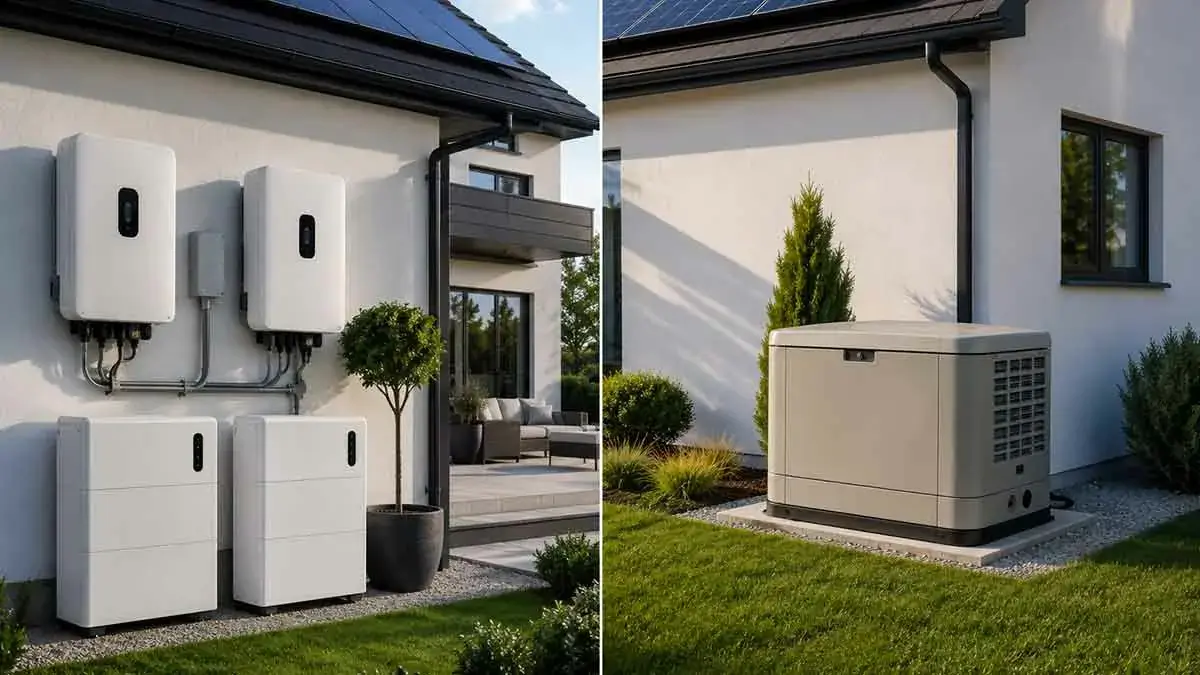
A solar battery and a generator can both provide backup electricity during a power outage, but they use fundamentally different approaches. A solar battery stores electrical energy for later use, while a generator produces electricity from a fuel source when it is running.
Choosing between a solar battery and a generator depends on several factors, including how long outages typically last, which appliances you need to operate, whether you already have solar panels, fuel availability, installation cost, and how important quiet and automatic operation are to you.
A battery can be especially useful for short outages, solar self-consumption, and quiet backup power. A generator can have an advantage during extended outages because it can continue producing electricity as long as it has fuel and remains operational.
This guide compares solar batteries and generators to help you determine which backup power solution is better suited to your home.
Table of Contents
Solar Battery vs Generator: Quick Comparison
| Feature | Solar Battery | Generator |
|---|---|---|
| Energy source | Stored electricity | Fuel |
| Noise | Very quiet during operation | Produces operating noise |
| Direct emissions at home | None during battery discharge | Produces exhaust |
| Refueling | Recharged by solar or grid, depending on system | Requires fuel |
| Solar integration | Excellent | Usually separate from solar |
| Backup duration | Limited by usable capacity and charging | Can continue while fuel is available |
| Automatic backup | Often available | Available with many standby systems |
| Routine maintenance | Generally limited | Usually requires more maintenance |
| High-power loads | Depends on inverter and battery output | Often well suited to high loads |
| Upfront cost | Can be substantial | Varies by generator type |
| Long-term operating cost | Potentially low | Depends on fuel and maintenance |
The table provides a general comparison. Actual performance depends on the specific battery, generator, electrical system, installation, and operating conditions.
What Is a Solar Battery?
A solar battery is an energy-storage system that stores electricity for use at a later time.
A residential battery system may include:
- Battery modules
- Battery management equipment
- Inverter or hybrid inverter
- Backup controls
- Monitoring equipment
- Electrical protection equipment
- Transfer or backup equipment
The battery can be charged using electricity generated by solar panels. Depending on the system and local utility rules, it may also be capable of charging from the electrical grid.
Stored electricity can then be used when:
- Solar production is low
- The sun has set
- Grid electricity is expensive
- The electrical grid is unavailable
A battery does not generate electricity by itself. It stores electricity produced or supplied by another source.
What Is a Home Generator?
A home generator produces electricity by converting mechanical energy into electrical energy.
Residential generators can use different fuels, including:
- Natural gas
- Propane
- Gasoline
- Diesel
There are two broad categories of residential generators.
Portable Generators
Portable generators are generally moved into position when needed and may require manual setup and connection.
They can provide emergency power at a lower initial cost than many permanently installed systems, but they require greater user involvement.
Standby Generators
Standby generators are permanently installed and connected to the home’s electrical system through appropriate transfer equipment.
Many standby systems can detect a grid outage and start automatically.
The generator continues operating as long as the system has an adequate fuel supply and remains operational.
How Does a Solar Battery Work During an Outage?
A backup-capable battery system can automatically disconnect the home from the electrical grid when a power outage occurs.
The battery then supplies electricity to designated circuits or, depending on the system, a larger portion of the home.
It may power loads such as:
- Refrigerators
- Lighting
- Internet equipment
- Security systems
- Selected outlets
- Pumps
- Other essential appliances
If compatible solar panels are installed, the solar system may also recharge the battery during daylight.
However, a standard grid-connected solar installation does not automatically provide power during an outage. The solar inverter, battery, and backup controls must be designed to operate safely when the grid is unavailable.
How Does a Generator Work During an Outage?
A generator supplies electricity by operating its engine and electrical generator.
A portable generator may require the homeowner to:
- Move it to a safe operating location.
- Start it according to the manufacturer’s instructions.
- Connect the appropriate loads using approved equipment.
- Monitor fuel and operation.
A standby generator can automate much of this process.
When the electrical grid fails, the system can detect the outage, start the generator, and transfer the designated electrical loads to generator power.
The exact operation depends on the generator and transfer equipment.
Backup Duration: Solar Battery vs Generator
Backup duration is one of the most important differences between these technologies.
Solar Battery Backup Duration
A battery has a finite amount of usable stored energy.
For example, a system with 10 kWh of usable capacity cannot continuously supply a 2 kW load for five hours under all conditions. Inverter losses, operating limits, appliance cycling, and other factors affect actual runtime.
A simplified estimate is:
Usable Battery Capacity ÷ Average Electrical Load = Approximate Runtime
For example:
10 kWh ÷ 1 kW = approximately 10 hours
Actual runtime will vary.
Solar panels can potentially extend the overall backup period by producing additional electricity during daylight.
Generator Backup Duration
A generator does not have a fixed energy capacity in the same way as a battery.
Instead, its runtime depends primarily on:
- Fuel availability
- Fuel consumption
- Generator capacity
- Household electrical load
- Maintenance condition
This gives generators an important advantage during long outages when a reliable fuel supply is available.
Power Output and Large Appliances
Battery capacity and power output are different specifications.
Battery capacity is measured in kilowatt-hours (kWh) and describes stored energy.
Power output is measured in kilowatts (kW) and describes how much electricity the system can supply at a given moment.
This distinction becomes important when operating high-demand appliances such as:
- Central air conditioning
- Electric heating
- Electric water heaters
- Electric ovens
- Pumps
- EV chargers
A battery may have substantial stored energy but still be unable to operate several high-power appliances simultaneously if its inverter does not provide sufficient output.
Generators also have power limits, but appropriately sized standby generators can often support substantial household loads.
Always compare the continuous and peak power requirements of your appliances with the backup system’s rated output.
Solar Battery Advantages
Quiet Operation
One of the biggest advantages of a battery is quiet operation.
Unlike a fuel-burning generator, a battery does not require an engine to run continuously while supplying electricity.
This can be especially useful during nighttime outages or in areas where generator noise is a concern.
Solar Integration
A battery can work directly with a compatible solar system.
Excess solar electricity generated during the day can be stored and used later instead of being immediately exported to the grid, depending on system configuration and utility rules.
Low Routine Maintenance
Residential batteries generally require less routine mechanical maintenance than combustion generators.
There is no engine oil, spark plug, or fuel filter to maintain in the battery itself.
Automatic Backup
Many backup battery systems can switch to backup operation automatically.
This can provide a convenient transition during an outage without requiring the homeowner to start equipment manually.
No Fuel Storage for Battery Operation
A battery does not require gasoline, propane, or diesel to discharge electricity.
This eliminates fuel storage and refueling as part of normal battery operation.
Energy Management
A battery can also be used for purposes beyond outage backup.
Depending on the electricity rate structure, it may help shift electricity consumption from expensive periods to lower-cost periods.
Solar Battery Disadvantages
Limited Stored Energy
The battery can only provide as much energy as its usable capacity and available charging sources allow.
High household consumption can drain a battery relatively quickly.
High Initial Cost
A complete battery installation may require significant investment, particularly when it includes backup equipment, electrical upgrades, and installation.
Power Limitations
The battery and inverter must be properly sized for the appliances you want to operate.
Large electrical loads can require substantial power output.
Dependence on Charging Availability
A battery that is repeatedly discharged during a prolonged outage needs a way to recharge.
Solar can provide that energy, but cloudy weather, shading, short winter days, and high household demand can reduce available solar production.
Generator Advantages
Long-Duration Backup
A generator can continue producing electricity for an extended period when sufficient fuel is available.
This can be valuable during multi-day outages.
High Power Capability
Larger generators can provide substantial electrical output.
This can make them suitable for homes that need to operate:
- Air conditioning
- Heating equipment
- Pumps
- Refrigeration
- Water heaters
- Other high-demand appliances
The generator still needs to be properly sized for the home’s electrical requirements.
Useful During Extended Grid Outages
For households that regularly experience long outages, the ability to refuel a generator can provide an important advantage over a battery with limited stored capacity.
Lower Entry Cost With Some Portable Models
Portable generators can cost substantially less initially than a complete residential battery backup system.
However, the comparison should include safe connection equipment, installation, fuel, maintenance, and the level of automation provided.
Generator Disadvantages
Noise
Generators produce engine and exhaust noise while operating.
Noise levels vary according to:
- Generator type
- Generator size
- Enclosure
- Installation location
- Operating load
Noise can become more noticeable during long outages.
Fuel Dependence
A generator requires a suitable fuel source.
During a widespread emergency, obtaining fuel may become more difficult.
Higher Maintenance Requirements
Combustion generators contain engines and mechanical components that require periodic maintenance.
Depending on the system, maintenance may include:
- Oil changes
- Filter replacement
- Battery checks
- Fuel-system service
- Engine inspections
- Periodic testing
Exhaust and Carbon Monoxide Risk
Fuel-burning generators produce exhaust gases, including carbon monoxide.
Portable generators must never be operated inside a home, garage, basement, shed, or other enclosed or partially enclosed space.
Generators must be installed and operated according to the manufacturer’s safety requirements and applicable local regulations.
Solar Battery vs Generator Cost
Comparing only the purchase price can produce a misleading result.
Evaluate the complete installed system cost.
Solar Battery Costs
A battery installation may include:
- Battery equipment
- Inverter
- Backup gateway or controls
- Electrical work
- Panel or service upgrades
- Installation labor
- Permits
- Monitoring equipment
If solar panels are not already installed, adding a solar array increases the overall project cost.
Generator Costs
Generator-related costs may include:
- Generator equipment
- Transfer switch
- Electrical installation
- Fuel connection
- Fuel storage where applicable
- Permits
- Installation
- Maintenance
A portable generator may have a much lower purchase price than a standby generator, but it also provides a different level of convenience and automation.
Operating Costs
Solar Battery
Battery operating costs can be relatively low, particularly when the system is charged using excess solar electricity.
However, batteries gradually degrade over time, and eventual replacement may be required.
If the battery is charged from the grid, the cost of that electricity should also be included when evaluating its economics.
Generator
Generator operating costs depend heavily on:
- Fuel consumption
- Fuel prices
- Maintenance
- Repairs
- Frequency of use
A generator that operates for several days can consume a substantial amount of fuel.
Maintenance Requirements
Solar Battery
Routine battery maintenance generally focuses on:
- Monitoring system status
- Checking alerts
- Maintaining required clearances
- Following manufacturer recommendations
- Scheduling professional service when necessary
Battery equipment should not be opened or modified by unqualified individuals.
Generator
Generators generally require more mechanical maintenance.
Depending on the equipment, this may include:
- Regular exercise cycles
- Oil changes
- Filter replacement
- Battery maintenance
- Fuel-system inspection
- Engine service
Follow the manufacturer’s maintenance schedule.
Noise Comparison
For most homes, a solar battery has a clear noise advantage.
A battery does not use an internal combustion engine to generate electricity.
A generator, by contrast, produces mechanical and exhaust noise during operation.
When considering a generator, evaluate:
- Distance from bedrooms
- Distance from neighboring properties
- Installation location
- Local noise requirements
- Manufacturer noise specifications
Noise can become an important consideration when an outage lasts overnight or several days.
Environmental Considerations
A battery produces no direct exhaust emissions at the home while discharging.
A fuel-burning generator produces exhaust emissions whenever it operates.
However, comparing environmental impact is more complicated than simply comparing operating emissions.
The overall impact of battery storage can depend on:
- How its charging electricity is generated
- Battery manufacturing
- Equipment lifespan
- Recycling and end-of-life management
Generator impact depends on:
- Fuel type
- Fuel consumption
- Operating hours
- Generator efficiency
If environmental impact is a major priority, evaluate the complete energy system rather than only the backup equipment.
Reliability During Long Outages
Neither technology is completely unlimited.
A battery’s ability to provide extended backup depends on:
- Usable capacity
- Household consumption
- Solar production
- Weather
- Recharge opportunities
- System configuration
A generator’s ability to provide extended backup depends on:
- Fuel availability
- Fuel delivery
- Mechanical condition
- Maintenance
- Generator capacity
For a multi-day outage, a generator may have an advantage when fuel is readily available.
A solar-plus-battery system can potentially provide extended backup when solar production is sufficient and household consumption is managed carefully.
Solar Battery vs Generator for Whole-Home Backup
Whole-home backup requires more than simply choosing a battery or generator.
The system must be sized to handle the home’s electrical loads.
A Solar Battery May Be Better When:
- Outages are usually short
- Quiet operation is important
- Solar integration is a priority
- Automatic backup is desired
- Critical loads are the primary concern
- You want energy storage for everyday use
A Generator May Be Better When:
- Outages frequently last several days
- High-power appliances must operate
- Reliable fuel is available
- Whole-home backup is a priority
- Initial equipment cost is an important consideration
The actual electrical design is critical. A battery or generator that is too small may not provide the expected whole-home backup.
Solar Battery vs Generator for Short Outages
For outages lasting minutes or a few hours, a battery can be particularly convenient.
It can provide:
- Quiet operation
- Automatic backup
- No refueling
- Fast availability
- Integration with solar
A generator can also provide excellent backup, but portable models may require manual setup and fuel.
For short and frequent interruptions, convenience can make a battery particularly attractive.
Solar Battery vs Generator for Long Outages
For outages lasting several days, generators often have an advantage because they can continue producing electricity as long as they have fuel.
A battery can also support long-duration backup when combined with solar, but the system must have enough solar production and storage capacity to match household consumption.
During prolonged cloudy weather, battery recharge may be limited.
For this reason, homeowners in areas with frequent extended outages may consider a generator or a hybrid backup strategy.
Can You Use a Solar Battery and Generator Together?
Yes.
A battery and generator can be combined in a professionally designed backup system.
A possible configuration could work as follows:
Solar Panels → Battery → Home
with a generator available as an additional backup source.
The battery may handle short outages and routine energy management, while the generator can provide additional energy during prolonged outages.
A combined system may offer:
- Quiet backup for shorter outages
- Solar energy storage
- Extended backup capability
- Additional power during prolonged outages
- Greater flexibility
However, combining systems increases equipment, installation, control, and maintenance requirements.
Compatibility must be verified before connecting a generator to a battery-based backup system.
How to Choose Between a Solar Battery and Generator
Start by identifying what you actually need the backup system to accomplish.
How Long Do Your Outages Usually Last?
If outages normally last less than a few hours, battery storage may provide enough capacity.
If outages regularly last multiple days, fuel availability becomes more important.
What Appliances Must Remain Powered?
Create a list of essential loads.
Include:
- Refrigerators
- Lighting
- Internet equipment
- Security systems
- Pumps
- Heating and cooling
- Water heating
- Cooking equipment
- Essential medical equipment
Then determine both the running power and starting power where relevant.
Do You Already Have Solar Panels?
If you already have a compatible solar system, adding battery storage may provide additional value.
It can allow some excess solar production to be stored for use later.
Is Quiet Operation Important?
If noise is a major concern, a battery has a significant advantage during normal operation.
Do You Have Reliable Fuel Access?
A generator requires an adequate fuel supply.
Consider how fuel would be obtained during a major emergency.
What Is Your Budget?
Compare the complete installed cost rather than the equipment price alone.
Include:
- Installation
- Electrical upgrades
- Fuel
- Maintenance
- Replacement
- Financing costs where applicable
Do You Need Automatic Backup?
Both batteries and standby generators can provide automatic backup when designed with the appropriate equipment.
Portable generators generally require more manual involvement.
Solar Battery vs Generator Comparison Checklist
| Factor | Solar Battery | Generator |
|---|---|---|
| Short outages | Excellent | Good |
| Multi-day outages | Depends on capacity and recharge | Strong with reliable fuel |
| Quiet operation | Excellent | Limited |
| Automatic backup | Often available | Available with standby systems |
| Solar integration | Excellent | Usually limited |
| High-power loads | Depends on system | Often strong |
| Routine maintenance | Generally low | Generally higher |
| Fuel dependence | No fuel required for discharge | Requires fuel |
| Solar self-consumption | Excellent | Not applicable by itself |
| Upfront cost | Often substantial | Varies significantly |
| Operating cost | Potentially low | Fuel-dependent |
| Backup flexibility | Depends on system design | Strong when properly sized |
| Extended cloudy outage | Can be challenging | Less dependent on weather |
Common Backup Power Mistakes
Choosing Only by Battery Capacity
A battery’s kWh rating does not tell you how much power it can supply at once.
Evaluate both usable capacity and power output.
Choosing Only by Generator Wattage
A generator’s rated output is important, but fuel consumption, installation, transfer equipment, and long-term maintenance also matter.
Assuming Solar Panels Automatically Provide Backup
Standard grid-tied solar systems may shut down when the grid fails.
Backup-capable equipment is required for continued operation during an outage.
Ignoring Starting Loads
Some appliances require more power when motors start.
This can affect whether a battery inverter or generator can operate the appliance reliably.
Ignoring Fuel Availability
A generator cannot provide extended backup if fuel is unavailable.
Oversizing the System Without Identifying Critical Loads
Trying to operate every appliance during an outage can substantially increase system cost.
Identify essential loads first.
Comparing Equipment Prices Instead of Complete System Costs
Installation, electrical upgrades, controls, fuel, maintenance, and other costs can significantly change the final price.
Ignoring Safety Requirements
Generators and battery systems both involve significant electrical or energy-related hazards.
Use qualified professionals for installation and specialized service.
Which Is Better: Solar Battery or Generator?
There is no universal winner.
A solar battery is generally better for quiet, automatic backup, solar integration, and everyday energy management. It can be particularly attractive for shorter outages and households that already have solar panels.
A generator is generally better for extended outages and high-power loads, especially when reliable fuel is readily available.
For homeowners who want both advantages, a solar-plus-battery system combined with a generator can provide a flexible backup strategy when the equipment is properly designed and integrated.
The best option depends on the type of outage you are preparing for rather than on the technology alone.
Final Thoughts
Choosing between a solar battery and a generator starts with understanding your home’s actual backup requirements.
Determine how much power your essential appliances need, how much energy they consume, and how long your typical outages last. Then consider solar availability, fuel access, installation cost, maintenance, noise, automatic operation, and long-term operating expenses.
A solar battery can provide quiet and convenient backup while also supporting solar self-consumption and energy management. A generator can provide extended runtime and substantial power as long as fuel and proper maintenance are available.
For many homeowners, the decision is not simply about choosing the most powerful system. It is about choosing the system that provides the right amount of power, energy capacity, reliability, and convenience for the home’s actual needs.
Before purchasing either system, compare complete installation proposals and verify the expected performance under realistic outage conditions.